
Home › Products › Low pressure valves › Ball valves
Quarter turn · 8 variants · ready stockBall valves, 1/8" to 4", in SS316 and brass
Threaded and weld‑end quarter‑turn shut‑off valves in eight variants — one, two and three‑piece bodies, three‑way L‑port and T‑port, brass, and two mini ranges. 300 PSI in brass, 1000 PSI in stainless, 2000 PSI in the two‑piece, for service from −29 °C to 150 °C. This page exists to get you to the right one.
Get a quotation within 2 working hours
Send the part number, standard, size or quantity. Stock in Malaysia or Singapore, ISO 9001:2015 certified.
What a low pressure ball valve is
A quarter turn, and almost no maintenance.
A ball valve is a shut‑off valve that controls the flow of a liquid or gas. The eight here are stainless steel ball valves in SS316 and brass ball valves, stocked in Malaysia and supplied throughout Singapore. A drilled ball turns inside the body: bore in line with the pipe and it is open, bore across the pipe and it is shut. Because that is a quarter turn, the valve is easy to operate and requires almost no maintenance, and it gives maximum flow capacity with minimum pressure drop when open.
Ball valves divide first by pressure class. Low pressure ball valves are the ones used for water, general oil and gas applications — and despite the name they are used for critical applications with demanding requirements, which is why the construction detail on this page matters. Everything below is the low‑pressure threaded and weld‑end range. For flanged bodies in cast and forged steel, see flange end ball valves; for higher classes, high pressure ball valves.
- Two things decide the valve: how many pieces the body is made from, and whether the bore is full or reduced. The first decides whether you can service it; the second decides how much it flows. Body · bore.
- The bore is not a free choice on every variant. A one‑piece ball valve is always reduced bore; the two‑piece is full bore. That is a property of the construction, not an option to tick. Why.
- Material is the corrosion decision. SS316 is the standard material in this range because of its high corrosion resistance; brass is the lower‑cost option and is limited to 300 PSI. Side by side.
- Temperature moves the pressure rating. The range runs −29 °C to 150 °C, and environment temperature affects the working pressure. The curve.
All eight ball valves, side by side
Size, bore, material, pressure and ends — then the reason to pick each one.
| Variant | Size | Bore | Material | Max pressure | Ends | Choose it when |
|---|---|---|---|---|---|---|
| 1‑piece | 1/4"–4" | Reduced | SS316 | 1000 PSI | BSPP · NPT | Leak path matters more than flow, and the valve will never be opened. Solid cast body, no service. |
| 2‑piece | 1/4"–4" | Full | SS316 | 1000 & 2000 PSI | BSPP · NPT | The default. Full bore, serviceable, and the only variant with a 2000 PSI range. |
| 3‑piece | 1/4"–4" | Full | SS316 | 1000 PSI | BSPP · NPT · socket weld · butt weld | The line cannot be shut down for maintenance. Service it in place — and the only threaded variant offered with weld ends. |
| L‑port 3‑way | 1/4"–2" | Reduced | SS316 | 1000 PSI | BSPP · NPT | You need to divert flow from one outlet to another, or shut it off. Two ports connect at a time. |
| T‑port 3‑way | 1/4"–2" | Reduced | SS316 | 1000 PSI | BSPP · NPT | You need to mix, split or divert. The T drilling can join all three ports at once, which the L cannot. |
| Brass | 1/4"–4" | Near‑full | Brass | 300 PSI | BSPP · NPT | Water, air and non‑corrosive duty on a budget. Read the pressure column — it is a third of the stainless. |
| Brass mini | 1/4"–3/4" | Reduced | Brass | 300 PSI | BSPP only | Small isolation, gauge and drain points where space and cost rule. No NPT option. |
| SS316 mini | 1/8"–1" | Reduced | SS316 | 1000 PSI | BSPP · NPT | Gauge, drain and instrument isolation in stainless. The only way to get 1/8" in this range. |
- ⚠ Brass is 300 PSI, not 1000. Both brass variants are rated 300 PSI against 1000 PSI for every stainless one — roughly a third. If the duty was specified around a stainless figure, brass is not a drop‑in substitution.
- Only the 2‑piece reaches 2000 PSI. It is supplied in two separate ranges, 1000 PSI and 2000 PSI, with different dimensions and different part numbers — so “2 piece” alone does not specify the valve. both 1000 and 2000 PSI tables.
- Full bore only comes from the 2‑piece and 3‑piece. If flow area matters, the one‑piece is out before you start — it is always reduced bore. The flow penalty, in numbers.
- The three‑way pair stops at 2". L‑port and T‑port run 1/4" to 2" (DN8–50), not to 4". Above 2" a three‑way function has to be built from two‑way valves.
- L‑port and T‑port are dimensionally identical. Same body, same face‑to‑face, same weights — the only difference is how the ball is drilled, and therefore what the handle positions do. You can swap one for the other without touching the pipework.
The eight ball valves we stock
Each one has its own page with the full bill of materials, every size and a catalogue PDF.
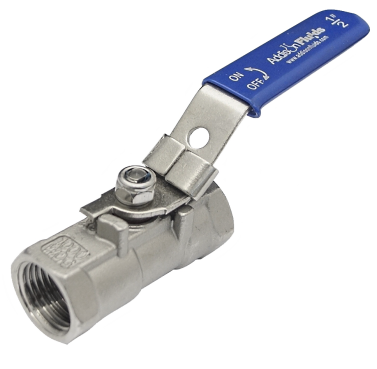 Solid body · not serviceable
1‑piece ball valve
Size1/4"–4"BoreReducedPressure1000 PSIEndsBSPP · NPT Ready stock→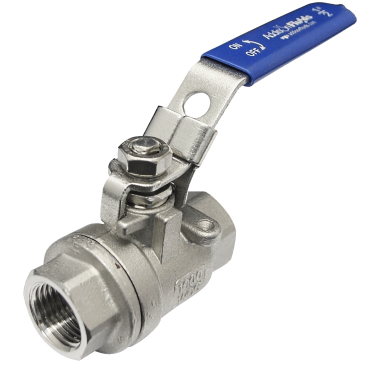 Full bore · the default choice
2‑piece ball valve
Size1/4"–4"BoreFullPressure1000 & 2000 PSIEndsBSPP · NPT Ready stock→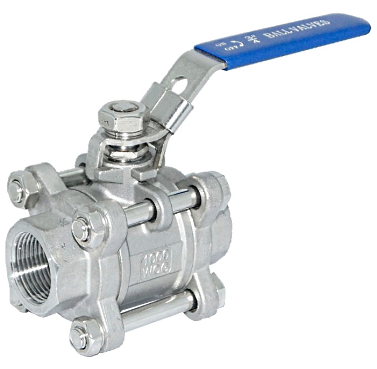 Service in place · weld ends
3‑piece ball valve
Size1/4"–4"BoreFullPressure1000 PSIEndsBSPP · NPT · socket weld Ready stock→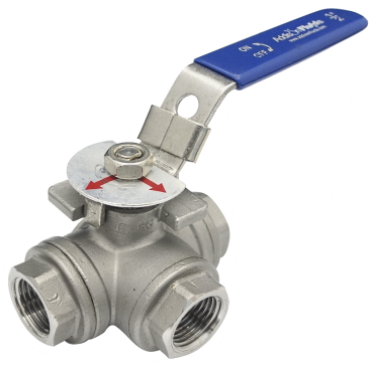 3‑way · divert
L‑port ball valve
Size1/4"–2"BoreReducedPressure1000 PSIEndsBSPP · NPT Ready stock→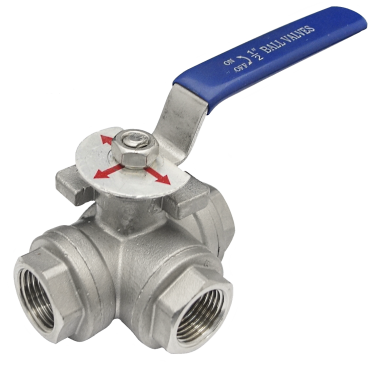 3‑way · mix or split
T‑port ball valve
Size1/4"–2"BoreReducedPressure1000 PSIEndsBSPP · NPT Ready stock→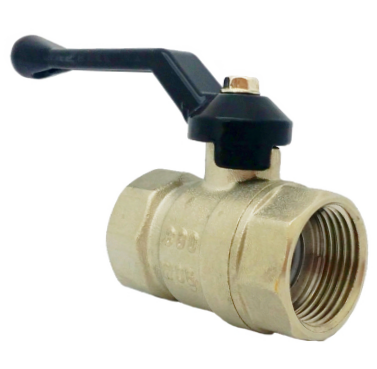 Lower cost · 300 PSI
Brass ball valve
Size1/4"–4"BoreNear‑fullPressure300 PSIEndsBSPP · NPT Ready stock→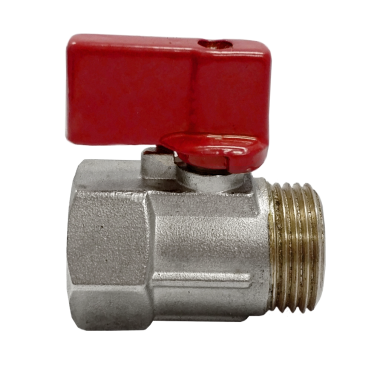 Compact · BSPP only
Brass mini ball valve
Size1/4"–3/4"BoreReducedPressure300 PSIEndsBSPP only Ready stock→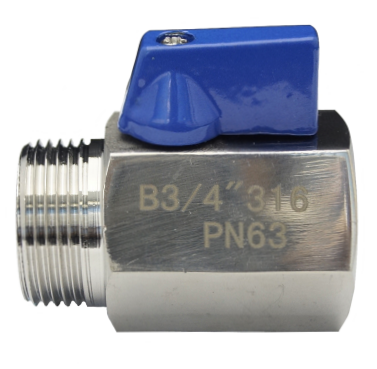 Down to 1/8" · stainless
SS316 mini ball valve
Size1/8"–1"BoreReducedPressure1000 PSIEndsBSPP · NPT Ready stock→Full bore or reduced bore
The single spec that changes how much the valve flows — and it is decided by the body.
A low pressure ball valve divides into a full bore and a reduced bore valve based on the flow passage formed. A full bore valve has an over‑sized ball, which makes the hole in the ball the same size as the pipeline — so the valve does not restrict the line at all. A reduced bore valve has an opening whose flow area is less than the inner diameter of the pipeline; it is generally used in switches and circuits for general hydraulic applications, where a pressure drop across an open valve does not matter.
This is not a box you tick. A one‑piece ball valve is always a reduced bore valve, and the two‑piece is the standard (full) bore. The construction determines it. The table below is taken from the dimension tables on the variant pages — column d is the actual bore in millimetres.
| Nominal size | Pipe bore | 1‑piece bore | 2‑piece bore | Flow area, 1‑piece vs 2‑piece |
|---|---|---|---|---|
| 1/4" | DN8 | 5 mm | 10 mm | 25% |
| 3/8" | DN10 | 7 mm | 12 mm | 34% |
| 1/2" | DN15 | 9 mm | 15 mm | 36% |
| 3/4" | DN20 | 12 mm | 20 mm | 36% |
| 1" | DN25 | 15 mm | 25 mm | 36% |
| 1 1/4" | DN32 | 20 mm | 32 mm | 39% |
| 1 1/2" | DN40 | 25 mm | 38 mm | 43% |
| 2" | DN50 | 32 mm | 50 mm | 41% |
- ⚠ The reduced bore is a real restriction, not a rounding. At 1/2" the one‑piece bore is 9 mm against 15 mm — and because flow area goes with the square of the diameter, that is roughly 36% of the area. The last column is that ratio at every size.
- A reduced‑bore valve is about one pipe size down. A 1" one‑piece valve has a 15 mm bore — the same as a 1/2" full‑bore valve. Useful when you are sizing on flow rather than on the thread.
- Reduced bore is the right answer more often than it looks. On an isolation valve that spends its life fully open or fully shut in a switch or circuit duty, the pressure drop is usually irrelevant and the valve is cheaper and lighter.
- It matters when it is not isolation. Pump suction, gravity drains, long runs, anything already marginal on pressure drop, and any line you may want to rod through — specify full bore, which means the two‑piece or the three‑piece.
- Both three‑way variants are reduced bore, as is normal for a three‑way ball. If flow area through a diverter is critical, the alternative is two full‑bore two‑way valves.
One, two or three pieces
How many parts the body splits into — which decides whether you can ever open it.
The names refer to the number of pieces the valve body is made from. It sounds like a manufacturing detail. It is actually the maintenance decision, and it is the one that is expensive to get wrong, because it cannot be changed after the valve is in the pipe.
1‑piece — sealed for life
The body and end connections are made from a single piece of material. The solid, cast body significantly decreases the risk of leakage, because there is no body joint to leak from. The trim and seals are inserted through one of the end connections, which is also why the port size cannot equal the line size — it is always reduced bore. It cannot be taken apart and serviced: when the seat wears, the valve is replaced. 1‑piece ball valve sizes and parts.
2‑piece — the common one
The most commonly used construction. Two separate pieces: one carries the body and an end connection, the second fits into the first to hold the trim in place and provides the other end. It is full bore, and it allows disassembly if the internal parts need replacing — but it also holds the potential of leakage where the two pieces are joined. That trade is the whole story: a joint you can open is a joint that can weep. 2‑piece ball valve sizes and parts.
3‑piece — service without shutdown
Two end caps and a body, bolted together. The end caps are threaded, welded or flanged to the pipe on both sides, which separates the connection portions of the valve from the rest of the body. The consequence is the reason to buy it: the centre section lifts out for service while the end caps stay in the pipe, so it prevents a line shutdown if maintenance is required. It is also the only variant here offered with socket weld ends. 3‑piece ball valve sizes and parts.
- Fewer pieces means fewer leak paths; more pieces means more access. That is the entire trade‑off, and there is no variant that wins both.
- Ask one question: will anyone ever open this valve? If no, the one‑piece is the tightest and cheapest. If yes, the two‑piece. If yes and the line cannot be drained or stopped to do it, the three‑piece.
- The three‑piece pays for itself on a line that cannot stop. The valve costs more than a two‑piece; a single unplanned shutdown usually costs more than the difference.
- All three share the same trim materials — SS316 ball, PTFE seats and seals, SS316 stem — so construction is not a quality grade. A one‑piece is not a lesser valve, it is a different answer.
- The one‑piece and two‑piece are not interchangeable in the pipe. At 1/2" the face‑to‑face is 57 mm against 62 mm, and the bores differ. Swapping construction after installation means re‑working the pipework.
Brass or stainless
The third choice, after bore and body. It is mostly decided by the fluid, not the budget.
Six of the eight valves here are SS316 and two are brass. The brass ones cost less and that is a legitimate reason to buy them — but the pressure rating is a third of the stainless, so it is never a like‑for‑like swap. Read the pressure row first and the cost row last.
| Brass | SS316 | |
|---|---|---|
| Working pressure | 300 PSI | 1000 PSI, and 2000 PSI on the 2‑piece |
| Size range | 1/4" to 4" | 1/8" to 4" — the only 1/8" is the SS316 mini |
| Body | Brass | SS316 and CF8M |
| Ball | Chrome‑plated brass — the plating is the wearing surface | SS316, solid |
| Seat | PTFE | PTFE |
| Temperature | −29 to 150 °C | −29 to 150 °C — the same, because the PTFE seat sets it, not the body |
| Water and air | Suitable — what it is made for | Suitable |
| Corrosive service | ⚠ No. Brass has no useful corrosion resistance here | Yes — this is the reason to pay for it |
| Chlorides and marine duty | ⚠ No — and brass can dezincify in some waters | Better, and the standard choice — but no stainless is immune to chlorides, so tell us the water |
| What is not brass | ⚠ The handle is aluminium, the nut is steel and the O‑ring is NBR. It is not an all‑brass valve | Handle aluminium, stem bolt SS304 — also not all 316 |
| Cost | Lower | Higher |
| Choose it when | Water, air or non‑corrosive service, comfortably under 300 PSI, cost matters | Anything corrosive, anything above 300 PSI, anything marine, or anything you would rather not revisit |
- ⚠ 300 PSI is not 300 PSI at temperature. Like the stainless valves, the brass rating falls as the fluid gets hotter. Read the derating curve before choosing on the catalogue figure.
- The two brass valves are the brass ball valve and the brass mini. Everything else on this page is SS316.
- We will tell you when brass is wrong. It is the commonest way to save money on a valve order and the commonest way to have to do the job twice.
How a ball valve works
Five minutes, from our own channel.
If you would rather watch than read, this covers the same ground as the sections above — what a ball valve is, the difference between the pressure classes, and how the construction and the bore affect what you get.
- RFS Hydraulics · 5 min 16 s · published 6 July 2022. Our own video, not a manufacturer’s reel.
- It is an overview, not a selection guide. The figures that actually decide the order are on this page: the eight variants side by side, full against reduced bore, and the pressure–temperature curve.
- One thing the video does not cover: that brass is 300 PSI against 1000 for the stainless variants. Check the comparison table before substituting on price.
Ball valves — the specification
The range as a whole. Per‑variant figures are on the eight pages.
| Size range | 1/8" to 4" (DN6 to DN100) across the range — 1/8" only in the SS316 mini; the three‑way pair stops at 2" |
| Body materials | Stainless steel SS316 (and CF8M, the cast equivalent) · brass. SS316 is the standard material here, for its high corrosion resistance |
| Working pressure | 300 PSI brass · 1000 PSI stainless · 2000 PSI two‑piece stainless only — by variant |
| Temperature | −29 °C to 150 °C — and temperature affects the working pressure, see below |
| Connections | Threaded BSPP or NPT · socket weld and butt weld on the three‑piece · BSPP only on the brass mini |
| Bore | Full bore on the two‑piece and three‑piece · reduced bore on the one‑piece, both three‑way and both mini — the difference in numbers |
| Operation | Quarter turn lever, manual. Almost no maintenance; maximum flow capacity with minimum pressure drop when open |
| Seats and seals | PTFE seat, seal gasket, stem seal and stem packing throughout the stainless range; PTFE seat with an NBR O‑ring on the brass |
| Trim | SS316 ball and stem on the stainless variants, with an anti‑static device on the one, two and three‑piece · chrome‑plated brass ball on the brass |
| Marine coding | IMPA codes published for the one‑piece (75 24 11–18), the brass (75 24 01–07) and the two‑piece 2000 PSI range |
| Not on this page | Flanged bodies, and cast and forged steel — those are flange end ball valves. Higher classes are high pressure ball valves |
| Stock | Held in Malaysia or Singapore |
Pressure falls as temperature rises
The PSI on the label is the cold rating. Here is the curve, as numbers.
These valves are mainly used in conditions with a temperature ranging from −29 °C to 150 °C, and across that range the environment temperature affects the working pressure. The limit is set by the PTFE seat, not by the body: SS316 is untroubled by 150 °C, but PTFE softens as it warms, and the seat is the part holding the pressure.
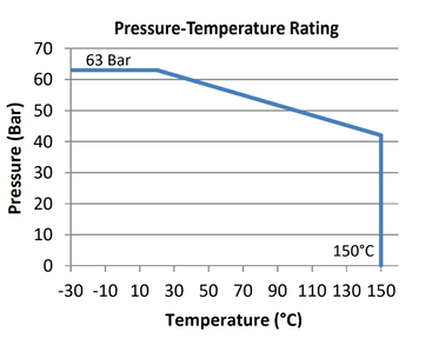
Read off that curve and interpolated along its straight section. Treat these as approximate figures for selection and ask us to confirm any duty close to the limit.
| Temperature | Working pressure | Approx. PSI | Share of the cold rating |
|---|---|---|---|
| −30 to +20 °C | 63 bar | 914 PSI | 100% |
| 40 °C | 59.8 bar | 867 PSI | 95% |
| 60 °C | 56.5 bar | 819 PSI | 90% |
| 80 °C | 53.3 bar | 773 PSI | 85% |
| 100 °C | 50.1 bar | 727 PSI | 80% |
| 120 °C | 46.8 bar | 679 PSI | 74% |
| 140 °C | 43.6 bar | 632 PSI | 69% |
| 150 °C | 42 bar | 609 PSI | 67% |
- ⚠ A third of the rating is gone by 150 °C. The valve holds 63 bar cold and 42 bar hot — 67% of the cold figure. If you sized on the catalogue number and the line runs hot, the margin you thought you had is not there.
- Nothing is lost below about 20 °C. The curve is flat from −30 °C to roughly +20 °C, so ambient and chilled service get the full rating. Derating only starts once the line is warm.
- ⚠ The curve stops dead at 150 °C. It does not taper past it — it drops vertically to zero. 150 °C is a hard ceiling, not a point to design a small margin beyond.
- The range is rated 1000 PSI, and the derating curve is drawn to 63 bar. Both are the manufacturer’s figures, quoted as printed. For any duty near the limit, give us the pressure and temperature together and we confirm against the specific part number.
- Brass has far less to give away. Both brass variants start at 300 PSI cold, so the same proportional derating leaves much smaller absolute headroom. On warm duty, stainless is often the cheaper answer once you allow for it. Compare.
- Send the service temperature with the enquiry. It is the field most often left blank, and on this product it changes which valve you should be quoted.
Installing a ball valve
Six steps — and four of them happen before the valve goes near the pipe.
Installation plays a key role in the functioning of the valve, and improper installation may damage the valve and lead to malfunction of the fluid control system. The sequence below is the manufacturer’s. Notice how much of it is about the pipe.
Before the valve goes in
- 1. Clean the pipes. Remove all kinds of objects from the pipes before installing. Debris carried into a ball valve scores the seat, and a scored PTFE seat weeps for the rest of its life.
- 2. Align the connecting pipes on both sides of the valve properly.
- 3. Check both sections match. The valve cannot absorb any gaps. Any distortion in the pipes can affect the tightness of the connection and the functioning of the valve, and can even result in a rupture.
- 4. Support the pipework. Where sections of piping do not have proper support in place, they should be temporarily fixed to avoid unnecessary strain on the valve.
Making the joint
- 5. Apply thread sealant when making up the connections.
- 6. Double‑check the tightness of the connection to ensure the valve performs.
- ⚠ The valve is not a pipe alignment tool. Three of the six steps — align, match, support — exist because a ball valve pulled into a misaligned joint distorts, and a distorted body binds the ball or cracks. Fix the pipe first.
- Match the thread form. BSPP and NPT are not interchangeable. If you are unsure which is on the existing pipework, send us a photo before ordering.
- Leave room for the handle. It needs 90° of clear sweep, and the lever is longer than the valve. Handle length is a column on every variant page — worth checking against a tight manifold before the valve arrives.
Where these valves are used
Low pressure does not mean low consequence.
Ball valves take a leading role in the valve industry as the scope of application is enormous. The low‑pressure range is highly used for the smooth working of water, oil and gas systems, and widely leveraged for water, general oil and gas applications. They are also used for critical applications with demanding requirements — which is the reason the bore, the construction and the derating curve on this page are worth reading before ordering.
Isolation on water, oil and gas lines
The core duty. A quarter‑turn shut‑off that an operator can see the state of from across the room — handle in line, open; handle across, shut. Full bore where the line cannot afford a restriction, reduced bore where it can.
Hydraulic switches and circuits
Where the reduced bore valve belongs, and where it is generally used. On a circuit that is either open or shut, the pressure drop across an open valve is irrelevant and the smaller ball is cheaper and lighter.
Diverting and mixing
L‑port to send one flow to either of two destinations; T‑port to mix, split, or join all three ports at once. One valve instead of two plus a tee — up to 2".
Instrument, gauge and drain points
The SS316 mini down to 1/8" and the brass mini to 3/4". Small isolation for pressure gauges, transmitters, sample and drain points where a full‑size valve will not fit.
Marine and shipboard
IMPA coded across the one‑piece and brass ranges, so a ship’s purchasing department can order against the code it already uses rather than a supplier part number.
Lines that cannot be shut down
The case for the three‑piece. The end caps stay welded or screwed into the pipe while the centre section comes out, so seat replacement does not mean a line shutdown.
Ball valve supply in Malaysia and Singapore
Where the stock is, what the price includes, and what we need from you.
We are an industrial valve distributor holding ball valve stock in Malaysia and Singapore and supplying customers across both markets. The eight variants on this page are stocked items, not indent orders.
Stock and delivery
- Stock held in Malaysia and Singapore — so both markets are served from local stock, without a freight lead time.
- A landed price, not an ex‑works one. Transport, currency, duties and taxes are already inside the figure we quote, so the number you approve is the number you pay.
- Availability confirmed against real stock before we quote. If a size is not on the shelf we say so rather than quote a date we cannot hold.
- The whole low pressure range from one delivery — gate, globe, check valves, butterfly valves and the Y‑strainer that keeps grit off the seat.
What to send us
- Size and end connection — and whether that is BSPP or NPT, because they are not interchangeable.
- Working pressure and service temperature. Both, not just pressure — the rating falls as the fluid gets hotter.
- What is in the line. It decides brass or stainless, and it is the question most enquiries leave out.
- Whether the valve will ever be opened up. That decides one, two or three pieces, and it is easier to answer now than in three years.
- A photograph of what is on the wall is often faster than a part number, and we are happy to work from one.
- Industries we supply these into — water, oil and gas lines, hydraulic systems, marine and shipboard work, and instrument, gauge and drain points. What each variant suits.
- Ask for what the catalogue does not print. Material certificates, actuator mounting, cracking pressures and test figures are obtained from the factory on request — and we would rather chase them before you order than after.
Why buy ball valves from us
Eight variants that look alike on a price list and are not interchangeable.
We check the bore, not just the size
“1/2‑inch ball valve” describes a 9 mm bore and a 15 mm bore equally well. We confirm full or reduced before quoting, because it is a third of the flow area and it cannot be changed later.
We ask whether it will ever be opened
That one question picks the construction. One‑piece if never, two‑piece if maybe, three‑piece if it has to be done without stopping the line. Nobody enjoys discovering the answer after the valve is welded in.
Derated pressure, not catalogue pressure
We quote against your service temperature. The stainless range loses a third of its rating by 150 °C, and the curve tops out at 63 bar where the badge says 1000 PSI — we tell you that rather than letting you find it. The figures.
We will say when brass is wrong
Brass is 300 PSI against 1000. It is the right valve for plenty of duties and a false economy on others, and the difference is not visible on a price comparison. We flag it before you order, not after.
Full bills of materials, published
Every variant page lists every internal part and its material — ball, seat, stem, gaskets, packing, gland, anti‑static device. No paperwork request, no email gate. If you need to know what touches your fluid, it is on the page.
Stock in Malaysia and Singapore
Both branches are in Malaysia, and we supply across Singapore from the same stock. Held both sides, quoted at a landed price — transport, currency, duties and taxes already inside the figure. Send a part number, a size or a photo of what is on the wall.
Questions we get asked
The ones that come up on the phone.
What is a low pressure ball valve used for?
A ball valve is a shut‑off valve that controls the flow of a liquid or gas. Ball valves split into low pressure and high pressure types, and different industries use different ones depending on their working pressure requirement. The low‑pressure range is widely used for water, general oil and gas applications — and also for critical applications with demanding requirements, so “low pressure” describes the class, not the importance of the duty.
Which ball valve should I order?
Two questions settle it. Will the valve ever be opened for service? Never → one‑piece. Possibly → two‑piece. Yes, and the line cannot be shut down to do it → three‑piece. Then: does flow area matter? If yes you need full bore, which rules out the one‑piece. Diverting or mixing instead of isolating? L‑port or T‑port. All eight side by side.
What is the difference between a 1, 2 and 3 piece ball valve?
The number of pieces the body is made from, which decides whether it can be serviced. The one‑piece has body and ends made from a single piece of material — a solid cast body that significantly decreases the risk of leakage, but it cannot be taken apart. The two‑piece is the most commonly used: it allows disassembly to replace internal parts, at the cost of a potential leak path where the two pieces join. The three‑piece is two end caps and a body, which separates the pipe connections from the rest of the valve so it prevents a line shutdown if maintenance is required. Longer answer.
What is the difference between full bore and reduced bore?
A full bore valve has an over‑sized ball, making the hole in the ball the same size as the pipeline — it does not restrict flow. A reduced bore valve has a flow area less than the inner diameter of the pipeline, and is generally used in switches and circuits for general hydraulic applications. The gap is bigger than it sounds: at 1/2" the bores are 9 mm and 15 mm, so the reduced‑bore valve passes roughly 36% of the area. Every size.
Can I choose full bore on any of these valves?
No — it follows the construction. A one‑piece ball valve is always reduced bore, because the trim is inserted through one of the end connections, so the port size cannot equal the line size. The two‑piece is the standard (full) bore, and the three‑piece is full bore too. Both three‑way variants and both minis are reduced. If you need full bore, you are choosing between the two‑piece and the three‑piece.
What size ball valves do you stock?
1/8" to 4" (DN6 to DN100) across the range, but not every variant covers all of it. 1/8" comes only from the SS316 mini; the brass mini stops at 3/4"; the three‑way pair stops at 2"; and the one, two, three‑piece and brass all run 1/4" to 4". The table.
What pressure can these ball valves take?
It depends on the variant and it is not a small spread. Brass is 300 PSI. The stainless variants are 1000 PSI. The two‑piece is also supplied in a separate 2000 PSI range with its own dimensions and part numbers — it is the only variant that goes that high. All of those are cold figures; temperature takes some back.
Can I use a brass ball valve instead of stainless to save money?
Only if the duty fits 300 PSI, which is roughly a third of the stainless rating — so it is not a like‑for‑like substitution. Brass is a sound choice for water, air and non‑corrosive service at modest pressure. Against corrosion, SS316 is the standard material because of its high corrosion resistance. Also note the brass valve is not all brass: the handle is aluminium, the nut is steel and the O‑ring is NBR. the full brass ball valve parts list.
What temperature can a ball valve work at?
−29 °C to 150 °C, and the environment temperature affects the working pressure inside that band. The manufacturer’s curve is flat at 63 bar up to about 20 °C, then falls in a straight line to 42 bar at 150 °C — about 67% of the cold rating — and stops dead there. The limit is the PTFE seat, not the stainless body. The full table.
What is the difference between an L-port and a T-port valve?
How the ball is drilled, and therefore what the handle positions do. An L‑port connects two ports at a time — it diverts flow from one outlet to the other, or shuts off. A T‑port can connect all three at once, so it will mix, split or divert. Mechanically they are the same valve: identical bodies, identical face‑to‑face dimensions, identical weights. You can swap one for the other without touching the pipework. L‑port · T‑port.
Do you supply weld-end ball valves?
Yes — socket weld and butt weld ends on the three‑piece, which is the only variant in this range offered welded at all, alongside BSPP and NPT. That pairs naturally with the three‑piece design: welded end caps stay in the pipe and the centre section still comes out for service.
Do you supply flanged or carbon steel ball valves?
Yes, but not from this page. Everything here is threaded or socket weld, in SS316 and brass. For flanged bodies and for cast and forged carbon steel, go to flange end ball valves — ANSI 150 and ANSI 300, in cast steel, forged steel and SS316. For higher classes, high pressure ball valves.
How do I install a ball valve?
Clean the pipes of all objects, align both sides, check the sections match because the valve cannot absorb any gaps, support unsupported pipework so there is no strain on the valve, apply thread sealant, then double‑check tightness. Four of the six steps are about the pipe, not the valve — because any distortion in the pipes can affect the tightness of the connection, the functioning of the valve, and can even result in a rupture. The sequence.
What are the internal parts made of?
On the stainless variants: SS316 and CF8M body and cap, SS316 ball and stem, PTFE seat, seal gasket, stem seal and stem packing, with an SS304 anti‑static device, SS304 packing gland, SS301 spring washer and an SS201 handle. On brass: brass body, bonnet and stem, chrome‑plated brass ball, PTFE seat, NBR O‑ring, aluminium handle, steel nut. Every variant page publishes its own full list.
Is the ball valve maintenance-free?
Close to it in normal service — the quarter‑turn design requires almost no maintenance. What wears is the PTFE seat, usually from grit carried down the line, which is exactly why step one of installation is to clean the pipes. When the seat does go, the construction decides your options: the two‑piece and three‑piece can be stripped and re‑seated, and the one‑piece is replaced.
Can I fit an actuator to one of these? Is there an ISO 5211 pad?
Every valve in this range is supplied lever operated, and the manufacturer does not publish an ISO 5211 mounting pad for any of the eight — no pad size, no bolt pattern, no stem square. So we cannot tell you from the datasheet whether a standard actuator will bolt on. Tell us the size and the actuator you have in mind and we will get the mounting details from the factory before you order. If you need a valve that is designed from the start to be actuated, we stock one: the PN16/PN40 SS316 wafer type ball valve carries F03 and F04 cast into its top plate and a dedicated ISO 5211 pad detail on the manufacturer’s section. It is a flanged‑pipework valve, not a threaded one, so it is a different fitting job — but it is the one ball valve here whose actuator interface is actually published. What it still does not publish is torque, and an actuator has to be sized on torque, so we would chase that figure either way. Note that our butterfly valves do publish a top‑flange drilling — 4‑7 mm on a 50 mm circle up to 3", 4‑9 on 70 mm from 4" up.
Can I get a lockable handle for lock-out tag-out?
Not as a published option. The parts lists for these eight valves show a plain aluminium or stainless lever with a nut — no locking device, no padlock hasp, no memory stop. If your site procedure needs a valve that can be padlocked shut, tell us at enquiry stage: it is a question for the factory rather than something we can answer from the catalogue, and it is much easier to specify than to retrofit. Do not assume a lever can be locked just because it has a hole in it.
Can you supply material certificates, EN 10204 3.1?
Ask, and we will obtain them. Certification is not published in the catalogue for this range, so we do not claim it on the page — but the castings do carry heat numbers, which is what makes traceability possible in the first place. If your order needs EN 10204 3.1 material certificates, say so with the enquiry rather than after delivery: certificates have to be issued against the specific heat the valves came from, and that is far harder once stock has been picked and shipped.
What is not published for these valves?
Four things buyers ask for that the manufacturer does not print, and we would rather list them than have you assume. There is no Cv or flow coefficient, so pressure drop cannot be calculated from the datasheet — though a full bore valve is close to the pipe itself, and reduced bore costs you more than people expect. There is no ISO 5211 actuator pad on any of the eight — the only ball valve we stock that publishes one is the PN16/PN40 wafer type, and that is a flanged‑pipework valve. There is no API 608 or fire‑safe certification — these are soft‑seated PTFE valves and nothing in the literature claims a fire‑safe design, so if your specification calls for one, this range does not meet it on paper. And there is no published certification package. We will chase any of these with the factory; what we will not do is print a figure we have not been given.
Catalogues
One per variant. Direct PDF download — no form, no email address.
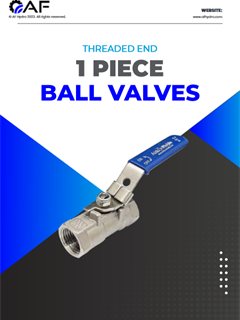 1‑piece ball valves — reduced bore, 1000 PSI, BSPP and NPT, with IMPA codesAF Hydro · PDFPDF
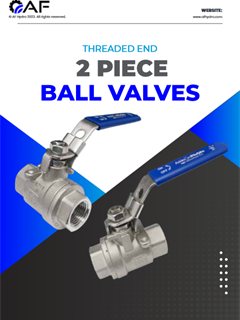 2‑piece ball valves — full bore, both the 1000 PSI and 2000 PSI rangesAF Hydro · PDFPDF
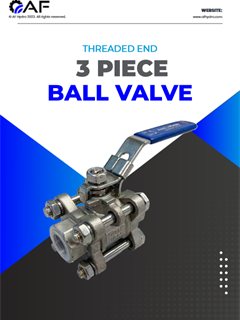 3‑piece ball valves — full bore, threaded and socket weld endsAF Hydro · PDFPDF
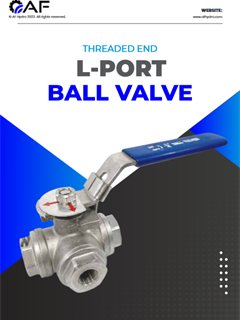 3‑way L‑port ball valves — divert or shut off, 1/4" to 2"AF Hydro · PDFPDF
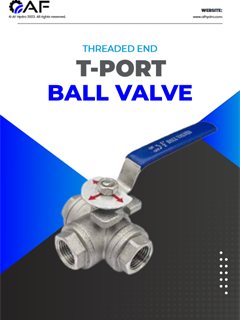 3‑way T‑port ball valves — mix, split or divert, 1/4" to 2"AF Hydro · PDFPDF
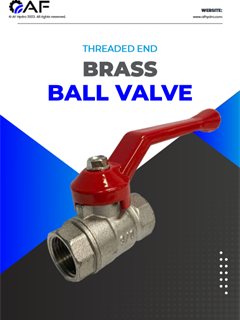 Brass ball valves — 300 PSI, 1/4" to 4", with IMPA codesAF Hydro · PDFPDF
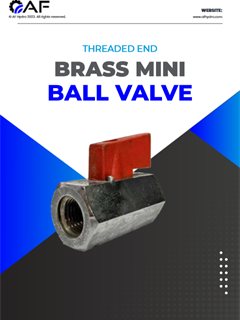 Brass mini ball valves — male × female, BSPP, 1/4" to 3/4"AF Hydro · PDFPDF
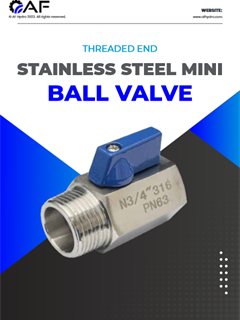 SS316 mini ball valves — 1000 PSI, down to 1/8"AF Hydro · PDFPDF
Related: flange end ball valves for flanged, cast and forged steel bodies · the PN16/PN40 SS316 wafer type where the pipework is flanged but the gap is short, or where an ISO 5211 actuator has to bolt on · high pressure ball valves · gate valves and globe valves where throttling rather than isolation is wanted · Y‑strainers to keep grit off the seat · class 150 threaded fittings for the pipework around it.
Send the size, the pressure and the service temperature
We will tell you which of the eight fits, confirm full or reduced bore, give you the derated pressure rather than the catalogue maximum, and quote a landed price. Stock in Malaysia and Singapore.