
Home › Products › High pressure valves › SAE flange end ball valves
MHA Zentgraf · ready stockSAE flange end ball valves to ISO 6162, 1/2" to 3"
Two‑way isolating ball valves that bolt straight to an SAE flange port — no thread to make up in place. Three body ranges cover DN13 to DN80 in steel or SS316, on the ISO 6162‑1 (3000 psi) and ISO 6162‑2 (6000 psi) patterns. Valve body PN size by size, and why the flange interface is usually what limits the joint — below.
Get a quotation within 2 working hours
Send the part number, standard, size or quantity. Stock in Malaysia or Singapore, ISO 9001:2015 certified.
What an SAE flange end ball valve is, and when you need one
A quarter‑turn isolator with the port pattern already on it.
This is an ordinary two‑way, quarter‑turn ball valve — open or shut, full bore, no throttling — with the difference that the ends are SAE flange faces to ISO 6162 rather than threads. Four bolts and an O‑ring seal each end, so the valve bolts to a pump, manifold or flanged pipe run in the same way an SAE flange does, and comes off the same way.
You need the flange end rather than a threaded one when the port is already a flange pad, when the size is large enough that a thread would be hard to make up in place, or when the valve has to be removable without breaking into the pipework. It is the standard choice on pump and motor ports, power packs, test rigs and large hydraulic circuits.
Not the same as a threaded ball valve, or a check valve
All three turn up on the same enquiry and only one of them isolates on a flange face. The ends decide whether it will fit; the handle decides whether it isolates at all.
| SAE flange end ball valve | Threaded ball valve | SAE flange check valve | |
|---|---|---|---|
| What it does | Isolates — open or shut | Isolates — open or shut | Non‑return — flow one way only |
| Operated by | Hand lever, quarter turn | Hand lever, quarter turn | Nothing — no handle, the flow works it |
| Ends | SAE flange, ISO 6162 | Threaded BSPP or NPT, or compression | SAE flange, Code 61 / Code 62 |
| Bore | 1/2" to 3" | 1/8" to 2" | 1/2" to 2" |
| Bolts to | A flange pad already on the port | A threaded or tube port | A flange pad |
| Comes out without breaking the run | Yes — unbolt both ends | No — the thread has to be broken | Yes |
If the line needs to be regulated rather than isolated, none of the three is the answer — use a needle valve. Throttling with a ball valve ruins the seat.
The flange pattern is the first decision, not the last. ISO 6162‑1 is the 3000 psi pattern and ISO 6162‑2 the 6000 psi one. They share a nominal size but not a bolt spacing, so a valve on the wrong pattern will not bolt to your port. Many parts carry both — a KH‑DN15 is marked SAE210/420 — but you still have to tell us which one your port is.
Specification
Everything that has to be on the enquiry, in one table.
| Property | Specification |
|---|---|
| Size range | DN13 to DN80 · 1/2" to 3" |
| Body ranges | BKH / BKHP‑SAE DN13–DN25 · MKHP‑SAE DN32–DN50 · KH‑SAE DN15–DN80 |
| Flange pattern | ISO 6162‑1 (3000 psi) · ISO 6162‑2 (6000 psi), across all three ranges |
| Valve body PN | 315 to 420 bar depending on range and size — see the table |
| Bolt options | Metric (M8, M10, M12) or UNC (5/16", 3/8", 7/16") |
| Body material | Steel or stainless SS316 |
| Ball seats | POM across all three ranges |
| Seals | NBR standard · FPM (Viton®) as the alternative code |
| Temperature | −20 °C to +100 °C (BKH, MKHP) · −10 °C to +100 °C (KH) |
| Brand | MHA Zentgraf, Germany |
| What we need to quote | Bore, flange pattern (6162‑1 or ‑2), working pressure, the medium and metric or UNC bolts |
MHA prints the same warning on every sheet in this family: “Please note the pressure ratings of the connection flanges!” The valve body and the flange interface are rated separately, and the joint is only as strong as the weaker of the two. That is the point of the next section.
What the valve looks like, and what the body tells you.
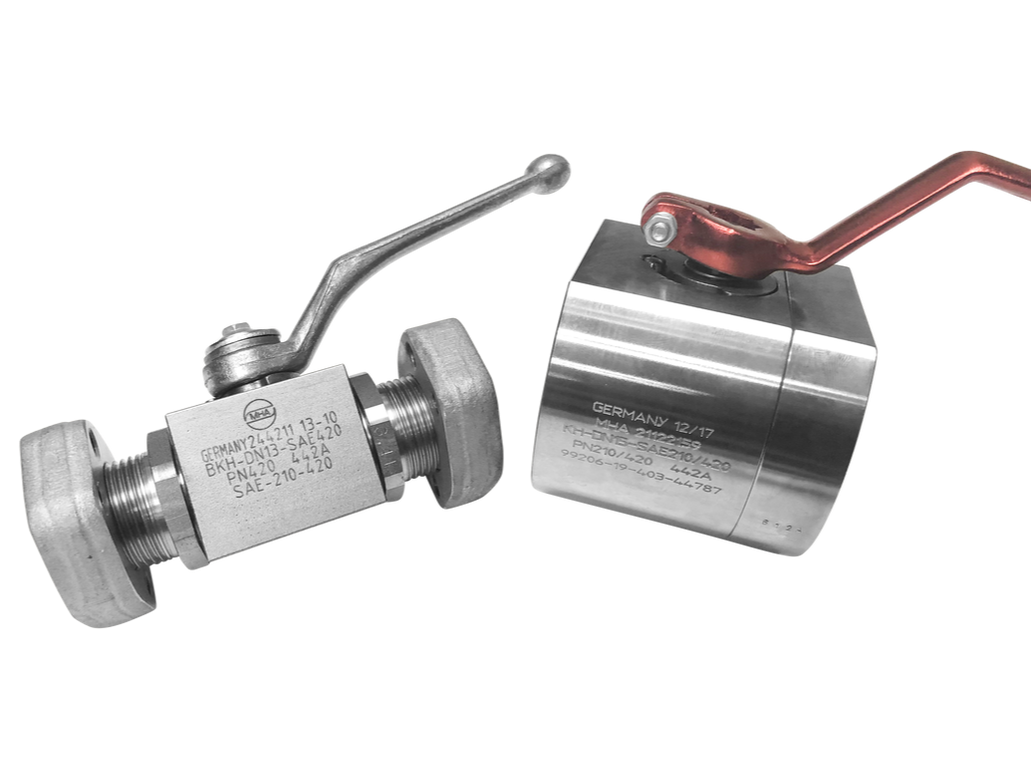
442A. On the BKH the flange adapters are screwed onto extended male threads at each end, so the assembly is longer. The KH is one piece — visibly shorter for the same duty.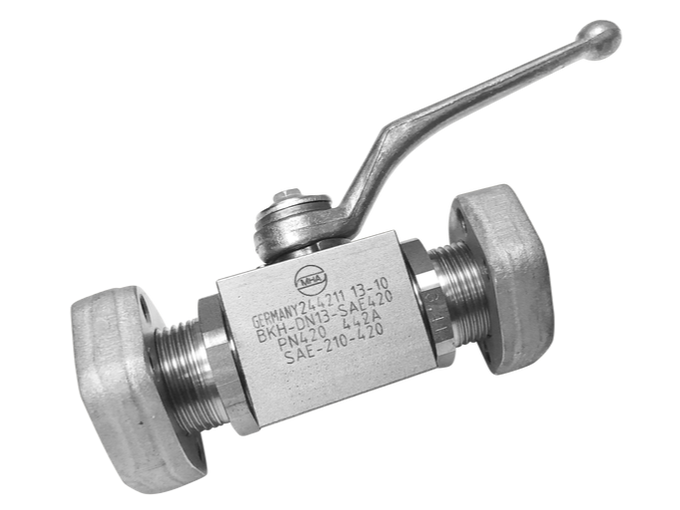
BKH‑DN13‑SAE420 · PN420 · 442A.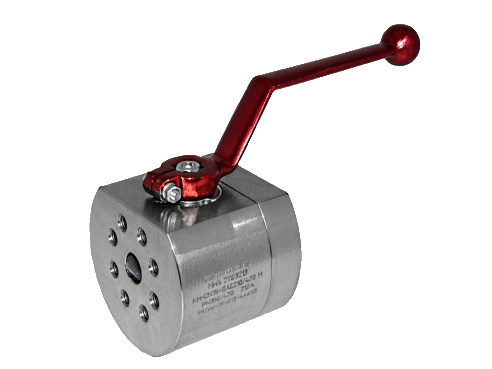
KH‑DN15‑SAE210/420. It is drilled twice — four holes on the corners, four more turned 45° between them — so one face takes either a Code 61 or a Code 62 flange. Count the holes before you assume which pattern is in front of you.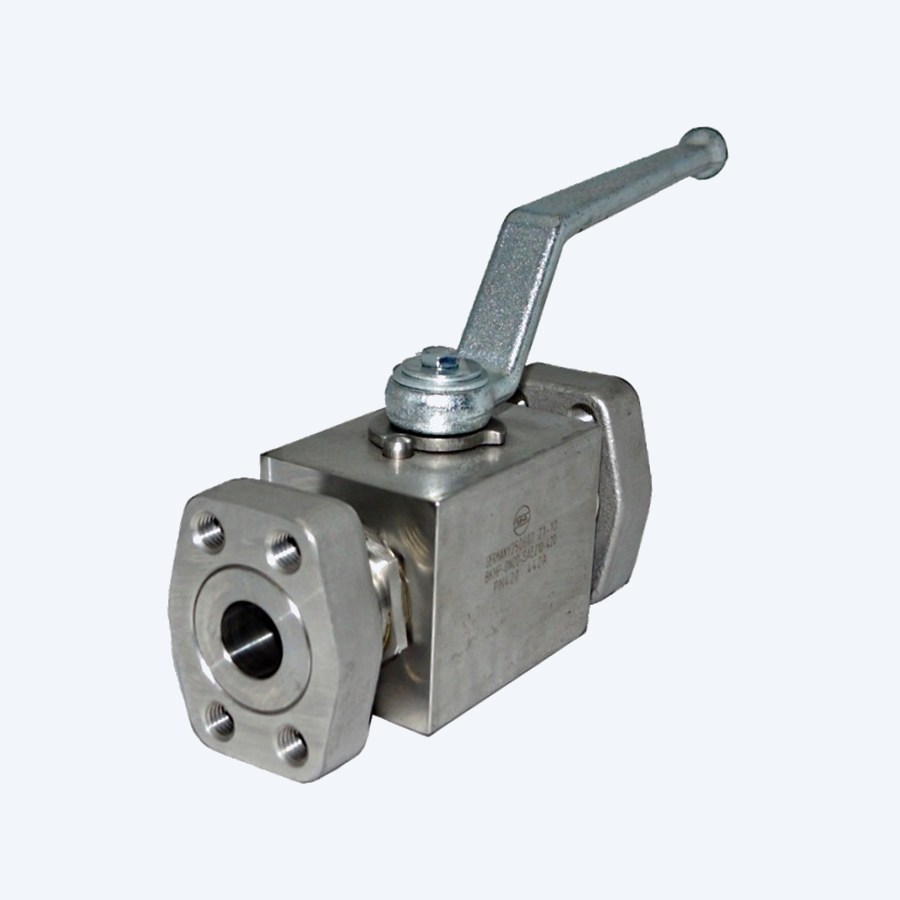
Buying SAE flange end ball valves in Malaysia and Singapore
Where the stock sits, what it costs to get it to you, and how fast it moves.
Stock, delivery and ordering
- Where the stock is — the office is in Kuala Lumpur, and valves are held in two warehouses: Johor Bahru and Singapore. The running sizes are the small bores in the BKH range. Addresses and direct lines are on the contact page.
- Dispatch — stock items leave the same or next working day.
- Larger bores — MKHP and the larger KH bodies are usually brought in, so the lead time comes back with the quote rather than being a shelf figure.
- Delivery cost — already inside the product price, along with transport, currency conversion, duties and taxes. Nothing is added afterwards.
What moves where. Singapore is mostly marine, offshore and shipyard work, usually SS316. Malaysia is hydraulics, palm oil mills and mining, mostly steel.
How a valve enquiry runs
Five things and we can price it without going back and forth:
- Bore — DN13 to DN80, or the inch size.
- Flange pattern — ISO 6162‑1 or ‑2. The one people leave out, and the one that decides whether it bolts on.
- Working pressure — the line pressure, checked against the table rather than the range name.
- Bolt thread — metric or UNC.
- The medium — it picks the material code and the seal.
A product specialist prices it within two working hours. Replacing an existing valve? Send a photo of the body marking and one of the flange face with a rule across the bolt centres.
BKH, MKHP or KH?
Three bodies cover the range. Your bore decides which, and the bore also decides what patterns you can have.
| Range | Bore | Inch | Flange patterns | Stem | Temperature |
|---|---|---|---|---|---|
| BKH / BKHP‑SAE | DN13–DN25 | 1/2"–1" | 6162‑1 and 6162‑2 | Steel | −20 / +100 °C |
| MKHP‑SAE | DN32–DN50 | 1¼"–2" | 6162‑1 and 6162‑2 | Steel | −20 / +100 °C |
| KH‑SAE | DN15–DN80 | 1/2"–3" | 6162‑1 and 6162‑2 | Duplex | −10 / +100 °C |
The ranges overlap, so the bore alone does not pick the body. KH runs the whole way from DN15 to DN80, so at 1/2", 1" or 2" you may have a choice between a BKH or MKHP and a KH — and they are not the same valve. KH is full port with the adapter in one piece, so it is shorter; BKH and MKHP screw their adapters onto extended threads. Note also that KH uses a duplex stem where the smaller bodies use steel, and it is rated to −10 °C rather than −20 °C — worth knowing on cold‑start or outdoor plant.
KH is also where the accessories live: locking devices, actuators, mounting holes, position switches and detent are all catalogue options on that range. If the valve has to be padlocked open, actuated or position‑sensed, say so with the enquiry rather than after.
Pressure: the valve body and the flange are rated separately
This is the section that stops a wrong order, so it is worth two minutes.
A valve in this family carries two different pressure numbers, and they are not the same thing. The flange pattern is rated by its class — ISO 6162‑1 is the 3000 psi (about 210 bar) interface, ISO 6162‑2 the 6000 psi (about 420 bar) one. The valve body has its own PN, printed per size in MHA’s tables, and it is often higher than the flange it sits on.
So on a BKH‑DN13‑SAE210 the body is PN 350 bar while the ISO 6162‑1 interface it bolts to is a 3000 psi pattern. The joint is limited by the flange, not the valve. Specifying against the body PN and ignoring the interface is how a line ends up over‑pressured at the one place it was never rated.
| Type | Bore | Pattern | Valve body PN |
|---|---|---|---|
| BKH‑DN13‑SAE210 | 13 | ISO 6162‑1 | 350 bar |
| BKH‑DN20‑SAE210 | 20 | ISO 6162‑1 | 350 bar |
| BKH‑DN25‑SAE210 | 25 | ISO 6162‑1 | 315 bar |
| BKH‑DN13‑SAE420 | 13 | ISO 6162‑2 | 420 bar |
| BKH‑DN20‑SAE420 | 20 | ISO 6162‑2 | 420 bar |
| BKH‑DN25‑SAE420 | 25 | ISO 6162‑2 | 315 bar |
| BKHP‑DN25‑SAE420 | 25 | ISO 6162‑2 | 420 bar |
DN25 is the size to watch. In both patterns the standard BKH body drops to 315 bar at DN25 while DN13 and DN20 hold 350 or 420. If you need the full 420 bar at 1", the part is the BKHP, not the BKH — a different body, slightly longer, and the only one in the table that gets there. Asking for “a 1" 420 bar SAE ball valve” and being sent a BKH is a real failure mode, and it is why we confirm the pressure against the size rather than the range name.
MHA also offers PN100 and PN160 variants at DN80 in the KH range, so the large bores are not a single rating either. Give us the working pressure and the bore together and we will name the part.
The material code, and what the medium does to it
Body, ball, stem, seats and seals are each specified. The code is how they travel together.
MHA specifies these valves as a material combination rather than a single grade, because five parts touch the fluid: body, ball, stem, ball seats and O‑rings. The seats are POM across every range. What varies is the metal and, critically, the elastomer.
| Range | Code | Body / ball | Stem | O‑rings | Temperature |
|---|---|---|---|---|---|
| BKH · MKHP | 112A | Steel | Steel | NBR | −20 / +100 °C |
| BKH · MKHP | alternative | Steel | Steel | FPM (Viton®) | −20 / +100 °C |
| BKH · MKHP | 442A | Stainless SS316 | Stainless | NBR | −30 / +100 °C |
| KH | 282A | Steel | Duplex | NBR | −10 / +100 °C |
| KH | alternative | Steel | Duplex | FPM (Viton®) | −10 / +100 °C |
Read the elastomer column, not the body column. The steel or stainless choice is about corrosion and is usually obvious from the installation. The NBR or FPM choice is about the fluid, it is invisible once the valve is assembled, and it is where wrong‑code valves fail. NBR is right for mineral hydraulic oil; FPM is what you move to for fuels, solvents, higher temperature or an aggressive medium — and it is not the better seal in general, because it stiffens at low temperature sooner than nitrile does.
We do not publish a code for every medium, on purpose. Water‑glycol, HFC and chemical service are not a table lookup — guessing the code from one is how the wrong seal gets fitted, and a valve supplied on an insufficient specification falls outside the maker’s warranty. Tell us the medium and we will confirm the combination against MHA’s material code sheet.
Flow: Kv and Cv, size by size
A full‑bore valve still costs you pressure. This is how much.
Two coefficients describe the same thing from different ends. Cv is the flow in US gallons per minute of water at 15 °C for a 1 psi pressure drop. Kv is the flow in m³/h of water between 5 and 40 °C for a 0.1 MPa (1 bar) loss. They convert directly: Kv = Cv ÷ 1.156.
| Size | Kv (m³/h) | Cv (US gal/min) |
|---|---|---|
| 1/2" | 19.4 | 22.6 |
| 3/4" | 45.6 | 53.0 |
| 1" | 71.5 | 83.1 |
| 1¼" | 105 | 122.1 |
| 1½" | 170 | 197.7 |
| 2" | 275 | 319.8 |
| 2½" | 507 | 589.5 |
| 3" | 905 | 1052.3 |
Why it is worth checking. The figures roughly double with each size step, so a bore chosen one size down to save money costs far more in pressure drop than the price difference — and on a long run that shows up as heat in the oil, not just a lower reading at the gauge. If flow rate is the binding constraint rather than pressure, size on Kv and work back to the bore.
What a complete joint actually needs
The valve is one of five items. This is the commonest short‑order on the page.
The valve gives you the flat side of the flange pair, not both halves. Its adapter presents a flat face; the mating half — the O‑ring side, which carries the seal in its groove — is a separate part. Order the valve alone and it arrives with nothing to bolt to.
| Qty | Item | Why |
|---|---|---|
| 1 set | Ball valve with SAE flange adapter | The valve itself — presents the flat side at each end |
| 1 set | SAE flange, O‑ring side | The mating half. It carries the O‑ring groove, so without it there is nothing to seal against |
| 8 | Allen cap screws | Four per end. Metric or UNC to match the valve |
| 8 | Spring washers | Four per end |
| 2 | O‑ring seals | One per joint. The seal is what holds pressure, not the metal faces |
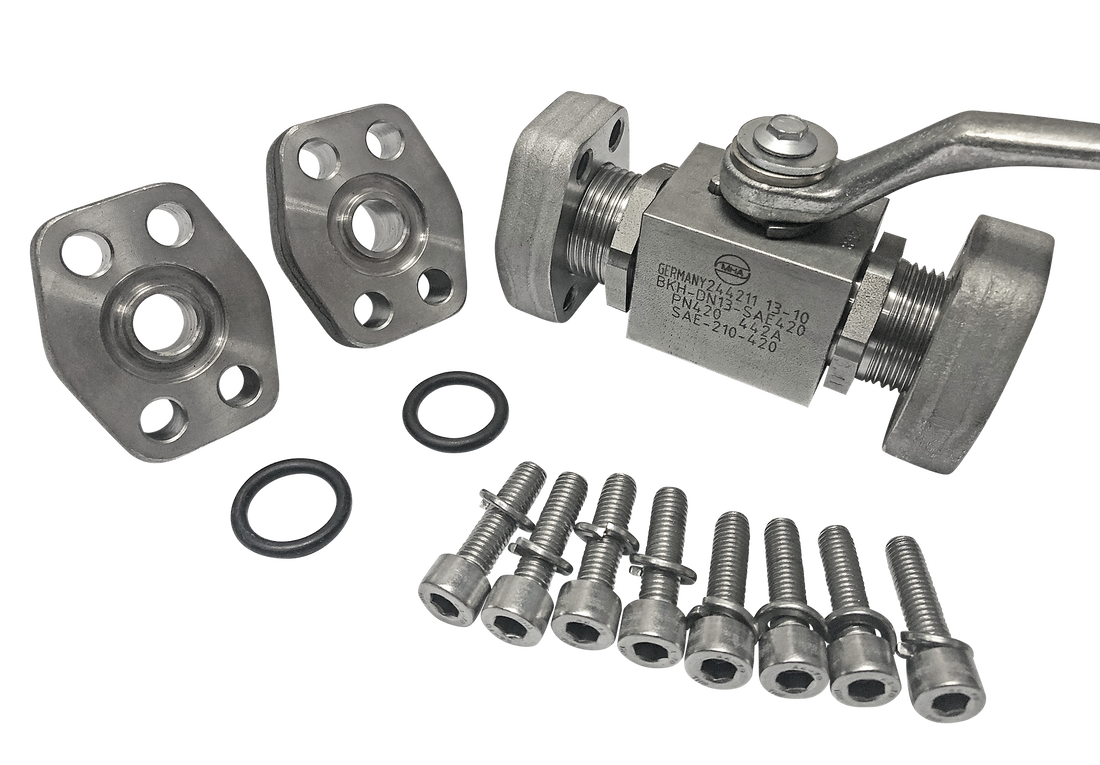
BKH‑DN13‑SAE420 · PN420 · 442A. Laid out beside it: the two O‑ring‑side flange halves, two O‑rings and eight Allen cap screws — none of which comes with the valve.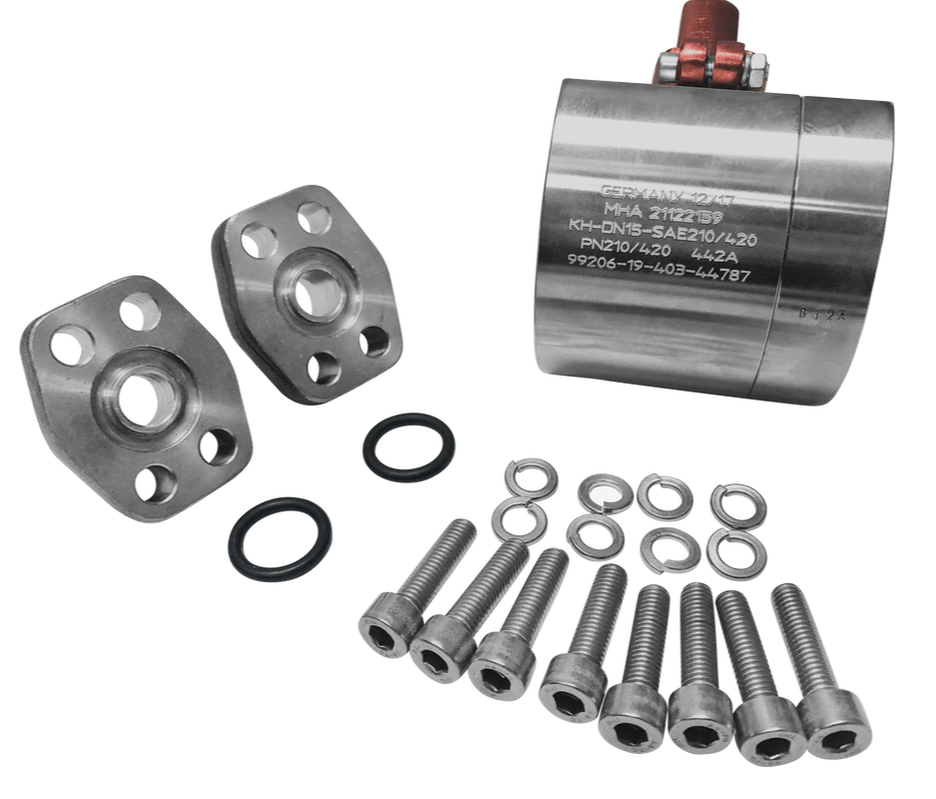
KH‑DN15‑SAE210/420 · 442A. Here the eight spring washers are in shot as well — the fifth item on the list, and the one most often left off an order.We quote the complete set unless you tell us otherwise, because a valve on its own is not an installable joint. If you already hold the O‑ring‑side flanges, say so and we will price the valve alone.
Why the KH body is shorter
On BKH and MKH the flange adapters are screwed onto extended male threads at each end of the valve, which makes the assembly longer overall and puts two more joints in it. KH is MHA’s newer design: full port, with body and adapter in a single piece, so there are fewer assembly points and the valve is physically shorter. Where the valve has to drop into a fixed gap in existing pipework, that length difference is often what decides which range you can use — so give us the available face‑to‑face dimension along with the bore.
How to read a valve you already have
The body marking carries the whole specification. So does the flange face.
Read the body
- The type string — for example
BKH‑DN20‑SAE420. It gives you the range, the bore and the flange pattern in one line. - PN — the body rating, stamped on the valve.
- The four‑digit code — 112A, 442A or 282A. This is the material combination, including the seal.
- Works order and date — MHA marks these, which is how a valve gets traced back.
Measure the flange face
- Bolt‑hole centres — this is what separates ISO 6162‑1 from 6162‑2 at the same nominal size. Take it centre to centre on the long side of the four‑hole rectangle, with a rule rather than a tape.
- Bolt thread — metric or UNC. Check before you order, not after.
- The O‑ring — if you still have the old one it confirms the pattern and the size.
Full detail on reading a flange face is on the SAE flange page.
Send a photo of the body marking and one of the flange face with a rule across the bolt centres, to info@rfshydraulics.com or on WhatsApp. We identify these every week — and the marking usually tells us more than the measurements do.
Fitting it
Four steps, and one warning that is specific to the large bores.
The four steps, in order
1. Confirm the pattern before you lift it. ISO 6162‑1 and ‑2 look alike at a glance and differ in bolt spacing. If it does not drop onto the studs, stop rather than force it.
2. Fit new O‑rings and check the faces. The seal is the cheap part. A scratch across a sealing face is a leak path no amount of bolt torque will close.
3. Bring the bolts up evenly, across the diagonal. Opposite corners in stages so each O‑ring compresses squarely rather than being pinched on one side.
4. Operate it fully before commissioning. A quarter turn, both ways, with the line depressurised. A valve that does not reach its stops is a valve that will not seal.
Two things specific to this valve
Fix the lever centrally. On the KH range MHA warns that vibration can let the handle operate the valve by itself if the lever is not held central. On a 3" or 4" isolator that is a valve changing state with nobody near it. Locking devices and detent are catalogue options — ask for them where vibration is a factor.
Do not throttle with it. Held part‑open, the flow wire‑draws the seat and the valve weeps in the closed position afterwards. Use a needle valve to regulate and this valve to isolate it.
Because both ends are flanged, the valve comes out without breaking into the pipework — which is the whole reason for specifying a flange end rather than a thread.
Watch the valve explained
Specification, patterns and where it fits.
Why buy SAE flange end ball valves from RFS Hydraulics
Six things that decide whether a valve order goes smoothly.
Ready stock on the running sizes
The small BKH bores are held in Johor Bahru and Singapore and dispatch the same or next working day. Larger bores come back with a lead time on the quote.
German‑made, marked
MHA Zentgraf, with the type, PN, material code and works order on the body — not an unbranded valve with a figure on the box.
We check the pattern
We confirm 6162‑1 against 6162‑2 and the bolt thread before quoting, because that is what decides whether it bolts on at all.
We check the pressure by size
Not by range name. DN25 drops to 315 bar unless it is a BKHP — the kind of detail that turns into a returned valve.
Three bodies, both materials
BKH, MKHP and KH in steel or SS316, so the bore and the material are design choices rather than whatever one supplier holds.
The flange and tube as well
We stock the SAE flanges, O‑rings and tube either side of the valve. More about RFS Hydraulics.
Delivery within Malaysia is already inside the price. Also see threaded high pressure ball valves, SAE flange check valves and ISO 6164 ball valves. See the FAQ or the terms and conditions.
Frequently asked questions
Sixteen, starting with the one that decides whether the valve bolts on.
What is the difference between ISO 6162‑1 and ISO 6162‑2?
They are the two SAE flange patterns. ISO 6162‑1 is the 3000 psi interface (SAE Code 61) and ISO 6162‑2 the 6000 psi one (Code 62). They share a nominal size but not a bolt spacing, so a valve on the wrong pattern will not bolt to your port. In this family both patterns are available up to 2"; above that, only 6162‑1.
What pressure will an SAE flange end ball valve take?
Two numbers apply and you need both. The valve body has its own PN — 350 bar at DN13 and DN20 on the 6162‑1 pattern, 420 bar on 6162‑2, and 315 bar at DN25 in either. The flange interface is rated by its class, roughly 210 bar for 6162‑1 and 420 bar for 6162‑2. The joint is limited by whichever is lower, which is usually the flange. MHA prints the warning on every sheet: note the pressure ratings of the connection flanges.
I need 420 bar at 1". Which part is that?
The BKHP‑DN25‑SAE420, not the BKH. The standard BKH body drops to 315 bar at DN25 in both flange patterns; the BKHP is a different, slightly longer body and it is the only one in the range that holds the full 420 bar at that bore. Asking for “a 1" 420 bar SAE ball valve” and being sent a BKH is a real and common error.
What sizes do you supply?
DN13 to DN80, which is 1/2" to 3", across three bodies: BKH/BKHP at DN13–DN25, MKHP at DN32–DN50 and KH at DN15–DN80 — so KH overlaps the other two and offers a shorter, full‑port alternative at the small bores. Note that the threaded BKH valves go smaller than this, but the SAE flange end versions start at DN13.
Which flange pattern can I have at 3"?
Both patterns run through the range, but availability is per part, not per size — some parts are built for one pattern and some carry both, which is why a KH‑DN15 is marked SAE210/420. At 3" (DN80), the top of the range, send us the drawing and we will confirm which pattern is actually built at that bore rather than have you design around an assumption. It is also the size where the flange interface, not the valve body, is almost always the limiting element.
What does the material code mean?
It specifies five parts at once — body, ball, stem, ball seats and O‑rings. 112A is steel throughout with NBR seals; 442A is SS316 with NBR; 282A is the KH code, steel with a duplex stem. Each has an alternative combination with FPM (Viton®) instead of nitrile. Ball seats are POM in every case. The elastomer is the part that matters most and the part you cannot see once the valve is together.
NBR or FPM (Viton)?
NBR for mineral hydraulic oil, which is most jobs, and it is the cheaper seal. FPM when the temperature is higher than nitrile takes or the medium is a fuel, a solvent or an aggressive chemical. FPM is not simply the better seal — it stiffens at low temperature sooner than NBR. Tell us the medium and the peak temperature and we will pick it.
Can a ball valve be used for throttling?
No. A ball valve is an isolation device: open or shut. Held part‑open, the flow is forced through a narrow crescent between ball and seat and the velocity wire‑draws the seat, cutting a channel across the sealing face. After that the valve weeps in the closed position for the rest of its life. If the job needs regulation, use a needle valve and let the ball valve isolate it.
Why must the lever be held centrally?
On the KH range MHA states it explicitly: the lever must be fixed centrally during operation, because in the presence of vibration the handle can otherwise operate the valve by itself. On a large‑bore isolator that is a valve changing state without anyone touching it. Where vibration is a factor, ask about the locking devices and detent options on that range.
Metric or UNC bolts?
Both are catalogue options, and they are not interchangeable. The smaller sizes come in M8, M10 and M12 metric or 5/16", 3/8" and 7/16" UNC. It depends on the port you are bolting to, so it belongs on the enquiry — a valve with the wrong bolt thread is a valve you cannot fit.
Do I have to order the flanges separately?
Yes, and this is the commonest short‑order on this product. The valve presents a flat face at each end. The mating half — the SAE flange, O‑ring side, which carries the seal in its groove — is a separate part, as are the screws, washers and O‑rings. A complete joint pair is five items; see what a complete joint needs. We quote the full set unless you tell us you already hold the flanges.
Is the lever supplied fitted?
Usually not. MHA’s own drawings carry the note “normally lever will be delivered unassembled”, so expect to fit it on site. That matters twice over: check the lever is in the box before the fitter travels, and once fitted make sure it is secured centrally — on the KH range MHA warns that vibration can otherwise let the handle work the valve by itself.
What temperature will it take?
It depends on the body and the material code, and the spread is wider than people expect. BKH and MKHP: −20 °C to +100 °C. KH: −10 °C to +100 °C — the narrowest of the three at the cold end. The 442A stainless combination is rated −30 °C to +100 °C. If the plant cold‑starts outdoors, the cold figure is the one to check, not the hot one.
Is it full bore?
The KH body is a full port design — the bore through the ball matches the line, so there is no step to throttle the flow, which is part of why its Kv figures are what they are. If full bore is a requirement rather than a preference, say so and we will confirm it against the specific part number, because it is not a safe assumption across every body and every bore.
Can it be locked open, or actuated?
Yes — on the KH range these are catalogue options rather than specials: locking devices, actuators, mounting holes, position switches, detent and combinations of them. If the valve has to be padlocked in one position, driven, or position‑sensed for an interlock, say so with the enquiry. Retrofitting a mounting pattern to a valve already on the shelf is usually not possible.
Kv or Cv — which figure do I use?
They describe the same thing in different units, so use whichever your calculation is in. Cv is US gallons per minute of water at 15 °C for a 1 psi drop; Kv is m³/h of water between 5 and 40 °C for a 1 bar drop. Convert with Kv = Cv ÷ 1.156. Both are in the flow table. If flow rate rather than pressure is the binding constraint, size on Kv and work back to the bore.
Catalogues
Direct PDF download — no form, no email address.
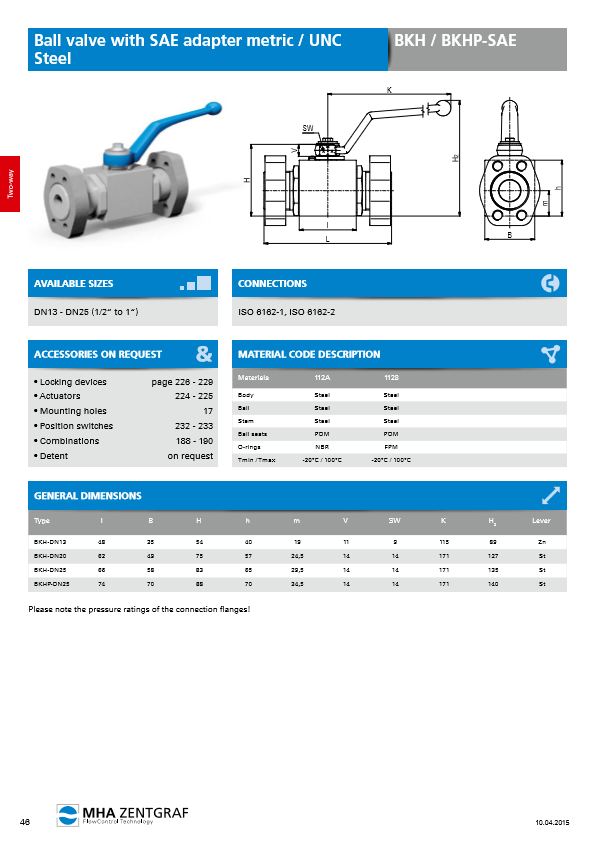 BKH & BKHP‑SAE — DN13 to DN25MHA Zentgraf · PDFPDF
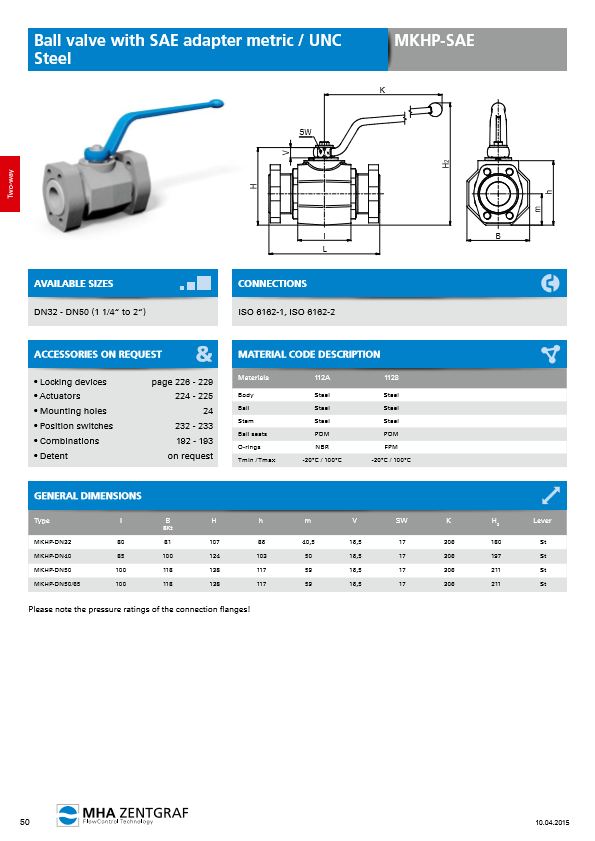 MKH & MKHP‑SAE — DN32 to DN50MHA Zentgraf · PDFPDF
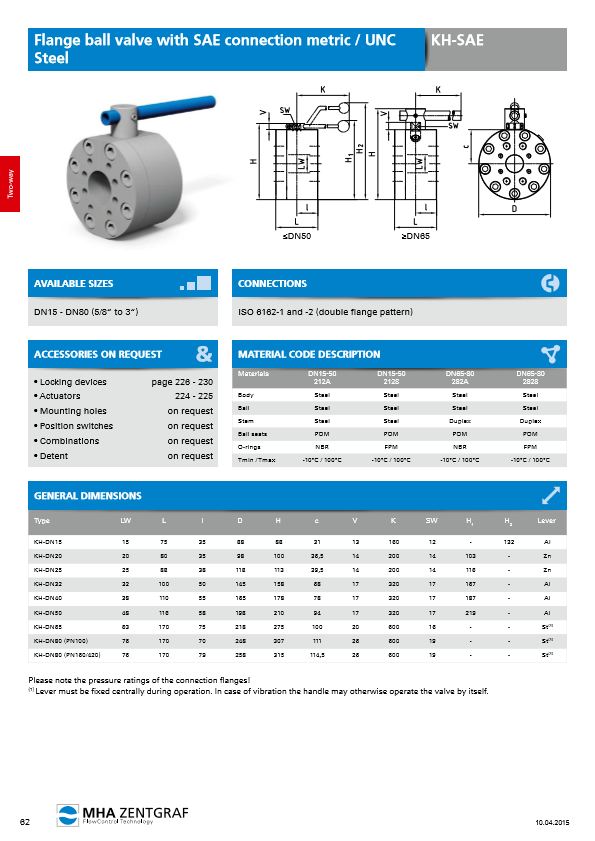 KH‑SAE — DN15 to DN80MHA Zentgraf · PDFPDF
All three are the 10.04.2015 edition and carry the full dimension and order‑code tables in steel and stainless, for both the ISO 6162‑1 and ISO 6162‑2 patterns with metric and UNC bolts. Dimensions and part numbers are in the catalogues; stock and price are not — send us the list and we will confirm both.
Related: threaded and compression high pressure ball valves · SAE flanges · needle valves for regulation.
Send the bore, the flange pattern, the pressure and the medium.
Or a photo of the body marking and the flange face. A product specialist confirms the part number within two working hours.