
Home › Products › Accessories › Stauff level gauges
STAUFF · ready stockSTAUFF level gauges, type SNA, 76 mm to 305 mm
A visual fluid level indicator that bolts to the side of a hydraulic reservoir on two banjo bolts, so the oil level can be read at a glance without opening anything. Six nominal sizes from 76 mm to 305 mm, IP65, working from −30 °C to +80 °C, and available with a thermometer, a thermo switch or a PT100 sensor built into the same body. The one figure to check first: tank pressure must not exceed 2 bar.
Get a quotation within 2 working hours
Send the part number, standard, size or quantity. Stock in Malaysia or Singapore, ISO 9001:2015 certified.
What a level gauge is, and when you need one
Two banjo bolts, a sight tube between them, and the level reads itself.
A STAUFF level gauge is a pair of banjo bolts joined by a polyamide sight tube in an epoxy‑coated steel housing. It bolts through the reservoir wall, the fluid finds its own level in the tube, and a scale plate behind it turns that into a reading. Nothing powered, nothing to calibrate, and the level is visible from the walkway rather than needing a dipstick and a torch. Type SNA, and the size you order is the bolt centre distance — which is also the thing to measure if you are replacing one.
The constraint to check before anything else is tank pressure: the SNA is for reservoirs not exceeding 2 bar / 29 psi. That covers an ordinary vented or lightly pressurised hydraulic tank, and rules out a pressure vessel. It also has an option most sight glasses do not: a thermometer, a thermo switch or a PT100 temperature sensor can be built into the same unit, so one hole in the tank gives you level and temperature together.
| Level gauge, type SNA (this page) | A plain sight glass | An electronic level sensor | |
|---|---|---|---|
| What it gives you | A continuous visual reading over its whole length | Fluid present or not at one point | A signal, and no reading at the tank |
| Reading length | 76 to 305 mm standard, to 950 mm special | A single window | Depends on the probe |
| Temperature too? | Yes — thermometer, thermo switch or PT100 in the same body | No | Usually a separate device |
| Power | None, unless a switch or sensor is fitted | None | Required |
| Tank pressure limit | 2 bar / 29 psi | Depends on the fitting | Depends on the device |
| Mounting | Two banjo bolts, M10, M12 or 1/2" UNC/UNF/UNEF | A single threaded port | A port or a flange |
| Fit it when | Someone needs to read the level, and the temperature, standing at the machine | You only need a min or max check | The level has to be logged or interlocked |
Specification
Everything an enquiry needs, in one place.
| Type | SNA — STAUFF level gauge with visual fluid level indication |
| Function | Visual fluid level indication in hydraulic reservoirs |
| Max tank pressure | 2 bar / 29 psi — not for pressure vessels |
| Nominal sizes | Six: 76, 127, 150, 176, 254 and 305 mm (2.99" to 12.00"). The nominal size is the bolt centre distance |
| Display | Undivided on SNA 076 to 176 · subdivided by a strut into 2 sections on SNA 254 and 3 sections on SNA 305 |
| Housing | Steel St 12, black epoxy coated. Aluminium and stainless steel available — see special options |
| Sight tube and plugs | Polyamide (PA) |
| Sealings | NBR (Buna‑N) standard, FPM (Viton) optional |
| Scale plate | PVC, with STAUFF logo, neutral, or custom printed. Aluminium on request |
| Media compatibility | Mineral and petroleum based hydraulic fluids (HL and HLP). Other media — see special sight tube materials |
| Protection rating | IP65 — dust tight and protected against water jets. IP67 on request |
| Operating temperature | −30 °C to +80 °C (−22 to +176 °F). Low‑temperature versions to −40 °C on request |
| Tightening torque | 8 N·m / 5.9 ft·lb recommended |
| Banjo bolt sizes | M12 (standard), M10, 1/2‑13 UNC, 1/2‑20 UNF, 1/2‑28 UNEF. Steel or stainless |
| Temperature options | Capillary tube thermometer (to +80 °C), dial thermometer with 200 or 300 mm probe (to +100 °C), thermo switch or PT100 sensor — see the options |
| Bolt spacing tolerance | ±0.20 mm on the bolt centre distance, to DIN ISO 2768‑f, at every nominal size |
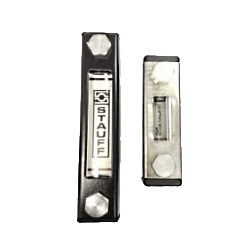
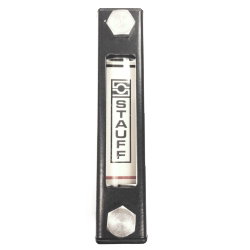
Buying Stauff level gauges in Malaysia and Singapore
Where the stock sits, what it costs to get it to you, and how fast it moves.
Stock, delivery and ordering
- Where the stock is — the office is in Kuala Lumpur, and gauges are held in two warehouses: Johor Bahru and Singapore. Addresses and direct lines are on the contact page.
- Dispatch — stock items leave the same or next working day.
- The running items are the 127 mm and 254 mm sizes with M12 bolts, NBR seals and the standard scale plate. Thermo switches, PT100 sensors, custom scale plates and the special sizes are built to order.
- Replacing one? Measure the bolt centre distance and the bolt thread. Those two figures decide almost everything.
- Delivery cost — already inside the product price, along with transport, currency conversion, duties and taxes. Nothing is added afterwards.
Special sizes up to 950 mm are made to order, held to a 1 mm tolerance, and STAUFF will do them in small and medium quantities — useful on a one‑off tank build.
How a level gauge enquiry runs
Five things and we can price it without going back and forth:
- Bolt centre distance in mm — that is the nominal size, and it is what the order code asks for.
- Banjo bolt thread — M12, M10 or one of the 1/2" unified threads, and steel or stainless.
- Sealing — NBR for mineral oil, Viton for anything hotter or more aggressive.
- Do you want temperature as well? A thermometer, a thermo switch or a PT100 — and if a switch, at what temperature it should trip.
- Scale plate — STAUFF logo, neutral, or your own artwork.
A product specialist prices it within two working hours. One constraint worth flagging early: thermo switches and sensors are only available on the M12 bolt size.
Sizes and dimensions
Six standard sizes. The nominal figure is the bolt centre distance, L2.
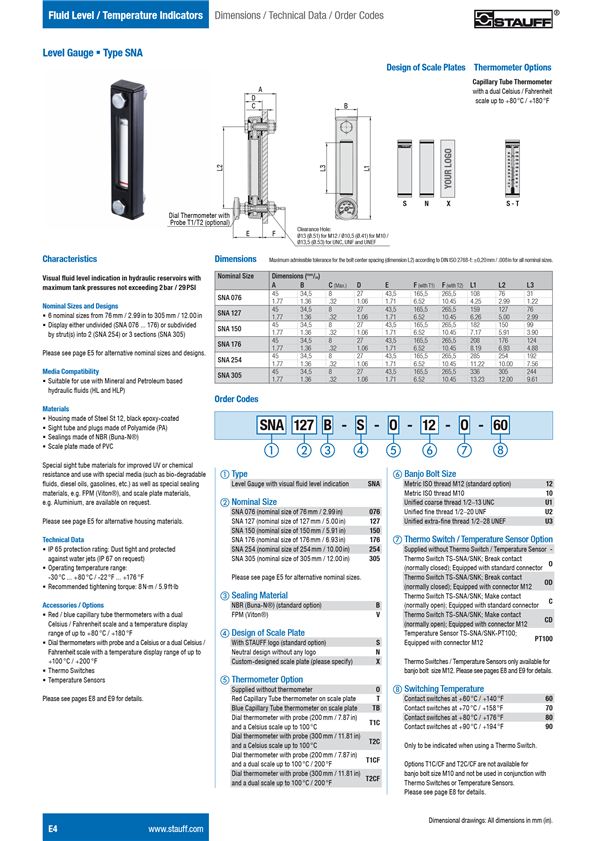
Every SNA shares the same cross‑section — A 45 mm wide, B 34.5 mm deep, with the same banjo bolt geometry — and only the length changes. L2 is the bolt centre distance and equals the nominal size; L1 is the overall length and L3 the visible sight‑tube length, which is the figure that actually tells you how much level you can see.
| Type | Nominal size | Bolt centres L2 | Overall L1 | Visible length L3 | Display |
|---|---|---|---|---|---|
| SNA 076 | 76 mm / 2.99" | 76 | 108 | 31 | Undivided |
| SNA 127 | 127 mm / 5.00" | 127 | 159 | 76 | Undivided |
| SNA 150 | 150 mm / 5.91" | 150 | 182 | 99 | Undivided |
| SNA 176 | 176 mm / 6.93" | 176 | 208 | 124 | Undivided |
| SNA 254 | 254 mm / 10.00" | 254 | 285 | 192 | 2 sections, one strut |
| SNA 305 | 305 mm / 12.00" | 305 | 336 | 244 | 3 sections, two struts |
Dimensions in mm. Common to all six: A 45, B 34.5, C 8 max, D 27, E 43.5. Bolt centre tolerance ±0.20 mm per DIN ISO 2768‑f. Where a dial thermometer with a probe is fitted, the projection F is 165.5 mm with the 200 mm probe and 265.5 mm with the 300 mm probe — check that against the tank depth before ordering.
| Banjo bolt | Clearance hole needed in the tank wall |
|---|---|
| M12 (standard) | Ø13.0 mm (0.51") |
| M10 | Ø10.5 mm (0.41") |
| 1/2" UNC, UNF or UNEF | Ø13.5 mm (0.53") |
Drill the pair at the nominal spacing, within the ±0.20 mm tolerance. Two holes at the wrong pitch is the one mistake on this product that cannot be corrected with a spanner.
The order code, field by field
Eight positions, and three of them constrain each other.
A complete SNA is specified as, for example, SNA 127 B‑S‑0‑12‑O‑60 — a 127 mm gauge with NBR seals, a STAUFF‑logo scale plate, no thermometer, M12 bolts, a normally‑closed thermo switch on the standard connector, tripping at +60 °C.
| # | Field | Options |
|---|---|---|
| 1 | Type | SNA — level gauge with visual fluid level indication |
| 2 | Nominal size | 076 · 127 · 150 · 176 · 254 · 305 |
| 3 | Sealing material | B NBR (Buna‑N), standard · V FPM (Viton) |
| 4 | Scale plate design | S with STAUFF logo, standard · N neutral, no logo · X custom designed |
| 5 | Thermometer option | 0 none · T red capillary tube on the scale plate · TB blue capillary tube · T1C dial, 200 mm probe, Celsius to 100 °C · T2C dial, 300 mm probe, Celsius · T1CF dial, 200 mm probe, dual to 100 °C/200 °F · T2CF dial, 300 mm probe, dual |
| 6 | Banjo bolt size | 12 M12, standard · 10 M10 · U1 1/2‑13 UNC · U2 1/2‑20 UNF · U3 1/2‑28 UNEF |
| 7 | Thermo switch or sensor | - none · O break contact, standard connector · OD break contact, M12 connector · C make contact, standard connector · CD make contact, M12 connector · PT100 temperature sensor, M12 connector |
| 8 | Switching temperature | 60 +60 °C · 70 +70 °C · 80 +80 °C · 90 +90 °C — only stated when a thermo switch is fitted |
- Thermo switches and PT100 sensors are M12 only. If field 7 is used, field 6 has to be
12. That single rule catches more orders than any other on this product. - Dial thermometers are not available on M10, and cannot be combined with a thermo switch or a sensor. Choose either a dial thermometer or a switch, not both.
- Field 8 only applies with a switch. Leave it off entirely if field 7 is
-orPT100.
Level and temperature in one unit
Four ways to read or act on oil temperature without a second hole in the tank.
This is the reason to choose an SNA over a plain sight glass. Oil temperature matters as much as level — too hot and viscosity drops, seals harden and the oil oxidises — and the SNA can carry the measurement in the same body.
| Option | Range | What it does | Choose it when |
|---|---|---|---|
| Capillary tube thermometer codes T, TB | Dual °C/°F to +80 °C / +180 °F | A thermometer strip printed onto the scale plate, red or blue | You just want the temperature visible next to the level. The cheapest option and nothing to fit |
| Dial thermometer with probe codes T1C, T2C, T1CF, T2CF | Celsius or dual to +100 °C / +200 °F | A dial on the gauge with a 200 or 300 mm probe reaching into the oil | You want a proper reading of the bulk oil rather than the tank wall. Check the tank depth first |
| Thermo switch codes O, OD, C, CD | Trips at +60, +70, +80 or +90 °C | A contact that opens or closes at the set temperature — break or make, standard or M12 connector | Something has to happen at temperature: a fan, an alarm, an interlock |
| PT100 sensor code PT100 | Continuous measurement | A platinum resistance sensor on an M12 connector, feeding a controller | The temperature has to be read or logged by a control system, not just switched on |
- Break contact or make contact? A break contact (normally closed) opens on rising temperature — the fail‑safe choice for an alarm or interlock, because a broken wire looks the same as a trip. A make contact (normally open) closes on rising temperature, which suits switching a cooler fan on.
- Standard connector or M12? M12 is the industrial plug‑and‑play standard and the right choice on new plant; the standard connector suits an existing terminal box.
- Probe projection matters. With a dial thermometer the unit projects 165.5 mm (200 mm probe) or 265.5 mm (300 mm probe) into the tank. Confirm there is nothing in the way — a baffle, a return diffuser or the suction strainer.
Materials and what they limit
Every limit on this product traces back to one of five parts.
| Part | Standard material | What it decides |
|---|---|---|
| Housing | Steel St 12, black epoxy coated | Corrosion resistance and appearance. Aluminium or stainless available for washdown, marine and food plant |
| Sight tube and plugs | Polyamide (PA) | The media and UV limits. Special tube materials exist for bio‑degradable fluids, diesel and gasoline — see below |
| Sealings | NBR (Buna‑N) | Media compatibility and the temperature ceiling. FPM (Viton) or EPDM on request |
| Scale plate | PVC | Only fitted on nominal sizes below 670 mm. Aluminium on request |
| Floating element | Polyamide (PA), coloured | The recommended level indication above 670 mm, where a scale plate is no longer offered |
| Banjo bolts | Steel | Stainless available. The thread also decides whether a thermo switch can be fitted — M12 only |
- Media compatibility is set by the tube and the seal. As standard the SNA is for mineral and petroleum based hydraulic fluids, HL and HLP. Bio‑degradable fluids, diesel oils and gasolines need a special sight tube material — tell us the fluid rather than assuming.
- The polyamide tube is why the pressure limit is 2 bar. It is a sight tube, not a pressure part; the limit is a property of the design, not a conservative guess.
Special sizes and special conditions
Beyond 305 mm, below −30 °C, or not on mineral oil.
The six standard sizes cover most reservoirs, but STAUFF makes the SNA well beyond them — and in small and medium quantities, not just production runs. Three extensions are worth knowing about:
Longer than 305 mm
- Up to 950 mm / 37.4" nominal, made to order.
- Held to a 1 mm tolerance to your stated bolt centres.
- Struts subdivide the display into two or more sections, positioned on engineering grounds or to your requirement.
- Above 450 mm, plastic dampening clips are fitted to stop the sight tube vibrating.
- Above 670 mm a coloured floating element replaces the scale plate as the level indication.
Harder conditions
- Low temperature — versions for extremes down to −40 °C / −40 °F, against the standard −30 °C.
- Special media — sight tube materials with better UV and chemical resistance, for bio‑degradable fluids, diesel oils and gasolines.
- Special sealings — FPM (Viton) and others, defined separately.
- Housing material — aluminium or stainless steel instead of coated steel.
- Scale plate — aluminium rather than PVC, and custom artwork if you want your own markings.
- IP67 rather than IP65, on request.
For anything on this list, send the fluid, its temperature and its viscosity along with the bolt centres. Those three figures are what STAUFF asks for on its own enquiry checklist, and they decide the tube, the seal and the housing between them.
Fitting it
Two holes, two bolts, one torque figure. Get the pitch right and the rest is easy.
Before you drill
- Set the pitch to the nominal size — 76, 127, 150, 176, 254 or 305 mm between hole centres, within ±0.20 mm.
- Drill the right clearance: Ø13.0 for M12, Ø10.5 for M10, Ø13.5 for the 1/2" unified threads.
- Position it to read the working range — the visible length is shorter than the bolt centres, from 31 mm on the SNA 076 up to 244 mm on the SNA 305.
- Check inside the tank for baffles and the suction strainer, especially with a probe thermometer projecting 165 or 265 mm.
- Deburr the holes and make sure the wall is flat where the sealings land.
Assembly and service
- Torque to 8 N·m / 5.9 ft·lb. That is the recommended figure and it is low — this is a polyamide sight tube in a light housing, not a flange. Overtightening cracks tubes.
- Tighten both bolts evenly so the housing is not pulled out of line.
- Keep it out of the firing line. IP65 handles hose‑down, but a sight tube is still plastic; do not use it as a step or a handhold.
- Clean the outside only, with something that will not attack polyamide or PVC. Solvent on the sight tube will craze it.
- If the tube discolours or crazes, the fluid or the UV exposure is outside what the standard tube is for — ask about a special tube material rather than replacing like for like.
How to identify one you already have
Two measurements name almost any SNA.
| Measure or look at | What it gives you |
|---|---|
| Bolt centre distance | The nominal size, and therefore field 2 of the order code. 76, 127, 150, 176, 254 or 305 mm — and if it is none of those, it is one of the special sizes |
| Bolt thread | Field 6. M12 is standard and the only one that takes a switch or sensor; M10 and the three 1/2" unified threads are the alternatives |
| Number of struts | Confirms the size on the long ones — one strut is the SNA 254, two is the SNA 305, none is 176 or shorter |
| The scale plate | STAUFF logo, blank, or custom — field 4. If there is a thermometer strip printed on it, that is field 5 as T or TB |
| A dial or a connector | A dial on the body means a probe thermometer; an electrical connector means a thermo switch or PT100 — and therefore M12 bolts |
| Housing colour and finish | Black epoxy is the standard steel housing; bare metal suggests the aluminium or stainless option |
Send the bolt centre distance, the thread, and a photograph of the front. That is enough to quote the identical unit — and if the old one failed early, worth telling us the fluid too, because a crazed sight tube usually means the standard polyamide was the wrong choice rather than the gauge being faulty.
Frequently asked questions
Twelve, starting with the limit that rules the product in or out.
What tank pressure will it take?
A maximum of 2 bar / 29 psi. The SNA is a reservoir level gauge, not a pressure‑vessel fitting — the sight tube is polyamide, so the limit is a property of the design rather than a cautious figure. That covers an ordinary vented or lightly pressurised hydraulic tank. If your reservoir runs above 2 bar, this is the wrong product and you should be looking at a different style of indicator.
What size do I order?
The bolt centre distance in millimetres — that is what the nominal size means. Six standard sizes: 76, 127, 150, 176, 254 and 305 mm. Note that the visible sight-tube length is shorter than the bolt centres, from 31 mm on the SNA 076 up to 244 mm on the SNA 305, so if what matters is how much level you can see, work from the L3 column rather than the nominal figure.
Can I get one longer than 305 mm?
Yes — special sizes are made up to a maximum nominal size of 950 mm / 37.4 in, held to a 1 mm tolerance, and STAUFF will do them in small and medium quantities rather than only in production runs. Two things change on the long ones: plastic dampening clips are fitted above 450 mm to stop the sight tube vibrating, and above 670 mm a coloured floating element replaces the scale plate as the level indication.
Can I have a thermometer as well?
Yes, four ways. A capillary tube thermometer printed on the scale plate reads to +80 degrees C. A dial thermometer with a 200 or 300 mm probe reads the bulk oil to +100 degrees C. A thermo switch gives a contact that trips at 60, 70, 80 or 90 degrees C. A PT100 sensor gives a continuous signal to a controller. It is the main advantage of the SNA over a plain sight glass — one hole in the tank, level and temperature together.
Why does the thermo switch need M12 bolts?
Because the switch and the PT100 sensor are built into the banjo bolt, and STAUFF only offers that in the M12 size. So if you want a switch or a sensor, field 6 of the order code has to be 12. It is the constraint most often missed on this product. Related rule: the dial thermometers are not available on M10 either, and cannot be combined with a thermo switch or sensor — choose one or the other.
Break contact or make contact on the switch?
Break contact (normally closed) opens as the temperature rises. That is the fail‑safe choice for an alarm or an interlock, because a broken wire produces the same result as a genuine trip — the system errs towards stopping. Make contact (normally open) closes as the temperature rises, which is what you want for switching on a cooler fan. Both are available with a standard connector or an M12 connector.
What fluids is it suitable for?
As standard, mineral and petroleum based hydraulic fluids — HL and HLP. That is set by the polyamide sight tube and the NBR sealings, not by the housing. For bio-degradable fluids, diesel oils or gasolines, special sight tube materials with better chemical and UV resistance are available, and FPM (Viton) or EPDM sealings can be specified. Tell us the fluid, its temperature and its viscosity rather than assuming the standard build suits.
How tight do the bolts go?
8 N·m / 5.9 ft·lb is the recommended figure, and it is deliberately low. This is a polyamide sight tube in a light epoxy‑coated housing — not a flange — and the commonest way to destroy a new gauge is to treat the banjo bolts like structural fasteners. Tighten both evenly so the housing is not pulled out of line.
What hole size do I drill?
13.0 mm for M12, 10.5 mm for M10, and 13.5 mm for the 1/2 inch UNC, UNF and UNEF threads. Drill the pair at the nominal spacing, within the plus or minus 0.20 mm bolt centre tolerance that STAUFF works to. Two holes at the wrong pitch is the one error on this product that a spanner cannot fix, so measure twice.
What is the temperature range?
Minus 30 to plus 80 degrees C (minus 22 to plus 176 degrees F) as standard. Special low‑temperature versions run to minus 40 degrees C. Note this is the gauge's own operating range; the thermometer options have their own display ranges, up to +80 degrees C on the capillary type and +100 degrees C on the dial with probe.
Is it protected against washdown?
IP65 as standard — dust tight and protected against water jets — with IP67 available on request. That covers ordinary hose‑down. What it does not make it is armoured: the sight tube is plastic, and it should not be used as a step or a handhold, nor cleaned with solvents, which will craze polyamide and PVC.
The sight tube has gone cloudy. Is that normal?
No, and replacing it like for like will probably not fix it. Crazing or discolouration usually means the fluid or the UV exposure is outside what the standard polyamide tube is designed for — a bio-degradable fluid, a solvent used for cleaning, or strong sunlight on an outdoor tank. Tell us the fluid and where the tank sits and we will quote a special sight tube material with better chemical and UV resistance rather than the same part again.
Catalogues
Direct PDF download — no form, no email address.
Related: pressure gauges · Stauff filler breathers for the same reservoir · Stauff test couplings.
Send the bolt centre distance and the bolt thread.
Add the fluid and whether you want temperature as well. A product specialist confirms the order code within two working hours.