
Home › Products › High pressure fittings › JIC fittings
SAE J514 · ready stockJIC 37° flare fittings to SAE J514 and ISO 8434‑2
Three parts — body, sleeve and nut — sealing metal to metal on a 37° flared cone. No O‑ring in the joint, which is why it survives temperatures an elastomer would not. Stocked 1/4" to 1‑1/2" in SS316 and carbon steel, to 430 bar, with JIC, BSPP and NPT on the far end. The nut and body are universal across metric and inch tube — only the sleeve changes.
Get a quotation within 2 working hours
Send the part number, standard, size or quantity. Stock in Malaysia or Singapore, ISO 9001:2015 certified.
What a JIC fitting is
A 37° cone, and no soft seal anywhere in the joint.
JIC stands for Joint Industry Council, the body that originally standardised the design. The fittings are made to SAE J514 and ISO 8434‑2. A complete set is three parts — body, sleeve and nut — and the body is machined with a 37° flared seating surface. That is why the trade calls them flared fittings.
The seal is made when the flared face of the tube is clamped against the 37° cone of the body by the nut, through the sleeve. Metal against metal — there is no O‑ring, nothing to perish, nothing to extrude. Fitting sizes are set by the tube outside diameter, and the range takes both metric and inch tube.
- The nut and the body are universal. They fit metric or inch tube alike. Only the sleeve changes to match the tube outside diameter — which is worth knowing before you order a whole new set of parts.
- It is the standard hose end. A JIC body without its sleeve and nut is used as a hose adapter, mating to the female swivel end of a hose assembly. That swivel is the reason JIC dominates hose work: you can tighten the joint without twisting the hose.
- Both halves carry a 37° seat. Male and female JIC both have the cone, and the seal happens where the male flare line meets the female cone seat.
- Fluid power, and general high pressure. Designed for systems where power is transmitted and controlled by a pressurised fluid, and used anywhere fluid is carried at high pressure.
Where it is the right choice
- Onto hose — with a female swivel end, this is the default connection.
- Where temperature rules out an O‑ring — the metal‑to‑metal seat has no elastomer to cook.
- Vibration — considerably better than a tapered pipe thread.
- Mixed thread systems — JIC to BSPP or NPT on one body saves an adapter.
Where something else is better
- Tube runs on a 24° port — that is DIN 2353, and its cutting ring needs no flaring tool.
- Instrumentation and gas — a twin‑ferrule fitting is the usual answer on small bore.
- Nominal bore pipe — forged pipe fittings, threaded or socket weld.
- Joints broken daily — a quick release coupling.
Specification
Everything an enquiry needs, in one place.
| Type | 37° flared tube fitting — body, sleeve and nut |
| Standards | SAE J514 · ISO 8434‑2 |
| Stocked size range | 1/4" to 1‑1/2". The dash tables run −02 (1/8") to −32 (2") — the ends of that range are available to order |
| Working pressure | Up to 430 bar, falling as the size increases |
| Seating surface | 37° flare, metal to metal, on both the male and the female half |
| Materials | Stainless steel SS316 · carbon steel · brass |
| Surface protection | Passivation on SS316 · white zinc plating on carbon steel · acid cleaning on brass |
| Temperature | −60 °C to +200 °C in SS316 and carbon steel · −45 °C to +175 °C in brass |
| Thread combinations | JIC × JIC · JIC × BSPP · JIC × NPT |
| Tube systems | Metric and inch. Nut and body are common to both; the sleeve is the part that changes |
| Optional seals | Where a port end carries one: NBR −23 to +120 °C (default) or FKM/Viton® −20 to +180 °C |
| Assembly | Flare the tube to 37°, lubricate, hand tighten, then torque to the table |
| Stock | Held in Johor Bahru and Singapore |
Two numbers get confused on this page. 37° is the JIC cone — and 60° cones also exist in the same range, on port ends rather than tube ends. And where a fitting carries a soft seal, that seal caps the temperature well below the metal figure. Both are set out below.
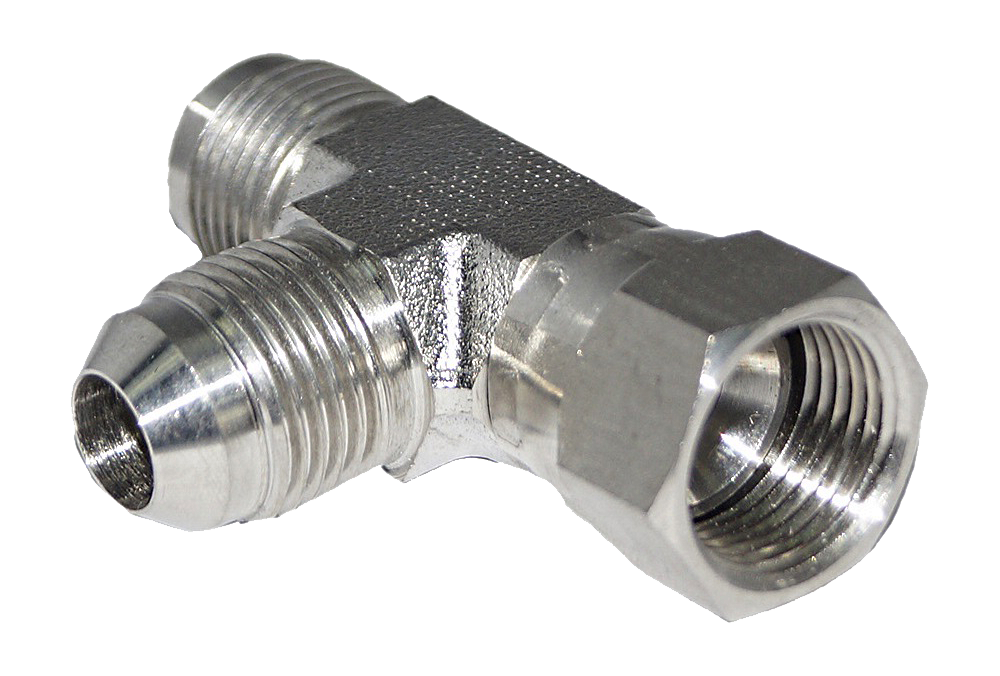
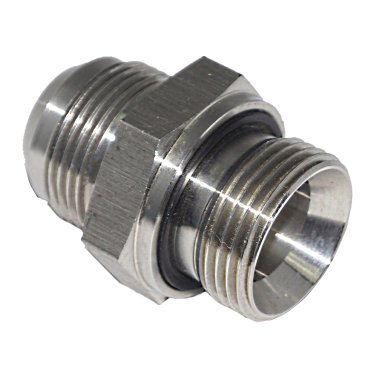
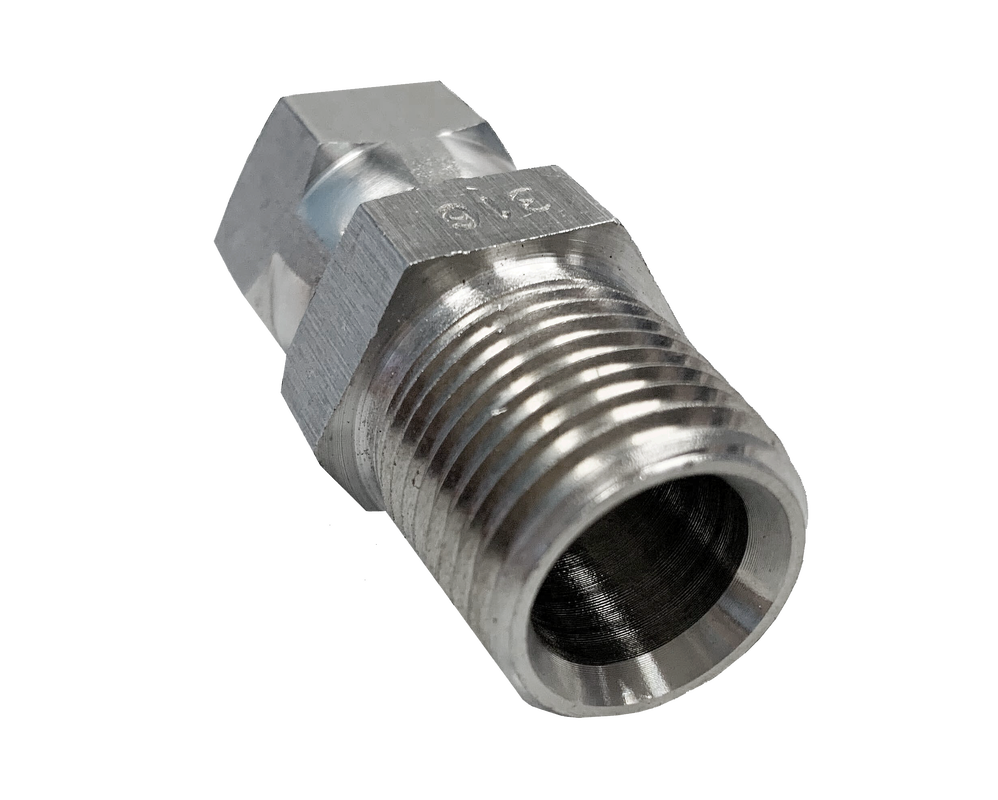
What the ends look like — and why the cone angle is the thing to check.
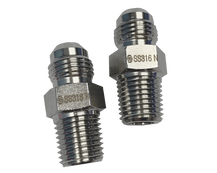
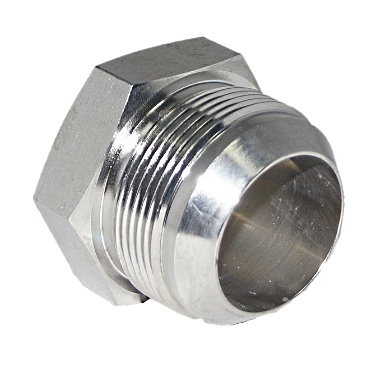
Buying JIC fittings in Malaysia and Singapore
Where the stock sits, and the four things we need to quote.
Stock, delivery and ordering
- Running sizes in SS316 and carbon steel are held in Johor Bahru and Singapore.
- On a stocked item, order to delivery can be under three working days.
- Sleeves and nuts sell separately. The sleeve is the part that changes between metric and inch tube, so it is the one worth keeping spares of.
- One price, delivered — transport, currency, duties and taxes are inside the quoted figure.
What we need from you
- Dash size, or the tube outside diameter — and say whether the tube is metric or inch.
- What is on the far end — JIC, BSPP or NPT, and male or female.
- Material — SS316, carbon steel or brass — and the fluid.
- Whether it lands on a hose — a hose assembly wants the body as an adapter, not the full set.
Dash sizes, and how to read them
The number is sixteenths of an inch. That is the whole trick.
The dash size is American shorthand that makes ordering quicker once you know it. It is the numerator of a fraction whose denominator is always 16. So a −08 is 8/16", which is 1/2". Once you have the dash, the UNF thread follows from it.
| Dash size | Tube OD | Nominal thread (UNF) |
|---|---|---|
| −02 | 1/8" | 5/16 − 24 |
| −03 | 3/16" | 3/8 − 24 |
| −04 | 1/4" | 7/16 − 20 |
| −05 | 5/16" | 1/2 − 20 |
| −06 | 3/8" | 9/16 − 18 |
| −08 | 1/2" | 3/4 − 16 |
| −10 | 5/8" | 7/8 − 14 |
| −12 | 3/4" | 1‑1/16 − 12 |
| −14 | 7/8" | 1‑3/16 − 12 |
| −16 | 1" | 1‑5/16 − 12 |
| −20 | 1‑1/4" | 1‑5/8 − 12 |
| −24 | 1‑1/2" | 1‑7/8 − 12 |
| −32 | 2" | 2‑1/2 − 12 |
- Metric sizes do not use dash numbers. Measure the thread with a pitch gauge — sit it on the thread until the fit is snug. M16 × 2.0 means a 16 mm thread outside diameter with 2.0 mm between threads.
- The dash jumps. There is no −07, −09 or −11 in the range, and it steps in fours above −16. If you have calculated a dash that is not in the table, re‑measure.
- The dash is the tube, not the thread. A −08 fitting takes 1/2" tube but has a 3/4‑16 UNF thread. Quoting the thread as the size is a common way to order the wrong part.
- 1/4" is not 6 mm. It is 6.35 mm. Inch and metric tube are not interchangeable even where the numbers look close, and the sleeve is what has to match.
JIC or NPT — and why it matters
Two thread choices that behave very differently.
JIC and NPT are the two options most systems come down to. JIC seals on a 37° cone, mating either a flared tube or a hose fitting. NPT seals on the tapered thread itself, which is why it needs sealant and why it does not enjoy being taken apart. Compared on the things that decide a job:
| Feature | 37° flare (JIC) | National Pipe Thread (NPT) |
|---|---|---|
| Working pressure | Very good | Good |
| Vibration resistance | Good | Poor |
| Ease of installation | Good | Good |
| Seal reliability | Good | Poor |
| Temperature | Excellent | Excellent |
| Reusability | Good | Poor |
- Vibration and reuse are where they part company. A tapered thread relies on thread interference, and both vibration and repeated make‑up degrade it. A cone seat does not care.
- You do not have to choose one for the whole system. We stock JIC × NPT and JIC × BSPP bodies, so the tube side can be JIC while the port side matches whatever is already there — without an extra adapter and an extra joint.
- Do not confuse 37° with 60°. The JIC tube end is 37°. Some port ends in the same range use a 60° cone with a soft seal. They look similar and will not seal against each other.
- And 37° is not 24°. A DIN 2353 port is a 24° cone. Forcing a JIC nut onto one damages both parts.
Material, surface protection and temperature
Two limits: the metal, and the seal if one is fitted.
Surface protection is not cosmetic here. Contamination is removed and a protective finish applied, because corrosion resistance at the cone is what keeps the joint sealing. Each material gets its own treatment and its own temperature band.
| Material | Surface protection | Temperature rating |
|---|---|---|
| Stainless steel SS316 | Passivation | −60 °C to +200 °C |
| Carbon steel | White zinc plating | −60 °C to +200 °C |
| Brass | Acid cleaning | −45 °C to +175 °C |
If a seal is fitted, the seal is the limit
The 37° joint itself is metal to metal and has no elastomer in it. But where a port end carries an O‑ring, that seal material caps the temperature a long way below the metal figure — and the lower of the two numbers wins. NBR is the default unless you ask for something else.
| Seal material | Temperature rating | Notes |
|---|---|---|
| NBR nitrile | −23 °C to +120 °C −9 °F to +248 °F | Supplied as standard |
| FKM (Viton®) | −20 °C to +180 °C −4 °F to +356 °F | Ask for it — higher temperature, better with many fluids |
Note that FKM is better hot but worse cold than NBR. See O‑rings for the full range. Tell us the fluid as well as the temperature — solvents rule out materials that temperature alone would allow.
Assembly, and the torque that goes with it
Four steps — and one failure mode you have to know about.
The four steps
- Check and prepare. Inspect the fitting surface and the sealing surface for contamination or damage. Cut the tube to length and flare the end to 37°.
- Lubricate. Hydraulic fluid on the threads and over the whole face of the flare.
- Assemble. Fit the nut and sleeve onto the tube, align the parts, and turn the flare nut by hand until the sealing surfaces are in full contact.
- Torque. Tighten to the figure in the table and confirm the joint is made up to the standard.
Over‑tightening is the failure mode
- Make the joint with no external load on it. The tube must reach the fitting without being pulled or sprung into place.
- Over‑torque deforms the 37° flare on the male end.
- Excessive deformation loses clamping force — and with it, the seal. The joint then leaks under pressure however hard you tighten it.
- So the over‑torque column is a limit, not a target. Work to the assembly figure.
| Tube OD metric | Tube OD inch | Assembly torque, steel & SS316 | Over‑torque limit |
|---|---|---|---|
| 6 mm | 1/4" | 15–16 Nm | 24 Nm |
| 8 mm | 5/16" | 19–21 Nm | 31 Nm |
| 10 mm | 3/8" | 24–28 Nm | 42 Nm |
| 12 mm | 1/2" | 49–53 Nm | 80 Nm |
| 16 mm | 5/8" | 77–85 Nm | 114 Nm |
| 20 mm | 3/4" | 107–119 Nm | 160 Nm |
| 25 mm | 1" | 147–154 Nm | 214 Nm |
| 32 mm | 1‑1/4" | 172–181 Nm | 271 Nm |
| 38 mm | 1‑1/2" | 215–226 Nm | 339 Nm |
| 50 mm | 2" | 332–350 Nm | 497 Nm |
Figures for steel and SS316. Brass is softer — ask us before applying these to a brass fitting. Note the metric and inch columns are paired by convention, not by exact equivalence: 12 mm and 1/2" are 12.0 and 12.7 mm.
Identifying a JIC fitting
Find the cone, then check what angle it is.
Nearly every mistake on this range comes from a cone that looks right and is not. Look at the seat before you measure the thread — and remember the range carries 37° on tube ends and 60° on some port ends.
- Count the parts. A complete JIC tube connection is body, sleeve and nut. A body on its own is a hose adapter, not an incomplete order.
- The sleeve is the metric/inch part. If you are converting a machine from inch to metric tube, you may need only new sleeves — the nuts and bodies carry over.
- Still unsure? Photograph the seat end‑on and put a caliper across the thread. Send us both and we will identify it.
Why buy JIC fittings from us
Stocked locally, and quoted by people who ask about both ends.
We ask what the far end is
Most JIC orders go wrong on the second connection, not the first. We confirm JIC, BSPP or NPT and male or female before the order goes in.
Stock on both sides of the causeway
Johor Bahru and Singapore, in SS316 and carbon steel — so a stocked size can be on site in under three working days.
Sleeves and nuts as spares
The sleeve is the consumable and the part that changes between metric and inch tube. We stock them separately.
Torque figures with the order
We send the assembly torque and the over‑torque limit for your size, because a crushed 37° flare is the commonest cause of a callback.
Hose ends too
JIC bodies for female swivel hose assemblies, alongside the tube fittings — from the same shelf and the same quote.
Landed pricing
One figure, delivered — transport, currency, duties and taxes already inside it.
Questions we get asked
The ones that come up on the phone.
What does JIC stand for?
Joint Industry Council — the body that originally standardised the design. The fittings themselves are made to SAE J514 and ISO 8434‑2. In the trade they are also called flared fittings, because the body is machined with a 37° flared seating surface and the tube is flared to match.
How do I work out my dash size?
The dash number is the numerator of a fraction over 16. A −08 is 8/16", so 1/2" tube. Take the tube outside diameter, express it in sixteenths, and that is your dash. Note the dash refers to the tube, not the thread — a −08 fitting has a 3/4‑16 UNF thread. The full table covers −02 to −32.
What is the difference between JIC and NPT?
Where the seal happens. JIC seals on a 37° cone — metal against metal, no sealant needed. NPT seals on the tapered thread itself, so it needs sealant and degrades when it is taken apart. On the things that matter, JIC is better on working pressure, vibration resistance, seal reliability and reusability; the two are equal on temperature and on ease of installation. Full comparison.
Is a 37° JIC the same as a 45° or 60° flare?
No, and this is the most expensive mistake on the range. JIC is 37°. A 60° cone also appears in this range on port ends, usually with a soft seal, and 45° flares exist in automotive work. They look similar to the eye and will not seal against each other — a mismatched pair either weeps immediately or damages the cone. If a joint will not seal and both halves look conical, check the angle first.
Can I use the same nut on metric and inch tube?
Yes. The nut and body are universal across both systems — only the sleeve changes to match the tube outside diameter. That is genuinely useful if you are converting a machine over: you may need only new sleeves. Do not stretch it, though: 1/4" is 6.35 mm, not 6 mm, and the sleeve has to match the tube it is on.
How tight should a JIC fitting be?
To the assembly torque for the size — for example 49–53 Nm on 1/2" and 147–154 Nm on 1" in steel or SS316. Hand tighten first until the sealing faces are in full contact, then torque. The over‑torque figure is a limit, not a target — going past it deforms the 37° flare, and a deformed flare loses clamping force and stops sealing. Full table.
Why is my JIC joint leaking?
Four likely causes, in order. Over‑tightened — the flare is deformed and has lost clamping force; no amount of extra torque fixes it. Wrong cone angle — a 60° port end against a 37° tube end. Damaged or dirty seat — a nick on the cone is a leak path. External load — the tube was sprung into place, so the faces are not parallel. Take it apart and look at the cone; it usually tells you which.
Do JIC fittings work with hose?
Yes — it is the standard hose connection. The JIC body without its sleeve and nut is used as a hose adapter, mating to the female swivel end of a hose assembly. The swivel is the point: you can tighten the joint fully without twisting the hose, which a fixed fitting would force you to do. Tell us it is going onto hose and we will quote the body rather than the full set.
What temperature can I run?
−60 °C to +200 °C in SS316 and carbon steel, and −45 °C to +175 °C in brass. The 37° joint is metal to metal so nothing in it perishes. But if a port end carries an O‑ring, that becomes the real limit — NBR stops at +120 °C and FKM at +180 °C, and the lower of the two figures is the one you have. NBR is supplied unless you ask otherwise.
Which material should I choose?
SS316 for corrosive, marine, washdown or high‑temperature duty — it is passivated, and it is what we stock most of. Carbon steel with white zinc plating for ordinary hydraulic work at lower cost. Brass for low pressure and compatible media, remembering its lower ceiling of +175 °C and that it is softer, so the torque figures need checking with us first.
What sizes do you stock?
1/4" to 1‑1/2" from stock, which covers −04 to −24. The dash tables run from −02 (1/8") to −32 (2") and the ends of that range are available to order. Both metric and inch tube are supported throughout — tell us which system your tube is in, because that decides the sleeve.
Do you deliver to Singapore, and what does delivery cost?
Yes. We hold stock in Johor Bahru and Singapore, and a stocked item can be delivered in under three working days. Our quote is a landed price — transport, currency, duties and taxes are already in the figure, so what you approve is what you pay.
Catalogue
Direct PDF download — no form, no email address.
 JIC fittings — every body style, dash size, thread and dimensionRFS Hydraulics · PDFPDF
 JIC fittings — the manufacturer catalogueHSME · PDFPDF
Related: compression fittings for a 24° tube port · ferrule fittings for instrumentation · pipe adapters where two thread forms must meet · forged pipe fittings for nominal bore pipe · O‑rings for port‑end seals · hydraulic steel tube to run with them.
Send the dash size and what is on the far end
That is enough for a landed price. SS316 and carbon steel in the running sizes are on the shelf in Johor Bahru and Singapore.