
Home › Products › High pressure valves › SAE flange check valves
MHA Zentgraf · ready stockSAE flange check valves to ISO 6162‑1 & ISO 6162‑2, 1/2" to 2"
A spring‑loaded non‑return valve that bolts between two SAE flange faces instead of screwing into a thread. MHA type RVZ‑SAE, DN15 to DN50, on the 210 bar (Code 61) or 420 bar (Code 62) pattern, in steel or SS316. It arrives as a valve, two O‑rings and two holding plates — and the part most people forget is the one that is not in the box.
Get a quotation within 2 working hours
Send the part number, standard, size or quantity. Stock in Malaysia or Singapore, ISO 9001:2015 certified.
What an SAE flange check valve is, and when you need one
The same one‑way valve, mounted the way a flange port wants it.
Inside, this is an ordinary spring‑loaded poppet check valve: free flow one way, and the poppet reseats to lock the load as soon as the flow stops. What is different is the outside. Instead of a male or female thread, both ends are SAE flange faces to ISO 6162, so the valve is clamped between two flange connections by four bolts a side with an O‑ring sealing each face. MHA calls it the RVZ‑SAE, and the standard opening pressure is 2 bar — noticeably higher than the 0.5 bar you get on a threaded check valve, because this one is normally there to hold a load rather than just to stop backflow.
Reach for it when the port is already a flange face — a pump, a manifold, a cylinder feed, a flanged pipe run — or when the line is big enough that making up a 2 inch thread in place is no longer sensible. The usual job is hydraulically locking a cylinder or an accumulator: flow passes to load it, the poppet shuts, and the load stays where it is until something else releases it. Where you want to choose when to open and shut, that is a SAE flange end ball valve, not a check valve.
| SAE flange check valve (this page) | SAE flange end ball valve | |
|---|---|---|
| What it does | Decides for itself — opens on flow, shuts on reversal | You decide — quarter turn, open or shut |
| Moving part | Spring and poppet, no external control | Ball and stem, with a lever on top |
| Size range | DN15–DN50, 1/2" to 2" | DN13–DN80, 1/2" to 3" |
| Flange patterns | ISO 6162‑1 and 6162‑2, every size | Pattern availability varies by body range |
| What is in the box | Valve + 2 O‑rings + 2 holding plates | Valve only — flanges, bolts and washers separate |
| Pressure drop | Always some — it is a spring‑loaded restriction | Effectively none when fully open |
| Fit it for | Load holding, backflow protection, keeping branches apart | Isolation for maintenance, directing flow |
Specification
Everything an enquiry needs, in one place.
| Type | RVZ‑SAE — check valve with SAE adapter, MHA Zentgraf |
| Function | Spring‑loaded poppet check valve (non‑return). Free flow one way, locks the load against reverse flow |
| Size range | DN15 to DN50, 1/2" to 2" |
| Flange standards | ISO 6162‑1 — 21 MPa / 3000 psi (SAE Code 61) · ISO 6162‑2 — 42 MPa / 6000 psi (SAE Code 62). Both patterns across the whole size range |
| Working pressure | 210 bar on the SAE210 build, 420 bar on the SAE420 build |
| Cracking pressure | 0.2 MPa = 2 bar standard. Other opening pressures on request. Tolerance on the spring is about ±30 percent |
| Scope of delivery | Check valve + 2 O‑rings + 2 holding plates. The adapter plate must be ordered separately |
| Seal configuration | Four standard builds — no seals, inlet side sealed, outlet side sealed, or both sides sealed. Threaded holes on request. See how it goes together |
| Body material | Steel (code 28p8) or stainless SS316 (code 44p8) |
| Poppet | Steel, or stainless steel to match the body |
| Seat | Polyurethane |
| O‑rings | FPM (Viton) |
| Temperature | −20 °C to +100 °C |
| Flow direction | B to A, with an arrow on the body. See fitting it |
| Options | Orifice drilled through the poppet for a controlled back flow; other cracking pressures; threaded holes |
| Testing | Batch tested to DIN EN 12266‑1, methods P10, P11 and P12. Test report with heat numbers on request |
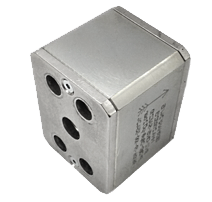
Buying SAE flange check valves in Malaysia and Singapore
Where the stock sits, what it costs to get it to you, and how fast it moves.
Stock, delivery and ordering
- Where the stock is — the office is in Kuala Lumpur, and valves are held in two warehouses: Johor Bahru and Singapore. Addresses and direct lines are on the contact page.
- Dispatch — stock items leave the same or next working day.
- The running sizes are the smaller bores, DN15 to DN25. The larger bodies and the stainless builds are usually brought in, so those come back with a lead time on the quote rather than a shelf figure.
- Delivery cost — already inside the product price, along with transport, currency conversion, duties and taxes. Nothing is added afterwards.
Order the adapter plate at the same time. It is a separate part number and it is the single commonest thing left off a first order — see what it is for.
How a check valve enquiry runs
Five things and we can price it without going back and forth:
- Bore — DN15 to DN50, or the inch size.
- Flange pattern — ISO 6162‑1 or ‑2. The one people leave out, and the one that decides whether it bolts on.
- Which faces are sealed — none, inlet, outlet or both. It depends on what you are bolting it to.
- Cracking pressure — the standard 2 bar, or a figure you specify.
- Material — steel or SS316, decided by the medium and the environment.
A product specialist prices it within two working hours. Replacing an existing valve? Send a photo of the body marking — the type, the pressure, the material code and the opening pressure are all stamped on the flat.
210 or 420? The flange class decides more than the pressure
Same valve, same bore, two different bolt patterns. They do not interchange.
Every size in the range is made in both classes. SAE210 is built to ISO 6162‑1 — 21 MPa, 3000 psi, what most people call SAE Code 61. SAE420 is built to ISO 6162‑2 — 42 MPa, 6000 psi, Code 62. The two share a nominal size but not a bolt spacing: at DN15 the bolt centres are 17.5 × 38.1 mm on the 210 and 18.2 × 40.5 mm on the 420. So a 420 valve will not bolt to a 210 port, and the higher class is physically bigger and heavier as well as stronger.
| RVZ‑SAE210 | RVZ‑SAE420 | |
|---|---|---|
| Flange standard | ISO 6162‑1 | ISO 6162‑2 |
| Also called | SAE Code 61, 3000 psi | SAE Code 62, 6000 psi |
| Rating | 21 MPa — 210 bar | 42 MPa — 420 bar |
| Bolt centres at DN15 | 17.5 × 38.1 mm | 18.2 × 40.5 mm |
| Bolt hole at DN50 | 13 mm | 22 mm |
| Body across flats at DN50 | 100 mm | 115 mm |
| Bore (LW) | Identical — the flow path does not change with the class | |
| Cracking pressure | 2 bar standard on both | |
- Check what you are bolting to, not what the pump is rated at. MHA prints the warning on its own sheet: “Please note the pressure ratings of the connection flanges!” A 420 bar valve bolted to 210 bar flanges is a 210 bar joint.
- Measure the bolt centres if you are matching an existing port. A rule across the bolt holes settles it in seconds; the nominal size on its own does not.
Dimensions, bolt pattern and order numbers
Both classes, size by size. The bolt centres are the figures worth checking twice.
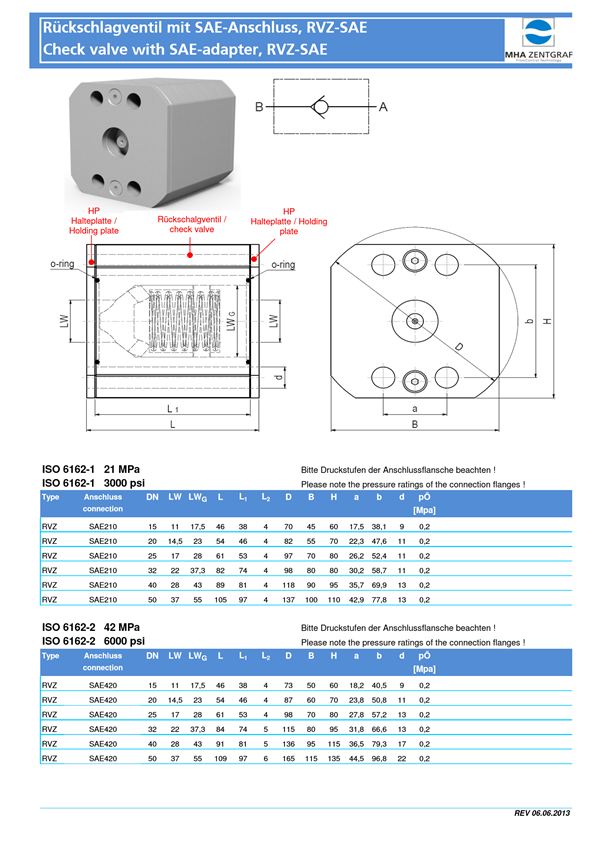
LW is the bore through the valve, L the overall length across both holding plates, B the body width and H the height. a × b are the bolt centres and d the bolt hole diameter — those four numbers decide whether it bolts to your port. All dimensions in millimetres.
| ISO 6162‑1 — 21 MPa / 3000 psi (SAE210) | ||||||||
|---|---|---|---|---|---|---|---|---|
| DN | Inch | Bore LW | Length L | Width B | Height H | Bolt centres a × b | Hole d | MHA order no. |
| DN15 | 1/2" | 11 | 46 | 45 | 60 | 17.5 × 38.1 | 9 | 55424 |
| DN20 | 3/4" | 14.5 | 54 | 55 | 70 | 22.3 × 47.6 | 11 | 55425 |
| DN25 | 1" | 17 | 61 | 70 | 80 | 26.2 × 52.4 | 11 | 55394 |
| DN32 | 1¼" | 22 | 82 | 80 | 80 | 30.2 × 58.7 | 11 | 55395 |
| DN40 | 1½" | 28 | 89 | 90 | 95 | 35.7 × 69.9 | 13 | 54350 |
| DN50 | 2" | 37 | 105 | 100 | 110 | 42.9 × 77.8 | 13 | 55426 |
| ISO 6162‑2 — 42 MPa / 6000 psi (SAE420) | ||||||||
|---|---|---|---|---|---|---|---|---|
| DN | Inch | Bore LW | Length L | Width B | Height H | Bolt centres a × b | Hole d | MHA order no. |
| DN15 | 1/2" | 11 | 46 | 50 | 60 | 18.2 × 40.5 | 9 | 55732 |
| DN20 | 3/4" | 14.5 | 54 | 60 | 70 | 23.8 × 50.8 | 11 | 55731 |
| DN25 | 1" | 17 | 61 | 70 | 80 | 27.8 × 57.2 | 13 | 55721 |
| DN32 | 1¼" | 22 | 84 | 80 | 95 | 31.8 × 66.6 | 13 | 55716 |
| DN40 | 1½" | 28 | 91 | 95 | 115 | 36.5 × 79.3 | 17 | 55022 |
| DN50 | 2" | 37 | 109 | 115 | 135 | 44.5 × 96.8 | 22 | 55726 |
MHA Zentgraf RVZ‑SAE sheet, revision 06.06.2013. The bore is the same in both classes, so going from 210 to 420 buys you pressure, not flow. Indicative unit weights from our own listing: DN15 1.10 kg · DN20 1.50 · DN25 2.30 · DN32 3.45 · DN40 4.85 · DN50 7.80 kg — ask if an exact figure matters for freight, since MHA leaves the weight column open on the sheet.
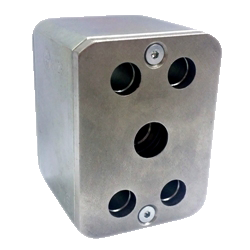
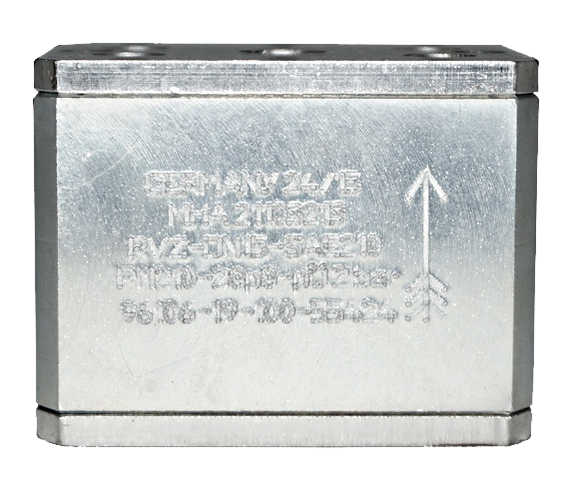
PN210 · 28p8 · pÖ 2 bar — next to the flow arrow. The top face shows the four bolt holes and the two plate screws.What is in the box, and which faces are sealed
Three parts arrive. A fourth may be needed, and it is not one of them.
MHA supplies the RVZ‑SAE as one check valve, two O‑rings and two holding plates — the plates clamp the valve into the joint and the O‑rings seal the faces. What is not included is the adapter plate, and neither are the flange halves, bolts and washers on the mating side. Where an SAE joint needs an O‑ring‑side flange, that is a separate part in exactly the way it is for a plain SAE flange.
| Build option | What it means | Use it when |
|---|---|---|
| Option A | Without seals | Both mating parts already carry their own O‑ring grooves |
| Option B | Inlet side sealed | The upstream part has a flat face and no groove |
| Option C | Outlet side sealed | The downstream part has a flat face and no groove |
| Option D | Both sides sealed | The usual choice when the valve goes between two flat faces |
| Option E | With threaded holes (on request) | You need to bolt into the valve body rather than through it |
- Decide this before you order, not on site. Which faces carry the seal depends on what the valve is bolting to, and it is set at build.
- A controlled leak‑back is an option, not a fault. An orifice drilled through the poppet gives a deliberate restricted reverse flow — useful for bleeding a locked cylinder down in a controlled way. Specify it with the order; it cannot be added later.
- Three ways to mount it. MHA shows the valve in line with a holding plate each side, or with a plate on the outlet side only, or on the inlet side only — so it can sit hard against a manifold face where there is no room for a plate on both sides.
The adapter plate, and why you probably want one
A separate part number that saves you dismantling the valve to service something else.
The adapter plate is a steel spacer with a flange face on each side. It lets you stack the check valve against another flanged component — MHA’s own example is a KHZ ball valve — and, more usefully, it means that component can be taken off for maintenance without removing the RVZ. On a manifold where the check valve is buried behind an isolator, that is the difference between a ten‑minute job and draining a circuit.
| DN | Inch | Thickness L | Class | MHA order no. |
|---|---|---|---|---|
| DN15 | 1/2" | On request | — | |
| DN20 | 3/4" | 29 | 21 MPa | 55443 |
| DN25 | 1" | 29 | 21 MPa | 55444 |
| DN32 | 1¼" | 33 | 21 MPa | 55445 |
| DN40 | 1½" | 33 | 21 MPa | 55446 |
| DN50 | 2" | 33 | 21 MPa | 55447 |
Steel body. Thickness in mm. The plates listed on MHA’s sheet are the ISO 6162‑1 (21 MPa) set, and DN15 is quoted on request rather than as a stock reference. For a 420 bar stack, ask and we will confirm availability with the factory before you commit to the layout.
Steel or SS316 — and what the code means
MHA describes the whole build in one code. Two of them cover this valve.
The material code on an MHA valve is not just the body: it covers the body, the moving part, the seat and the seals as a set. On the RVZ‑SAE there are two, and the difference between them is the body and poppet metal — the seat and the O‑rings are the same in both, which is why the temperature range does not change with material.
Code 28p8 | Code 44p8 | |
|---|---|---|
| Body | Steel | Stainless steel SS316 |
| Poppet | Steel | Stainless steel |
| Seat | Polyurethane | Polyurethane |
| O‑rings | FPM (Viton) | FPM (Viton) |
| Temperature | −20 to +100 °C | −20 to +100 °C |
| Cracking pressure | 2 bar standard | 2 bar standard |
| Typical duty | Machine hydraulics, mills, mining, power packs | Marine, offshore, shipyard, washdown |
- Viton as standard is worth knowing. The O‑rings are FPM rather than nitrile in both codes, which is why this valve suits hot oil and a wider fluid range than a nitrile‑sealed part would.
- A polyurethane seat is a soft seat. It gives a better shut‑off than a metal‑to‑metal poppet, and it is the reason this valve is used for load holding rather than just backflow protection.
- No pressure penalty for stainless here. Unlike the threaded RV, where the stainless body is capped lower than the steel, the RVZ‑SAE is limited by its flange class — so 210 is 210 and 420 is 420 in either material.
Fitting it
The bolt pattern stops you fitting the wrong valve. Nothing stops you fitting it backwards.
Before it goes in
- Check the class against the port — bolt centres, hole size, and the rating of the flange you are bolting to. The joint is only as strong as the weaker half.
- Look through the bore for swarf and packing debris, and push the poppet off its seat to confirm it moves freely and snaps back.
- Check the O‑rings are the ones you need — and that they are seated in the right faces for the build option you ordered.
- Clean both faces. An SAE flange joint seals on the O‑ring against a flat face; a scratch across the groove will weep however hard you pull the bolts.
Direction, bolts and orientation
- Flow is B to A. The body carries a large arrow pointing the way flow is allowed to pass — from your pressure source through to the load.
- Backwards means blocked. There is no partial credit: fitted the wrong way round the valve holds against the flow you wanted and passes nothing.
- Pull the bolts down evenly, in a cross pattern, to the flange maker’s torque for that size and class — not to the valve, which is not the sealing element.
- Vertical or horizontal both work. The spring does not rely on gravity, so orientation is about access rather than function.
- Support the pipework so the valve is not carrying pipe weight into the flange faces.
Testing and traceability
Batch tested at the works, to a named standard, with the heat numbers recorded.
MHA Zentgraf batch tests its valves before they ship, to DIN EN 12266‑1 — the European standard for the testing of industrial valves. Three test methods from that standard apply, and each valve batch is recorded against them.
| Method | What it proves |
|---|---|
| P10 | Strength of the body — a hydrostatic shell test at 1.5 times the rated pressure. This is the test that says the casting and the machining will hold. |
| P11 | Tightness of the body — a leak test on the shell and the joints, with air at up to 0.6 MPa or at 1.5 times the rated pressure. |
| P12 | Tightness of the seat — a leak test across the closed poppet, at 1.1 times the rated pressure or with air at 0.6 MPa. This is the one that says it actually holds a load. |
- Heat numbers appear in the report. The test record identifies the material heats behind the batch, so a valve in your hand can be tied back to the paperwork that covers it.
- Ask for the report with the order. Project‑specific testing and documentation is available on request — but raise it before the order ships, while the batch is still identifiable.
- Cracking pressure has a tolerance. Springs and machining being what they are, the opening pressure can sit roughly 30 percent either side of nominal. If your circuit needs it tighter than that, say so and we will check what the factory can hold.
How to identify an RVZ‑SAE you already have
The body tells you everything except the seal option.
MHA stamps the flat of the body with the whole specification, in a fixed order. A DN20 420‑series valve reads something like:
| Line on the body | What it is |
|---|---|
GERMANY 25/15 | Country of manufacture and the week and year it was made |
MHA 2103213 | The maker, and the drawing or article reference |
RVZ‑DN20‑SAE420 | Type, bore and flange class — the three things you need to reorder |
PN420‑28p8‑pÖ 2 bar | Rating, material code and cracking pressure in one line |
96107‑19‑100‑55731 | Works order, ending in the MHA order number — and 55731 is exactly the catalogue reference for a DN20 at 42 MPa |
That last line is the useful one: it means a photograph of the marking is enough to reorder the identical valve, because the order number is on the part. The one thing the marking does not tell you is which faces were built sealed — for that, look at whether there is an O‑ring groove in each face.
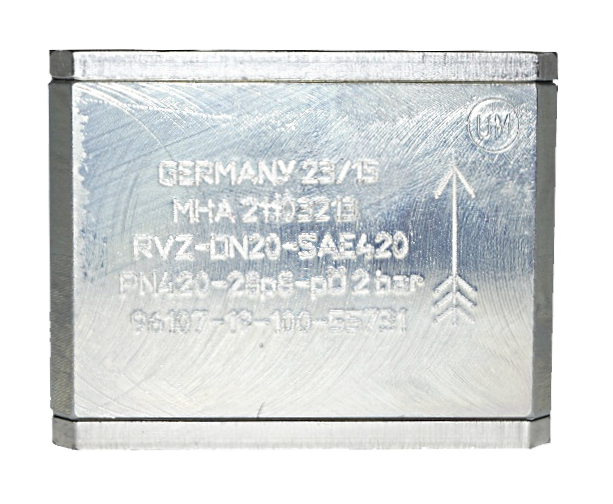
PN420 · 28p8 · pÖ 2 bar gives the rating, the material set and the opening pressure, and the works order ends 55731 — MHA’s own catalogue number for this valve. Nothing needs measuring.Why buy SAE flange check valves from RFS Hydraulics
Six things that decide whether a valve order goes smoothly.
Ready stock on the running sizes
The smaller bores, DN15 to DN25, are held in Johor Bahru and Singapore and dispatch the same or next working day. Larger bodies and stainless builds come back with a lead time on the quote rather than a guess.
We check the class before quoting
ISO 6162‑1 against 6162‑2 is what decides whether the valve bolts on, and the bolt centres differ by only a few millimetres. We confirm it against your port — a photo with a rule across the bolt holes is enough.
We tell you about the adapter plate
It is a separate part number and the commonest omission on a first order. If your layout needs one, it goes on the quote rather than turning up as a surprise when the valve arrives.
German‑made, marked, batch tested
MHA Zentgraf, with the type, class, material code and opening pressure stamped on the body, batch tested to DIN EN 12266‑1. Test reports with heat numbers on request.
The seal option is part of the conversation
Sealed on neither face, one face or both is a build decision, not something to discover on site. We ask what the valve is bolting to before the order goes in.
One price, delivered
Transport, currency, duties and taxes are already inside the figure we quote. Nothing is added at the end, and delivery within Malaysia is included.
Frequently asked questions
Fourteen, starting with the one that decides whether the valve bolts on.
What is the difference between ISO 6162‑1 and ISO 6162‑2?
They are the two SAE flange patterns. ISO 6162-1 is the 21 MPa (3000 psi) interface, known as SAE Code 61, and ISO 6162-2 the 42 MPa (6000 psi) one, Code 62. They share a nominal size but not a bolt spacing: at DN15 the centres are 17.5 by 38.1 mm on the 210 series and 18.2 by 40.5 mm on the 420. So the two do not interchange, and the 420 valve is physically larger and heavier at the same bore. Every size of the RVZ-SAE is made in both classes.
What comes with the valve?
One check valve, two O-rings and two holding plates. That is MHA's stated scope of delivery. The adapter plate is not included and has to be ordered separately, and neither are the flange halves, bolts and washers on the mating side. The commonest short order on this product is the adapter plate, so if your layout needs one it is worth putting on the same purchase order.
What is the adapter plate actually for?
It is a flanged steel spacer that lets you stack the check valve against another flanged component — MHA's own example is a KHZ ball valve. The real benefit is maintenance: with the adapter plate in the stack you can remove the other component without taking the check valve out. Plates are listed for DN20 to DN50 in the 21 MPa class, 29 or 33 mm thick, and DN15 is on request.
Which way round does it go?
Flow is B to A and there is a large arrow on the body pointing the direction flow is allowed to pass — from your pressure source towards the load. Fitted the wrong way round it blocks the line rather than protecting it. The bolt pattern will stop you fitting the wrong class of valve, but nothing stops you fitting the right one backwards, so check the arrow before the bolts go in. Vertical and horizontal both work.
What is the cracking pressure, and can I change it?
Standard is 0.2 MPa, which is 2 bar, on every size and in both classes. Other opening pressures are available to order, but not adjustable afterwards — it is a spring inside a closed body. Note also that spring and machining tolerances mean the actual figure can sit roughly 30 percent either side of nominal, so if your circuit needs it held tighter than that, say so at enquiry.
Why is the cracking pressure 2 bar here when a threaded check valve is 0.5 bar?
Because they are usually doing different jobs. A threaded RV is often just stopping backflow, so the lightest spring that reliably reseats is best — every extra bar of cracking pressure is permanent pressure drop. The flange-mounted RVZ is more often holding a load on a cylinder or an accumulator, where a firmer spring gives a more definite reseat. If the 2 bar is costing you too much drop, ask about a lighter spring.
Do I need seals on one face or both?
It depends on what the valve is bolting to. MHA builds four versions: Option A without seals, Option B with the inlet side sealed, Option C with the outlet side sealed, and Option D with both sides sealed. Where both mating parts already have their own O-ring grooves you want A; where the valve sits between two flat faces you want D. There is also Option E with threaded holes, on request. It is a build choice, so it belongs in the enquiry.
Can I get a controlled reverse flow rather than a full block?
Yes — an orifice can be drilled through the poppet, which gives a deliberate restricted back flow instead of a hard shut. It is used where a locked cylinder has to bleed down in a controlled way rather than staying locked. It has to be specified with the order, since it means machining the poppet, and it cannot be added on site.
Does the stainless version have a lower pressure rating?
No. Unlike the threaded RV — where the stainless body is capped at 350 bar against 500 for the steel — the RVZ-SAE is limited by its flange class rather than the body metal, so 210 is 210 bar and 420 is 420 bar in either material. Code 28p8 is the steel build and 44p8 the SS316 one; the seat, the O-rings and the temperature range are the same in both.
What is the valve made of?
Body and poppet in steel or stainless SS316, a polyurethane seat and FPM (Viton) O-rings as standard, rated minus 20 to plus 100 degrees C. The Viton is worth noting — it gives a wider fluid and temperature range than a nitrile-sealed valve. The polyurethane seat is a soft seat, which is why this valve holds a load better than a metal-to-metal poppet does.
Does going from 210 to 420 give me more flow?
No. The bore is identical in both classes — 11 mm at DN15 rising to 37 mm at DN50 — so moving up a class buys pressure capability and a larger, heavier body, not flow. If you need more flow, go up a bore size. If you need more pressure at the same flow, go up a class.
How do I identify the one already in my machine?
Read the flat of the body. It carries the country and date, the maker's reference, then RVZ-DN20-SAE420 style type, bore and class, then a line giving the rating, material code and cracking pressure, and finally a works order number that ends in MHA's own catalogue order number. A photograph of that marking is enough for us to quote the identical valve. What the marking does not show is which faces were built sealed — check the faces for O-ring grooves.
Is it tested, and can I have the paperwork?
MHA batch tests to DIN EN 12266-1 using methods P10, P11 and P12 — body strength at 1.5 times rated pressure, body tightness, and seat tightness across the closed poppet. The heat numbers appear in the test report, so a valve can be tied back to its paperwork. Project-specific testing and documentation is available on request; ask with the order rather than afterwards.
Can it be repaired if it starts passing?
Usually it does not need to be. The commonest cause of a check valve passing is debris trapped on the seat, so the first move is to flush the line and inspect rather than to condemn the valve. Beyond that there is no service kit for these bodies and replacement is the practical answer — but a damaged O-ring or a scored flange face is a separate and much cheaper problem, so check those first.
Catalogues
Direct PDF download — no form, no email address.
Related: threaded high pressure check valves for threaded ports · SAE flange end ball valves for isolation · SAE flanges for the mating halves.
Send the bore, the flange class, the seal option and the cracking pressure.
Or a photo of the body marking — the order number is stamped on the part. A product specialist confirms it within two working hours.