
Home › Products › Accessories › Stauff tube cleaning systems
STAUFF Clean · ready stockSTAUFF tube cleaning systems — pneumatic launcher, nozzles and foam projectiles
A foam projectile fired down the bore by compressed air. Sized about 15% larger than the inside diameter, it is compressed against the wall as it travels and pushes the loose contamination out of the far end. Hose, tube or pipe, 1/4" to 2" (6 to 50 mm), with or without end fittings — on ordinary shop air.
Get a quotation within 2 working hours
Send the part number, standard, size or quantity. Stock in Malaysia or Singapore, ISO 9001:2015 certified.
What the system is, and what it actually removes
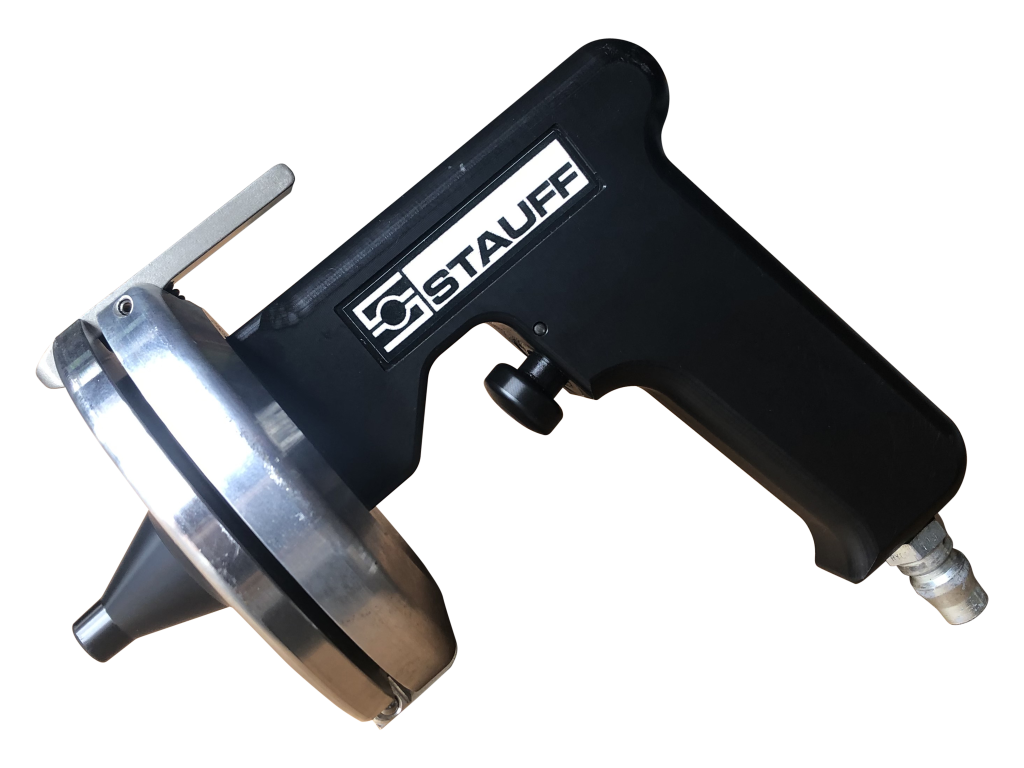
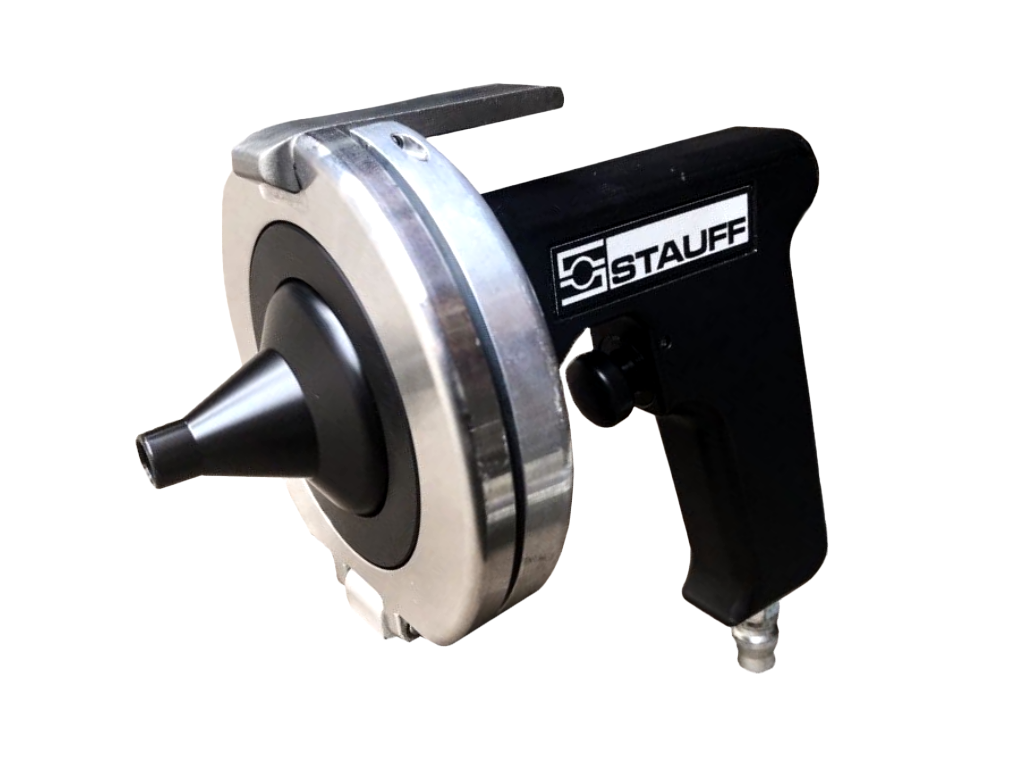
Three parts: a launcher, a nozzle that seals, and a projectile sized to the bore.
A tube, pipe or hose picks up debris in service — scale off the wall, swarf left from fabrication, dirt carried in the fluid. Left there it moves when the system starts and ends up in a pump, a valve or a filter. The STAUFF Clean system removes it mechanically: a pneumatic launcher uses compressed air to drive a foam projectile through a nozzle and into the line.
The nozzle is the part that makes it work. Each one is shaped to form an airtight seal against a specific hose, tube or pipe end — with or without end fittings, so the air goes down the bore instead of past it. The projectile is deliberately about 15% larger than the internal diameter: it is squeezed as it enters, and that compression against the wall is what wipes the surface and carries the loose material out of the far end.
What it is for
- New fabrication — getting cutting swarf and scale out of a tube run before it is ever pressurised.
- Hose assemblies — clearing a crimped assembly before it goes on the machine.
- Maintenance — clearing lines during a strip‑down rather than flushing dirt into the new oil.
- Light rust and scale in metal tube and pipe, with the abrasive or grinding series.
What it is not
- Not a substitute for flushing. It removes loose contamination. It does not replace a proper flush for varnish or fine particulate held in suspension.
- Not for a blocked line. A projectile needs a path; a solid blockage stops it.
- Not a pressure test. Cleaning a line says nothing about whether it will hold.
For sampling the oil after the job, see test couplings.
Specification
Everything an enquiry needs, in one place.
| System | STAUFF Clean — pneumatic launcher, nozzles and foam projectiles |
| Method | Compressed air propels a foam projectile through the nozzle and along the bore; compression against the wall expels loose contaminants from the far end |
| Line diameter | 1/4" to 2" · 6 mm to 50 mm |
| Operating air pressure | Works effectively between 85 psi (6 bar) and 120 psi (8 bar) |
| Air compressor requirement | 87 to 145 psi · 6 to 10 bar |
| Effective air volume | 66 to 106 GPM · 250 to 400 litre/min |
| Projectile sizing rule | Approximately 15% larger than the internal diameter of the hose, tube or pipe |
| Projectile series | (S) standard · (C) coupling · (A) abrasive · (G) grinding |
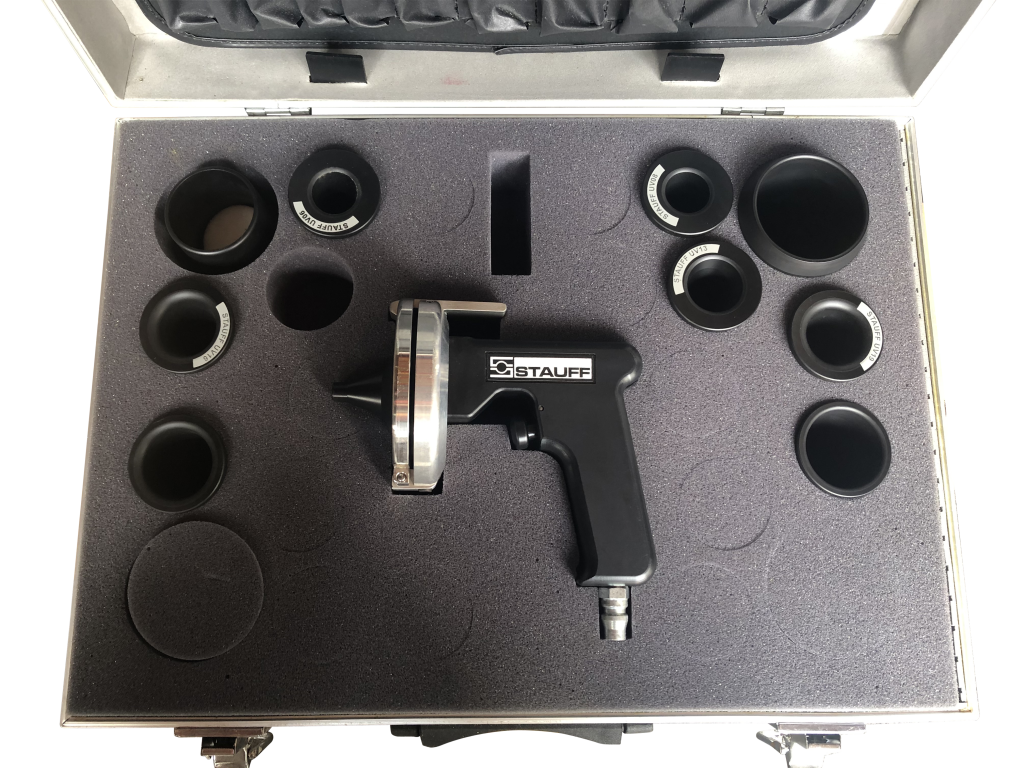
| Launcher kits | SC‑10UV‑K — launcher complete with a set of 10 universal nozzles · SC‑LK1 — launcher only |
| Nozzle kit sets | SC‑10UV‑S universal · SC‑18MT‑S metric tube · SC‑10J‑S JIC · SC‑7B‑S NPT |
| Nozzle fitment | Seals on hose, tube or pipe with or without end fittings — the nozzle is chosen to match the end you have |
| Typical duty | New fabrication, hose assembly cleaning, maintenance strip‑downs, light rust and scale removal |
| Brand | STAUFF |
Note the two air figures: 85 to 120 psi is the range the system works properly across, while 87 to 145 psi is the compressor specification. If your shop air sits at the bottom of that band, the projectile will still travel — it just will not clean as hard.
Buying tube cleaning systems in Malaysia and Singapore
Where the stock sits, and how a first order usually runs.
Stock, delivery and ordering
- The SC‑10UV‑K launcher kit — launcher plus ten universal nozzles — is the usual first purchase and the one we hold.
- Projectiles are consumables, ordered by series and size. Buy them by the box for the sizes you actually run.
- Stock sits in Johor Bahru and Singapore; on a stocked item, order to delivery can be under three working days.
- One price, delivered — transport, currency, duties and taxes are inside the quoted figure.
How a first order usually runs
- Tell us the bore sizes you work on and whether the ends have fittings crimped on.
- We pick the nozzle set — universal, metric tube, JIC or NPT.
- We list the projectile series and sizes against your bores.
- Add the abrasive or grinding series only if you are cleaning metal with rust in it.
The four projectile series
The letter in the part number is the series, and it is the choice that matters most.
| Series | What it is for | How to recognise it |
|---|---|---|
| (S) Standard SC‑S‑07 to SC‑S‑60 | Cleaning hose, tube or pipe without end fittings or restrictions | Plain foam, uniform through its length |
| (C) Coupling SC‑C‑07 to SC‑C‑60 | Hose assemblies — hose with end fittings already on — or removing loose particles from tube or pipe | Foam shaped to pass an end fitting. These are the standard stock items |
| (A) Abrasive SC‑A‑07 to SC‑A‑60 | Metal tube and pipe, to take off light rust and scale | An abrasive pad fixed to one end of the projectile |
| (G) Grinding SC‑G‑07 to SC‑G‑60 | Metal tube and pipe, for heavier rust and build‑up on the internal surface | Coated in carborundum for its full length — not just one end |
- Abrasive and grinding are for metal only. Neither belongs inside a rubber hose.
- The difference between A and G is coverage, not just grit. Abrasive works with a pad on one end; grinding is coated along the whole body, so it cuts continuously as it travels. If light rust is not shifting, that is the step up.
- Coupling series is the one to keep on the shelf if you make up hose assemblies — it is the series designed to get past a crimped fitting.
Choosing the nozzle and the projectile
Nozzle on the end you have; projectile on the bore, plus about 15%.
Hose and tube
| Hose / tube inch ID | Metric OD | Universal nozzle | Projectile — no end fittings | Projectile — with end fittings |
|---|---|---|---|---|
| 1/4" | 6 mm | UV06 | TCS07 to TCS10 | TCC07 to TCC09 |
| 5/16" | 8 mm | UV08 | TCS10 to TCS12 | TCC10 to TCC12 |
| 3/8" | 10 mm | UV10 | TCS12 to TCS14 | TCC12 to TCC14 |
| 1/2" | 13 mm | UV13 | TCS16 to TCS18 | TCC14 to TCC16 |
| 5/8" | 16 mm | UV16 | TCS18 to TCS22 | TCC18 to TCC20 |
| 3/4" | 19 mm | UV19 | TCS22 to TCS24 | TCC20 to TCC22 |
| 1" | 25 mm | UV25 | TCS30 to TCS33 | TCC30 to TCC33 |
| 1 1/4" | 32 mm | UV32 | TCS36 to TCS40 | TCC36 to TCC40 |
| 1 1/2" | 38 mm | UV38 | TCS45 to TCS50 | TCC40 to TCC50 |
| 2" | 50 mm | UV50 | TCS55 to TCS60 | TCC55 to TCC60 |
Metallic pipe
| Nominal bore | Inch OD | Metric OD | Universal nozzle | SCH40, no fittings | SCH80, no fittings |
|---|---|---|---|---|---|
| 1/4" | 0.540" | 13.7 mm | UV06 | TCS12 to TCS14 | TCS09 to TCS10 |
| 3/8" | 0.675" | 17.1 mm | UV10 | TCS14 to TCS16 | TCS12 to TCS14 |
| 1/2" | 0.840" | 21.3 mm | UV13 | TCS18 to TCS22 | TCS16 to TCS20 |
| 3/4" | 1.050" | 26.7 mm | UV19 | TCS26 to TCS30 | TCS22 to TCS26 |
| 1" | 1.315" | 33.4 mm | UV25 | TCS33 to TCS36 | TCS24 to TCS30 |
| 1 1/4" | 1.660" | 42.2 mm | UV32 | TCS40 to TCS45 | TCS36 to TCS40 |
| 1 1/2" | 1.900" | 48.3 mm | UV38 | TCS50 | TCS45 to TCS50 |
| 2" | 2.375" | 60.3 mm | UV50 | TCS60 | TCS60 |
- Read the pipe chart on bore, not on OD. A 1/2" pipe is 21.3 mm outside — the nozzle is chosen for the end, the projectile for the bore, and on SCH80 the bore is smaller so the projectile is smaller too.
- The two projectile columns are not interchangeable. A projectile sized for a bare tube end will not pass a crimped fitting.
- These are starting points. Where a size straddles two projectiles, the larger cleans harder and the smaller travels more easily. On a long run, start smaller.
Launcher and nozzle kits
One launcher, then the nozzle set that matches your ends.
| Part | What it is | Sizes in the set |
|---|---|---|
| SC‑10UV‑K | Launcher kit, complete — the pneumatic gun with a set of ten universal nozzles | 6, 8, 10, 13, 16, 19, 25, 32, 38, 50 mm |
| SC‑LK1 | Launcher only — for a second gun, or where nozzles are already held | — |
| SC‑10UV‑S | Universal nozzle set | 6, 8, 10, 13, 16, 19, 25, 32, 38, 50 mm |
| SC‑18MT‑S | Metric tube nozzle set | 6, 8, 10, 12, 14, 15, 16, 18, 20, 22, 25, 28, 30, 35, 38, 42, 50, 60 mm |
| SC‑10J‑S | JIC nozzle set | 6, 8, 10, 13, 16, 19, 25, 32, 38, 50 mm |
| SC‑7B‑S | NPT nozzle set | 1/4", 3/8", 1/2", 5/8", 3/4", 1", 1 1/4" |
- Start with SC‑10UV‑K. The universal nozzles cover the common bores and the kit gets you working the day it lands.
- Add a set when your ends are consistent. A shop that only makes up JIC assemblies is better served by the JIC set than by universals — the seal is better and so is the clean.
- The metric tube set is the widest, running up to 60 mm, which is beyond the 50 mm line size the system is specified for — useful on pipe, where 2" NB measures 60.3 mm outside.
Why a projectile, rather than chemicals or heat
There are three ways to clean the inside of a line, and they suit different problems.
Mechanical
Something physically wipes the wall and carries the debris out. That is what this system does. Fast, needs no consumable but the projectile, and leaves nothing behind — but it only reaches where the projectile passes, so a branch or a dead leg is not cleaned.
Chemical
A cleaning fluid is circulated to flush the system out. It reaches everywhere the fluid reaches, including corners a projectile never sees — but it needs a lot of chemical, and then it needs disposing of, and any residue left in the line becomes tomorrow’s contamination.
Thermal
Heat is used to dry the deposits so they can be washed out. Used where no chemical or foreign body may touch the bore — medical and food production — rather than in general hydraulics.
In practice
On a hydraulic build, mechanical cleaning before assembly and a proper flush afterwards are complementary, not alternatives. The projectile gets the loose material out so the flush is not just moving it around.
Why buy Stauff tube cleaning systems from RFS Hydraulics
Six things that decide whether the kit gets used or sits in a cupboard.
We size the projectiles for you
Send the bores you work on and whether the ends are fitted. We come back with the series and size list, not a chart to interpret.
We ask about the ends first
The single commonest mistake is a projectile that cannot pass a crimped fitting. Coupling series for hose assemblies — we will ask before quoting.
Consumables held locally
Projectiles in Johor Bahru and Singapore. A cleaning kit with no projectiles left is a paperweight, so we keep the running sizes on the shelf.
We check your air
The system wants 85 to 120 psi and 250 to 400 l/min. If your shop air will not deliver that, better to know before the kit arrives than after.
Straight answers on what it will not do
It removes loose contamination. If what you have is varnish or a blockage, we will tell you this is the wrong tool rather than sell you a box of projectiles.
One price, delivered
Transport, currency, duties and taxes are already inside the figure we quote. Nothing is added at the end.
Frequently asked questions
Ten, starting with how the projectile is sized.
How do I size the projectile?
The rule is that the projectile should be roughly 15% larger in diameter than the inside diameter of the hose, tube or pipe. That over‑size is the whole point: the foam is compressed as it enters, and the pressure of the foam against the wall is what wipes the bore. Undersize it and it rattles through without touching the sides; grossly oversize it and it will not travel.
What air supply do I need?
The system works effectively between 85 psi (6 bar) and 120 psi (8 bar), with a compressor specification of 87 to 145 psi (6 to 10 bar) and an effective air volume of 66 to 106 GPM (250 to 400 litre/min). Volume matters as much as pressure on a long line — a small compressor may reach the pressure but run out of air before the projectile reaches the end.
Which projectile series do I need?
(S) Standard for hose, tube or pipe with no end fittings or restrictions. (C) Coupling for hose assemblies with fittings already on, and for pulling loose particles out of tube or pipe. (A) Abrasive for metal tube and pipe with light rust or scale — it has an abrasive pad on one end. (G) Grinding for heavier rust and build‑up — coated in carborundum along its full length.
Can I use an abrasive projectile in a rubber hose?
No. The abrasive and grinding series are for metal tube and pipe. An abrasive pad or a carborundum coating inside a rubber hose will damage the liner, and a damaged liner is a future failure. For hose use the standard or coupling series.
What size line can it handle?
1/4" to 2", or 6 mm to 50 mm. Nozzles run across that range in the universal set, and the metric tube set extends to 60 mm — which is what you need for 2" nominal bore pipe, since that measures 60.3 mm on the outside.
Does it work on a hose that already has fittings crimped on?
Yes — that is exactly what the coupling series (C) is for, and it is why the nozzles are made to seal on ends with or without fittings. Use a standard‑series projectile on a fitted assembly and it will very likely stop at the fitting.
How many times can a projectile be used?
Treat them as single‑use consumables. A projectile comes out of the line carrying the dirt it just removed, and a foam body that has been compressed the length of a tube is not the size it started at. They are the cheapest part of the job — reusing one to save a few cents is how dirt goes back into a clean line.
Which nozzle set should I buy?
Start with SC‑10UV‑K, the launcher with ten universal nozzles — it covers the common bores and works on most ends. If your work is consistently one connection type, add the matching set: SC‑18MT‑S for metric tube, SC‑10J‑S for JIC, SC‑7B‑S for NPT. A nozzle made for the end you actually have seals better, and a better seal cleans better.
Will it clear a blocked line?
No. The projectile needs a path through the bore to travel along. A solid blockage stops it, and driving air harder behind a stuck projectile is not a good idea. The system is for removing loose contamination from a line that is otherwise clear.
Do I still need to flush the system afterwards?
Usually yes, and the two jobs are different. Mechanical cleaning takes out the loose material — swarf, scale, dirt — before assembly. A flush deals with what is held in suspension or bonded to the wall, and it reaches the corners a projectile never passes. Doing the mechanical clean first means the flush is not simply redistributing debris.
Catalogue
Direct PDF download — no form, no email address.
Related: Stauff test couplings for sampling the oil afterwards · filler breathers to keep dirt out of the tank · hydraulic steel tube.
Send the bore sizes, and say whether the ends have fittings on.
We will come back with the launcher kit, the nozzle set and the projectile series and sizes to match. A product specialist confirms it within two working hours.