
Home › Products › Low pressure valves › Y‑strainers
1/4" to 4" · ANSI 150 · JIS 10K · NPT · BSPPY‑strainers, 1/4" to 4"
The part that protects everything downstream. Five variants in cast steel and SS316, flanged or threaded, with a removable screen and a blowdown cap. Plus the mesh chart, read the right way round.
Get a quotation within 2 working hours
Send the part number, standard, size or quantity. Stock in Malaysia or Singapore, ISO 9001:2015 certified.
What a Y‑strainer does
It is not a valve. It shuts nothing off — it catches things.
A Y‑strainer is a tee with a screen in the leg. Flow enters, passes through a perforated or woven mesh element angled down into the branch, and leaves clean. Anything larger than the mesh opening stays behind in the leg. Because the leg points downward in service, gravity keeps the debris where the screen already put it, and a cap at the bottom lets you flush or lift it out.
What it catches is rarely the fluid’s fault. It is construction debris — weld spatter, pipe scale, rust, thread cuttings, jointing compound, the odd offcut. A new system sheds all of it in the first weeks of running, and it all arrives at whatever is narrowest downstream. That is usually a globe valve seat, a control valve trim, a flow meter, a pump impeller or a regulator — parts that cost far more than the strainer and take far longer to replace.
- It protects, it does not isolate. A Y‑strainer has no closure member and no handle. Put a gate valve or a ball valve either side of it so you can take it out of service to clean the screen without draining the line.
- The mesh is a trade, not a setting. A finer screen catches more and blocks sooner, and pressure drop rises as it fills. Choosing mesh is choosing how often someone goes and cleans it. The chart, and how to read it.
- The screen is the wear part. Everything else is a casting. Screens are SS316 on the stainless variants and SS304 on the cast steel ones — the part‑by‑part comparison.
- Pressure drop is the instrument. A clean strainer costs you very little. A blocked one costs you a great deal, and the only way to know which you have is to watch the differential. How to monitor it.
- Five variants, one screen principle. The manufacturer’s catalogue is the reference for every figure below; anything it does not state — a dimension, a mesh size, a temperature — we obtain from the factory or measure on a stocked unit. The comparison.
Five variants, one photograph each. All photographs of the stocked item, not renders.
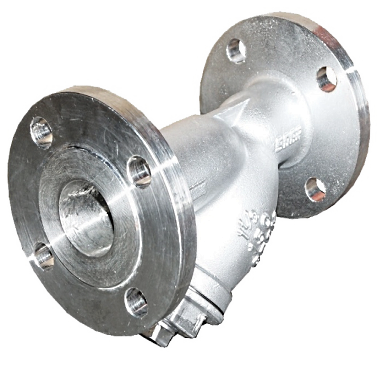
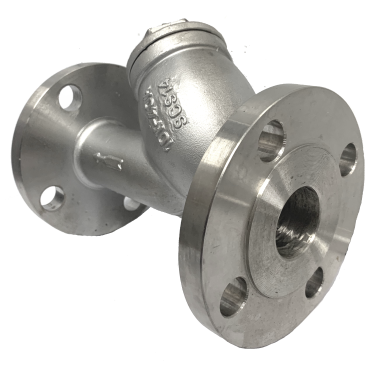
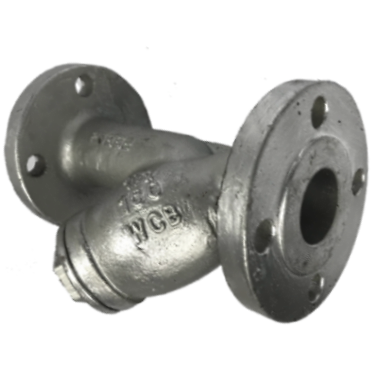
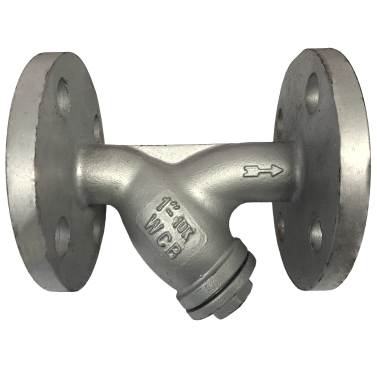
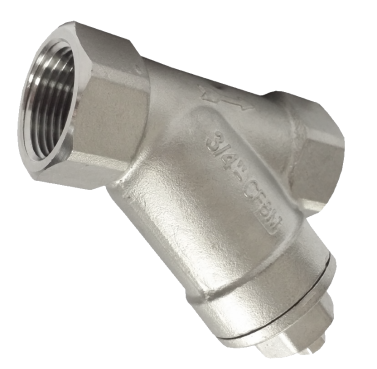
What it is protecting
Put the cost of the strainer next to the cost of the thing behind it.
A Y‑strainer is cheap insurance, and the case for it is arithmetic rather than opinion. Below is what sits downstream in a typical line and what a piece of weld spatter does to each. Everything in the first column is something we stock, so these are not hypothetical pairings.
| What is downstream | What debris does to it | What it costs you |
|---|---|---|
| Globe valve | A globe valve throttles by squeezing flow through a narrow gap, so anything solid arrives at high velocity and cuts the seat and disc face. On the forged variants the seat is part of the body. | The valve. A cut seat that is integral to the body cannot be replaced. |
| Gate valve | Grit settles in the seat pocket at the bottom of the bore, which is exactly where the gate has to land. The valve then will not shut fully. | Isolation. A gate valve that will not seal is no longer a safety device. |
| Ball valve | Particles are dragged across the PTFE seats every time the ball turns, scoring a leak path in a soft material. | The seats, and on a one‑piece body the whole valve. |
| Check valve | Debris holds the disc fractionally off its seat, so it passes reverse flow while looking perfectly normal from outside. | Backflow protection, silently — the worst failure mode on this list. |
| Pump | Hard particles pass through the impeller and wear rings at full tip speed. | Efficiency first, then the impeller. The bill arrives months later as energy cost. |
| Flow meter | Fouls a turbine rotor or coats an orifice, and the reading drifts without any alarm. | Trust in your instruments, which is expensive to rebuild. |
| Control valve or regulator | Jams a small trim clearance, so the loop hunts or sticks. | Process stability, and a fault that is hard to diagnose. |
- Fit it upstream of the thing you are protecting, not somewhere convenient. Debris travels with the flow, so a strainer downstream of a pump protects nothing but the pipe.
- A new system is the dangerous one. Most of what a strainer will ever catch arrives in the first few weeks of running, as the pipework sheds its own construction debris. Check the screen early and often at first, then settle into an interval.
- Two valves and two gauges make it maintainable. Isolating valves either side let you clean the screen without draining the system; gauges either side tell you when to. Neither costs much next to the equipment behind it.
All five compared
End connection first, then body material. The flags are real and they are explained.
| Variant | Ends | Size | Body | Screen | Pressure | Temperature | Choose it when |
|---|---|---|---|---|---|---|---|
| ANSI 150 SS316 | ANSI 150# flange | 1½"–4" | SS316 / CF8M | SS316, 1 mm | Class 150 | −20 to 230 °C | Corrosive or clean‑service duty on ANSI pipework. |
| JIS 10K SS316 | JIS 10K flange | 1½"–4" | SS316 / CF8M | SS316, 1 mm | 10K | −20 to 230 °C | The same strainer for Japanese‑standard pipework. |
| ANSI 150 cast steel | ANSI 150# flange | 1"–4" | WCB carbon steel | SS304, mesh not stated | 150# | −29 to 150 °C | Non‑corrosive duty where cost matters. Widest flanged range. |
| JIS 10K cast steel | JIS 10K flange | 1"–4" | WCB carbon steel | SS304, mesh not stated | 10K | −29 to 150 °C | As above, on JIS pipework. Dimensions on request — see below. |
| Threaded SS316 | NPT or BSPP | 1/4"–4" | SS316 / CF8M | SS316 | 800 PSI | Not published | Small bore, high pressure, or anything below 1". |
- JIS 10K cast steel dimensions are quoted per order. The catalogue publishes the part numbers for this variant but not a dimension table, so we quote dimensions against your enquiry instead — ask us for any figure and we will measure a stocked unit. The JIS 10K SS316 table is complete if you want a guide to JIS flange dimensions at these sizes.
- ANSI 150 cast steel part numbers are quoted as per the catalogue. The rows from 1" to 2½" read VL‑CS‑YS‑F‑10K‑nn and the 3" and 4" rows read ‑150‑; the dimensions are ASME B16.5 Class 150 throughout, so the fit is ANSI. State the size and flange standard on your order and we match the code for you.
- Temperature ratings are as the catalogue states them: −20 to 230 °C for the stainless variants and −29 to 150 °C for cast steel, both with a PTFE gasket. If your duty runs above 150 °C, choose a stainless variant.
- The threaded variant runs 1/4" to 4" (DN8 to DN100) — the dimension table carries full rows with part numbers from 1/4" up, and 1/4" through 1¼" are available in both thread forms. No working temperature is published for it; we obtain one from the factory on request.
- ANSI 150 and JIS 10K do not bolt to one another. Both sit near 1.6 to 2 MPa, which is what makes it an expensive mistake rather than an obvious one. Check the bolt circle on the mating flange, not the pressure rating.
- The flanged variants stop at 4" and the threaded one starts at 1/4". Between them they cover DN8 to DN100 with no gap, and 1½" to 4" is available in either style.
Mesh, microns and inches
The chart is correct. The sentence that used to sit above it was not.
Mesh number is the count of openings across one linear inch. A 10 mesh screen has ten openings per inch; a 120 mesh screen has a hundred and twenty. Because the wire has to fit in the same inch either way, a higher mesh number means smaller holes — and therefore a finer filter that catches more and blocks sooner.
Reading the mesh chart
- The higher the mesh number, the finer the screen. Mesh counts openings across one linear inch, so more openings in the same inch means smaller openings: 10 mesh passes 2000 microns; 120 mesh passes 125.
- A 10 mesh screen has 10 openings across one inch — the mesh number and the opening count are the same figure.
- The chart is verified. We checked all seventeen rows: every micron figure is the standard sieve value for that mesh, and every inch figure is that micron figure divided by 25,400.
- When in doubt, specify from the micron column — it is the particle size, stated directly.
How to choose one
- Start from what you are protecting, not from the fluid. Find the smallest clearance downstream — a control valve trim, a nozzle, a pump wear ring — and screen finer than that.
- Do not go finer than you need. Every step finer raises pressure drop and shortens the interval between cleanings. A screen nobody cleans is worse than a coarse one somebody does.
- Coarse for commissioning, fine for running. Weld spatter and scale are large and arrive early; a coarse screen catches them without blocking. Fit finer later if the duty needs it.
- 1 mm is exactly 18 mesh. Both stainless variants ship with a 1 mm SS316 screen as standard, which is 18 mesh on the chart below and sits at its coarse end — good for construction debris, not a fine filter.
- Tell us the mesh you want with the size and the end connection. Screens are the wear part and are ordered separately.
The mesh chart
Seventeen sizes, from 10 mesh to 120. All arithmetic checked.
| Mesh | Opening (µm) | Opening (mm) | Opening (in) | Typically catches |
|---|---|---|---|---|
| 10 | 2000 | 2.000 | 0.0787 | Weld spatter, scale, offcuts ← coarsest |
| 12 | 1680 | 1.680 | 0.0661 | Weld spatter, scale, offcuts |
| 14 | 1410 | 1.410 | 0.0555 | Weld spatter, scale, offcuts |
| 16 | 1190 | 1.190 | 0.0469 | Weld spatter, scale, offcuts |
| 18 | 1000 | 1.000 | 0.0394 | Rust flake, jointing compound ← the 1 mm standard screen |
| 20 | 841 | 0.841 | 0.0331 | Rust flake, jointing compound |
| 25 | 707 | 0.707 | 0.0280 | Rust flake, jointing compound |
| 30 | 595 | 0.595 | 0.0232 | Rust flake, jointing compound |
| 35 | 500 | 0.500 | 0.0197 | Coarse sand, fine scale |
| 40 | 420 | 0.420 | 0.0165 | Coarse sand, fine scale |
| 45 | 354 | 0.354 | 0.0138 | Coarse sand, fine scale |
| 50 | 297 | 0.297 | 0.0117 | Coarse sand, fine scale |
| 60 | 250 | 0.250 | 0.0098 | Coarse sand, fine scale |
| 70 | 210 | 0.210 | 0.0083 | Fine sediment |
| 80 | 177 | 0.177 | 0.0070 | Fine sediment |
| 100 | 149 | 0.149 | 0.0059 | Fine sediment |
| 120 | 125 | 0.125 | 0.0049 | Fine sediment ← finest |
- Read it downwards for finer. Mesh number rises, opening falls, filtration improves and pressure drop rises. There is no free end of this table.
- The millimetre column is ours. The manufacturer publishes microns and inches; we have added millimetres because that is what the screens are specified in — the standard 1 mm element is exactly 18 mesh.
- “Typically catches” is guidance, not a specification. What a screen actually stops depends on particle shape as much as size — a long thin sliver can pass a hole it is much larger than. Size the screen from the smallest clearance you are protecting.
- Every micron figure here is the standard sieve value for that mesh, and every inch figure is that micron figure divided by 25,400. We re‑checked all seventeen rows and changed none of them — only the explanation above needed fixing.
The five variants
Each has its own page, with the full parts list and dimensions.
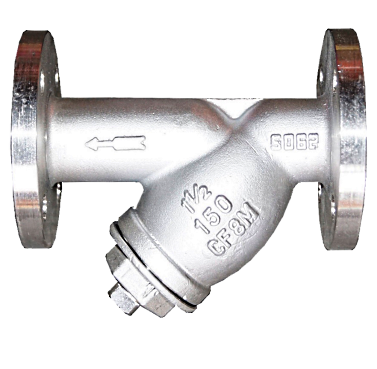
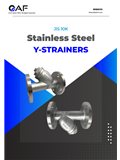
ANSI 150 SS316
VL‑S‑YS‑F‑150
Stainless SS316 / CF8M body and bonnet with an SS316 1 mm screen and a PTFE gasket. 1½" to 4", Class 150, to 230 °C. Weights published for every size, 4.6 to 24.0 kg.
- EndsANSI 150# flange
- ScreenSS316, 1 mm
- Sizes5 tabulated
Stocked in Malaysia or Singapore
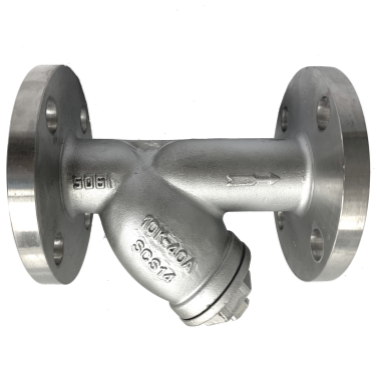
JIS 10K SS316
VL‑S‑YS‑F‑10K
The same stainless strainer on JIS 10K flanges, 1½" to 4". Flange diameters of 140, 155, 175, 185 and 210 mm are genuine JIS figures — this table is the complete and reliable one in this range.
- EndsJIS 10K flange
- ScreenSS316, 1 mm
- Sizes5 tabulated
Stocked in Malaysia or Singapore
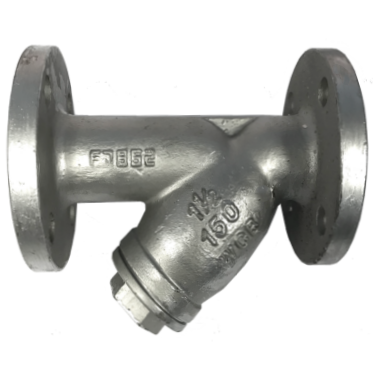
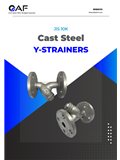
ANSI 150 cast steel
VL‑CS‑YS‑F‑150
A216 WCB carbon steel body and cover with an SS304 screen and A193 B7 bolting. The widest flanged range at 1" to 4", 150#, to 150 °C. Not a stainless strainer.
- EndsANSI 150# flange
- ScreenSS304
- Sizes7 tabulated
Stocked in Malaysia or Singapore
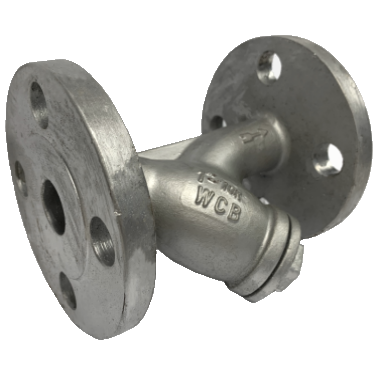
JIS 10K cast steel
VL‑CS‑YS‑F‑10K
The cast steel strainer on JIS 10K flanges, 1" to 4", 10K, to 150 °C. Dimensions are quoted per order — the page explains what is published and what we confirm for you.
- EndsJIS 10K flange
- ScreenSS304
- Sizes7 part numbers
Stocked in Malaysia or Singapore
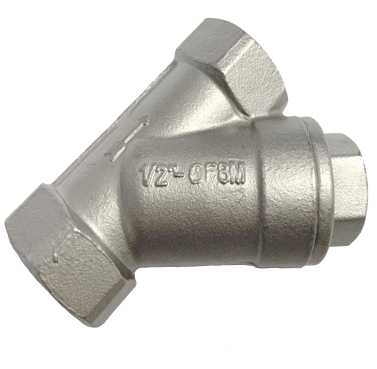
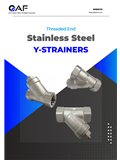
Threaded SS316
VL‑S‑YS‑G / ‑N‑800
800 PSI in SS316 / CF8M, from 1/4" to 4" in BSPP or NPT — 22 part numbers, eleven sizes in each thread form. Five times the pressure of the flanged variants, and the only way below 1".
- EndsNPT or BSPP
- ScreenSS316
- Sizes11 per thread form
Stocked in Malaysia or Singapore
What each part is made of
Six or seven parts. There is not much to a strainer, which is the point.
A Y‑strainer has no moving parts. There is a body, a screen, a cover or cap, a gasket and the bolting that holds the cover on. That is the whole machine, and it is why a strainer outlasts everything it protects — provided somebody empties it.
| Part | SS316 variants (all three) | Cast steel variants (both) |
|---|---|---|
| Body | SS316 & CF8M — forged and cast stainless | WCB — cast carbon steel |
| Screen | SS316, 1 mm mesh on the flanged pair | SS304 — mesh size not published |
| Cover or cap | SS316 & CF8M (called the bonnet on the flanged pair, the cap on the threaded one) | WCB |
| Gasket | PTFE | PTFE |
| Bolting | SS304 bolts and nuts on the flanged pair; the threaded one has no bolting — the cap screws on | A193 B7 bolts with A194 2H nuts — alloy‑steel pressure bolting |
| Drain plug | SS316 on the threaded variant; the flanged pair publish a plug size but no material | Not separately listed |
| Parts in the list | 7 flanged, 6 threaded | 6 |
- The screen grade differs from the body grade on the cast steel variants. A WCB body with an SS304 screen is the normal, sensible arrangement — the screen is thin and needs corrosion resistance the body does not. But note it is 304, not 316: on chloride‑bearing service the screen will pit before the body does.
- ⚠ The cast steel variants do not publish a mesh size. The stainless pair state SS316 1 mm mesh; the cast steel pages say only “filter screen, SS304”. Specify the mesh you want when you order a cast steel strainer rather than assuming 1 mm. The chart.
- The bolting is the real material difference. A193 B7 / A194 2H on cast steel is stronger alloy‑steel pressure bolting; SS304 on the stainless variants is more corrosion‑resistant and weaker. Each suits its body.
- PTFE gasket on all five. Which is what makes the 150 °C ceiling on the cast steel variants hard to explain — the stainless ones use the same gasket and are rated to 230 °C. The published figures.
- Screens are a spare part, not a fixture. They are the only thing that wears or blocks, they lift out through the cover, and we stock them. Send the size, the variant and the mesh.
Pressure and temperature, all five
Four of these figures need reading twice. They are flagged.
| Variant | Nominal | Shell test | Tightness test | Temperature |
|---|---|---|---|---|
| ANSI 150 SS316 | Class 150 | not published | 3.0 MPa | −20 to 230 °C |
| JIS 10K SS316 | JIS 10K | 3.0 MPa | not published | −20 to 230 °C |
| ANSI 150 cast steel | 150# | 3.0 MPa | not published | −29 to 150 °C |
| JIS 10K cast steel | JIS 10K | 3.0 MPa | not published | −29 to 150 °C |
| Threaded SS316 | 800 PSI | not published | not published | not published |
- ANSI 150 SS316: the catalogue prints its 3.0 MPa figure against the tightness test, with the shell test not separately stated; the other three flanged variants publish 3.0 MPa as the shell test. We quote each page exactly as the catalogue prints it and confirm the full test regime on enquiry.
- 230 °C on stainless and 150 °C on cast steel are the catalogue ratings. If your duty is between 150 and 230 °C, use a stainless variant.
- −20 °C applies to the stainless variants and −29 °C to cast steel, as published. It matters only on genuinely cold duty; ask if you are near it.
- The threaded variant is rated 800 PSI; the catalogue does not print a test pressure or temperature for it. We obtain both from the factory before you commit to anything demanding.
- ⚠ 3.0 MPa is a proof test, not a working pressure. It is roughly twice the 150# / 10K rating and exists to prove the casting. Do not design to it.
- Pressure rating is not the number that limits a strainer in service. Differential pressure across a blocking screen is what collapses an element, and that happens far below the shell rating. Watch the differential.
Y‑strainers — the specification
The range as a whole. Per‑variant figures are on the five pages.
| Size range | 1/4" to 4" (DN8 to DN100) — threaded covers 1/4" up, flanged runs 1" to 4" |
| End types | ANSI 150# flange · JIS 10K flange · NPT · BSPP |
| Body materials | SS316 / CF8M stainless · A216 WCB cast carbon steel |
| Screen | SS316 on the stainless variants, 1 mm as standard on the flanged pair · SS304 on cast steel, mesh not published |
| Working pressure | 800 PSI threaded · 150# or 10K flanged |
| Working temperature | 230 °C stainless flanged · 150 °C cast steel · threaded not published |
| Gasket | PTFE on all five |
| Bolting | A193 B7 / A194 2H on cast steel · SS304 on stainless · none on the threaded body |
| Shell test | 3.0 MPa where published — two variants publish none |
| Moving parts | None. A strainer does not open, close or throttle |
| Orientation | Screen leg and cap pointing downward — see fitting |
| Cleaning | Flush through the bottom cap, or lift the screen out through the cover — see maintenance |
| Catalogues | A manufacturer PDF for each of the five variants, linked on its own page |
| Not on this page | Gate valves and ball valves to isolate the strainer · globe valves to throttle · check valves to stop reverse flow |
| Stock | Held in Malaysia or Singapore |
Fitting one
The manufacturer’s procedure, with the two missing steps supplied.
Getting a strainer in correctly is mostly about which way up it goes and what you do before the fluid arrives. Fitted upside down it still filters, but the debris it catches falls back into the flow every time the system stops, so it delivers the rubbish to your equipment in batches instead of holding it.
- Step 1 — depressurise and drain. The whole system, not just the section. No process fluid may enter the line while the strainer is being fitted.
- Step 2 — inspect and clean. Check the strainer inside and out for casting defects or transit damage, and make sure both connection points are clean and free of particles. It is worth doing: fitting a strainer with grit already inside it is a wasted job.
- Step 3 — support the pipework properly. The run must be free of bending load, tensile load and vibration. A strainer is a casting with a bolted cover; it should not be carrying pipe stress, and it must never be used to pull a misaligned flange together.
- Step 4 — cap downward, and check the arrow. The cover cap must point downward before start‑up so gravity holds the debris in the leg. Most bodies also carry a cast flow arrow — visible on the JIS cast steel photograph — and the flow must follow it. On a vertical run, flow must be downward.
- Step 5 — close the cap, then start slowly. Confirm the bottom cap is closed and not leaking, then bring the system up gradually. A sudden start puts a shock load through both the screen and the pipework, and a screen is a thin perforated part.
The procedure, numbered from the start
- The full sequence begins with depressurise and drain, then inspect and clean — the manufacturer gives these before the numbered steps, so we number the whole procedure from 1.
- Every instruction below is the manufacturer’s own; only the numbering has been added.
What to fit around it
- An isolating valve either side. A gate valve or ball valve upstream and downstream lets you clean the screen without draining the system. Without them, every clean is a shutdown.
- A gauge either side. Two pressure gauges, inlet and outlet, turn “is it blocked?” into a number you can read. This is the single most useful thing you can add.
- Clearance under the cap. The screen comes out downward through the cover, so leave enough room below the strainer to actually get it out. On a 4" unit that is not a small allowance.
- A drain line or a bucket. Flushing the bottom cap discharges whatever the screen has collected. Decide in advance where it goes.
Keeping it working
A strainer nobody cleans is a restriction, not a filter.
There is no fixed service interval for a strainer, and any supplier who gives you one is guessing. The interval depends entirely on how dirty your fluid is, and the only honest way to set it is to measure. That is what the two gauges are for.
- Record the pressure drop when it is clean. Fit a gauge at the inlet and one at the outlet, and note the difference on a new screen. That baseline is the number everything else is judged against — without it, a later reading tells you nothing.
- Watch the differential, then set your interval from it. As the screen fills, drop rises. Check and log it often at first — especially in the first weeks of a new system, when the pipework is shedding its own construction debris — and let the pattern tell you the interval.
- Flush the bottom cap first. Small amounts of contamination clear by opening the cap and letting flow carry the debris out. That is a minutes job and needs no dismantling.
- If flushing is not enough, lift the screen out. Remove the bottom cover and take the element out. It is self‑aligning, so it goes back the way it came. Clean it, check it for damage, and replace it if it is torn or deformed — a holed screen filters nothing and gives no warning that it has stopped.
- ⚠ A blocked screen can collapse. The differential across a fully blocked element can exceed what the mesh will take, and once it tears the debris goes straight downstream. This is the real failure mode of a strainer, and it happens far below the body’s pressure rating.
- Rising drop with a clean screen means something else. If the differential climbs and the element is clear, look downstream — a partly closed valve or a fouled component. The strainer is doing its job and telling you about someone else’s.
- Keep a spare screen. The element is the only wear part on the whole assembly. Having one on the shelf is the difference between a clean and a shutdown.
Why buy them from us
Stock, a landed price, and data we have actually checked.
What you get
- Stock in Malaysia and Singapore, not a container to wait for.
- A landed price — transport, currency, duties and taxes already inside the figure, so the number we quote is the number you pay.
- Screens as a spare part, in the mesh you ask for. The element is the only thing that wears.
- The manufacturer’s catalogue PDF for each variant, linked on its own page. You can check us against the source.
- The whole low pressure range from one supplier — gate, globe, ball and check valves to go with the strainer, so the line comes from one place with one delivery.
How we treat the data
- The catalogue is the standard. Every figure on these pages is quoted as the manufacturer prints it, and anything the catalogue does not state — a dimension, a test figure, a temperature — we obtain from the factory or measure on a stocked unit.
- We withhold rather than guess. The JIS cast steel dimensions are not on the site because there is nothing real to publish. We will measure a stocked unit for you instead.
- We corrected our own page. The mesh explanation here used to be backwards. We say so rather than edit it quietly.
- We check the arithmetic. All seventeen rows of the mesh chart were verified against the standard sieve values and the micron‑to‑inch conversion before we republished them.
- We never invent a number. If a weight, a mesh size or a temperature is not published, this site says it is not published.
Questions we get asked
The ones that come up on the phone.
What does a Y‑strainer actually do?
It is a tee with a screen in the leg. Flow passes through a perforated or woven mesh element angled down into the branch, and anything larger than the mesh opening stays behind. A cap at the bottom lets you flush the debris out or lift the screen for cleaning. It has no moving parts and it does not shut anything off — it exists to keep debris out of the pumps, valves, meters and regulators downstream.
Which mesh size should I choose?
Work back from the smallest clearance you are protecting — a control valve trim, a nozzle, a pump wear ring — and choose a screen finer than that. Then do not go finer than you need: every step finer raises pressure drop and shortens the interval between cleanings. For commissioning a new system, coarse is usually right, because weld spatter and scale are large and arrive early. The standard element on the flanged stainless variants is 1 mm, which is exactly 18 mesh. The full chart is on this page.
Does a higher mesh number mean a finer or a coarser screen?
Finer. Mesh number is the count of openings across one linear inch, so more openings in the same inch means smaller openings: 10 mesh passes 2000 microns and 120 mesh passes 125.
Which way round and which way up does it go?
The cap points downward, so gravity holds the debris in the leg rather than letting it drop back into the flow every time the system stops. Flow follows the arrow cast into the body. On a vertical run, flow must be downward. Leave clearance below the strainer, because the screen comes out downward through the cover. The full procedure.
How often does it need cleaning?
There is no fixed interval, and anyone who gives you one is guessing — it depends entirely on how dirty your fluid is. Fit a pressure gauge either side and record the drop when the screen is clean; that baseline is what every later reading is judged against. Check often in the first weeks of a new system, when the pipework is shedding its own construction debris, and let the pattern set your interval. How to monitor it.
What happens if I never clean it?
Pressure drop climbs until the differential across the blocked element exceeds what the mesh will take, and the screen tears. Everything it had collected then goes straight downstream, and nothing warns you. That is the real failure mode of a strainer, and it happens far below the body’s pressure rating — so the shell test figure is no protection against it.
Which variant should I choose?
End connection first, then material. Below 1", or above 150#, the threaded SS316 is the only option — 1/4" to 4" at 800 PSI in BSPP or NPT. On flanged pipework, match the standard: ANSI 150 or JIS 10K in stainless, or the cast steel equivalents where the duty is non‑corrosive and cost matters. All five side by side.
Will an ANSI 150 strainer bolt to my JIS 10K flange?
No. Both sit near 1.6 to 2 MPa, which is exactly what makes this an expensive mistake rather than an obvious one — the bolt circles differ. At 2" the JIS flange is 155 mm across against 152 mm for ANSI: close enough to look interchangeable, drilled differently. Check the bolt circle on the mating flange, not the pressure rating.
Do I need isolating valves either side?
Strongly recommended. A strainer has no closure member of its own, so without a valve upstream and downstream every screen clean becomes a system drain. A gate valve or a ball valve either side costs very little against the downtime, and we stock both.
Is the cast steel version stainless?
No. The body and cover are A216 WCB cast carbon steel, and only the screen is stainless — SS304, not 316. It has no useful corrosion resistance and on chloride‑bearing service the screen will pit before the body does. Note that this page used to state that Y‑strainers “are made of stainless steel material, which is completely corrosion resistant”, which was true of three of the five variants and not of the other two. For corrosive duty use an SS316 variant. The part‑by‑part comparison.
Where are the JIS cast steel dimensions?
They are quoted per order. The catalogue publishes the part numbers for that variant but not a dimension table, so we confirm dimensions against your enquiry — ask us and we will measure a stocked unit. The JIS 10K SS316 table is complete if you want a guide to JIS flange dimensions at these sizes.
What sizes and pressures do you hold?
1/4" to 4" (DN8 to DN100) across the five variants, at 150# or 10K flanged and 800 PSI threaded, held in Malaysia or Singapore. Send the size, the end connection and the mesh you want and we will confirm availability and a landed price — transport, currency, duties and taxes already inside the figure.
Catalogues
Direct PDF downloads — no form, no email address.
Send the size, the end connection and the mesh
We will confirm the ends match your pipework, recommend a mesh for what you are protecting, and quote a landed price with a spare screen. Stock in Malaysia and Singapore.