
Home › Products › Low pressure valves › Butterfly valves
1½" to 6" · DN40 to DN150 · wafer or lugButterfly valves, 1½" to 6"
A disc that turns in the flow rather than lifting out of it — so it fits between two flanges and takes almost no room in the run. Cast iron body, CF8 stainless disc, EPDM seat, quarter‑turn lever. In wafer or lug form.
Get a quotation within 2 working hours
Send the part number, standard, size or quantity. Stock in Malaysia or Singapore, ISO 9001:2015 certified.
How a butterfly valve works
The disc never leaves the flow. That is the whole design.
A butterfly valve is a disc on a shaft, turning inside a ring. A quarter turn takes it from edge‑on to the flow (open) to square across it (shut), where its rim presses into a rubber seat liner that runs round the inside of the body. Because the disc pivots in place rather than lifting clear, the body needs to be no longer than the disc is thick — which is why a butterfly valve fits between two flanges and adds barely any length to the pipe run.
That compactness is what you buy. At 6", a butterfly valve occupies about 26 mm of pipe run against 356 mm for a flanged swing check valve and 406 mm for a flanged gate valve. It also weighs a fraction as much, and it costs less at every size above about 3". The trade is that the disc sits in the flow even when fully open, so there is always some restriction, and the seat is an elastomer, which limits what you can put through it and how hot it can get.
- ⚠ The seat is the pressure boundary, and it is rubber. Not a metal seat with a soft insert — the EPDM liner is what seals the disc, and on a wafer body it also seals against both pipe flanges. That makes fluid compatibility the first question, not the last one.
- ⚠ And the seat and the O‑ring are different rubbers. The seat is EPDM and the shaft O‑ring is NBR. Those two materials have almost opposite compatibility — EPDM is poor with mineral oil, NBR is poor with hot water and steam. The window where both are happy is narrow, and it is the single most important thing on this page.
- Wafer or lug is a real decision, not a preference. A wafer body is clamped between two flanges by bolts that pass right through. A lug body has tapped holes, so each flange bolts to it independently — which means you can remove the downstream pipe with the valve still holding pressure. The difference in full.
- It throttles, but not well at the ends. Between roughly 30° and 70° open, disc angle and flow track each other usefully. Below 30° the flow barely changes; above 70° it barely changes either. For real control use a globe valve.
- ⚠ Check disc clearance before you order. On the smaller sizes the disc swings outside the body face as it opens. Fitted hard against a reducer, a pump flange or a lined pipe, it can foul — and you will not find out until you try to open it.
Three angles on the same valve. Photographs of the stocked item, not renders.
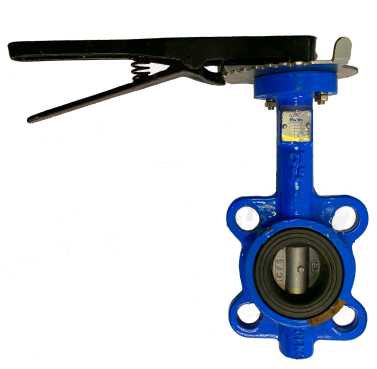
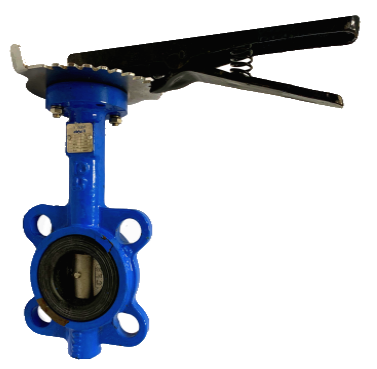
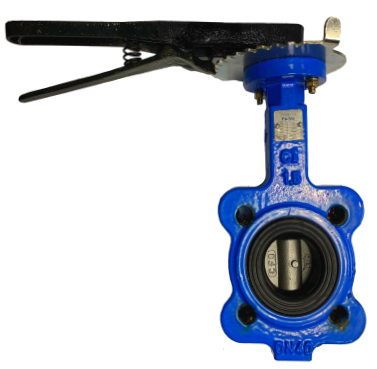
Wafer or lug
One of these lets you take the downstream pipe off. The other does not.
Both bodies hold the same disc, the same shaft and the same seat, and both are drilled to sit inside an ANSI 150 bolt pattern. The difference is entirely in how the bolts engage the body, and it decides one practical thing: whether the valve can hold pressure with only one flange attached.
| Wafer type | Lug type | |
|---|---|---|
| How it bolts | Bolts pass right through lugs on the body and clamp both flanges together | Body has tapped holes; each flange bolts to the valve independently |
| Dead‑end service | No. Remove one flange and the joint comes apart | Yes. The downstream pipe can be removed with the valve shut and holding pressure |
| End of a line | Not suitable | Suitable — it can terminate a run |
| Bolt spec published | Hole size in mm — 4‑16 to 4‑22 | Thread size in inches — 4‑½" to 8‑¾" |
| Weight and cost | Lower — less metal, no tapping | Higher |
| Face‑to‑face | 24 to 28 mm across the range | 24 to 27 mm — effectively the same |
| Height at 6" | 374 mm | 369 mm |
| Catalogue | Wafer type PDF | Lug type PDF |
- If the valve is anywhere near the end of a line, buy the lug. Not because of pressure rating — both are the same valve — but because a wafer body cannot be left holding pressure against an open flange. That includes future work: a wafer valve is fine until someone needs to take the pump off.
- Otherwise the wafer is the sensible default. Lighter, cheaper, and mid‑run it does everything the lug does.
- ⚠ Bolt to the flange standard. ASME B16.5 Class 150 uses 8 bolts from NPS 4 upward — the lug table carries 8 at 4", 5" and 6" and the wafer table 4, each as printed. On a wafer body those bolts are what clamp the valve in place, so take the bolt count from the flange standard.
- Both take the same actuator. The top flange is identical between them — 4‑7 mm on a 50 mm circle up to 3", 4‑9 on 70 mm from 4" up — so a gearbox or actuator specified for one fits the other.
- Neither is a substitute for an isolating valve on critical duty. A resilient‑seated butterfly valve seals well when new. It is not a gate valve and it should not be the only thing between a person and the line.
The range
Two irons, two body styles — four valves, each with its own page and full dimensions.
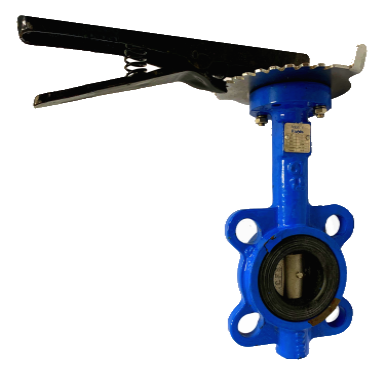 Wafer type · clamps between the flanges
Cast iron — wafer
Size1½"–6"BodyCast iron · CF8 discSeatEPDMTemp−30 to 120 °C Ready stock→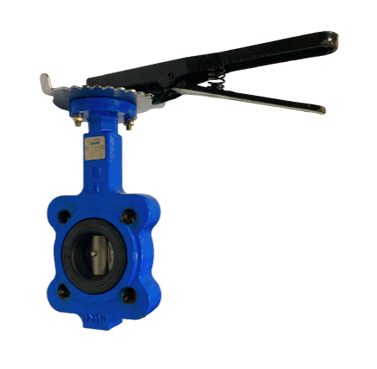 Lug type · tapped lugs, dead‑end service
Cast iron — lug
Size1½"–6"BodyCast iron · CF8 discSeatEPDMBolts8 from 4" up Ready stock→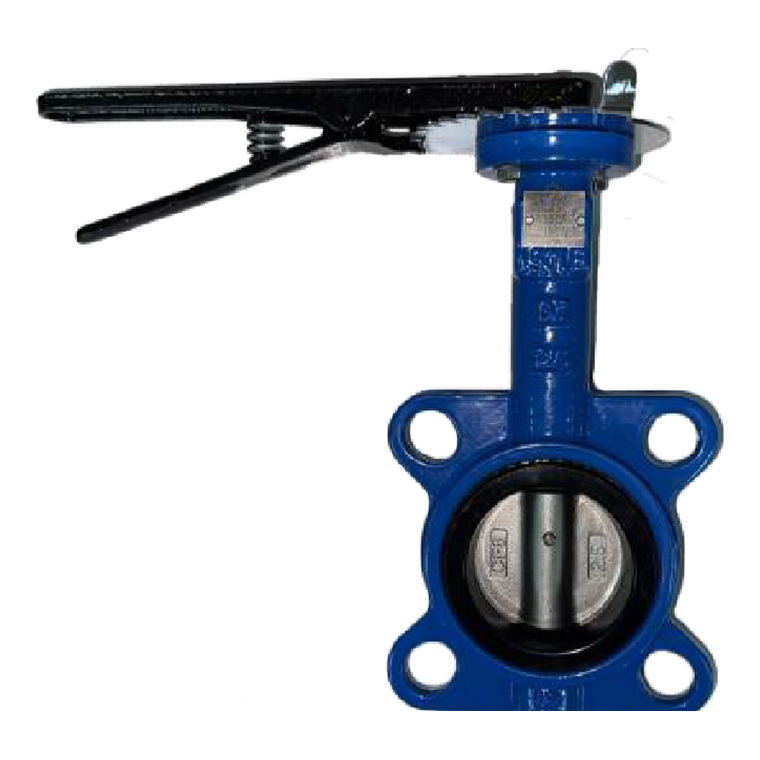 Wafer type · ductile iron · 4 flange standards
Ductile iron — wafer
Size2"–4" stockedBodyDuctile iron · CF8 discSeatEPDMEndsPN10/16 · ANSI 150# · JIS 10K Ready stock→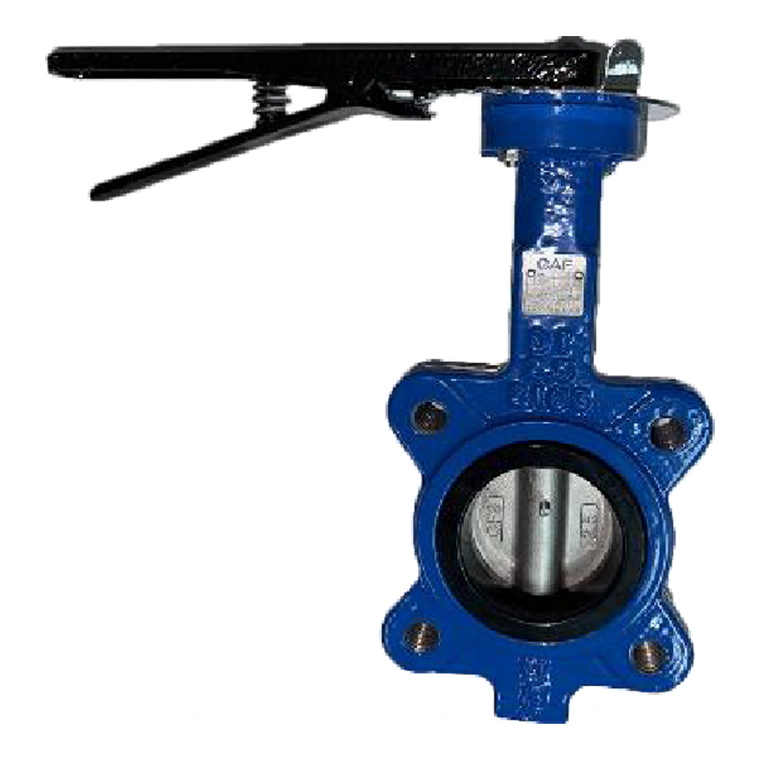 Lug type · ductile iron · dead‑end service
Ductile iron — lug
Size2"–4" stockedBodyDuctile iron · CF8 discSeatEPDMEndsANSI 150# · tapped Ready stock→- Wafer and lug are the same valve inside. We checked the two published parts lists and the two test tables against each other: they are identical. Only the dimensions differ, and each page publishes its own table in full.
- Ductile iron is the tougher body — for lines with vibration, water hammer or pipe loads — and the ductile iron wafer is drilled for PN10, PN16, ANSI 150# and JIS 10K in one body, where the cast iron pair and the ductile iron lug are ANSI only.
- Lug is the one that can end a line. Its tapped lugs let each flange bolt on independently, so the downstream pipe can come off with the valve holding pressure — a wafer body cannot do that.
- The product pages carry what this one does not — the eight‑part bill of materials, the sectional drawing for each body style, and the full dimension table with the top‑flange drilling for fitting an actuator.
⚠ Two rubbers, and they disagree
The most important thing on this page. Read it before you order.
This valve contains two different elastomers. The seat liner is EPDM — the part that seals the disc and, on a wafer body, seals against both pipe flanges. The shaft O‑ring is NBR — nitrile, the part that stops the fluid getting out along the shaft. Both are in contact with whatever is in the line, and their compatibility is close to opposite.
| Fluid | EPDM seat | NBR O‑ring | Verdict for this valve |
|---|---|---|---|
| Water, cold or warm | Good | Good | Yes. This is the duty the valve is built for. |
| Hot water and low‑pressure steam | Good — EPDM is at its best here | Poor — nitrile hardens and cracks | ⚠ Ask us. The seat is happy; the shaft seal is not. Note the published ceiling is 120 °C either way. |
| Mineral oil, hydraulic oil, diesel | Poor — EPDM swells badly in petroleum oils | Good — this is what nitrile is for | ⚠ No. The seat is the pressure boundary, and oil will destroy it. Use a ball valve. |
| Air and inert gas | Good | Good | Yes, within the temperature limits. |
| Glycol and water treatment chemicals | Generally good | Varies | Ask us with the exact chemical and concentration. |
| Anything aggressive or unusual | Depends entirely on the chemical | Depends entirely on the chemical | Send the fluid, the concentration and the temperature. We will check both elastomers, not one. |
- The short version: this is a water valve. Cold water, warm water, air. That is where an EPDM seat and an NBR O‑ring both work, and it covers most of what a 1½" to 6" butterfly valve is used for — HVAC, cooling circuits, tank isolation, general service.
- ⚠ Do not put oil through it. EPDM in mineral oil swells, softens and loses its shape, and on this valve the seat is the seal — there is no metal seat behind it to fall back on. For oil, use a ball valve or a gate valve.
- ⚠ The 120 °C ceiling is the seat, not the body. Cast iron and a CF8 disc would take far more. −30 to 120 °C is what the rubber allows — and the NBR O‑ring is the weaker of the two at the top end.
- Seats can be changed at the factory. If your fluid needs something other than EPDM, tell us before you order rather than after — a different liner is a specification, not a modification.
- The disc is CF8 — cast 304 stainless. It is the only part in the flow path that is stainless at all — the body is cast iron — and 304 has meaningfully less resistance to chlorides than 316. On treated or brackish water, say so.
Operating it
A quarter turn, a notched plate, and one habit worth having.
- The lever has a trigger and a notched quadrant. Squeeze to release, turn, let go and it locks in the nearest notch. That is how the disc is set and held part open — and it is why you can leave a butterfly valve at a throttled position where you could not leave a gate valve.
- Useful throttling is roughly 30° to 70°. Below 30° the disc is still nearly edge‑on and moving it changes flow very little; above 70° it is nearly shut and the last few degrees change everything. Set flow in the middle of the range, and for genuine control use a globe valve.
- ⚠ Torque rises sharply as it closes. The last part of the stroke presses the disc rim into the seat, and on the larger sizes that takes real effort. If it is hard to shut by hand at 6", the answer is a gearbox, not a longer bar — a bar on the lever bends the shaft or tears the seat.
- ⚠ Open it before the line is pressurised, and open it slowly. A disc that is forced open against full differential drags its rim across the seat under load. That is what wears a resilient seat out, and it happens on the first few operations rather than gradually.
- Check disc clearance before bolting up. On the smaller sizes the disc protrudes past the body face when open. Against a reducer, a pump flange, a lined pipe or a rubber expansion joint it can foul — and it will not be obvious until someone tries to open it under pressure.
- Do not use flange gaskets on a wafer body. The EPDM seat has raised faces that seal against the pipe flanges directly. An extra gasket lifts the flange off that face and makes the joint worse, not better.
- It goes in either way round. There is no flow direction on a butterfly valve — unlike a check valve, where fitting it backwards blocks the line. Orientation only matters for access to the lever and for the shaft, which is best horizontal so grit does not settle on the lower bushing.
Butterfly valves — the specification
As published. Where the source disagrees with itself, we say so.
| Size range | 1½" to 6" (DN40 to DN150) — seven sizes |
| Body styles | Wafer type and lug type, both to ANSI 150# drilling — the difference |
| Body | Cast iron |
| Disc | CF8 — cast 304 stainless, not CF8M |
| Seat | EPDM — and it is the pressure boundary. Check your fluid |
| Shaft | SS410, pinned to the disc with an SS304 pin, in polymer bushings |
| Shaft seal | NBR O‑ring — a different rubber from the seat, with different compatibility |
| Handle | Ductile iron lever with a notched locking plate |
| ⚠ Working pressure | The source gives two figures. The specification box says 150 PSI; the test table says a nominal of 1.6 MPa, which is 232 PSI. See below |
| Shell test | 2.4 MPa |
| Seal test | 1.76 MPa |
| Working temperature | −30 °C to 120 °C — set by the rubber, not the body |
| Operation | Quarter turn lever. Top flange takes a gearbox or actuator |
| Top flange | 4‑7 on ø50 up to 3" · 4‑9 on ø70 from 4" up — identical on both body styles |
| Face‑to‑face | 24 to 28 mm across the whole range — a fraction of any flanged valve |
| Catalogues | Wafer type · Lug type |
| Full dimensions | All seven sizes — wafer type and lug type, each on its own page |
| Stock | Held in Malaysia or Singapore |
Two pressure figures — how to read them
150 PSI or 232 PSI. They are not the same valve rating.
The specification box on the manufacturer’s sheet gives the working pressure as 150 PSI. The test table on the same sheet gives a nominal pressure of 1.6 MPa, which is 232 PSI. Those differ by more than half, and both appear on both body styles.
What the numbers suggest
- 1.6 MPa is PN16, a standard European pressure class. The shell test of 2.4 MPa is exactly 1.5× that, and the seal test of 1.76 MPa is exactly 1.1× — both the conventional multipliers. The test figures are internally consistent with a PN16 valve.
- “150” is also the flange drilling. The body is drilled to sit in an ANSI 150# bolt pattern.
- A PN16 valve given ANSI 150 drilling is a normal product; we confirm the governing rating with the factory for the size you are buying.
What we will tell you
- Design to 150 PSI unless we confirm otherwise. That is the lower of the two published figures and the safe one to work from.
- We will not print 232 PSI as the rating on the strength of an inference, however reasonable the arithmetic looks.
- Ask us and we will get it from the factory. If your duty sits between 150 and 232 PSI, that is exactly the case where this matters and we will settle it before you order.
- Both figures are published here as printed, which is why you are reading about it rather than finding out later.
Butterfly, ball or gate
Three ways to shut a line, and they are not interchangeable.
All three of these isolate. What separates them is how much room they take, how much pressure they cost you open, and how well they seal after a few years. At 1½" the choice is mostly about price; at 6" it is about whether you can physically fit the valve in.
| Butterfly | Ball valve | Gate valve | |
|---|---|---|---|
| Length in the run at 6" | 26 mm — wafer body between flanges | Around 394 mm flanged | Around 406 mm flanged |
| Pressure drop open | Some, always — the disc stays in the flow | Almost none — full bore straight through | Almost none — the gate lifts clear |
| Operation | Quarter turn, lever with notches | Quarter turn, lever | Many turns, handwheel |
| Can it be left part open? | Yes — roughly 30° to 70° | No — it cuts the seats | No — it wears the seat and vibrates |
| Seat | EPDM rubber — and it is the pressure boundary | PTFE — sets a 150 °C ceiling | Metal — reaches 425 °C |
| Temperature | −30 to 120 °C | To 150 °C | To 425 °C |
| Weight at 6" | Light — a ring and a disc | Heavy | Heavy |
| Cost at 6" | Lowest by a distance | Highest | Middle |
| Best at | Large bore, low pressure, water, and anywhere space is tight | Tight shut‑off, frequent operation, oil and gas | Hot duty and full‑bore isolation |
- The size crossover is around 3". Below it, a ball valve is compact enough and seals better. Above it, a ball valve gets heavy and expensive fast while a butterfly valve barely changes — which is why 4" to 6" water service is butterfly territory.
- ⚠ Do not choose butterfly for oil. The EPDM seat rules it out. The compatibility table.
- Do not choose butterfly for hot duty. 120 °C against 425 °C for a metal‑seated gate valve. That is the rubber talking, and no amount of cast iron changes it.
- Do choose butterfly when the run is short. If you cannot find 400 mm of straight pipe, a flanged valve is not going in and a wafer body is the answer.
- And if you need to stop reverse flow rather than shut the line, none of these is right — you want a check valve, and in a short run a dual plate one.
Why buy them from us
Stock, a landed price, and the awkward facts up front.
What you get
- Stock in Malaysia and Singapore, in both body styles.
- A landed price — transport, currency, duties and taxes already inside the figure.
- Both manufacturer catalogues, wafer and lug, so you can check us against the source.
- A seat specified for your fluid rather than whatever is on the shelf — if EPDM is wrong for you, tell us before you order.
- The rest of the line from one supplier — gate, globe, ball and check valves, plus the Y‑strainer to keep grit off the seat.
How we treat the data
- We publish the contradictions we find. The working pressure is given twice and differently, and the two bolt patterns disagree at 4" and above. Both are set out rather than smoothed over.
- We design to the lower figure. Where the source says both 150 PSI and 232 PSI, we quote 150 and go and ask.
- We check against the standard. The bolt‑count problem was found by comparing both tables with ASME B16.5, which is also how we can say which one is right.
- We flag what the datasheet does not. The EPDM‑versus‑NBR compatibility trap is not in the manufacturer’s literature at all. It is the thing most likely to cost you a valve.
- We never invent a number. If it is not published, this site says it is not published.
Questions we get asked
The ones that come up on the phone.
What is a butterfly valve, and when is it the right choice?
A disc on a shaft, turning inside a ring. A quarter turn takes it from edge‑on to the flow to square across it, sealing against a rubber liner round the inside of the body. Because the disc pivots in place rather than lifting clear, the body fits between two flanges — about 26 mm of pipe run at 6" against roughly 400 mm for a flanged gate or ball valve. It is the right choice for large bore, low pressure water service, and anywhere the run is too short for a flanged valve.
Wafer or lug — which do I need?
Lug if the valve is anywhere near the end of a line. A lug body has tapped holes, so each flange bolts to it independently and the downstream pipe can be taken off with the valve shut and holding pressure. A wafer body is clamped between two flanges by bolts passing right through, so removing one flange takes the joint apart — it cannot do dead‑end service. Mid‑run, wafer is lighter and cheaper and does everything lug does. The full comparison.
Can I use it on oil?
No. The seat is EPDM, which swells and softens badly in mineral oil — and on this valve the seat is the pressure boundary, so there is no metal seat behind it to fall back on. Use a ball valve instead. Note also that the shaft O‑ring is NBR, which is good with oil — the two rubbers in this valve have close to opposite compatibility, which is exactly why the fluid question needs both checked.
What temperature can it take?
−30 to 120 °C, and the limit is the rubber, not the body — cast iron and a CF8 disc would take far more. Within that range the NBR shaft O‑ring is the weaker part at the top end, since nitrile hardens in hot water where the EPDM seat is perfectly happy. For anything hot, use a metal‑seated gate valve, which reaches 425 °C.
Is it 150 PSI or 232 PSI?
The source says both, and we publish both. The specification box says 150 PSI; the test table says a nominal of 1.6 MPa, which is 232 PSI. The test figures are internally consistent with a PN16 valve — the shell test is exactly 1.5× and the seal test exactly 1.1× 1.6 MPa — and “150” is also the ANSI flange class the body is drilled to, which is an easy thing to end up in a pressure field. Design to 150 PSI unless we confirm otherwise, and if your duty sits between the two, ask and we will settle it with the factory. The full reasoning.
Can I throttle with it?
Within limits. Useful control is roughly 30° to 70° open — below 30° the disc is nearly edge‑on and moving it changes flow very little, above 70° the last few degrees change everything. The notched locking plate under the lever is designed for exactly this, so unlike a gate valve you may leave it part open. For genuine flow control, use a globe valve.
Does it need gaskets against the pipe flanges?
No — and adding them makes the joint worse. The EPDM seat has raised faces that seal directly against the pipe flanges. An extra gasket lifts the flange off that sealing face. Bolt the flanges straight onto the seat faces and pull up evenly.
Which way round does it go in?
Either way. A butterfly valve has no flow direction — unlike a check valve, where fitting it backwards blocks the line. What does matter is disc clearance: on the smaller sizes the disc swings past the body face as it opens, so check it will not foul a reducer, a pump flange or a lined pipe. Fitting the shaft horizontal is also worth doing, so grit does not settle on the lower bushing.
Why is it hard to close at 6"?
Because torque rises sharply through the last part of the stroke, as the disc rim is pressed into the seat. That is normal. The answer is a gearbox on the top flange, not a longer bar — a bar bends the shaft or tears the seat. The top flange is drilled 4‑9 on a 70 mm circle at 4" and above, and it is identical on wafer and lug bodies, so a gearbox specified for one fits the other.
What sizes do you hold in stock?
1½" to 6" (DN40 to DN150) in both wafer and lug, held in Malaysia or Singapore. Send the size, the body style, the fluid and the temperature — the fluid matters more on this valve than on any other we stock — and we will confirm availability and a landed price. Full dimensions for all seven sizes are on the wafer type and lug type pages.
Catalogues
Direct PDF downloads — no form, no email address.
 Wafer type butterfly valves — cast iron, ANSI 150 drillingAF Hydro · PDFPDF
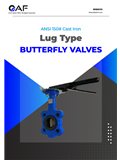 Lug type butterfly valves — cast iron, ANSI 150 drillingAF Hydro · PDFPDF
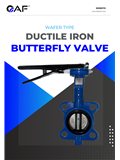 Ductile iron wafer type butterfly valves — PN10 · PN16 · ANSI 150 · JIS 10KAF Hydro · PDFPDF
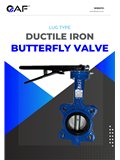 Ductile iron lug type butterfly valves — ANSI 150, tapped lugsAF Hydro · PDFPDF
Send the size, the body style and the fluid
The fluid matters more on this valve than on any other we stock, because the seat is rubber and it is the seal. Tell us what is in the line and how hot it gets, and we will confirm the seat is right, recommend wafer or lug, and quote a landed price. Stock in Malaysia and Singapore.