
Home › Products › High pressure valves › High pressure check valves
MHA Zentgraf & Inteva · ready stockHigh pressure check valves to ISO 228, NPT and SAE J514, 1/8" to 2"
A one‑way valve that screws into the line: free flow one way, shut the other, no handle and nothing to set. We stock two makes — MHA Zentgraf type RV in steel to 500 bar or SS316 to 350 bar, and the Inteva 504 series with a metal poppet and no seal to wear out. The catch on both is that the rating falls as the bore grows — the size‑by‑size tables are below.
Get a quotation within 2 working hours
Send the part number, standard, size or quantity. Stock in Malaysia or Singapore, ISO 9001:2015 certified.
What a high pressure check valve is, and when you need one
A spring, a poppet and a seat. No lever, no adjustment, nothing to leave in the wrong position.
A check valve lets fluid through in one direction only. A spring holds a poppet against its seat; when the upstream pressure beats the spring the poppet lifts and flow passes, and when the pressure drops back the spring reseats it before the flow can reverse. The pressure at which it first opens is the cracking pressure — 0.5 bar as standard on the MHA RV, 0.34 bar (5 psi) on the Inteva 504. It is also called a non‑return valve, and it works in a vertical or a horizontal line.
These are the threaded ones: a compact square or hex body that screws straight into a port or between two fittings, sized 1/8" to 2". Typical jobs are holding a load on a cylinder, protecting a pump or compressor from reverse flow, keeping one branch of a circuit from feeding back into another, and stopping the shock that a sudden reversal puts through a line. If your ports are SAE flange faces rather than threads, you want the SAE flange check valve instead — same function, different mounting.
| Threaded check valve (this page) | SAE flange check valve | |
|---|---|---|
| How it mounts | Screws into a threaded port or between two fittings | Bolts to an SAE flange face, four bolts and an O‑ring per side |
| Ends | Female thread — BSPP (ISO 228), NPT or SAE J514 UNF | SAE flange to ISO 6162‑1 or ISO 6162‑2 |
| Size range | 1/8" to 2" (DN6–DN40) | 1/2" to 2" (DN15–DN50) |
| Rating | To 500 bar in steel, falling with bore | 210 or 420 bar, set by the flange class |
| Cracking pressure | 0.34–0.5 bar standard | 2 bar standard |
| Comes as | One piece. Nothing else to order | Valve + 2 O‑rings + 2 holding plates; adapter plate separate |
| Reach for it when | The port is threaded, or you are building the valve into a pipe run | The port is already a flange face, or the line is too big to thread |
Specification
Everything an enquiry needs, in one place.
| Function | Spring‑loaded poppet check valve (non‑return). Free flow one way, closed against reverse flow |
| Makes stocked | MHA Zentgraf type RV (Germany) · Inteva 504 series ATR (Spain) |
| Size range | 1/8" to 2". MHA DN6–DN40; Inteva bore 4 mm to 50 mm |
| Max working pressure | MHA steel 500 bar to 1", 400 bar at 1¼", 350 bar at 1½" and 2". MHA stainless 350 bar throughout. Inteva 300 bar to 1½", 200 bar at 2" |
| Min burst pressure | Inteva 1200 bar to 1½", 800 bar at 2" — tested to ISO 18869 |
| Cracking pressure | MHA 0.5 bar standard, 4.5 bar option. Inteva 0.34 bar (5 psi) standard, six higher settings to 10 bar |
| Connections | Female thread. MHA: DIN ISO 228 (G / BSPP), ANSI B1.20.1 NPT, SAE J514 / ISO 11926‑1 UNF. Inteva: BSP or NPTF |
| Body material | Steel, or stainless SS316. Inteva carbon steel is to EN 10277‑3 |
| Seals | MHA: seat and seals per material code. Inteva: metal‑to‑metal poppet with no O‑ring as standard, or NBR / Viton / EPDM on request |
| Temperature | MHA −20 °C to +100 °C. Inteva depends on the seal: NBR −30/+100, Viton −10/+200, EPDM −40/+150 °C |
| Flow direction | B to A, marked on the body. See fitting it |
| Medium | Hydraulic oil. Inteva is rated for fluid Group II under 2014/68/EU |
| Certification | Works certificate on request. Inteva burst testing to ISO 18869 |
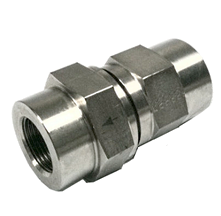
Buying high pressure check valves in Malaysia and Singapore
Where the stock sits, what it costs to get it to you, and how fast it moves.
Stock, delivery and ordering
- Where the stock is — the office is in Kuala Lumpur, and valves are held in two warehouses: Johor Bahru and Singapore. Addresses and direct lines are on the contact page.
- Dispatch — stock items leave the same or next working day.
- What is normally on the floor — MHA marks its own catalogue with which articles are usually stocked, and on the RV the run is the steel BSPP sizes. Stainless, NPT and the UNF ports are more often brought in, so those come back with a lead time on the quote.
- Delivery cost — already inside the product price, along with transport, currency conversion, duties and taxes. Nothing is added afterwards.
What moves where. Singapore is mostly marine, offshore and shipyard work, usually SS316. Malaysia is hydraulics, palm oil mills and mining, mostly steel.
How a check valve enquiry runs
Five things and we can price it without going back and forth:
- Port size and thread form — 1/8" to 2", and whether it is BSPP, NPT or SAE UNF. Not interchangeable.
- Working pressure — the line pressure, checked against the table for your bore rather than the headline figure.
- Flow rate — litres per minute. It sets the bore, not the port thread.
- Cracking pressure — standard, or one of the higher springs.
- The medium and the temperature — they pick steel against SS316, and the seal.
A product specialist prices it within two working hours. Replacing an existing valve? Send a photo of the body marking — on both makes the type and size are stamped on the flats.
MHA RV or Inteva 504?
Two different answers to the same job. Pressure decides it more often than price.
| MHA Zentgraf RV | Inteva 504 ATR | |
|---|---|---|
| Made in | Germany | Spain |
| Size range | DN6–DN40, 1/8"–2" | Bore 4–50 mm, 1/8"–2" |
| Max working pressure | 500 bar in steel to 1" | 300 bar to 1½" |
| Stainless option | SS316 body, 350 bar at every size | SS316 body, same rating as carbon |
| Closure | Poppet on a seat, sealed | Metal closure, no O‑ring — nothing to perish. Sealed versions on request |
| Cracking pressure | 0.5 bar, or 4.5 bar to order | Seven settings from 0.34 to 10 bar, chosen in the part number |
| Threads | BSPP, NPT and SAE J514 UNF | BSP; NPTF on request and minimum quantity |
| Burst figure published | No | Yes — 1200 bar to 1½", to ISO 18869 |
| Temperature ceiling | +100 °C | +200 °C with Viton seals |
| Choose it when | You need pressure above 300 bar, an SAE UNF port, or you are matching an existing MHA circuit | You want no elastomer in the flow path, a specific opening pressure, high temperature, or a published burst margin |
- Inteva publishes its interchangeability — the 504 is listed as interchangeable with Gromelle 4000, DMIC CVH, Parker DC and Snap‑tite CPIFF. If you are replacing one of those, send the old part number.
- Neither is adjustable in service. The cracking pressure is the spring you ordered, so it belongs in the enquiry rather than a later conversation.
Pressure by size — the number that catches people out
Neither make holds its headline figure across the whole range. Read your own row.
A check valve is quoted at a headline pressure and then used at whatever the line runs at. On both makes the rating steps down as the bore grows, and on the MHA RV the stainless body is rated lower than the steel one at every size — so a change of material can quietly halve your margin. These are the makers’ own figures.
| MHA type | Port | Inch | Steel body PN | SS316 body PN |
|---|---|---|---|---|
| RV‑DN6 | G1/8 | 1/8" | 500 bar | 350 bar |
| RV‑DN8 | G1/4 | 1/4" | 500 bar | 350 bar |
| RV‑DN10 | G3/8 | 3/8" | 500 bar | 350 bar |
| RV‑DN12 | G1/2 | 1/2" | 500 bar | 350 bar |
| RV‑DN16 | G3/4 | 3/4" | 500 bar | 350 bar |
| RV‑DN20 | G1 | 1" | 500 bar | 350 bar |
| RV‑DN25 | G1 1/4 | 1¼" | 400 bar | 350 bar |
| RV‑DN30 | G1 1/2 | 1½" | 350 bar | 350 bar |
| RV‑DN40 | G2 | 2" | 350 bar | 350 bar |
MHA type RV, catalogue sheet dated 10.04.2015. The same ladder applies on the NPT and SAE UNF ports. MHA prints its own warning on the sheet: “Please note the pressure ratings of the tube connections!” — the valve is only ever as strong as the fitting screwed into it.
| Inteva bore | Inch | Max rated flow | Max working pressure | Min burst pressure |
|---|---|---|---|---|
| 04 | 1/8" | 8 l/min · 2.11 gpm | 300 bar · 4350 psi | 1200 bar · 17,400 psi |
| 06 | 1/4" | 26 l/min · 6.87 gpm | 300 bar · 4350 psi | 1200 bar · 17,400 psi |
| 10 | 3/8" | 44 l/min · 11.6 gpm | 300 bar · 4350 psi | 1200 bar · 17,400 psi |
| 13 | 1/2" | 90 l/min · 23.85 gpm | 300 bar · 4350 psi | 1200 bar · 17,400 psi |
| 20 | 3/4" | 152 l/min · 40.2 gpm | 300 bar · 4350 psi | 1200 bar · 17,400 psi |
| 25 | 1" | 200 l/min · 52.8 gpm | 300 bar · 4350 psi | 1200 bar · 17,400 psi |
| 32 | 1¼" | 370 l/min · 97.8 gpm | 300 bar · 4350 psi | 1200 bar · 17,400 psi |
| 40 | 1½" | 598 l/min · 158 gpm | 300 bar · 4350 psi | 1200 bar · 17,400 psi |
| 50 | 2" | 875 l/min · 231 gpm | 200 bar · 2900 psi | 800 bar · 11,600 psi |
Inteva 504 series, technical data v11. Burst testing to ISO 18869. Note the last row: at 2" the working pressure drops to 200 bar and the burst figure with it, so a 2" Inteva is a different proposition from the rest of the range.
Ports, threads and dimensions
The DN number is not the thread size. Check the column, not the name.
On the MHA RV the DN figure is the bore, not the port: an RV‑DN20 is a 1" valve and an RV‑DN40 is a 2". That mismatch is behind a good share of wrong orders, so the thread is spelled out for all three connection standards below. L is the overall length, i the thread depth and B the square across the flats.
| Type | BSPP (ISO 228) | NPT (ANSI B1.20.1) | SAE J514 UNF | L | i | B | Weight |
|---|---|---|---|---|---|---|---|
| RV‑DN6 | G1/8 | 1/8" NPT | — | 45 | 9.5 | 16 | 0.10 kg |
| RV‑DN8 | G1/4 | 1/4" NPT | 7/16"‑20 UNF | 55 | 13.5 | 25 | 0.20 kg |
| RV‑DN10 | G3/8 | 3/8" NPT | 9/16"‑18 UNF | 65 | 13.5 | 30 | 0.40 kg |
| RV‑DN12 | G1/2 | 1/2" NPT | 3/4"‑16 UNF | 73 | 15.5 | 35 | 0.60–0.70 kg |
| RV‑DN16 | G3/4 | 3/4" NPT | 1 1/16"‑12 UN | 88 | 17.5 | 45 | 1.20 kg |
| RV‑DN20 | G1 | 1" NPT | 1 5/16"‑12 UN | 127 | 19.5–20 | 50 | 1.90–2.00 kg |
| RV‑DN25 | G1 1/4 | 1 1/4" NPT | 1 5/8"‑12 UN | 143 | 20–21.5 | 60 | 3.00–3.30 kg |
| RV‑DN30 | G1 1/2 | 1 1/2" NPT | 1 7/8"‑12 UN | 139.5–143 | 20–23.5 | 70 | 3.90–4.20 kg |
| RV‑DN40 | G2 | 2" NPT | 2 1/2"‑12 UN | 165 | 21–25.5 | 90 | 7.20–8.00 kg |
Dimensions in mm. Where a range is shown, the figure varies slightly between the BSPP, NPT and UNF versions of the same size — ask if the exact figure matters for the envelope. The SAE UNF port starts at DN8; there is no UNF version of the DN6.
| Inteva bore | Inch | BSP reference | NPTF reference | Hex (CH) | Length (B) |
|---|---|---|---|---|---|
| 04 | 1/8" | 504.110000AA | 504.110000BA | 14 | 42.5 |
| 06 | 1/4" | 504.110001AB | 504.110001BB | 19 | 56 |
| 10 | 3/8" | 504.110002AC | 504.110002BC | 22 | 67.5 |
| 13 | 1/2" | 504.110003AD | 504.110003BD | 30 | 77 |
| 20 | 3/4" | 504.110004AE | 504.110004BE | 36 | 90 |
| 25 | 1" | 504.110005AF | 504.110005BF | 46 | 106 |
| 32 | 1¼" | 504.110006AG | 504.110006BG | 55 | 125 |
| 40 | 1½" | 504.110007AH | 504.110007BH | 60 | 140 |
| 50 | 2" | 504.110008AI | 504.110008BI | 75 | 160 |
Dimensions in mm. The references above are the carbon steel, unsealed, 5 psi build — the standard shelf item. Change the material, the seal or the opening pressure and the digits change with it; see how the part number is built.
Cracking pressure — pick it before you order
It is a spring inside a sealed body. There is no adjuster.
The cracking pressure (also called opening pressure) is the differential the upstream side has to beat before the poppet lifts. Too low and the valve chatters or passes when you wanted it shut; too high and you are paying that figure back as pressure drop on every litre that goes through. It is fixed by the spring fitted at build, so it is chosen in the part number and cannot be changed on site.
MHA Zentgraf RV
- 0.5 bar — standard, every size, steel and stainless.
- 4.5 bar — the catalogue option, ordered as PÖ.
Two settings, so the choice is quick: the low one for a plain non‑return, the 4.5 bar where the valve also has to hold a small back pressure to keep another branch loaded.
Inteva 504
- 0.34 bar (5 psi) — standard.
- 1 bar (14 psi) · 2.5 bar (36 psi) · 4.5 bar (65 psi)
- 6 bar (87 psi) · 8 bar (115 psi) · 10 bar (145 psi)
Seven settings, each with its own two digits in the reference, and all held to ±0.3 bar. If you are tuning a circuit rather than just blocking reverse flow, this is the range to work in.
Steel or SS316, and which seal
The medium picks the body. The temperature picks the seal.
Both makes offer the same body in carbon steel and in stainless SS316. Steel is the default for hydraulic oil in a machine; SS316 is for salt air, washdown, chemical service and anything going offshore. On the MHA RV the choice costs you pressure — stainless is capped at 350 bar where the steel body reaches 500 — while on the Inteva the two materials share the same rating.
| MHA RV, code 1 | MHA RV, code 4 | Inteva 504 | |
|---|---|---|---|
| Body | Steel | Stainless steel | Carbon steel to EN 10277‑3, or SS316 |
| Closure | Poppet on seat | Poppet on seat | Metal poppet, no O‑ring (sealed versions available) |
| Spring | Per build | Per build | EN 10270‑3/‑1/SH |
| Seal options | Per material code | Per material code | NBR, Viton (FPM) or EPDM |
| Temperature | −20 to +100 °C | −20 to +100 °C | NBR −30/+100 · Viton −10/+200 · EPDM −40/+150 °C |
| Max pressure | To 500 bar | 350 bar all sizes | 300 bar (200 bar at 2") |
| Typical use | Machine hydraulics, mills, mining | Marine, offshore, washdown | Industrial; the stainless is listed for chemical and offshore |
- No seal is not a compromise, it is the point. Inteva builds the standard 504 with a metal closure and no elastomer in the flow path — there is nothing in it to swell, harden or extrude, and it takes pressure peaks better for the same reason. Where you need a soft seat for tighter shut‑off, the sealed versions are the ones to ask for.
- Viton is the reason to look at Inteva for hot oil. At +200 °C it is a hundred degrees past where either MHA body is rated.
Flow and pressure drop
Size the valve on the flow, not on the thread that happens to be in the port.
A check valve is a restriction, and the drop across it rises steeply once the bore is undersized. The flow figure decides the bore; the port thread is then whatever adapts to your pipework. If the flow sits near the top of a size, go up one — the cost difference is small next to the energy you pay for a permanent 3 bar loss.
| Bore | Inch | Inteva max rated flow | Rounded l/min per mm of bore |
|---|---|---|---|
| 04 | 1/8" | 8 l/min | 2 |
| 06 | 1/4" | 26 l/min | 4.3 |
| 10 | 3/8" | 44 l/min | 4.4 |
| 13 | 1/2" | 90 l/min | 6.9 |
| 20 | 3/4" | 152 l/min | 7.6 |
| 25 | 1" | 200 l/min | 8 |
| 32 | 1¼" | 370 l/min | 11.6 |
| 40 | 1½" | 598 l/min | 15 |
| 50 | 2" | 875 l/min | 17.5 |
- Inteva plots the drop. Every size sits on one pressure‑drop curve with its rated‑flow point marked, and those points fall between roughly 1.5 and 3.5 bar. Ask for the curve for your size if the drop is part of your calculation.
- MHA publishes curves, not a single number. The RV sheet carries a Δp characteristic for each size from DN6 to DN40, valid for hydraulic oil of 880 kg/m³ and 35 mm²/s kinematic viscosity, over a 0 to 15 bar drop. Tell us the flow and we will read your size off it.
- Viscosity matters. Both sets of figures are for a mineral hydraulic oil at those conditions. A thicker fluid, or a cold start, will drop more than the curve says.
How to identify a check valve you already have
Both makes stamp what they are on the body. You rarely need to take anything apart.
Before you measure anything, look at the flats. An MHA body carries the type and size — RV‑DN20‑G1 style — along with the works order number. An Inteva body carries the series name, the size, the batch date and the material. If the marking has worn off, the two things that identify it are the thread (form and size, gauged rather than guessed) and the across‑flats figure, both in the dimension tables.
| Position | Inteva 504 reference, digit by digit |
|---|---|
504. | Series |
| next digit | Material — 1 carbon steel, 2 SS316 |
| next digit | Closing — 1 poppet |
| next digit | Seal — 0 none, 1 NBR (90 Sh), 2 Viton, 3 EPDM |
| next two digits | Opening pressure — 00 = 0.34 bar, 10 = 1 bar, 25 = 2.5, 45 = 4.5, 60 = 6, 80 = 8, 99 = 10 bar |
| next digit | Size — 0 = 1/8" through 8 = 2" |
| two letters | Thread — the first letter is the form (A BSP, B NPTF), the second the size |
So 504.110003AD reads: 504 series, carbon steel, poppet, no seal, 0.34 bar opening, size 13 (1/2"), BSP. Change one digit and you change one thing — which makes it straightforward to reorder the same valve with a different spring.
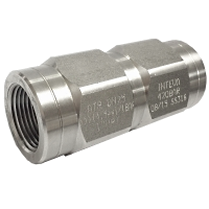
ATR, DN25, the batch date and SS316 — series, size, when it was made and what it is made of, without opening anything. Inteva sizes in millimetres of bore, so DN25 is the 1" valve.Fitting it
One decision matters more than all the rest: which way round it goes.
Before it goes in
- Look through it. Both ends should be clear of swarf, thread sealant and packing debris — a chip on the seat is the commonest cause of a valve that will not hold.
- Push the poppet off its seat with something blunt and let it go. It should move freely and snap back.
- Check both ports for burrs and damaged thread crests before you make anything up.
- Confirm the rating for your bore against the table, and the rating of the fittings you are screwing into it.
Direction, and how to read it
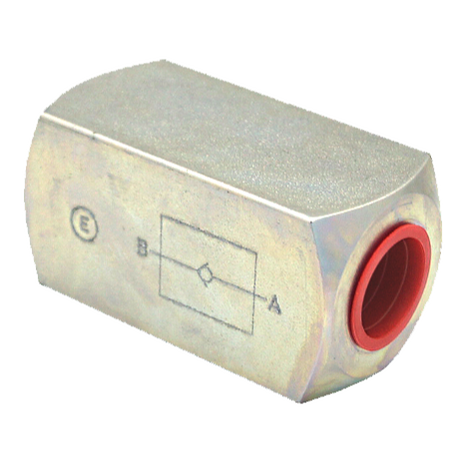
MHA states the flow direction as B to A, and the body carries either an arrow or the check‑valve symbol with the ports lettered. Either way:
- The arrow points the way flow is allowed to pass — from your pressure source, through the valve, to the load.
- B is the inlet, A is the outlet. Fit it backwards and you have blocked the line rather than protected it — and the symptom looks like a blockage somewhere else entirely.
- Vertical or horizontal both work. There is no preferred attitude; the spring does not rely on gravity.
- Support the pipework so the valve is not carrying pipe weight or taking vibration through the threads.
Nothing to set afterwards. If the cracking pressure turns out wrong for the circuit, that is a different spring — not an adjustment.
Why buy high pressure check valves from RFS Hydraulics
Six things that decide whether a valve order goes smoothly.
Ready stock on the running sizes
Held in Johor Bahru and Singapore, dispatched the same or next working day. The steel BSPP sizes are the ones that move; anything else comes back with a lead time on the quote rather than a guess.
Two makes, so you get the right one
MHA Zentgraf when you need 500 bar or an SAE UNF port, Inteva when you want no elastomer in the flow path, a specific opening pressure or +200 °C. One supplier, both answers.
We read the pressure table for you
The rating steps down with bore and the stainless RV sits below the steel at every size. We check your line pressure against your actual size before quoting, which is where this normally goes wrong.
Marked, branded, traceable
German and Spanish made, with the type, size and material stamped on the body — not an unbranded valve with a figure on the box. Works certificates on request.
Cross‑reference for replacements
Inteva publishes interchangeability with Gromelle, DMIC, Parker and Snap‑tite. Send the old part number or a photo of the marking and we will match it.
One price, delivered
Transport, currency, duties and taxes are already inside the figure we quote. Nothing is added at the end, and delivery within Malaysia is included.
Frequently asked questions
Fifteen, starting with the one that causes the most trouble on site.
Which way round does a check valve go?
MHA states the flow direction as B to A, and the body is marked either with an arrow or with the check‑valve symbol and the ports lettered. The arrow points the way flow is allowed to pass, so it points from your pressure source towards the load. Fitted the wrong way round the valve simply blocks the line, and the symptom usually looks like a blockage somewhere else. It works equally well in a vertical or a horizontal line.
What is cracking pressure, and which one should I ask for?
It is the pressure difference the inlet has to beat before the poppet lifts. The MHA RV is 0.5 bar as standard with a 4.5 bar option; the Inteva 504 offers seven settings from 0.34 bar (5 psi) up to 10 bar (145 psi), held to plus or minus 0.3 bar. Choose the lowest figure that reliably keeps the valve shut when you want it shut, because everything above that is pressure drop you pay for on every litre. If the valve also has to hold a small back pressure to keep another branch loaded, that is when the higher springs earn their place.
Can the cracking pressure be adjusted after delivery?
No. It is a spring inside a closed body and there is no adjuster on either make, so the setting is chosen in the part number at order. That is why we ask for it up front rather than after the valve has arrived. If a circuit turns out to need a different figure, it is a different valve, not a site adjustment.
Is an RV‑DN20 a 20 mm valve?
No, and this is the commonest ordering mistake on this product. On the MHA RV the DN figure refers to the bore, not the port thread: DN20 takes a G1 or 1 inch NPT port, DN25 is 1 1/4 inch, DN30 is 1 1/2 inch and DN40 is the 2 inch. Work from the thread column in the dimensions table rather than from the DN number. Inteva sizes in millimetres of bore in the same way, so an Inteva DN25 is also the 1 inch valve.
What is the maximum working pressure?
It depends on the size and the material, not on the range. The MHA RV in steel holds 500 bar from DN6 to DN20 (1/8 inch to 1 inch), then 400 bar at DN25 and 350 bar at DN30 and DN40. The stainless RV is 350 bar at every size. The Inteva 504 is 300 bar to 1 1/2 inch and 200 bar at 2 inch. Always check the row for your own size, and remember MHA prints its own reminder to check the rating of the tube connections screwed into the valve.
Why is the stainless version rated lower than the steel one?
On the MHA RV the stainless body is held to 350 bar across the whole range while the steel reaches 500 bar in the smaller sizes. So swapping to stainless for corrosion reasons can quietly cut your pressure margin by a third, and it is worth checking the number rather than assuming the material is a straight substitution. On the Inteva 504 the SS316 and the carbon steel bodies carry the same rating, so there is no penalty in changing material there.
Does the 2 inch Inteva really drop to 200 bar?
Yes. Every size from 1/8 inch to 1 1/2 inch is rated 300 bar with a minimum burst of 1200 bar, and the 2 inch drops to 200 bar working with an 800 bar burst. Burst figures are tested to ISO 18869. If you need more than 200 bar at 2 inch, the MHA RV‑DN40 at 350 bar is the alternative in the same port size.
Do I need BSPP, NPT or SAE UNF?
Whichever your port already is — they are not interchangeable, and forcing one into another damages both. BSPP (G, to ISO 228) is parallel and seals on a washer or an O‑ring; NPT is tapered and seals on the thread itself; SAE J514 UNF is a straight thread sealing on an O‑ring in the port face. MHA offers all three on the RV, though the SAE UNF port starts at DN8 rather than DN6. Inteva supplies BSP as standard, with NPTF on request and against a minimum quantity. If you are not certain what you have, gauge it or send us a photo with a thread gauge on it.
Can I use one of these on water?
Both are specified for hydraulic oil — Inteva lists the 504 for oil hydraulics in fluid Group II under the pressure equipment directive, and MHA quotes its flow figures for a mineral oil of 880 kg per cubic metre. Water and water‑glycol change both the material choice (stainless rather than steel) and the seal choice, and they change the flow behaviour as well. Tell us the medium and the temperature and we will confirm whether the standard build suits it before you order.
What temperature will it take?
The MHA RV is rated minus 20 to plus 100 degrees C in both steel and stainless. On the Inteva 504 the limit comes from the seal: NBR minus 30 to plus 100, Viton minus 10 to plus 200, EPDM minus 40 to plus 150 degrees C. So if you are above 100 degrees C the Inteva with Viton seals is the one to look at, and if you are well below zero the EPDM build gives the most headroom at the cold end.
Does the Inteva have an O‑ring in it?
Not in the standard build. Inteva makes the 504 with a metal closure and no O‑ring in the flow path, which is the main reason to choose it: there is nothing in the valve to swell, harden or extrude, and it takes pressure peaks better. Versions with O‑rings are available, in NBR, Viton or EPDM, and the seal is part of the reference number. Ask for the sealed build if tight shut‑off matters more than having no elastomer in the line.
Will it shut off drop‑tight?
A check valve is there to stop reverse flow, and neither maker specifies it as a zero‑leakage isolator. A metal‑to‑metal closure in particular is not a soft‑seated seal, so if your application needs a genuinely tight shut‑off, either ask for the sealed Inteva build or put a proper isolating valve in the line as well — a high pressure ball valve does that job. Tell us which of the two you actually need and we will not sell you the wrong one.
What replaces a Gromelle, Parker, DMIC or Snap‑tite check valve?
Inteva publishes the 504 as interchangeable with Gromelle 4000, DMIC CVH, Parker DC and Snap‑tite CPIFF. Send us the old part number, or a photo of the body marking, and we will come back with the 504 reference — including the opening pressure, which is the part people forget to carry across when they swap brands.
Can a check valve be repaired?
In practice, no. These are compact one‑piece bodies with no service kit, and at these pressures a reworked seat is not something to rely on. If a valve is passing, the usual cause is debris on the seat rather than wear — so it is worth flushing the line and looking through the valve before condemning it. Beyond that, replacement is the answer, and it is cheap next to the downtime.
Do you supply a certificate with it?
A works certificate is available on request — ask for it with the order rather than afterwards, while the batch is still identifiable. Inteva also publishes that its burst pressures are tested to ISO 18869, and both makes stamp the body with enough information (type, size, material, batch or works order) to tie a valve in your hand back to what was supplied.
Catalogues
Direct PDF download — no form, no email address.
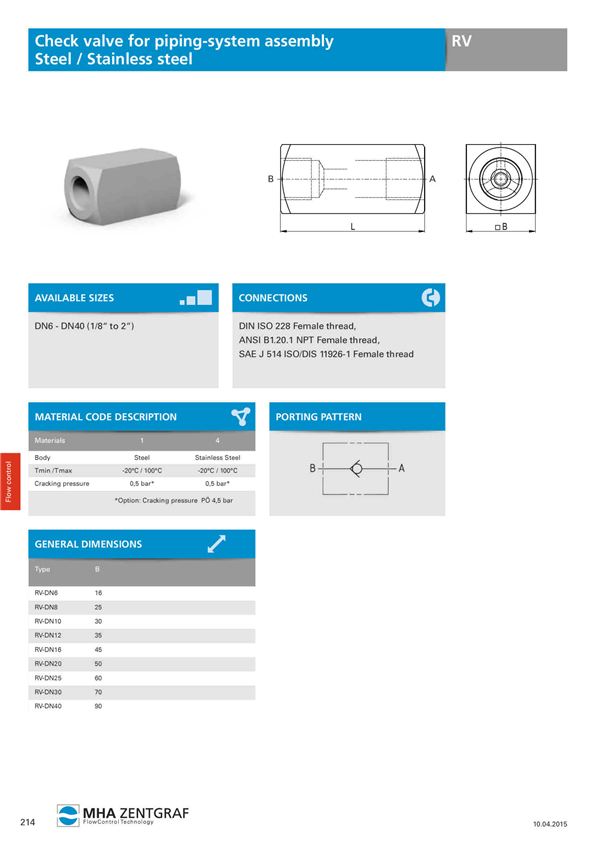 Type RV — DN6 to DN40, steel and stainlessMHA Zentgraf · PDFPDF
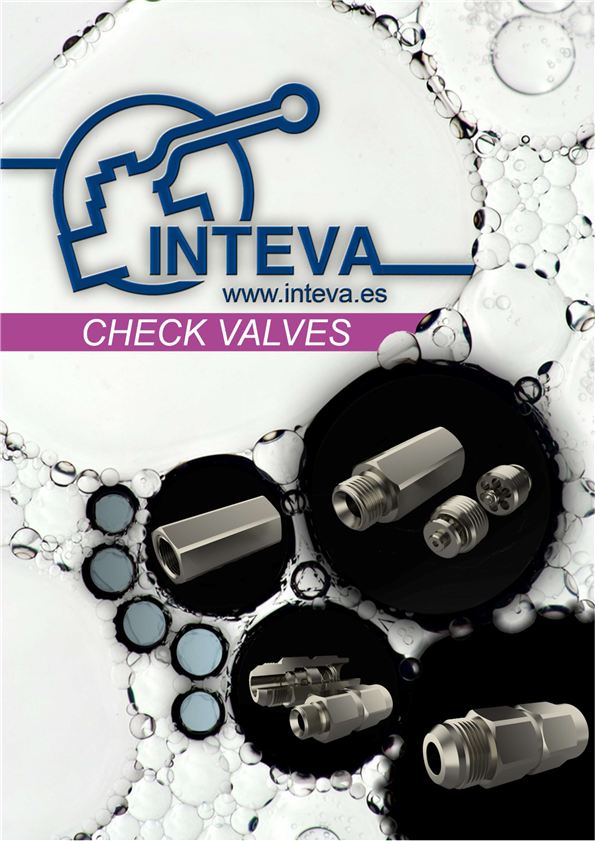 504 series ATR — 1/8" to 2", carbon and SS316Inteva · PDFPDF
Related: SAE flange check valves for flanged ports · high pressure ball valves for isolation · needle valves for regulation.
Send the port size, the thread form, the pressure and the flow.
Or a photo of the body marking. A product specialist confirms the part number within two working hours.