
Home › Products › High pressure fittings › Forged pipe fittings
ASME B16.11 · ready stockForged pipe fittings to ASME B16.11, 1/8" to 4" NB
Threaded and socket‑weld fittings for nominal bore pipe, forged rather than cast or fabricated, in carbon steel A105 and stainless steel SS316. Class 3000 and 6000. The heavy wall is what lets them carry a cut thread or a machined socket and still hold pressure — and the class number is a designation, not a working pressure. Stock in Johor Bahru and Singapore.
Get a quotation within 2 working hours
Send the part number, standard, size or quantity. Stock in Malaysia or Singapore, ISO 9001:2015 certified.
What a forged pipe fitting is
Forged, not cast — which is the whole point of the product.
A forged pipe fitting joins two runs of nominal bore pipe. It gets its name from how it is made: alloy or carbon steel is heated to its transforming temperature and pressed into shape in a die, rather than poured into a mould or welded up from plate. The result is a dense, grain‑aligned part with no porosity, and a wall deliberately thicker than the pipe it joins.
That thick wall is not over‑engineering. It is there so the fitting can have a tapered thread cut into it, or a socket machined into it, and still have enough metal left to carry the pressure. A thin‑wall fitting cannot do either.
- The governing standard is ASME B16.11. It sets the pressure–temperature ratings, dimensions, tolerances, markings and material requirements — so a class 3000 socket‑weld elbow from one maker interchanges with another’s.
- Also made to MSS‑SP‑79, 83, 95 and 97 and BS 3799, which cover reducing inserts, unions, bull plugs and branch outlet fittings.
- Where it is used: chemical, power generation, and oil and gas — anywhere the pressure is high, the medium is aggressive, or both.
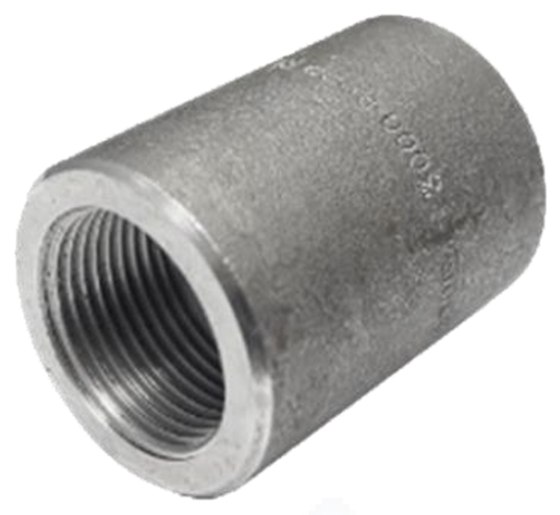
- Every fitting is permanently marked on the collar, and that marking tells you the size, class, material and heat number. How to read it.
Where it is the right choice
- Small‑bore high‑pressure pipework — instrument tapping points, drains, vents, sample lines.
- Where a flange would be absurd — below about 2" NB a flanged joint costs more and takes more room than it earns.
- Corrosive or high‑temperature duty in SS316.
- Anywhere the joint must be permanent — socket weld gives a joint with nothing to loosen.
Where something else is better
- Tube, not pipe. If you are working to an outside diameter rather than a nominal bore, you want DIN 2353 compression fittings or double ferrule fittings.
- Joints that come apart regularly — a quick release coupling, or a three‑piece union rather than a plain coupling.
- Onto hose — that is JIC, on a 37° flare.
- Large bore — above 4" NB this range stops and you are into flanges.
Specification
Everything an enquiry needs, in one place.
| Type | Forged pipe fitting, threaded or socket weld, for nominal bore pipe |
| Standards | ASME B16.11 · MSS‑SP‑79 · MSS‑SP‑83 · MSS‑SP‑95 · MSS‑SP‑97 · BS 3799 |
| Size range | 1/8" to 4" NB (nominal bore) |
| Pressure class | Class 3000 and Class 6000 from stock — marked 3M and 6M. Class 2000 and 9000 exist in the standard and are made to order |
| Materials | Carbon steel A105 · stainless steel SS316 (ASTM A182 F316) |
| Connections | Threaded — NPT tapered, or BSP parallel on straight items · Socket weld |
| Body styles | Couplings, half couplings, 90° and 45° elbows, street elbows, tees, three‑piece unions, caps, plugs, hex nipples, hex bushes — full list |
| Marking | Permanently stamped on the collar: trademark, country of origin, standard, size, class, material and heat number |
| Matching pipe schedule | SCH 80 to SCH XXS depending on class and connection — see the table |
| Reducing sizes | Available — reducing tees, hex nipples and bushes. Give us both sizes |
| Made to order | Mixed‑end fittings can be machined — for example a full coupling with one threaded end and one socket weld end |
| Stock | Held in Johor Bahru and Singapore |
The figure people misread is the class. 3000 and 6000 are class designations, not working pressures. The pressure your fitting will actually carry comes from the pressure–temperature table in ASME B16.11 for your material at your temperature — and it falls as the temperature rises. Tell us the duty and we will confirm the figure.
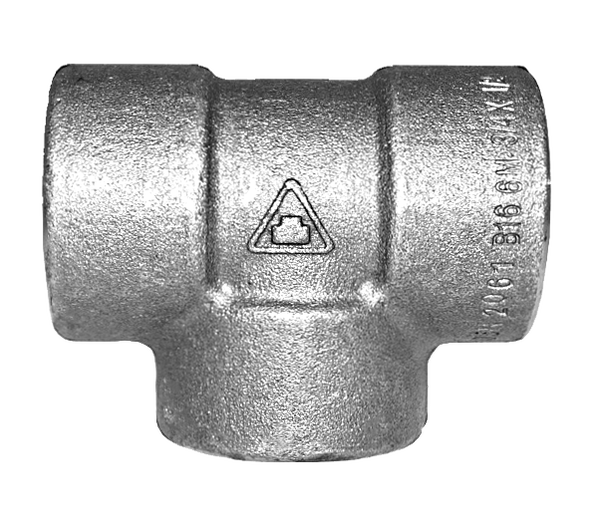
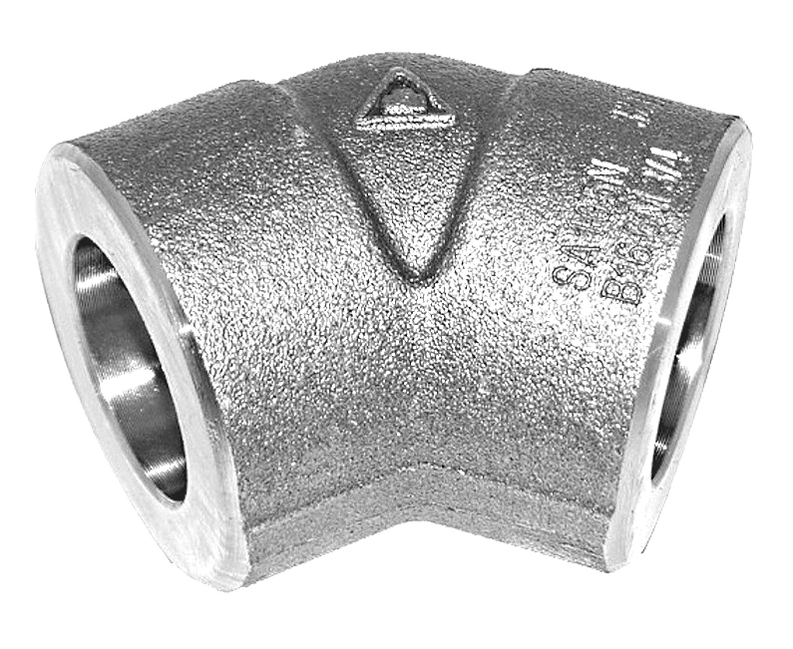
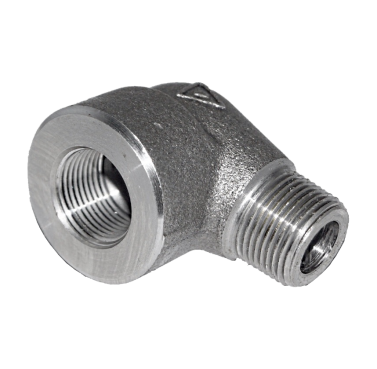
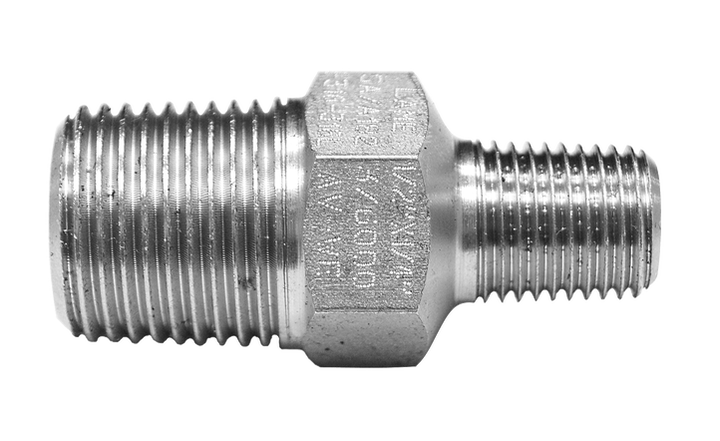
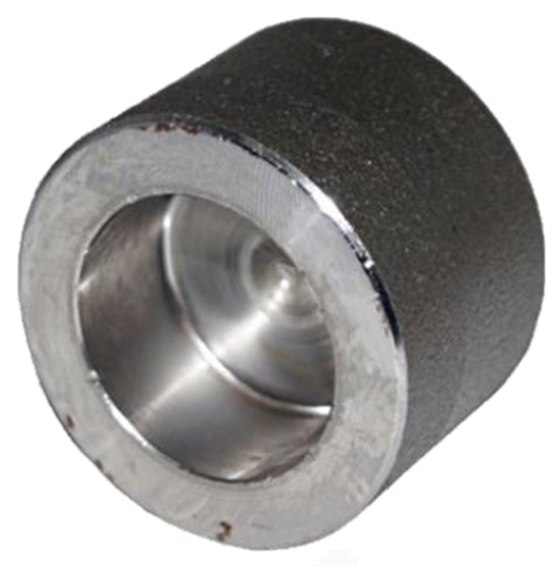
What the body styles look like, and what the marking tells you.
Buying forged pipe fittings in Malaysia and Singapore
Where the stock sits, and the five things we need to quote.
Stock, delivery and ordering
- Running sizes in A105 and SS316, class 3000 and 6000, are held in Johor Bahru and Singapore.
- On a stocked item, order to delivery can be under three working days.
- One price, delivered — transport, currency, duties and taxes are inside the quoted figure.
- Mixed‑end and special fittings are machined to order. Tell us what you need and we will quote the lead time with the price.
What we need from you
- Nominal bore — and both sizes if it is a reducing fitting.
- Class — 3000 or 6000. If you do not know, give us the working pressure and temperature instead.
- Material — A105 or SS316.
- Connection — NPT, BSP, or socket weld. Say which end, if they differ.
- Body style — and for a tee, whether the branch reduces.
What 3M and 6M actually mean
A class is a wall thickness, not a promise of pressure.
Forged fittings are made in class 2000, 3000, 6000 and 9000. In practice almost everything sold is class 3000 or 6000, and that is what we stock. On the fitting the class is stamped as 3M or 6M, where the M means thousand — so 3M is a class 3000 fitting.
The number began life as a pounds‑per‑square‑inch figure — class 3000 nominally 3000 psi, about 207 bar. Treat that as a label, not a rating. What a fitting will carry on your system depends on the material and the temperature, read off the pressure–temperature table in ASME B16.11, and it comes down as the temperature goes up. Two fittings marked 6M in different materials are not the same duty.
| Compared at the same bore | Class 3000 — 3M | Class 6000 — 6M |
|---|---|---|
| Body size | Smaller | Bigger |
| Wall thickness | Thinner | Thicker |
| Unit weight | Lighter | Heavier |
| Rated pressure | Lower | Higher |
| Nominal reference | 3000 psi ≈ 207 bar | 6000 psi ≈ 414 bar |
| Matching pipe | SCH 80 socket weld · SCH 160 threaded | SCH 160 socket weld · SCH XXS threaded |
- Same bore, bigger outside. A 6M fitting is physically larger across the flats than a 3M of the same nominal bore. Check your clearances before you upgrade class on a crowded manifold.
- Do not mix class within a joint. A 6M fitting on SCH 80 pipe is a 6M fitting on SCH 80 pipe — the weakest part sets the duty, and that is the pipe.
- Class 2000 and 9000 are in the standard but are not shelf items here. We can source them; expect a lead time.
The body styles, and how each one connects
Ten shapes cover almost every job.
Ordering goes wrong more often over which ends are male and which are female than over size or class. This is the full list as we stock it.
| Body style | Connection | What it is for |
|---|---|---|
| Straight coupling | Female × female | Joining two pipes in line. Also called a full coupling |
| Half coupling | Female | One socket only — welded to a vessel or a header as a branch or tapping point |
| 90° / 45° elbow | Female × female | Changing direction |
| 90° / 45° street elbow | Female × male | Turning straight out of a port without an extra nipple |
| Three‑way tee | Female × female × female | Combining two flows into one, or splitting one into two. Available reducing on the branch |
| Three‑piece union | Female × female | A joint you can break for maintenance without cutting pipe |
| End cap | Female | Closing off a male pipe end |
| Hex plug | Male | Closing off a female port |
| Hex nipple | Male × male | Joining two female ports. Available reducing to step size down |
| Hex bush | Female × male | Stepping a port up in size — the reverse of a reducing nipple |
- Cap and plug are not interchangeable. A cap goes over a male end; a plug goes into a female port. Both close a line off, and ordering the wrong one is the single most common mix‑up on this range.
- Reducer versus bush. A reducing nipple takes the flow size down; a hex bush takes it up. Give us the size at each end and the direction stops being ambiguous.
- Street elbows save a joint. Female one end, male the other — so you can turn directly off a port instead of fitting a nipple and then an elbow. One less thread to leak.
- Standard fittings have the same connection on every end. Anything mixed — one threaded end, one socket weld — is a machined special, and we can have it made.
Threaded or socket weld — and the pipe that goes with it
Two ways to make the joint, and the schedule each one expects.
Threaded
- NPT is the usual choice. The tapered thread means male and female wedge together and compress as they tighten, which is what forms the seal.
- BSP parallel is available — but only on straight items: full couplings, hex nipples and hex plugs.
- The pipe has to be threaded too. A threaded fitting needs a male threaded pipe end, cut on site or supplied ready‑threaded.
- It comes apart. That is the advantage — and the reason a threaded joint is the one that weeps if it was not made up properly.
Socket weld
- Simpler and stronger. The plain pipe end drops into a recess in the fitting and is fillet welded round the outside.
- No thread cutting, on the pipe or the fitting — so nothing to seal and nothing to loosen under vibration.
- Permanent. If the line may need breaking later, put a three‑piece union in it deliberately.
- Cut the pipe square and clean, and leave the small root gap the procedure calls for. Bottoming the pipe hard into the socket is the classic mistake.
Matching pipe schedule
Fitting and pipe are chosen together. A heavier class expects a heavier pipe — otherwise you have paid for a fitting whose capability the pipe cannot use.
| Class | Connection | Pipe schedule |
|---|---|---|
| 3000 lb | Socket weld | SCH 80 |
| 3000 lb | Threaded | SCH 160 |
| 6000 lb | Socket weld | SCH 160 |
| 6000 lb | Threaded | SCH XXS |
- Threaded needs the heavier pipe of the two. Cutting a thread removes wall, so a threaded joint expects a thicker schedule than a socket weld of the same class.
- This table is a reference, not a rule. It is not compulsory to pair them this way.
- The real number is a calculation. Minimum pipe wall has to account for the design pressure, corrosion allowance, thread depth, temperature and the environment. If nobody has done that sum for your line, do it before you buy the pipe — not after.
Reading the marking
Every fitting is stamped. It tells you everything you need to reorder.
ASME B16.11 requires the fitting to be permanently marked, and on this range the stamping is engraved into the collar. Between them the characters give you the maker, the standard, the size, the class, the material and the batch. Read it before you measure anything.
| What is marked | What it tells you |
|---|---|
| Manufacturer trademark | Who made it. Worth matching when you reorder |
| Country of origin | Required by the standard |
| Specification standard | Usually B16 for ASME B16.11 |
| Fitting size | Nominal bore. On a reducing fitting, both sizes — e.g. 3/4 × 1/2 |
| Class | 3M or 6M — class 3000 or 6000 |
| Material identification | 316 or F316 for stainless. A105 is not marked — carbon steel is the default group, so an unmarked material means A105 |
| Heat number | The batch, so the fitting can be traced back to its mill certificate |
The one that catches people out: no material marking does not mean unmarked stock — it means carbon steel A105. Stainless is always stamped.
What forged pipe fittings are used for
Three minutes: the standard, the classes, the body styles and the pipe thickness.
- 0:08 what forged pipe fittings are · 0:57 what 3000 and 6000 mean · 1:36 the different body styles · 2:27 how to determine pipe and fitting thickness.
- The section at 2:27 is the one to watch if you are specifying pipe as well as fittings — it is the same ground as the schedule table above.
Why buy forged pipe fittings from us
Stocked locally, and quoted by people who ask the right questions.
We ask which ends are male
Most wrong deliveries on this range are a cap sent for a plug, or a bush for a nipple. We confirm the connection on every end before the order goes in.
Stock on both sides of the causeway
Johor Bahru and Singapore, in A105 and SS316, class 3000 and 6000 — so a stocked item can be on site in under three working days.
Class checked against your duty
Give us the pressure and temperature and we will confirm the class against the B16.11 table, rather than reading the psi off the stamp.
Specials machined to order
Mixed threaded and socket‑weld ends, odd reducing combinations — we can have them made and will quote the lead time up front.
Heat numbers traceable
The heat number is stamped on every fitting, so a mill certificate can be matched to the piece in your hand when the inspector asks.
Landed pricing
One figure, delivered — transport, currency, duties and taxes already inside it. No surprise at the door.
Questions we get asked
The ones that come up on the phone.
What does 3M or 6M mean on a forged fitting?
The pressure class, with M meaning thousand. 3M is class 3000 and 6M is class 6000. The number started as a pounds‑per‑square‑inch figure — nominally about 207 bar and 414 bar — but treat it as a designation. What the fitting will carry on your line comes from the pressure–temperature table in ASME B16.11 for your material at your temperature.
Is a class 6000 fitting twice as strong as a class 3000?
No. It is physically bigger and thicker walled at the same nominal bore, and it carries more pressure — but the relationship is not a simple doubling, and in any case the pipe usually becomes the limit before the fitting does. A class 6000 fitting welded onto SCH 80 pipe gives you a SCH 80 line. Match the pipe to the class, or the extra fitting cost buys nothing.
What is the difference between an end cap and a hex plug?
Which way round the thread goes. A cap is female and fits over a male pipe end. A plug is male and screws into a female port. Both close a line off. This is the most frequent ordering mix‑up on the whole range, so tell us what you are closing rather than what the part is called and we will send the right one.
What is a street elbow?
An elbow with female thread on one leg and male on the other, in either 90° or 45°. A plain elbow is female on both legs, so turning out of a male port needs a nipple first. A street elbow does it directly — shorter, and one less threaded joint to make and to leak.
Should I use threaded or socket weld?
Socket weld if the joint is permanent — it is simpler, stronger, has nothing to loosen under vibration and needs no thread cut on the pipe. Threaded if the line has to come apart, or if there is no welding on site. If you choose socket weld but expect to break the line later, design a three‑piece union into it rather than compromising on threads throughout.
Which pipe schedule goes with which class?
As a reference: class 3000 socket weld with SCH 80, class 3000 threaded with SCH 160, class 6000 socket weld with SCH 160, and class 6000 threaded with SCH XXS. Threaded always wants the heavier schedule, because cutting the thread removes wall. It is not compulsory — the real minimum wall is a calculation that has to include design pressure, corrosion allowance, thread depth, temperature and environment.
My fitting has no material marking. Is that a problem?
No — it means carbon steel A105. Carbon steel is the default material group under the standard and is not stamped. Stainless is always marked, as 316 or F316. So an unmarked fitting is carbon steel, and a fitting stamped 316 is stainless. If you need it in writing, ask us for the certificate against the heat number on the collar.
Can I get one threaded end and one socket weld end?
Yes, as a machined special. Standard fittings carry the same connection on every end, but mixed‑end parts — a full coupling with one thread and one socket, for instance — can be made to order. Send the drawing or just describe it, and we will quote the price and the lead time together.
Do you do reducing sizes?
Yes — reducing tees, reducing hex nipples and hex bushes. Give us both sizes and say which end is which. Note the direction: a reducing nipple steps the size down, a hex bush steps it up. The marking on a reducing fitting shows both, in the form 3/4 × 1/2.
What size range do you stock?
1/8" to 4" nominal bore, in A105 carbon steel and SS316, class 3000 and 6000. Above 4" NB this range ends and the answer is normally a flanged connection instead. Below 1/8", and for anything working to a tube outside diameter rather than a nominal bore, you want ferrule or compression fittings.
Why forged rather than cast?
No porosity, and a grain structure aligned with the shape. Forging presses heated steel into a die instead of pouring it, so there are no voids for a crack to start in — which matters when the part is holding a few hundred bar. It also gives the heavy wall the fitting needs so a tapered thread or a machined socket can be cut into it and still leave enough metal to carry the pressure.
Do you deliver to Singapore, and what does delivery cost?
Yes. We hold stock in Johor Bahru and Singapore, and a stocked item can be delivered in under three working days. Our quote is a landed price — transport, currency, duties and taxes are already in the figure, so what you approve is what you pay.
Catalogue
Direct PDF download — no form, no email address.
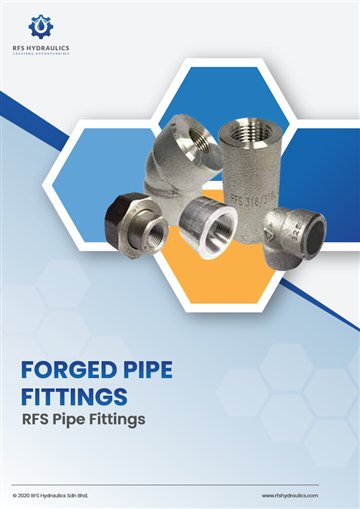 Forged pipe fittings — every body style, size, class and dimensionRFS Hydraulics · PDFPDF
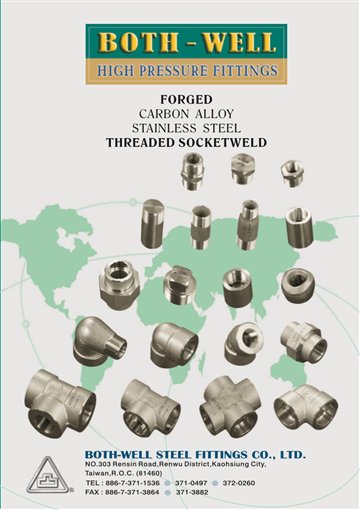 Forged pipe fittings — the manufacturer catalogueBoth‑Well, Taiwan · PDFPDF
Related: pipe adapters where two thread forms have to meet · compression fittings and ferrule fittings for tube rather than pipe · JIC fittings for hose · stainless steel pipe to run with them · high pressure ball valves to isolate the line.
Send the bore, the class and which ends are male
That is enough for a landed price on a stocked item. A105 and SS316 in class 3000 and 6000 are on the shelf in Johor Bahru and Singapore.