
Home › Products › Low pressure valves › Single plate check valves
1½" to 6" · up to 232 PSI · five flange standardsSingle plate check valves, 1½" to 6"
One spring‑loaded disc in a wafer body — lighter, cheaper and less obstructive than a dual plate, and it fits in the same nothing of a pipe run. CF8M, PN16.
Get a quotation within 2 working hours
Send the part number, standard, size or quantity. Stock in Malaysia or Singapore, ISO 9001:2015 certified.
How a single plate check valve works
One disc, one hinge, one spring.
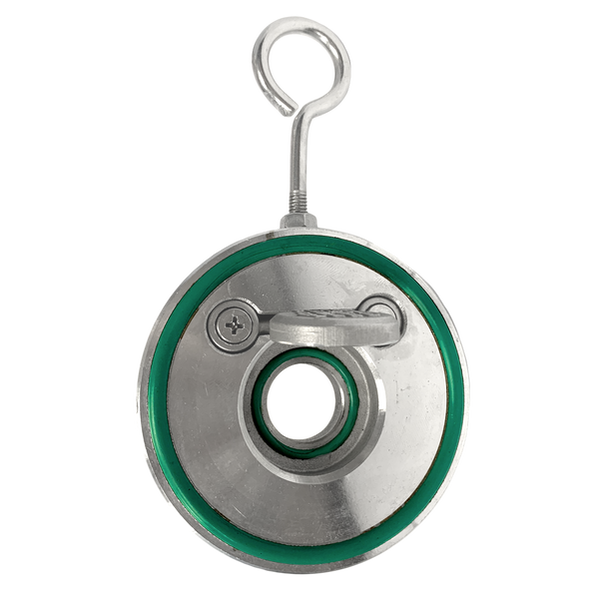
A single plate check valve is a wafer ring with one disc in it, hinged along one side and held shut by a spring. Forward flow pushes the disc back like a door; when flow falls away the spring closes it against a seal ring set into the body face. Like its dual plate cousin it is a thin ring with no bolt holes, clamped between two pipe flanges, so it takes almost no length in the run.
Against the dual plate, the trade is straightforward. One disc means less metal in the bore — there is a hinge at one side rather than a shaft straight across the middle — so it obstructs the flow less and it is lighter and cheaper. Two discs means each one travels a shorter distance, which closes slightly more gently and allows a thicker body and a higher pressure rating. Below 232 PSI the single plate is usually the better buy.
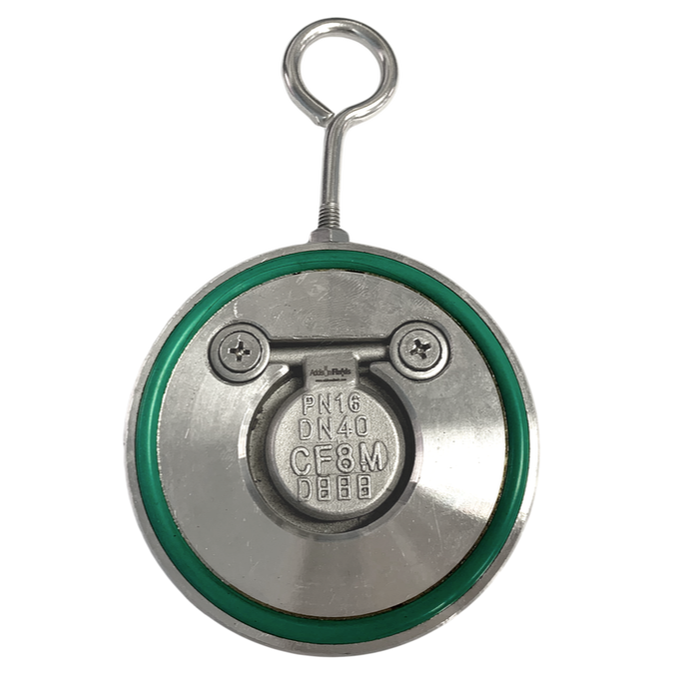
- It is genuinely CF8M. The disc on the stocked valve is cast “PN16 · DN40 · CF8M” — you can read it in the photograph below. That is cast 316, and it matters because the dual plate discs are cast CF8 (304).
- “PN16” is cast into the disc too, which corroborates the published rating: 232 PSI is 16 bar. The paperwork and the metal agree on this one.
- Any orientation, including flow downward. A spring closes it, not gravity — so unlike a swing check valve there are no rules about which way up it goes. Flow must still follow the arrow.
- Less obstruction than a dual plate. A hinge at one side rather than a shaft across the middle, and one disc edge rather than two. If pressure drop is the concern among the wafer types, this is the one.
- ⚠ It cannot sit at the end of a line. A wafer body is held only by the flange bolts passing either side of it. Remove one flange and nothing holds the valve.
- ⚠ It fails silently, like every check valve. Debris on the seat holds the disc fractionally open and it passes reverse flow while looking normal — and on a wafer valve you cannot see the disc without taking the flanges apart. Fit a Y‑strainer upstream.
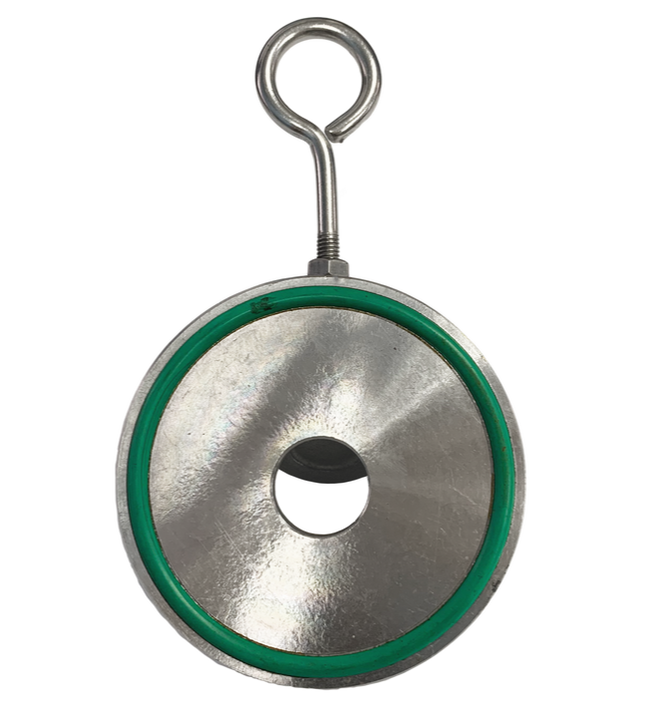
Photographs of the stocked item, not renders.
Single plate or dual plate
The manufacturer publishes this comparison. We have added what it leaves out.
| Single plate | Dual plate | |
|---|---|---|
| Disc | One disc on a hinge | Two half discs folding together |
| Body thickness | Thinner | Thicker |
| Weight | Lighter | Heavier |
| Cost | Lower | Higher |
| Working pressure | Up to 232 PSI (16 bar) | Up to 300 PSI |
| Flange standards | Five — ANSI 150, JIS 5K, JIS 10K, PN10, PN16 | Seven — the same five plus ANSI 300 and PN40 |
| Obstruction in the bore | Less — a hinge at one side | More — a shaft across the middle plus two disc edges |
| Disc grade on the stocked item | CF8M — cast 316, confirmed on the casting | CF8 — cast 304 on the stocked valve |
| Closing behaviour | Gentle — one larger disc arriving | Gentlest — each half travels half as far |
| Choose it when | PN16 is enough, and weight, cost or pressure drop matter | Above 232 PSI, or ANSI 300 / PN40, or slam is the main concern |
- The first five rows are the manufacturer’s own comparison, published as a straight single‑versus‑dual table and reproduced here as printed. The rest is what we have added from the specifications and from the valves themselves.
- The pressure decides it more often than anything else. If you need ANSI 300 or PN40, the single plate is not offered in them and the choice is made for you. Below 232 PSI, this is the lighter, cheaper and freer‑flowing of the two.
- ⚠ The disc grade is worth checking on both. This valve’s disc is cast CF8M; the dual plate’s is cast CF8. If your duty is chloride‑bearing, that difference is real — 304 pits where 316 does not, and on a check valve pitting starts at the seat face.
- Both work in any orientation, both sit between flanges, and neither can terminate a run.
- Neither beats a swing check on pressure drop. If you have 356 mm of straight pipe to spare and the pump does not trip hard, a swing disc lifting clear of the bore still costs you least head.
What is published, and what is not
A short datasheet. Here is exactly how short.
Published
- Size range — 1½" to 6" (DN40 to DN150).
- Working pressure — up to 232 PSI, which is 16 bar, and “PN16” is cast into the disc. Paperwork and metal agree.
- Material — “Stainless Steel / CF8M”, confirmed by the CF8M cast into the disc.
- Five flange standards — ANSI 150, JIS 5K, JIS 10K, PN10 and PN16.
- A dual‑versus‑single comparison table, reproduced in full above.
- A manufacturer catalogue PDF, and photographs of the stocked item.
⚠ Not published
- No dimension table. No face‑to‑face, and no body outside diameter — which on a wafer valve matters as much, because the body has to sit inside the flange bolt circle without fouling the bolts.
- No numbered bill of materials. One material line, against eight or nine numbered parts on every swing check variant.
- No weights — even though “lighter” is one of the five selling points in the comparison table.
- No test pressures.
- No working temperature, and there is a seal ring in this valve, so the elastomer will be what sets it. Ask before hot duty.
- No cracking pressure.
- No seal ring material. The stocked valve has a green ring, which is not enough to identify a compound from.
- ⚠ The seal ring is the one to ask about. Unlike the all‑metal spring check, this valve has an elastomer seal set into the seat face. That is almost certainly what limits its temperature and it decides its fluid compatibility — and neither the material nor the temperature is published. If your duty is hot, or the fluid is anything but clean water, tell us and we will get both from the factory.
- ⚠ “Up to 232 PSI” still spans five standards. A PN10 body is not a 232 PSI valve. The figure refers to the PN16 version, and there is no published breakdown by standard. Ask for the rating of the one you are ordering.
- Ask us for anything on the right‑hand list. Dimensions we measure off a stocked valve, same day. Test pressures, temperature, cracking pressure and the seal compound we get from the factory.
Five flange standards
State it when you order. A wafer valve is machined for one of them.
| Standard | Family | Nominal pressure | Also on the dual plate? |
|---|---|---|---|
| ANSI 150# | American | Class 150 | Yes |
| JIS 5K | Japanese | 5 kg/cm² | Yes |
| JIS 10K | Japanese | 10 kg/cm² | Yes |
| PN10 | European | 10 bar | Yes |
| PN16 | European | 16 bar — the 232 PSI rating | Yes |
- ⚠ Say which standard when you order. A 4" single plate check valve is five different products, and they do not interchange. This is the commonest ordering mistake on wafer valves.
- The two standards this range does not offer are the high‑pressure ones. ANSI 300 and PN40 are dual plate only, which is exactly why that valve reaches 300 PSI and this one stops at 232.
- ANSI 150 and JIS 10K sit at similar pressures and are drilled differently. Check the bolt circle on the mating flanges, not the pressure rating — and make sure both flanges either side match each other as well as the valve.
- Hold it while you bolt up. A wafer body is centred by the flange bolts and has nothing of its own to hang on. The eye bolt visible in the first photograph is there for exactly that.
Single plate check valves — the specification
As published. Blanks are marked, not filled.
| Size range | 1½" to 6" (DN40 to DN150) |
| Body style | Wafer — a ring clamped between two pipe flanges. It cannot terminate a run |
| Flange standards | ANSI 150# · JIS 5K · JIS 10K · PN10 · PN16 — five, and they are not interchangeable |
| Working pressure | Up to 232 PSI (16 bar) — and “PN16” is cast into the disc |
| Material | Stainless steel / CF8M — cast 316, confirmed by the marking on the disc |
| Disc | One disc, hinged along one side, spring closed |
| Seal | A seal ring set into the seat face — material not published |
| Orientation | Any, including vertical with flow downward — a spring closes it, not gravity |
| Flow direction | Follow the arrow. Fitted backwards, any check valve blocks the line |
| Length in the run | Almost none — against 356 mm for a flanged swing check at 6" |
| Obstruction in the bore | Less than a dual plate — a hinge at one side rather than a shaft across the middle |
| ⚠ Dimensions | Not published — we measure a stocked valve on request |
| ⚠ Weight, test pressures, temperature | Not published |
| Catalogue | The manufacturer’s PDF |
| Fit upstream | A Y‑strainer. This valve fails silently, as every check valve does |
| Stock | Held in Malaysia or Singapore |
Questions we get asked
The ones that come up on the phone.
What is a single plate check valve?
A wafer ring with one disc in it, hinged along one side and held shut by a spring. Forward flow pushes the disc open like a door; when flow falls away the spring closes it onto a seal ring set into the body face. The body is a thin ring with no bolt holes, clamped between two pipe flanges, so it takes almost no length in the run. 1½" to 6", up to 232 PSI, in five flange standards.
Single or dual plate?
Single below 232 PSI: it is lighter, cheaper and obstructs the bore less, because there is a hinge at one side rather than a shaft straight across the middle. Dual if you need more than 232 PSI, or the ANSI 300 or PN40 flange standards which this range does not offer, or if slam is the specific problem — two half discs each travel half as far and close a shade more gently. The full comparison.
Is it 316 or 304?
316. The disc on the stocked valve is cast “PN16 · DN40 · CF8M”, and CF8M is cast 316 — the marking is legible in the first photograph. Worth stating plainly, because the dual plate discs are cast CF8, which is 304, despite carrying the same “CF8M” specification line. On chloride‑bearing duty that difference is real.
Can I fit it upside down?
Yes. A spring closes it rather than gravity, so it works in any orientation including a vertical run with flow downward — which a swing check valve cannot do at all. The one rule that still applies is direction: flow must follow the arrow.
What temperature can it take?
Not published, and on this valve the answer will be set by the seal ring in the seat face rather than by the stainless body. The seal material is not published either — the stocked valve has a green ring, which is not enough to identify a compound from. If your duty is hot, or the fluid is anything but clean water, ask us and we will get both figures from the factory before you order.
Which flange standard do I need?
Whichever your pipework is, and you must state it when you order. This range is offered in five: ANSI 150, JIS 5K, JIS 10K, PN10 and PN16. A 4" single plate check valve is not one product but five, and they are not interchangeable. Note that ANSI 300 and PN40 are not offered on this valve — for those you need the dual plate. The full list.
Is it really 232 PSI?
232 PSI is 16 bar, and “PN16” is cast into the disc, so the paperwork and the metal agree — which is not something we can say about every product on this site. But “up to 232 PSI” still spans five flange standards: a PN10 body is not a 232 PSI valve. The figure refers to the PN16 version, and there is no published breakdown, so ask for the rating of the standard you are ordering.
Can it sit at the end of a line?
No. A wafer body has no bolt holes of its own — it is held only by the flange bolts passing either side of it. Take one flange off and nothing holds the valve. If it must terminate a run you need a lugged body, which is a different product; ask us.
How long is it? I need to check clearance.
No dimension table is published for this range. Tell us the size and flange standard and we will measure a stocked valve, same day. Ask for the body outside diameter as well as the length — on a wafer valve the body has to sit inside the flange bolt circle without fouling the bolts, and that is the dimension people forget.
What sizes do you hold in stock?
1½" to 6" (DN40 to DN150), held in Malaysia or Singapore. Send the size, the flange standard, the fluid and the temperature. We will confirm availability, get the rating for your standard and the seal material, and quote a landed price.
Catalogue
Direct PDF download — no form, no email address.
Send the size and the flange standard
The flange standard is not optional on a wafer valve — this range is offered in five and they do not interchange. Tell us which, plus the fluid and the temperature, and we will get the rating for your standard and the seal material, measure a stocked valve, and quote a landed price. Stock in Malaysia and Singapore.