
Home › Products › High pressure valves › Needle valves
RFS, HSME & MHA Zentgraf · ready stockNeedle valves in SS316 and steel, 1/8" to 2", 350 to 690 bar
A fine‑control valve: a tapered vee stem screwing down onto a small seat, so you can meter flow or pressure a fraction of a turn at a time instead of just opening and shutting. Three ranges cover it — RFS SS316 at 6,000 psi, HSME VNH10 at 10,000 psi and the MHA NDV at 350 bar with a graduated knob. Which one you want depends on pressure, temperature and whether you need to read the setting off the valve.
Get a quotation within 2 working hours
Send the part number, standard, size or quantity. Stock in Malaysia or Singapore, ISO 9001:2015 certified.
What a needle valve is, and when you need one
Not an isolator that happens to open slowly. A different job entirely.
A needle valve closes with a long, finely tapered stem seating in a small orifice. Because the stem is a shallow cone and the thread is fine, a full turn of the handle moves the tip only a little and changes the opening only a little — which is exactly what you want when you are setting a flow or a pressure rather than starting and stopping it. Typical jobs: throttling a cylinder or motor to slow it down, bleeding air out of a circuit, damping a pressure gauge so the needle stops flickering, taking a sample, and isolating an instrument for calibration.
The trade‑off is the other side of the same coin. The orifice is much smaller than the port thread — 3.2 mm on a 1/2" HSME body — so a needle valve is a poor choice where you simply want full flow when it is open. For that, use a high pressure ball valve. And repeatedly slamming a needle valve shut against high pressure will wire‑draw the seat: the tip is a precision surface, not a shut‑off.
| Needle valve (this page) | Ball valve | Check valve | |
|---|---|---|---|
| What it is for | Metering — set a flow or a pressure | Isolating — on or off | Direction — one way only |
| How it moves | Multi‑turn, fine thread | Quarter turn | Nothing to operate |
| Flow when open | Restricted — orifice much smaller than the port | Full bore, negligible drop | Restricted by the poppet and spring |
| Can you read the setting? | Yes on the MHA NDV — the knob is graduated | Open or shut, nothing between | Not applicable |
| Max pressure here | 690 bar (10,000 psi) | 500 bar | 500 bar |
| Size range here | 1/8" to 2" | 1/8" to 2" | 1/8" to 2" |
| Reach for it when | You need a setting, a bleed, or gauge protection | You need full flow or a hard shut‑off | You need to stop backflow automatically |
Specification
Everything an enquiry needs, in one place.
| Function | Multi‑turn needle (throttle) valve for metering, bleeding, gauge protection and instrument isolation |
| Ranges stocked | RFS SS316 6,000 psi · HSME VNH10 10,000 psi · MHA Zentgraf NDV 350 bar |
| Size range | 1/8" to 2". RFS and HSME 1/4" to 1"; MHA DN6 to DN40 (1/8" to 2") |
| Max working pressure | HSME 10,000 psi / 689 bar at 37 °C · RFS 6,000 psi / 420 bar · MHA 350 bar (35 MPa) every size |
| Proof testing, RFS range | Strength test 9,000 psi, seal test 6,600 psi — 1.5× and 1.1× nominal |
| Ends | Female NPT (all three), BSPP to DIN ISO 228 and SAE J514 on the MHA, male × female NPT on the RFS range, and 1/4", 3/8" and 1/2" OD tube fittings on the HSME |
| Body material | SS316 to ASTM A276, or steel. MHA offers steel or AISI 316 |
| Stem | Non‑rotating vee stem. HSME stainless stems are hard chrome plated with rolled threads |
| Packing / seals | HSME two‑piece chevron PTFE, or Grafoil for high temperature. RFS PTFE with a PTFE + 15% glass washer. MHA NBR or FPM (Viton) O‑rings |
| Temperature | MHA −20 to +100 °C (−30 with code 4A) · RFS −15 to +150 °C · HSME −53 °C to +648 °C with Grafoil packing, derated |
| Orifice and Cv | HSME 3.2 mm, Cv 0.21 to 1/2"; 5.0 mm, Cv 0.6 at 3/4" and 1" |
| Medium | Hydraulic oil, and on the RFS range general oil, gas and water |
| Design standards, RFS range | Design and manufacture GB/T 12224‑2005 and JB/T 7747‑2010; supply GB/T 12252‑2005; testing GB/T 13927‑1992 |
| Options | Lockable anti‑tamper bonnet with a removal key and padlock holes (HSME, add AK to the order) · panel mounting through the bonnet thread (MHA) · Grafoil packing for high temperature |
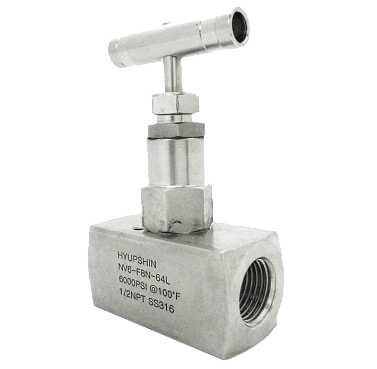
6000PSI @100°F — alongside 1/2NPT and SS316. Note that the pressure is quoted at a temperature: that is not decoration, it is the top of a derating curve.
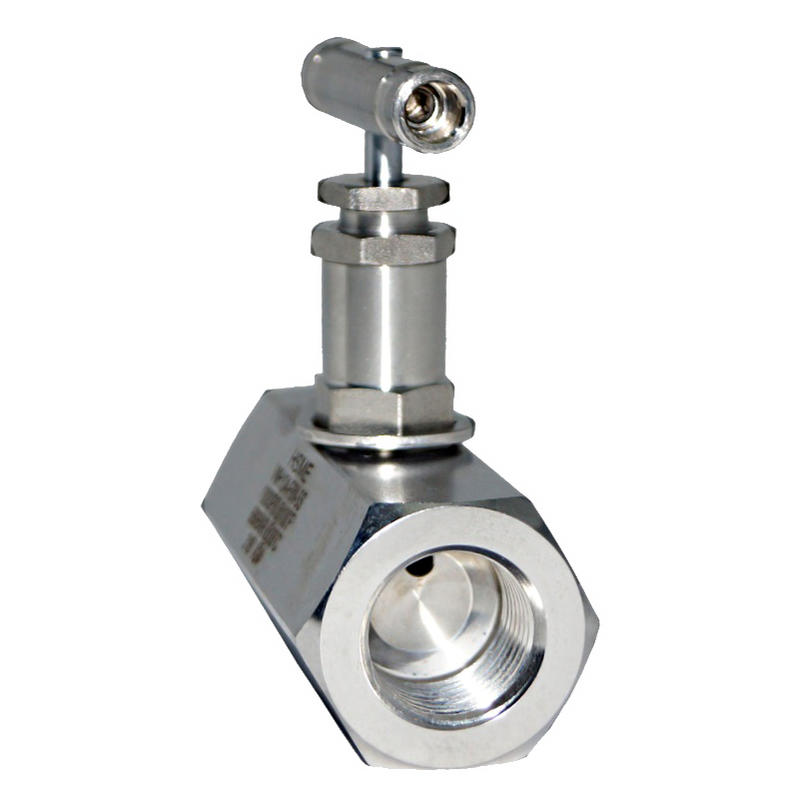
Buying needle valves in Malaysia and Singapore
Where the stock sits, what it costs to get it to you, and how fast it moves.
Stock, delivery and ordering
- Where the stock is — the office is in Kuala Lumpur, and valves are held in two warehouses: Johor Bahru and Singapore. Addresses and direct lines are on the contact page.
- Dispatch — stock items leave the same or next working day.
- The running sizes are the SS316 NPT bodies from 1/4" to 1/2", which is what most instrument and gauge work asks for. The 3/4" and 1" bodies, the tube‑fitting ends and the MHA NDV in stainless are more often brought in.
- Delivery cost — already inside the product price, along with transport, currency conversion, duties and taxes. Nothing is added afterwards.
What moves where. Singapore is mostly marine, offshore and shipyard work, almost always SS316. Malaysia is hydraulics, palm oil mills and mining, where the steel MHA bodies and gauge isolation are the common ask.
How a needle valve enquiry runs
Five things and we can price it without going back and forth:
- Port size and thread form — 1/8" to 2", and whether it is NPT, BSPP, SAE UNF or a tube fitting.
- Male × female or female × female — it changes the part number, and a male end often saves an adaptor.
- Working pressure — and the temperature it runs at, because on these valves the two are linked. See the derating table.
- What it is doing — metering, bleeding, gauge protection or instrument isolation. It decides the orifice and often the range.
- Do you need to read the setting? If yes, the graduated MHA knob is the one.
A product specialist prices it within two working hours. Replacing an existing valve? Send a photo of the body marking — all three ranges stamp the rating, the port and the material on the flat.
RFS, HSME or MHA?
Three answers to the same job. Pressure and temperature decide it, then the handle.
| RFS SS316 | HSME VNH10 | MHA Zentgraf NDV | |
|---|---|---|---|
| Working pressure | 6,000 psi / 420 bar | 10,000 psi / 689 bar | 350 bar (35 MPa) |
| Size range | 1/4" to 1" (tables from 1/8") | 1/4" to 1" | DN6 to DN40, 1/8" to 2" |
| Body | SS316 throughout | SS316 or steel | Steel or AISI 316 |
| Ends | NPT, F×F or M×F | NPT, plus 1/4"–1/2" OD tube fittings | BSPP, NPT and SAE J514 |
| Handle | T‑bar | T‑bar | Knurled knob with a graduated scale |
| Temperature | −15 to +150 °C | to +648 °C with Grafoil, derated | −20 to +100 °C |
| Packing | PTFE, glass‑filled washer | Chevron PTFE or Grafoil | NBR or FPM O‑rings |
| Panel mounting | — | — | Yes — through the bonnet thread |
| Security option | — | Lockable anti‑tamper bonnet and key | — |
| Proof test published | Yes — 9,000 psi strength, 6,600 psi seal | Pressure‑temperature table published | PN per size published |
| Choose it when | Instrument and gauge work in SS316, and you want a male end | You need above 420 bar, high temperature, tube ends, or the valve must be lockable | You need a repeatable setting, a panel mount, a BSPP or SAE port, or a size above 1" |
- Only the MHA goes above 1". Above that size the other two ranges stop, so a 1¼", 1½" or 2" needle valve means the NDV at 350 bar.
- Only the MHA can be read. If the point of the valve is to set something and come back to the same setting next month, the graduated knob is worth more than the extra pressure capability of the others.
Pressure falls as temperature rises
“10,000 psi” is a figure at 37 °C. Read the row for your own temperature.
Every needle valve on this page is quoted at a headline pressure at a stated temperature — the HSME body is stamped 10 000 psig @100 °F. Above that the metal and the packing both lose capability, and the rating comes down with them. HSME publishes the whole curve as a table, and it is the most useful piece of data on this page, because it also tells you which packing you need: PTFE runs out at 232 °C and Grafoil carries on to 648 °C.
| Temperature | SS316 body | Steel body | ||
|---|---|---|---|---|
| °F | °C | Grafoil packing | PTFE packing | PTFE packing |
| −65 to −20 | −53 to −28 | 10,000 psi (689 bar) | 10,000 psi (689 bar) | — |
| −20 to 100 | −28 to 37 | 10,000 psi (689 bar) | 10,000 psi (689 bar) | 10,000 psi (689 bar) |
| 200 | 93 | 9,290 psi (640 bar) | 9,290 psi (640 bar) | 9,290 psi (640 bar) |
| 300 | 148 | 8,390 psi (578 bar) | 8,390 psi (578 bar) | 8,390 psi (578 bar) |
| 350 | 176 | 8,045 psi (554 bar) | 8,045 psi (554 bar) | 8,045 psi (554 bar) |
| 400 | 204 | 7,705 psi (530 bar) | 7,705 psi (530 bar) | — |
| 450 | 232 | 7,435 psi (512 bar) | 7,435 psi (512 bar) | — |
| 500 | 260 | 7,165 psi (493 bar) | — | — |
| 600 | 315 | 6,770 psi (466 bar) | — | — |
| 700 | 371 | 6,480 psi (446 bar) | — | — |
| 800 | 426 | 6,230 psi (429 bar) | — | — |
| 900 | 482 | 5,905 psi (406 bar) | — | — |
| 1000 | 537 | 5,450 psi (375 bar) | — | — |
| 1100 | 593 | 4,835 psi (333 bar) | — | — |
| 1200 | 648 | 3,085 psi (212 bar) | — | — |
HSME VNH10 series pressure‑temperature ratings. Two things worth reading off it: the steel body stops at 176 °C where the stainless carries on, and at 648 °C the valve still holds 212 bar — more than the whole MHA range does at room temperature. Grafoil is rated to 523 °C in air and 648 °C in steam, and is not for use with pneumatically actuated valves.
| Range | Nominal | Strength test | Seal test | Stated at |
|---|---|---|---|---|
| RFS SS316 | 6,000 psi / 420 bar | 9,000 psi (1.5×) | 6,600 psi (1.1×) | −15 to +150 °C service |
| HSME VNH10 | 10,000 psi / 689 bar | Pressure‑temperature table above | 100 °F (37 °C) | |
| MHA NDV | 350 bar / 35 MPa | PN published per size and material code | −20 to +100 °C service | |
Sizes, dimensions and the space above the valve
The DN number is not the thread, and the valve grows taller as you open it.
On the MHA NDV, as on the rest of the MHA range, the DN figure is the bore and not the port: an NDV‑DN20 takes a G1 or 1" NPT port and an NDV‑DN40 is the 2". The column that matters when you are fitting one is H 2 — the height with the valve open. The knob rises as you unscrew it, so a valve that fits closed can foul a panel or a guard when someone opens it.
| MHA type | BSPP port | NPT port | Length L | Across flats B | Height closed H1 | Height open H2 | Weight |
|---|---|---|---|---|---|---|---|
| NDV‑DN6 | G1/8 | 1/8" NPT | 38 | 16 | 51 | 56 | 0.12 kg |
| NDV‑DN8 | G1/4 | 1/4" NPT | 48 | 25 | 65 | 71 | 0.25 kg |
| NDV‑DN10 | G3/8 | 3/8" NPT | 58 | 30 | 68 | 75 | 0.40 kg |
| NDV‑DN12 | G1/2 | 1/2" NPT | 68 | 35 | 82 | 92 | 0.60 kg |
| NDV‑DN16 | G3/4 | 3/4" NPT | 78 | 45 | 96 | 106 | 1.10 kg |
| NDV‑DN20 | G1 | 1" NPT | 108 | 50 | 121 | 134 | 2.40 kg |
| NDV‑DN25 | G1 1/4 | 1 1/4" NPT | 108 | 60 | 126 | 139 | 2.80 kg |
| NDV‑DN30 | G1 1/2 | 1 1/2" NPT | 108 | 70 | 131 | 144 | 3.50 kg |
| NDV‑DN40 | G2 | 2" NPT | 120 | 90 | 141 | 154 | 6.24 kg |
Dimensions in mm, MHA NDV catalogue. The NPT version is dimensionally the same apart from the thread depth, and the 2" NPT weighs 6.30 kg. The bonnet also carries a Pg conduit thread (Pg7 up to Pg29) so the valve can be mounted through a panel up to 4–10 mm thick depending on size.
| RFS NPT size | Length L | Port centre A | Height H | Handle W | Unit weight |
|---|---|---|---|---|---|
| 1/8" | 51 | 29 | 86 | 51 | — |
| 1/4" | 60 | 29 | 86 | 51 | 0.46 kg |
| 3/8" | 60 | 29 | 86 | 51 | 0.46 kg |
| 1/2" | 67 | 29 | 86 | 51 | 0.58 kg |
| 3/4" | 73 | 32 | 96 | — | 0.58 kg |
| 1" | 83 | 51 | 108 | 51 | — |
Dimensions in mm, RFS female × female datasheet. On the HSME VNH10 the equivalent figures are L 62–93.9 mm, hex 31.75 mm to 1/2" and 41–46 mm at 3/4" and 1", and open height 67.2–92.9 mm — ask for the sheet if you are working to a tight envelope.
Body, stem and packing
The packing decides the temperature. The stem decides how long it stays leak‑tight.
A needle valve leaks in one of two places: past the stem where it comes out of the bonnet, or past the seat where the tip meets the orifice. Everything in the construction is aimed at those two, and the differences between the ranges are worth understanding before you choose.
| Part | RFS SS316 | HSME VNH10 | MHA NDV |
|---|---|---|---|
| Body | SS316 | SS316 / A276, or white‑zinc‑plated steel A675 Gr.60‑90 | Steel, or AISI 316 |
| Stem | SS316 | Hard chrome‑plated SS316 with rolled threads | Per material code |
| Stem tip | SS316 stem core | Non‑rotating vee tip | Non‑rotating |
| Bonnet | SS316 | SS316, or plated steel S45C | Per material code |
| Packing | PTFE, with a PTFE + 15% glass washer | Two‑piece chevron PTFE to D1710, or Grafoil | NBR (codes 1A, 4A) or FPM / Viton (codes 18, 48) |
| Handle | SS304 bar handle | SS316 / A276 bar handle | Graduated knurled knob |
| Lubricant | — | Fluorocarbon based | — |
| Temperature | −15 to +150 °C | −53 to +648 °C, derated | −20 to +100 °C; −30 on code 4A |
- The three things that keep the stem sealed on the HSME. The packing sits below the stem threads, so system fluid never washes the lubricant out of them. The stem back‑seats in the full‑open position, giving a positive back stop that prevents stem blowout and keeps the valve from leaking through the bonnet if the packing ever fails. And a packing bolt lets you take up the packing externally, with the valve still in the line.
- A non‑rotating tip is not a detail. If the tip turned as you closed it, it would grind against the seat every time and the valve would stop sealing. Non‑rotating means repeatable leak‑tight shut‑off and a seat that survives.
- MHA material codes.
1Asteel body with NBR ·18steel with FPM ·4AAISI 316 with NBR, and the only one rated to −30 °C ·48AISI 316 with FPM. All four are PN 350 bar at every size.
Orifice, Cv and what actually gets through
Size a needle valve on the orifice, never on the port thread.
The number that governs flow is the orifice, and on a needle valve it is far smaller than the port. An HSME 1/2" body has a 3.2 mm orifice and a Cv of 0.21; going up to 3/4" nearly triples the Cv to 0.6 on a 5.0 mm orifice. That is the whole reason to move up a size — the thread is almost incidental.
| HSME body | Ports | Orifice | Cv | What it suits |
|---|---|---|---|---|
| VNH10A | 1/4", 3/8", 1/2" NPT; 1/4", 3/8", 1/2" OD tube; 1/2" and 3/4" male to 1/2" female | 3.2 mm (.126") | 0.21 | Gauge protection, bleeding, instrument isolation, fine metering |
| VNH10B | 3/4" female NPT | 5.0 mm (.196") | 0.6 | Metering a small actuator, drain and sample lines |
| VNH10C | 1" female NPT | 5.0 mm (.196") | 0.6 | Same flow as the 3/4", in a 1" port |
- The 1" is not a bigger valve. VNH10B and VNH10C share the same 5.0 mm orifice and the same Cv — the 1" body exists so it fits a 1" port, not so it flows more. If you need more flow, a needle valve is the wrong device.
- Cv into l/min, roughly. Cv is US gallons per minute of water at one psi of drop. For a rule of thumb on hydraulic oil, a Cv of 0.21 passes on the order of a litre or two per minute at a few bar of drop — enough to bleed or damp, nowhere near enough to run a cylinder.
- Do not use it as a stop valve. Closing a needle valve hard against high pressure and flow wire‑draws the seat. Where the line has to be shut and shut often, isolate with a ball valve and leave the needle valve set.
How to identify a needle valve you already have
The rating, the port and the material are on the body. The part number decodes cleanly.
Start with the flats. All three ranges stamp the important things there — on the SS316 bodies you will see the rating with its temperature (6000PSI @100°F), the port (1/2NPT) and the material (SS316). If you have the part number instead, it decodes in one pass:
| Reference | How it reads |
|---|---|
V‑N‑MF‑S‑N‑08 | RFS: valve · needle · male × female · stainless · NPT · size in sixteenths — so 08 is 1/2". The size digits run 04 = 1/4", 06 = 3/8", 08 = 1/2", 12 = 3/4", 16 = 1". |
VNH10A‑F8N‑ | HSME: VNH10 series, body size A (3.2 mm orifice), Female, 8 sixteenths = 1/2", NPT. A8T would be the 1/2" OD tube fitting instead, and MF8N the male × female. |
NDV‑DN12‑G1/2‑1A | MHA: type NDV, bore DN12, port G1/2, material code 1A (steel with NBR). The DN is the bore, so read the port from the third block, not the second. |
Suffix AK | HSME: the lockable anti‑tamper bonnet with removal key. Add it to the ordering number — it cannot be retrofitted. |
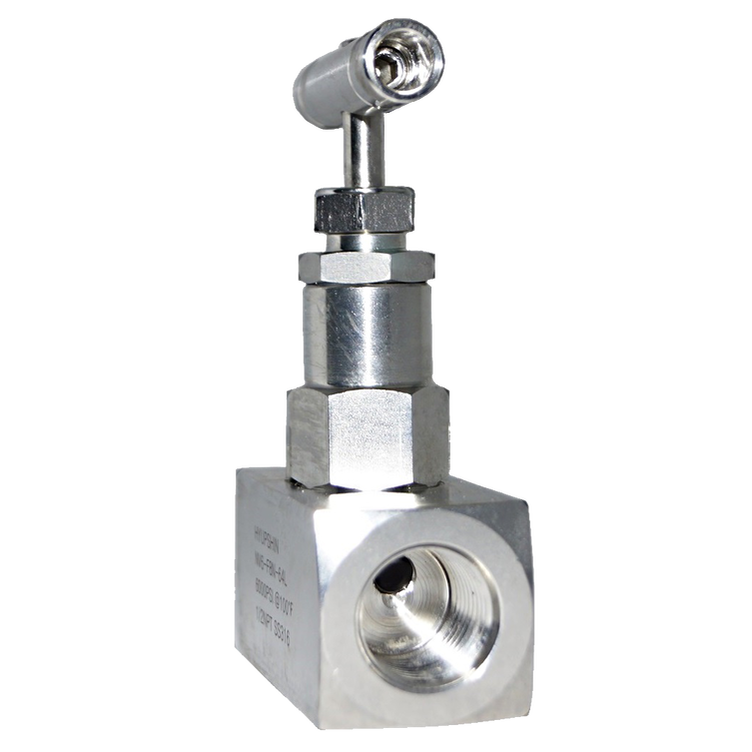
6000PSI @100°F, and 1/2NPT SS316. A photograph of that is enough for us to quote the identical valve — and the @100 °F is your reminder to check the derating table if the line runs hot.Fitting it, and setting it
Two thirds of needle valve problems are the seat, and most of those are avoidable.
Before and during fitting
- Leave clearance above the valve. The stem rises as it opens — up to 13 mm on the larger MHA bodies. Check the open height, not the closed one.
- Keep swarf out of the seat. The orifice is a few millimetres and the tip is a precision cone; one chip and it will not seal again. Flush the line before the valve goes in, not after.
- Hold the body, not the bonnet, when you make up the threads. Torquing through the bonnet loads the packing and the stem.
- NPT seals on the thread and BSPP does not — use the right sealant for the form you have, and keep it out of the bore.
- Panel mounting on the MHA goes through the bonnet’s Pg thread, up to the panel thickness in the table. Support the pipework so the panel is not carrying it.
Using it well
- Open it to set it, do not close it to stop. Set the flow you want and leave it; isolate elsewhere. Repeated hard shut‑off against pressure is what wire‑draws a seat.
- Do not use the handle for leverage. Hand tight on the seat is enough. A needle valve tightened with a bar deforms the tip, and then it leaks in both positions.
- Write the setting down. On the graduated MHA knob you can note the number and return to it. On a plain T‑bar, count turns from fully closed and record that instead.
- If the stem weeps, take up the packing bolt a little — on the HSME that can be done with the valve in the line and under pressure. It is a designed adjustment, not a repair.
- Gauge protection: crack the valve barely open. The point is to damp the pulses reaching the gauge, and almost closed does that better than half open.
Watch what a needle valve is for
Ninety seconds on metering, bleeding and gauge protection.
Why buy needle valves from RFS Hydraulics
Six things that decide whether a valve order goes smoothly.
Ready stock on the running sizes
The SS316 NPT bodies from 1/4" to 1/2" are held in Johor Bahru and Singapore and dispatch the same or next working day. Larger bodies and tube ends come back with a lead time on the quote.
Three ranges, so you get the right one
420 bar in SS316, 690 bar when you need it, or a graduated knob when the setting has to be repeatable. One supplier, three genuinely different answers.
We check the temperature, not just the pressure
On these valves the two are linked, and a valve chosen on its headline figure can be a third under‑rated at the temperature it actually runs. We read the derating table against your duty before quoting.
Our own brand, with the test figures published
The RFS SS316 range is built to GB/T 12224 and JB/T 7747 and proof tested at 9,000 psi strength and 6,600 psi seal — numbers we publish rather than a bare rating.
Marked and traceable
Rating, port and material stamped on the body flat on all three ranges. Send a photo of an old valve and we will match it — including the ends, which is where most replacements go wrong.
One price, delivered
Transport, currency, duties and taxes are already inside the figure we quote. Nothing is added at the end, and delivery within Malaysia is included.
Frequently asked questions
Fourteen, starting with the one that decides whether a needle valve is the right part at all.
What is a needle valve actually for?
Metering, not isolating. A long tapered vee stem seats in a small orifice on a fine thread, so a turn of the handle changes the opening only slightly — which is what you want when you are setting a flow or a pressure. The usual jobs are throttling a cylinder or motor, bleeding air out of a circuit, damping a pressure gauge so the needle stops flickering, taking a sample, and isolating an instrument for calibration. If you want full flow when it is open and none when it is shut, you want a ball valve instead.
Can I use a needle valve as a shut‑off valve?
It will shut, but doing it repeatedly against pressure and flow will wire‑draw the seat — the fluid erodes a path across the precision cone and after that the valve will not seal properly in any position. The right arrangement is to isolate with a ball valve and leave the needle valve at its setting. Also resist using the handle for leverage: hand tight on the seat is enough, and a needle valve tightened with a bar deforms the tip.
What is the maximum pressure?
Depends on the range, and on the temperature. HSME VNH10: 10,000 psi (689 bar) at up to 37 degrees C. RFS SS316: 6,000 psi (420 bar). MHA NDV: 350 bar (35 MPa) at every size and in every material code. All three fall as temperature rises — see the derating table, because that is the number people miss.
Why does the body say “6000PSI @100 °F”?
Because the rating is only true at that temperature. Steel and stainless lose strength as they heat up, and the packing has its own ceiling, so the safe working pressure comes down with temperature. On the HSME range the published table runs from 10,000 psi at 37 degrees C down to 3,085 psi at 648 degrees C. If your line runs hot, take the figure for your own temperature rather than the one stamped on the flat.
PTFE or Grafoil packing?
PTFE is the standard and is right for almost everything: it seals well at low load and needs no attention. Grafoil is the high‑temperature option — it takes the valve to 523 degrees C in air and 648 degrees C in steam, where PTFE has stopped at 232. Two things to know: Grafoil needs a load to seal, so it is slightly less forgiving on a valve that is rarely touched, and it is not for use with pneumatically actuated valves. If you are under 200 degrees C, take the PTFE.
How much will actually flow through it?
Less than the port suggests. The orifice is the governing figure: 3.2 mm with a Cv of 0.21 on the HSME bodies up to 1/2 inch, and 5.0 mm with a Cv of 0.6 at 3/4 inch and 1 inch. Note that the 3/4 inch and the 1 inch share the same orifice, so the 1 inch exists to suit a 1 inch port, not to pass more. Size the valve on the orifice and the Cv, never on the thread.
Is an NDV‑DN20 a 20 mm valve?
No — on the MHA range the DN figure is the bore, not the port. DN20 takes a G1 or 1 inch NPT port, DN25 is 1 1/4 inch, DN30 is 1 1/2 inch and DN40 is the 2 inch. Read the port from the thread column in the dimension table, or from the third block of the order code (NDV-DN12-G1/2-1A is the 1/2 inch).
Which range goes above 1 inch?
Only the MHA NDV, which runs to DN40 (2 inch) at 350 bar. The RFS and HSME ranges both stop at 1 inch. So a 1 1/4, 1 1/2 or 2 inch needle valve means the MHA body, and the pressure ceiling drops to 350 bar with it — worth knowing before a large size is designed in at 420 or 690 bar.
Can I get one with a scale so the setting is repeatable?
Yes — the MHA NDV has a knurled knob turning over a graduated ring, so the setting can be written down and returned to. That is the main reason to choose it over a plain T‑bar. On the RFS and HSME ranges, count turns from fully closed and record the number instead; it works, it is just less convenient than reading a figure off the valve.
Can the valve be locked, or made tamper‑proof?
Yes, on the HSME range. The lockable anti‑tamper bonnet uses a removal key — the operator has to have the separate key for the valve to be operable at all — and there are 6 mm holes drilled in the bonnet so it can be padlocked open or closed. The key can be chained to the valve if that suits better. Order it by adding AK to the ordering number; it cannot be retrofitted.
The stem is weeping. Is the valve finished?
Usually not. These valves have a packing bolt specifically so the packing can be taken up from outside, and on the HSME range that can be done with the valve still in the line. Nip it up a little and re‑check. It is a designed adjustment rather than a repair. If it still weeps after that, the packing has been chewed by debris or heat, and at that point replacement is the sensible answer.
What stops the stem blowing out?
On the HSME range the stem back‑seats: in the fully open position it seats against a positive back stop, which prevents stem blowout and also seals the bonnet if the packing has failed. The packing itself sits below the stem threads, so the system fluid never washes the lubricant out of the threads. Both are design features rather than options, and they are the reason this range takes the highest pressure of the three.
Can I mount one through a panel?
On the MHA NDV, yes. The bonnet carries a Pg conduit thread — Pg7 on the DN6 up to Pg29 on the larger bodies — and the catalogue gives a maximum panel thickness for each size, from 4 mm on the DN6 to 10 mm on the DN20 and above. Support the pipework separately so the panel is not carrying pipe weight through the valve.
Are these suitable for gas and water, or only hydraulic oil?
The RFS SS316 range is specified for general oil, gas and water. The MHA NDV is a hydraulic component and the seal choice matters — NBR or FPM (Viton) depending on the medium. The HSME range is rated by its packing and its wetted parts, which are SS316 with a fluorocarbon‑based lubricant. Tell us the medium and the temperature and we will confirm the material combination before you order rather than after.
Catalogues
Direct PDF download — no form, no email address.
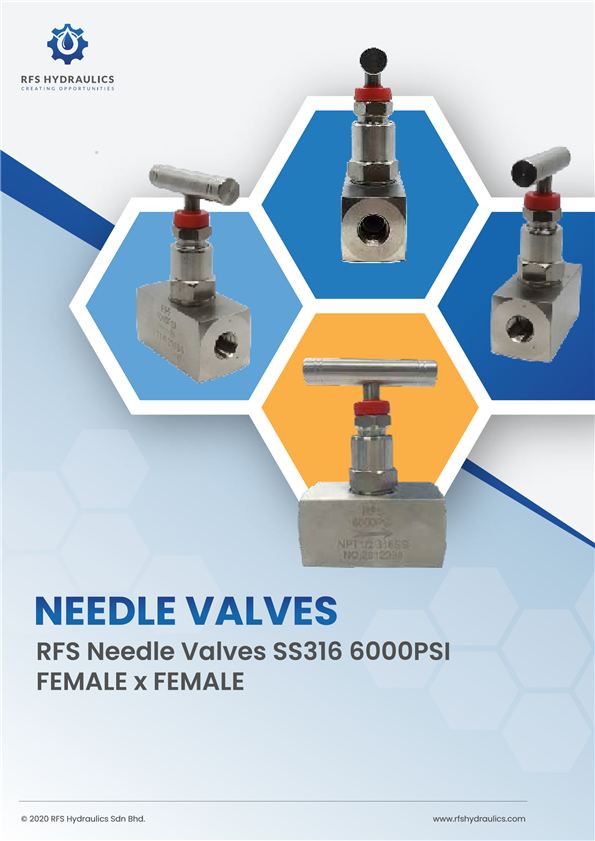 SS316 6,000 psi — female × femaleRFS Hydraulics · PDFPDF
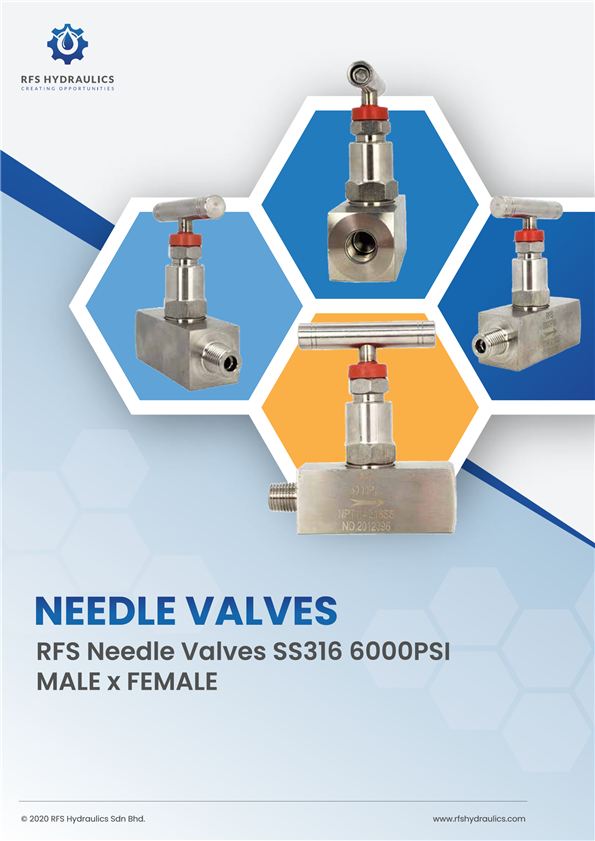 SS316 6,000 psi — male × femaleRFS Hydraulics · PDFPDF
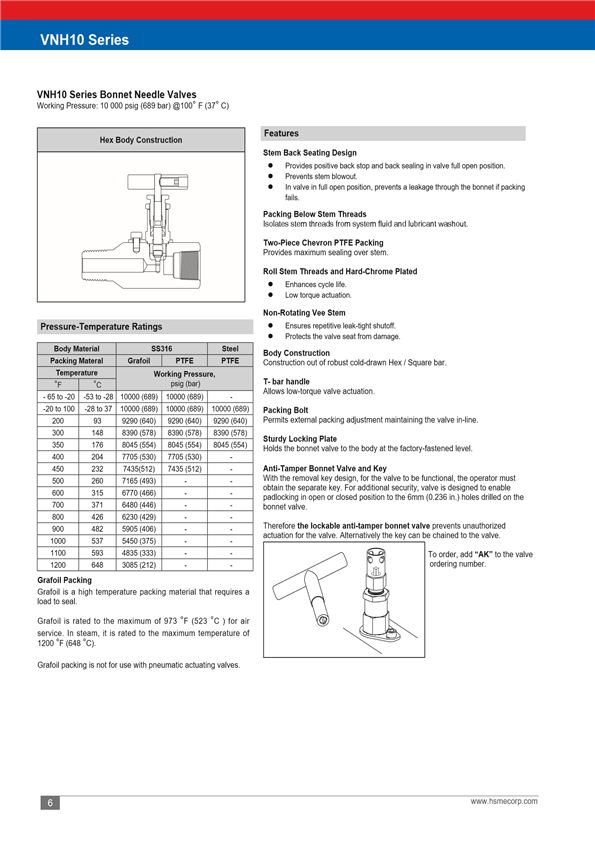 VNH10 series — 10,000 psi bonnet needle valvesHSME · PDFPDF
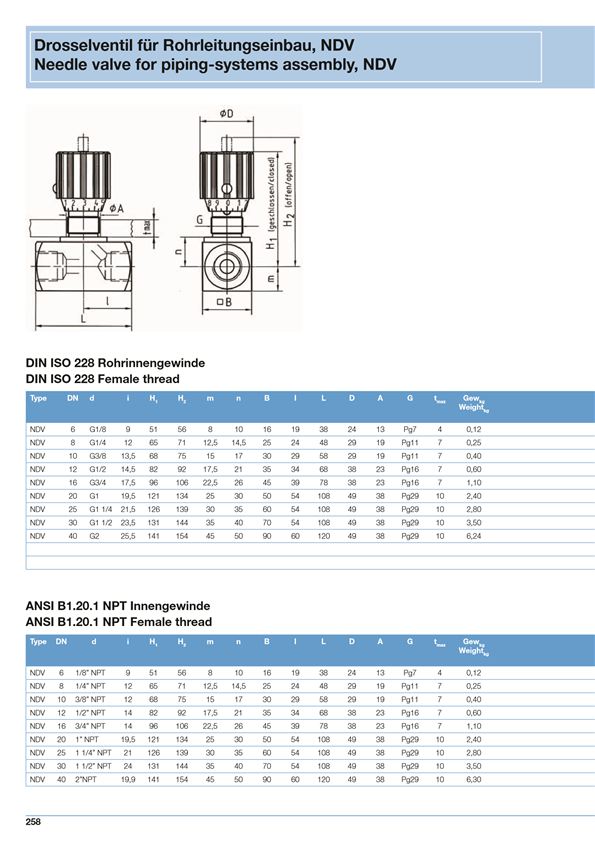 Type NDV — DN6 to DN40, steel and AISI 316MHA Zentgraf · PDFPDF
Related: high pressure ball valves for isolation · high pressure check valves for one‑way flow · pressure gauges, which is what most of these are protecting.
Send the port size, the thread form, the pressure and the temperature.
Or a photo of the body marking. A product specialist confirms the part number within two working hours.