
Home › Products › Clamps › STAUFF clamps
STAUFF · ready stockSTAUFF pipe clamps to DIN 3015, 6 mm to 406 mm
Two‑piece clamps that hold tube, pipe, hose and cable steady and take the vibration out of the run. Three series — standard to 102 mm, heavy to 406 mm, twin to 42 mm — in polypropylene, polyamide or aluminium, with carbon steel or SS316 hardware. The number that decides the job is not the clamp: it is the load group and the spacing along the pipe.
Get a quotation within 2 working hours
Send the part number, standard, size or quantity. Stock in Malaysia or Singapore, ISO 9001:2015 certified.
What a STAUFF clamp is, and what it is for
Two halves, a plate and two bolts — holding a line still.
A STAUFF clamp grips tube, pipe, hose or cable along a hydraulic run and holds it still. Its real job is not just support: it is to absorb the impact and vibration that flowing fluid creates, before that energy reaches a fitting or a weld. An unclamped run works its joints loose; a properly clamped one does not.
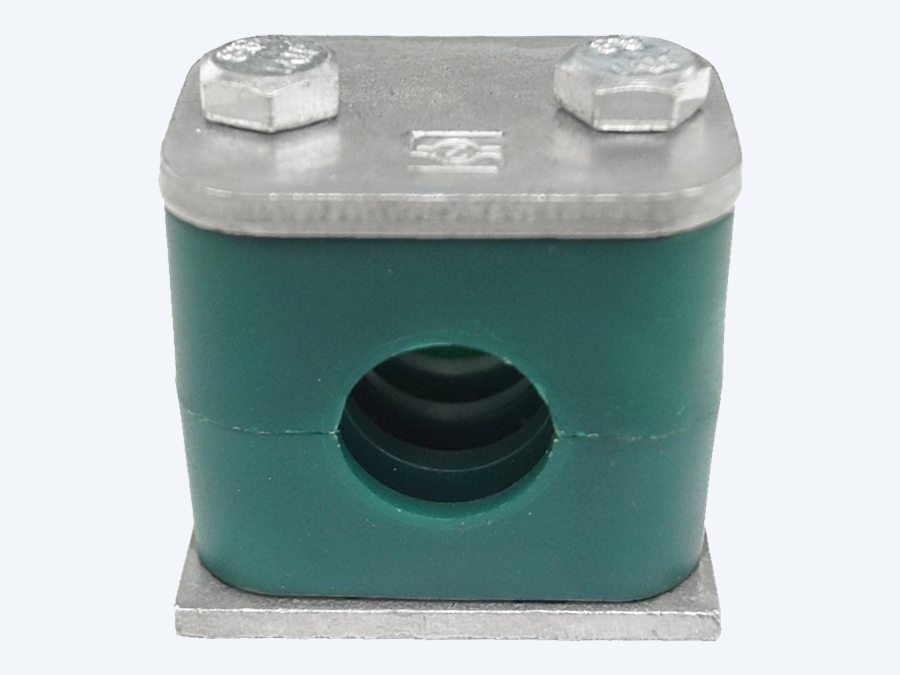
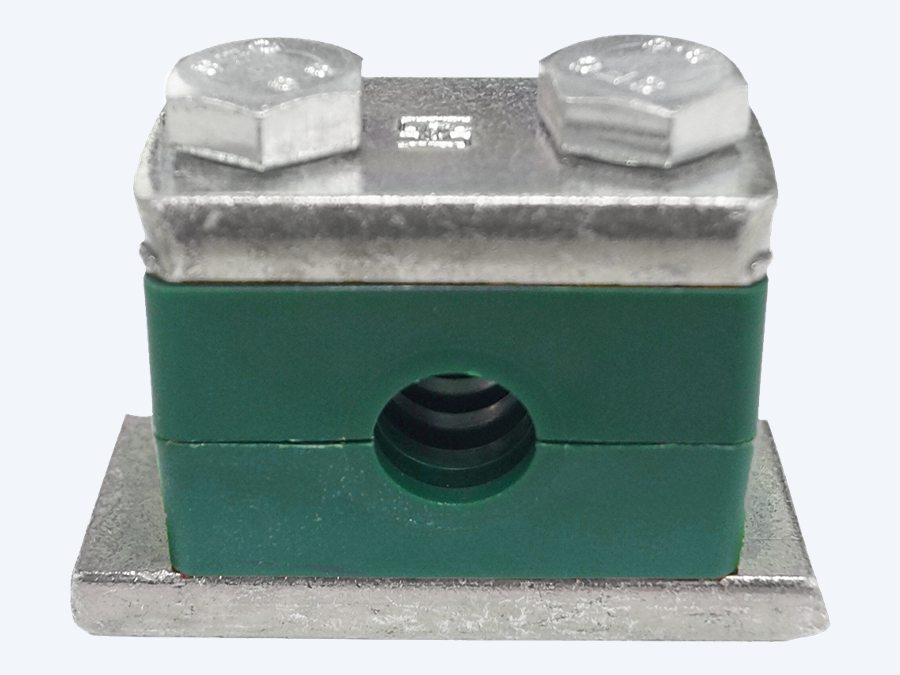
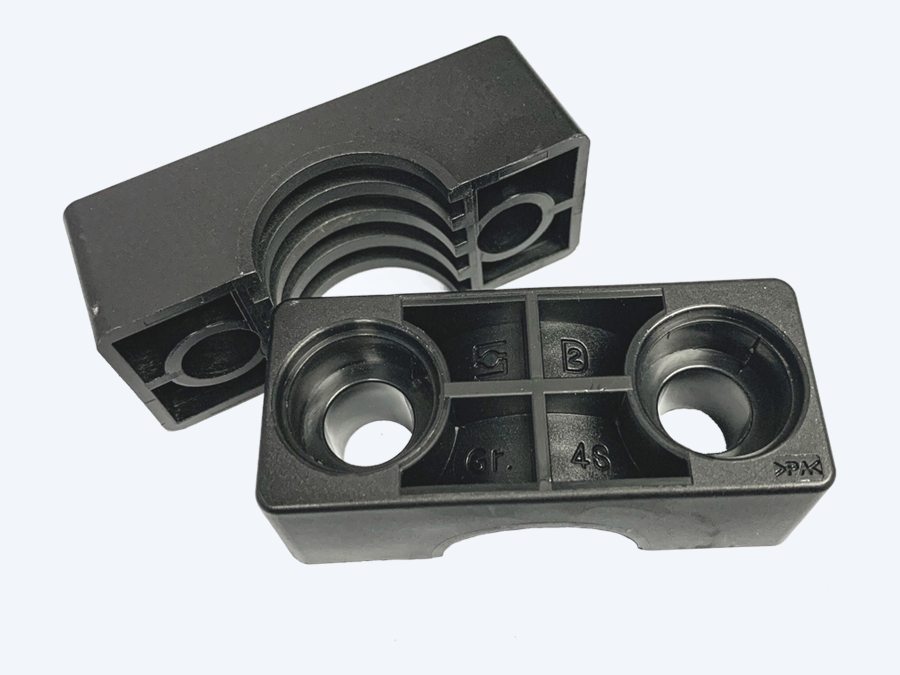
The clamp is two identical halves around the line, closed by a cover plate and two bolts, sitting on a base plate that is welded or bolted to structure. The halves are moulded with a profiled bore that grips the line along its axis without crushing it. Everything is built to DIN 3015, which is why parts from different batches and different suppliers still fit together.
- It comes apart. Undo two bolts and the line lifts out — which is why clamps are specified where a run has to be serviced, not just supported.
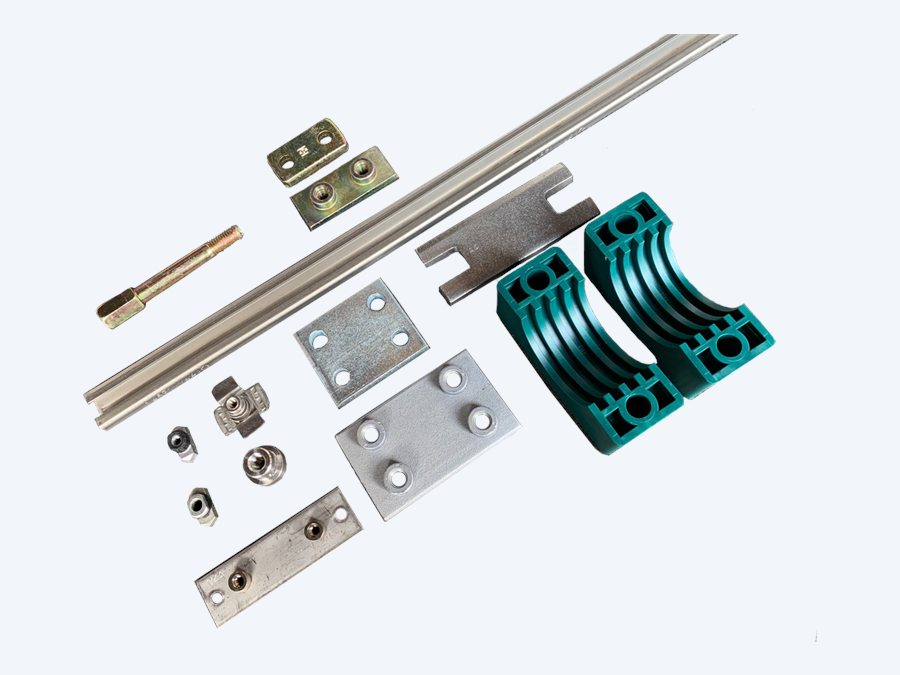
- It is a system, not a part. Base plates, mounting rails, rail nuts, stacking bolts and locking plates all come off the same standard, so a run can be built up, added to and re‑routed later.
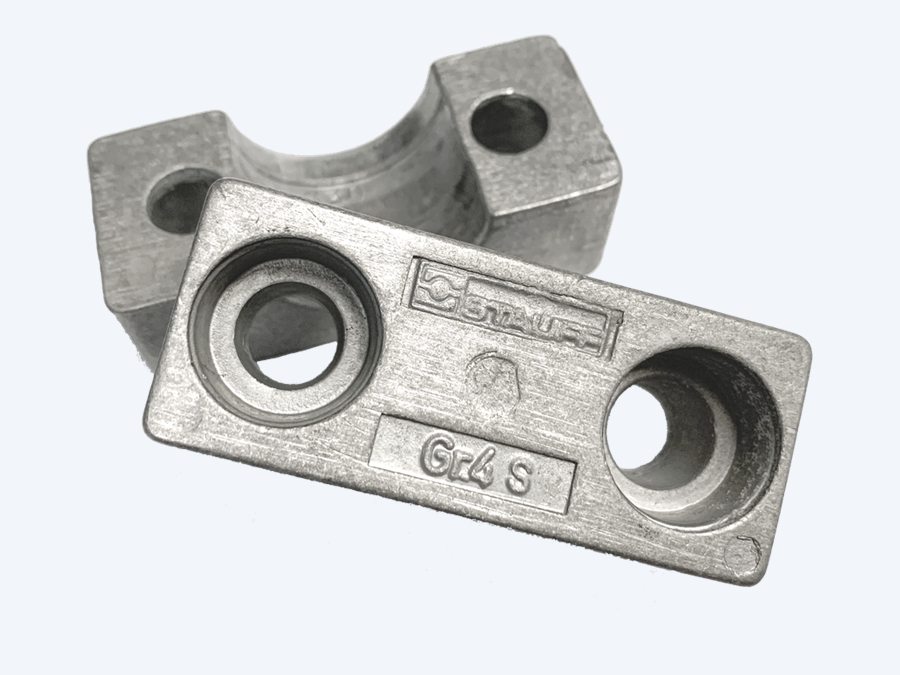
- The body material sets the temperature, and it is colour coded — green, black or silver. The three bodies.
- Also called tube clamps, pipe clamps and hydraulic brackets. Same product.
Where it earns its place
- Any hydraulic run with pressure pulsation — the clamp is what stops the pulse becoming movement.
- Mobile equipment and machine tools, where vibration is constant.
- Mining and metal plant, on the heavy series.
- Marine and offshore, in SS316 hardware.
Getting it wrong
- Clamps too far apart. The commonest fault, and the one that cracks fittings. Spacing table.
- Over‑tightened bolts — they break the clamp body on installation. Torque figures.
- Wrong body for the temperature — polypropylene stops at +90 °C.
- Carbon steel hardware in a wet environment. Specify W5 and it is SS316.
Specification
Everything an enquiry needs, in one place.
| Type | Two‑piece pipe, tube, hose and cable clamp |
| Standard | DIN 3015 — standard series, heavy series and twin series |
| Standard series | 6 mm to 102 mm outside diameter (to 4") |
| Heavy series | 6 mm to 406 mm outside diameter (to 16") |
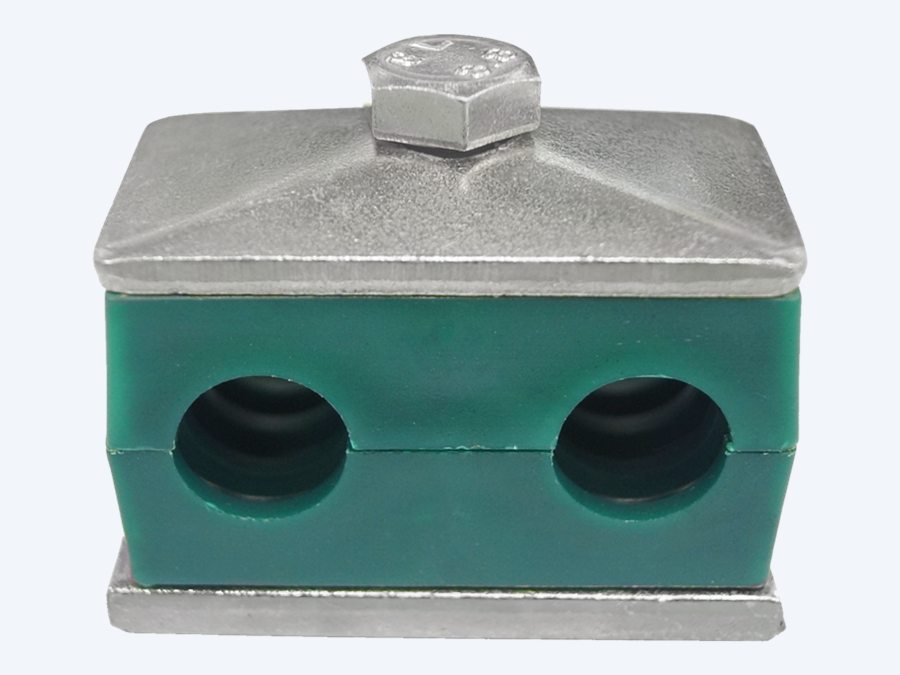
| Twin series | 6 mm to 42 mm outside diameter, two lines per clamp |
| Body materials | Polypropylene (PP) · polyamide (PA) · aluminium (AL) · polypropylene with rubber insert (RI) |
| Body temperature | PP −30 to +90 °C · PA −40 to +120 °C · AL to +300 °C |
| Hardware materials | Carbon steel ST37.4 · stainless A2 (AISI 304/303) · stainless A4 (AISI 316/316Ti) — finish codes W1 to W11 |
| Thread forms | Metric (code M) · UNC (code U) |
| Maximum load | From 0.6 kN on a group 1 PP clamp to 244.5 kN on a group 12S aluminium — by group |
| Tightening torque | 5 N·m to 600 N·m depending on series, group and body — full table |
| Common accessories | Top plate · base weld plate — held as standard items |
| Made to order | Double top plate · double base plate · stacking bolt · safety locking plate · mounting rail · hexagon rail nut · group weld plate · channel rail adaptor · elongated base plate |
| Stock | Held in Johor Bahru and Singapore |
Two figures are worth checking before you order. The load group — a group 1 clamp and a group 12S clamp differ by a factor of 400 in what they will carry. And the spacing: a 12 mm line wants a clamp every 1 metre, a 400 mm pipe every 7.5 metres. Get those right and the clamp choice follows.
The three series, the parts that go around them, and what the three body materials actually look like.
Buying STAUFF clamps in Malaysia and Singapore
Where the stock sits, and the five things we need.
Stock, delivery and ordering
- Running sizes in PP with galvanized hardware are held in Johor Bahru and Singapore, with top plates and base weld plates on the same shelf.
- On a stocked item, order to delivery can be under three working days.
- Parts sell separately. Clamp halves, cover plates, base plates and bolts are all individual line items — useful when you only need to add clamps to an existing rail.
- Aluminium bodies, SS316 hardware and the custom accessories are brought in to order; we quote the lead time with the price.
- One price, delivered — transport, currency, duties and taxes are inside the quoted figure.
What we need from you
- The tube or pipe outside diameter — not the nominal bore. The clamp is sized on OD.
- How many lines, and how close together — that decides standard against twin.
- Load and vibration, roughly — that decides standard against heavy.
- Temperature and environment — which sets the body material and whether the hardware needs to be SS316.
- How it mounts — welded base plate, bolted elongated plate, or mounting rail.
Standard, heavy or twin?
Load and vibration pick the series. Size only narrows it.
All three are DIN 3015 and all three use the same idea. What separates them is how much load and vibration the body will take — and the sizes follow from that, because a bigger pipe means a bigger load.
| Series | Size range | Designed for | Typical duty |
|---|---|---|---|
| Standard | 6–102 mm to 4" | Average load, moderate vibration | Mobile equipment, machine tools, instrumentation plumbing |
| Heavy | 6–406 mm to 16" | Higher load, higher vibration | Metal manufacturing, mining equipment |
| Twin | 6–42 mm two lines | Closely placed lines, moderate vibration | General industrial, where two lines run together |
- The series overlap at the small end. A 20 mm line can be clamped in any of the three — and they are different parts at different prices carrying different loads. Tell us the duty, not just the size.
- Twin is not two standards. It is one body with two bores, so it uses one base plate, one cover plate and two bolts instead of two of each. On a run of paired lines that is a real saving in parts and in space.
- Heavy reaches 406 mm; standard stops at 102 mm. Above 4" the choice is made for you.
- Load capacity is what you are buying. See the group tables — the same nominal size in heavy carries several times what it does in standard.
Body material and hardware finish
The colour tells you the temperature. The W code tells you the metal.
The clamp body is moulded plastic or cast aluminium, and it is colour coded — which is genuinely useful on site, because you can tell at a glance whether a clamp is rated for the temperature it is sitting in.
| Body material | Code | Colour | Temperature range |
|---|---|---|---|
| Polypropylene | PP | Green | −30 °C to +90 °C |
| Polyamide | PA | Black | −40 °C to +120 °C |
| Aluminium | AL | Silver | up to +300 °C |
A fourth option is polypropylene with a rubber insert (RI), where the line needs a softer grip or extra damping.
Hardware finish — the W codes
The plates, bolts and rail nuts are ordered by a W code. This is the part of the specification that decides whether the assembly survives a wet or salt environment, and it is the part most often left off an enquiry.
| Code | Material | Finish |
|---|---|---|
| W1 | Carbon steel ST37.4 | Untreated |
| W2 | Carbon steel ST37.4 | Phosphated |
| W3 | Carbon steel ST37.4 | Zinc / nickel plated |
| W4 | Stainless steel A2 | 1.4301 / 1.4305 — AISI 304 / 303 |
| W5 | Stainless steel A4 | 1.4401 / 1.4571 — AISI 316 / 316Ti |
| W10 | Carbon steel ST37.4 | Weld plate phosphated, all other parts zinc / nickel coated |
| W11 | Carbon steel ST37.4 | Rail nut untreated, all other parts zinc / nickel coated |
- W5 is the one to ask for offshore, marine or washdown — it is A4 stainless, AISI 316. W4 is A2, which is 304 and not the same thing in salt.
- W10 and W11 are deliberate mixtures. W10 leaves the weld plate phosphated because zinc coating burns off in the weld anyway; W11 leaves the rail nut untreated so it still slides in the rail. They are not compromises — they are the right answer for those two parts.
- W1 is untreated carbon steel. Indoors and dry only. If nobody specified a finish, this is what turns up rusty a year later.
- Body and hardware are chosen separately — a PP body with W5 stainless hardware is a normal, sensible combination.
Maximum load, by group
The number that actually decides which clamp you need.
Clamps are grouped by size, and each group has a maximum load that depends on the body material. Aluminium carries the most by a wide margin; polyamide beats polypropylene on the larger groups. Figures are kN.
Standard series and twin series
| Group | Polypropylene | Polyamide | Aluminium |
|---|---|---|---|
| 1 | 0.6 | 0.6 | 3.5 |
| 1A | 1.1 | 0.7 | 4.2 |
| 2 | 1.3 | 0.8 | 4.3 |
| 3 | 1.4 | 1.6 | 4.9 |
| 4 | 1.5 | 1.7 | 5.0 |
| 5 | 1.9 | 2.0 | 7.3 |
| 6 | 2.0 | 2.5 | 8.9 |
| 7 | 2.3 | 3.2 | not offered |
| 8 | 2.6 | 3.5 | not offered |
| 1D twin | 0.9 | 0.9 | not offered |
| 2D twin | 2.1 | 2.2 | not offered |
| 3D twin | 1.9 | 2.0 | not offered |
| 4D twin | 2.7 | 2.9 | not offered |
| 5D twin | 1.7 | 2.5 | not offered |
Heavy series
| Group | Polypropylene | Polyamide | Aluminium |
|---|---|---|---|
| 3S | 1.6 | 4.2 | 12.1 |
| 4S | 2.9 | 4.5 | 15.1 |
| 5S | 3.3 | 5.1 | 15.5 |
| 6S | 8.2 | 9.3 | 29.5 |
| 7S | 11.0 | 15.8 | 34.9 |
| 8S | 14.0 | 21.0 | 50.0 |
| 9S | 28.0 | 32.0 | 70.6 |
| 10S | 40.0 | 48.0 | 84.5 |
| 11S | 119.0 | 125.0 | 181.5 |
| 12S | 168.0 | 180.0 | 244.5 |
- Aluminium is not a marginal upgrade. At group 1 it carries 3.5 kN against 0.6 kN in polypropylene — almost six times. If the load is the problem, changing body material is the cheapest fix available.
- Polyamide overtakes polypropylene from group 3 upward, and the gap widens: at 3S it is 4.2 against 1.6 kN. Below group 3 they are level or PP is slightly ahead.
- The heavy series is a different order of magnitude. Group 12S in aluminium takes 244.5 kN — some 400 times a group 1 PP clamp.
- Aluminium is not offered in standard groups 7 and 8, nor in the twin series.
- Figures in kN. The catalogue lists the same values in lbf alongside — group 12S aluminium is 54,965 lbf.
Tightening torque
Under‑tighten and it slips. Over‑tighten and you break the clamp.
This is the figure that gets ignored on site and causes the most avoidable damage. An under‑torqued bolt lets the body deform and never develops the clamping force the joint needs. An over‑torqued bolt breaks the clamp on installation. Use a torque wrench, and pre‑tighten every bolt by hand before applying the final figure. Values in N·m.
| Series and group | Polypropylene | Polyamide | Aluminium |
|---|---|---|---|
| Standard, groups 1 to 6 | 8 | 10 | 12 |
| Standard, groups 7 and 8 | 8 | 10 | not offered |
| Twin 1D | 5 | 5 | not offered |
| Twin 2D, 3D, 4D | 12 | 12 | not offered |
| Twin 5D | 8 | 8 | not offered |
| Heavy 3S | 12 | 20 | 30 |
| Heavy 4S | 12 | 20 | 30 |
| Heavy 5S | 15 | 25 | 35 |
| Heavy 6S | 30 | 40 | 55 |
| Heavy 7S | 45 | 55 | 120 |
| Heavy 8S | 80 | 150 | 220 |
| Heavy 9S | 110 | 200 | 250 |
| Heavy 10S | 180 | 350 | 500 |
| Heavy 11S | 200 | 370 | 500 |
| Heavy 12S | 270 | 450 | 600 |
- The standard series is one figure across the range. Groups 1 to 8 all take 8 N·m in PP, 10 in PA, 12 in aluminium — the bolt is the same, so the torque is too. Only the heavy series climbs with size.
- The body material changes the torque, not just the load. A 12S clamp takes 270 N·m in PP but 600 N·m in aluminium. Torque to the body you actually have.
- Twin 1D is the lowest figure on the page at 5 N·m — barely more than hand tight. It is easy to destroy with a normal spanner.
- Hand tight first, every bolt. Pulling one bolt down fully before the other cocks the cover plate and loads the body unevenly.
- The catalogue lists lbf·ft alongside: 8 N·m is 6, and 600 N·m is 443.
How far apart to space the clamps
The most common design fault on a hydraulic run.
A clamp that is right in every other respect will not help if the next one is three metres away on a 12 mm line. Spacing is set by the pipe outside diameter — a small line needs support often, a large one carries itself between supports.
| Pipe outside diameter | Maximum distance between clamps |
|---|---|
| 6.0 – 12.7 mm | 1.0 m |
| 12.7 – 22.0 mm | 1.2 m |
| 22.0 – 32.0 mm | 1.5 m |
| 32.0 – 38.0 mm | 2.0 m |
| 38.0 – 57.0 mm | 2.7 m |
| 57.0 – 75.0 mm | 3.0 m |
| 75.0 – 76.1 mm | 3.5 m |
| 76.1 – 88.9 mm | 3.7 m |
| 88.9 – 102.0 mm | 4.0 m |
| 102.0 – 114.0 mm | 4.5 m |
| 114.0 – 168.0 mm | 5.0 m |
| 168.0 – 219.0 mm | 6.0 m |
| 219.0 – 324.0 mm | 6.7 m |
| 324.0 – 356.0 mm | 7.0 m |
| 356.0 – 406.0 mm | 7.5 m |
- Work out the count before you price the clamps. A 30 metre run of 12 mm tube needs about 30 clamps; the same run in 100 mm pipe needs about 8. That difference usually dwarfs the unit price.
- These are maxima, not targets. Close them up at bends, valves, pumps and anywhere the line changes direction — that is where the pulsation does its work.
- Support each side of a heavy component. A valve or a filter hanging between two distant clamps loads the joints either side of it.
- Vertical runs need the same discipline. The table is about span, not orientation.
The three ways to mount it
Base plate, mounting rail, or stacked — and the part numbers for each.
Every installation is one of three arrangements, and all three are covered by DIN 3015 base plates. The clamp body never changes; only what it sits on.
1 · Base plate
- The basic case. Weld the base plate to structure, or use an elongated base plate and bolt it through two holes at either end — no welding at all.
- Mark the positions first and check the alignment before welding; a misaligned plate pulls the line out of true.
- Push the lower clamp half onto the plate, lay in the line, add the upper half and cover plate, then bolt down.
- Threads are metric (M) or UNC (U). Bolt length depends on plate, rail and stacking height — it can be made to your assembly.
2 · Mounting rail
- For several clamps along one line. Weld or bracket‑mount the rail, then position clamps anywhere along it — and add or remove clamps later without touching the structure.
- Rail nuts drop into the channel and turn to lock. On standard and twin they insert and rotate; on heavy they slide in from the end of the rail.
- The nut is chamfered at the bottom and grooved on top, so it grips further into the rail and stays put when a clamp is temporarily removed instead of sliding out.
- The nut's upper section is shaped to the body cap, which is what makes vertical and overhead installation practical.
3 · Stacked
- For lines running one above another. Stacking bolts and safety locking plates let identical clamp bodies mount directly on top of each other.
- The locking plate goes between levels and stops the stacking bolts turning as the next level is tightened.
- Build up level by level, torquing as you go, and finish the top level with a cover plate and hexagon bolts.
- Stacks mount on either a base plate or rail nuts — the two methods combine.
Ordering a complete set
Sets are ordered by a part‑number code that spells out every component. These are the polypropylene combinations; the same pattern applies to PA and AL bodies.
| Part number | What is in the set |
|---|---|
| SP‑PP‑DP‑AS | Single weld plate, PP clamp, cover plate, hexagon head bolts (×2) |
| SP‑PP‑IS | Single weld plate, PP clamp, Allen cap screws (×2) |
| SPV‑PP‑DP‑AS | Elongated weld plate, PP clamp, cover plate, hexagon head bolts (×2) |
| SPV‑PP‑IS | Elongated weld plate, PP clamp, Allen cap screws (×2) |
| SM‑PP‑DP‑AS | Hexagon rail nuts (×2), PP clamp, cover plate, hexagon head bolts (×2) |
| SM‑PP‑IS | Hexagon rail nuts (×2), PP clamp, Allen cap screws (×2) |
| PP‑DP‑AS | PP clamp, cover plate, hexagon head bolts (×2) — no plate |
| PP‑IS | PP clamp, Allen cap screws (×2) — no plate |
| PP‑SIG‑AF | PP clamp, locking plate, stacking bolts (×2) — for stacking |
- Read the code from the left. SP is a single weld plate, SPV an elongated one, SM rail nuts, and no prefix means no mounting part at all — use that when you are adding clamps to a rail you already have.
- AS or IS is the fastener. AS gives a cover plate with hexagon head bolts; IS gives Allen cap screws and no cover plate. IS sits lower and suits tight spaces.
- SIG‑AF is the stacking set — locking plate plus stacking bolts, no cover plate, because another clamp goes on top.
- Send us the arrangement in words if the codes are unfamiliar. "Two 22 mm lines, welded plate, stainless, one above the other" is all we need.
What a STAUFF clamp is, in under 90 seconds
The body materials, the three series and how the clamps get mounted.
- 0:19 body materials · 0:32 the three series · 0:53 sample mounting configurations · 1:05 where to find out more.
- It is an overview, not an installation guide. For the figures that actually decide the order, use the load tables, the tightening torques and the spacing table above.
Why buy STAUFF clamps from us
The parts, the count, and the numbers that go with them.
We work out the count
Give us the run length and the tube size and we apply the spacing table. On small tube the number of clamps matters more than the unit price.
Load group checked, not guessed
Tell us the duty and we pick the series and body material against the load table — rather than defaulting everything to standard PP.
Torque figures with the order
We send the tightening torque for your group and body, because a broken clamp body on installation is nearly always an over‑torqued bolt.
The right W code
W5 is A4 stainless, AISI 316 — not W4, which is 304. We ask about the environment so the hardware outlives the clamp.
Parts, not just sets
Clamp halves, cover plates, base plates, rail nuts and bolts as individual line items — so adding to an existing rail costs what it should.
Stock on both sides of the causeway
Johor Bahru and Singapore, with a landed price — transport, currency, duties and taxes already inside the figure.
Questions we get asked
The ones that come up on the phone.
What is a STAUFF clamp actually for?
Holding a tube, pipe, hose or cable still — and more importantly absorbing the impact and vibration that flowing fluid creates before it reaches a fitting or a weld. A run that is not properly clamped works its joints loose over time. The clamp grips the line along its axis over a broad contact area, so it damps movement without deforming the tube.
How far apart should the clamps go?
By pipe outside diameter. A 6–12.7 mm line wants a clamp every 1 metre; 22–32 mm every 1.5 m; 88.9–102 mm every 4 m; and at the top of the heavy range, 356–406 mm every 7.5 m. Those are maxima — close them up at bends, valves and pumps. Full table.
Standard, heavy or twin — which do I need?
Load and vibration decide it, not size. Standard (6–102 mm) for average load and moderate vibration — mobile equipment, machine tools, instrumentation. Heavy (6–406 mm) for higher load and vibration — metal plant, mining. Twin (6–42 mm) where two lines run close together and one body with two bores saves space and parts. They overlap at the small end, so tell us the duty.
What do the colours mean?
The body material, and therefore the temperature. Green is polypropylene, −30 to +90 °C. Black is polyamide, −40 to +120 °C. Silver is aluminium, up to +300 °C. It is a genuinely useful convention on site — you can see at a glance whether a clamp is rated for where it is sitting. A fourth option, PP with a rubber insert, is used where the line needs a softer grip.
What does W5 mean?
The hardware finish code. W5 is A4 stainless — 1.4401/1.4571, AISI 316/316Ti, and it is what to specify for marine, offshore or washdown. Do not accept W4 as equivalent: that is A2, which is AISI 304, and it does not behave the same in salt. W1 is untreated carbon steel, W2 phosphated, W3 zinc/nickel plated. Full list.
Why are W10 and W11 mixtures of finishes?
Because the parts do different jobs. W10 leaves the weld plate phosphated and zinc‑coats everything else — there is no point plating a plate you are about to weld, because the coating burns off. W11 leaves the rail nut untreated and coats the rest, so the nut still slides and locks in the mounting rail. They are deliberate specifications, not compromises.
How tight should the bolts be?
To the figure for your series, group and body material. The standard series is 8 N·m in PP, 10 in PA and 12 in aluminium right across groups 1 to 8. The heavy series climbs with size, up to 270 / 450 / 600 N·m at group 12S. Pre‑tighten every bolt by hand first, then torque. Under‑torqued and the body deforms without developing clamping force; over‑torqued and you break the clamp on installation. Full table.
Which body material carries the most load?
Aluminium, by a wide margin. At group 1 it takes 3.5 kN against 0.6 kN in polypropylene — almost six times. Polyamide overtakes polypropylene from group 3 upward and the gap widens with size. So if load is the constraint, changing the body material is usually cheaper than changing series. Note aluminium is not offered in standard groups 7 and 8, nor in the twin series. Load tables.
Can I add clamps to a run later?
Yes, and it is worth designing for. Use a mounting rail: weld the rail once, then clamps position anywhere along it on rail nuts, and can be added or removed without touching the structure. The rail nut is chamfered and grooved so it stays in place when a clamp is temporarily removed rather than sliding out. On a base‑plate installation, adding a clamp means welding another plate.
Can I stack clamps on top of each other?
Yes — with stacking bolts and safety locking plates, identical bodies mount directly on top of one another, so lines running close together need not sit side by side. The locking plate goes between levels to stop the stacking bolts turning as the next level is tightened, and the top level finishes with a cover plate and hexagon bolts. Stacks work on either a base plate or rail nuts. The set code is PP‑SIG‑AF.
Do I size the clamp on the pipe bore or the outside diameter?
Outside diameter, always. The clamp closes around the outside of the line, so the bore of the clamp matches the tube or pipe OD — never the nominal bore. This is the single most common ordering error on clamps: a “1 inch pipe” is 33.7 mm outside, not 25.4, and it needs the clamp for 33.7.
Do you deliver to Singapore, and what does delivery cost?
Yes. We hold stock in Johor Bahru and Singapore, and a stocked item can be delivered in under three working days. Our quote is a landed price — transport, currency, duties and taxes are already in the figure, so what you approve is what you pay. Aluminium bodies, SS316 hardware and the custom accessories come in to order and we quote that lead time with the price.
Catalogue
Direct PDF download — no form, no email address.
Related: Tubeclo pipe clamps and rubber insert clamps as alternatives · ACT clamps · hydraulic steel tube and stainless steel tube to clamp · compression fittings and Walform tube for the joints between.
Send the tube size and the run length
We will work out the clamp count from the spacing table, pick the series and body against the load, and quote a landed price. Stock in Johor Bahru and Singapore.