
Home › Products › Accessories › Anti Bloc Fett grease
Eaton Walterscheid · ready stockEaton Walterscheid ABF Anti‑Bloc‑Fett assembly grease for stainless couplings
A single‑purpose assembly grease for making up stainless steel fittings in material 1.4571. It does two things: it stops the threads and ferrules galling as they are tightened, and it reduces the coefficient of friction so the torque you apply actually goes into the joint. If you have ever seized a stainless nut solid on its first assembly, this is the product that prevents it.
Get a quotation within 2 working hours
Send the part number, standard, size or quantity. Stock in Malaysia or Singapore, ISO 9001:2015 certified.
What Anti‑Bloc‑Fett is, and when you need it
One job, done before the spanner goes anywhere near the fitting.
ABF Anti‑Bloc‑Fett — Anti‑Bloc‑Grease, Graisse‑Anti‑Bloc — is Eaton Walterscheid’s special grease for the installation of stainless couplings in material 1.4571. It is not a general‑purpose lubricant and it is not a thread sealant. It exists because austenitic stainless steel behaves badly against itself under load: the two surfaces cold‑weld and tear instead of sliding, and a fitting that does that is ruined on its first assembly.
You need it whenever you are making up stainless on stainless — a stainless nut onto a stainless body, a stainless ferrule into a stainless port. That covers most marine, offshore, food, pharmaceutical and chemical pipework, which is exactly where stainless tube and ferrule fittings get specified. On plated carbon steel fittings it is unnecessary: the plating already does the job.
| ABF Anti‑Bloc‑Fett (this page) | Thread sealant or PTFE tape | General purpose grease | |
|---|---|---|---|
| What it is for | Preventing galling and reducing friction on assembly | Sealing a tapered thread | Lubricating moving parts |
| Where it goes | All contact surfaces of the fitting, before assembly | On the thread flanks only | Wherever it is needed |
| Does it seal? | No — the fitting's own design seals | Yes, that is its purpose | No |
| Formulated for | Stainless 1.4571 couplings | Any tapered thread | Nothing in particular |
| Effect on torque | Lowers friction, so the applied torque produces the intended clamp | Unpredictable | Unpredictable |
| Use it when | Assembling stainless on stainless | Sealing an NPT or BSPT joint | Not on a coupling assembly |
Specification
A short list, because it is a single‑purpose product.
| Product | ABF Anti‑Bloc‑Fett — also printed as Antibloc‑Grease and Graisse‑Anti‑Bloc on the same tin |
| Maker | Eaton Walterscheid, made in Germany |
| Purpose | Special grease for the installation of stainless couplings, material 1.4571 |
| Function 1 | To avoid gripping — galling, seizing and cold welding of the mating stainless surfaces |
| Function 2 | To reduce the coefficient of friction, so applied torque converts into clamp load rather than being lost to friction |
| Material it is for | 1.4571 — AISI 316Ti stainless, the grade used for stainless coupling bodies, nuts and ferrules |
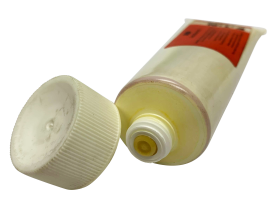
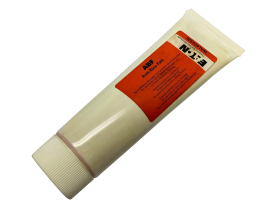
| Pack forms | Tin and tube |
| How it is applied | By brush or lint‑free cloth to all contact surfaces — see the method |
| What it is not | Not a thread sealant, not a general purpose grease, and not needed on plated carbon steel fittings |
Buying Anti‑Bloc‑Fett in Malaysia and Singapore
Where the stock sits, what it costs to get it to you, and how fast it moves.
Stock, delivery and ordering
- Where the stock is — the office is in Kuala Lumpur, and stock is held in two warehouses: Johor Bahru and Singapore. Addresses and direct lines are on the contact page.
- Dispatch — stock items leave the same or next working day.
- Order it with the fittings. This is a consumable that belongs on the same purchase order as the stainless couplings it is for — discovering it is missing on assembly day is how joints get made up dry.
- Two pack forms — tell us whether you want the tin for bench work or the tube for a site toolbox.
- Delivery cost — already inside the product price, along with transport, currency conversion, duties and taxes. Nothing is added afterwards.
Who buys it. Almost entirely marine, offshore and shipyard work in Singapore, and food, chemical and washdown plant in Malaysia — the places where stainless pipework is specified in the first place.
How an enquiry runs
Three things and we can price it:
- Pack form — tin or tube.
- Quantity — it is a consumable, and a little goes a long way, so most orders are small.
- What you are assembling — so we can confirm the grease is the right answer. On plated carbon steel fittings it is not needed at all, and we would rather say so.
A product specialist prices it within two working hours. If you are buying stainless ferrule fittings or compression fittings at the same time, put them on the same list and we will make sure the grease is on it.
Why stainless seizes, and plated steel does not
The failure this product exists to prevent, and why it happens on the first assembly rather than the tenth.
Galling is not wear and it is not corrosion. When two surfaces of the same austenitic stainless are pressed together and moved — which is exactly what a nut does on a thread — the natural oxide film breaks down at the contact points and the bare metal underneath cold‑welds. Keep turning and those welded points tear out, leaving torn ridges that jam the joint. Once it has started it accelerates, and the usual outcome is a nut that will neither tighten nor come off.
| Stainless on stainless | Plated carbon steel | |
|---|---|---|
| Surface film | Thin oxide, breaks down under contact load | Zinc or zinc/nickel plating acts as a sacrificial lubricant layer |
| What happens under load | Bare metal meets bare metal and cold‑welds | The plating shears in preference to the base metal |
| When it fails | First assembly, often before final torque | Rarely, and gradually |
| Symptom | Torque climbing fast and unevenly, then a nut that will not move either way | Normal, predictable torque |
| Needs assembly grease? | Yes — that is what ABF is for | No |
- This is why the label names a grade. 1.4571 / AISI 316Ti is the stainless used for coupling bodies, nuts and ferrules, and it is a classic galling pair against itself. The grease puts a film between the two so they slide instead of welding.
- The friction benefit is not a side effect. If friction is high and unpredictable, the torque you apply mostly goes into overcoming it rather than into clamping the joint — so a “correctly torqued” dry stainless fitting can be under‑clamped and leak. Lowering friction makes the torque figure mean something.
- It is cheap insurance. A seized stainless fitting usually means cutting it out, and on a stainless line that is a fabrication job rather than a spanner job.
How to apply it
Four steps, in Eaton’s own words, and the order matters.
The method on the datasheet is short and each part of it earns its place:
| Step | What to do | Why |
|---|---|---|
| 1 | Clean the fittings thoroughly before anything else | Grease over swarf or grit grinds the contact surfaces instead of protecting them. Cleaning first is not optional |
| 2 | Coat all contact surfaces with a sufficient amount of grease | Every surface that will slide under load — thread flanks, ferrule cone, nut face — not just the thread |
| 3 | Apply with a brush or a lint‑free cloth | A lint‑free cloth matters: fibres left in a fitting end up in the system, and in a stainless line that usually means a filter |
| 4 | Assemble immediately after greasing | Eaton is explicit — assemble at once to avoid contamination. Greased parts left on a bench collect dust, and grease holds it |
- ⭐ Then follow the fitting maker’s own assembly instructions. Eaton says so in as many words: “pay attention to the assembly instructions for the respective fitting systems”. The grease changes the friction, not the method — the number of turns, the torque and the ferrule‑bite procedure are still whatever the fitting system specifies.
- Sufficient, not generous. A film on the contact surfaces is what is wanted. Packing a fitting full of grease displaces nothing useful and pushes the excess into the fluid.
- One application, one assembly. If a joint has to come apart and go back together, clean and re‑grease. The first assembly will have wiped and contaminated the original film.
What goes wrong
Five ways to have the grease and still gall the fitting.
Common errors
- Greasing the thread only. On a ferrule fitting the ferrule cone and the nut face carry as much sliding load as the thread does. All contact surfaces means all of them.
- Skipping the clean. Grease is not a substitute for cleaning — it holds whatever debris was already there against the surfaces you were trying to protect.
- Greasing today, assembling tomorrow. The datasheet says assemble immediately. A greased fitting is a dust magnet.
- Using an ordinary grease instead. A general‑purpose grease lubricates but is not formulated to stop stainless cold‑welding under contact load. It may reduce the symptom and still let the joint gall.
- Using it as a sealant. It is not one. The fitting seals by its own design — ferrule bite, cone, or O‑ring. If a joint only seals when greased, something else is wrong.
When you do not need it
- Plated carbon steel fittings. The zinc or zinc/nickel plating already acts as the sacrificial layer. Adding grease changes the friction the fitting was designed and torqued around.
- Where a torque figure assumes a dry joint. If the fitting system specifies dry assembly, follow it — and ask us if a stainless version of that fitting has a different instruction.
- On the sealing face of a bonded seal or an O‑ring. Those seal on clean surfaces; grease on the face is a separate discussion and usually unnecessary.
- Inside the flow path. Nothing goes on the bore. Grease that ends up in the fluid is contamination, and on a stainless system it will be found by whoever next takes an oil sample.
Why buy Anti‑Bloc‑Fett from RFS Hydraulics
Six things, on a product where the main risk is not having it.
Ready stock, in both pack forms
Held in Johor Bahru and Singapore, in tin and tube, dispatched the same or next working day. It is a small line item that stops a stainless assembly job dead when it is missing.
It goes on the same quote as the fittings
If you are buying stainless ferrule or compression fittings, we put the grease on the list. Nobody plans to make up a stainless joint dry — it happens because the tin was not ordered.
We will tell you when you do not need it
On plated carbon steel fittings this product is unnecessary, and adding grease changes the friction the joint was torqued around. We would rather say that than sell a tin.
Genuine Eaton Walterscheid
The actual ABF product, made in Germany, formulated for 1.4571 stainless couplings — not a decanted general‑purpose grease with an anti‑seize claim on the label.
The method comes with it
Clean, coat all contact surfaces, brush or lint‑free cloth, assemble immediately — then follow the fitting system’s own instructions. Most galling happens with the right grease applied the wrong way.
One price, delivered
Transport, currency, duties and taxes are already inside the figure we quote. Nothing is added at the end, and delivery within Malaysia is included.
Frequently asked questions
Ten, starting with what the product actually prevents.
What does Anti‑Bloc‑Fett actually do?
Two things, both stated on the tin. It avoids gripping — galling, seizing, the cold welding that happens when stainless slides against stainless under load — and it reduces the coefficient of friction, so the torque you apply goes into clamping the joint rather than into overcoming friction. It is a special grease for the installation of stainless couplings in material 1.4571, and that is its whole purpose.
Why does stainless steel seize when carbon steel does not?
Because of the surface. Plated carbon steel has a zinc or zinc/nickel layer that shears in preference to the base metal, so it behaves like a built-in lubricant. Austenitic stainless has only a thin oxide film, and under contact load that film breaks down and the bare metal underneath cold-welds. Keep turning and the welded points tear out, leaving ridges that jam the joint. It typically fails on the first assembly, before final torque.
Is it a thread sealant?
No, and it should not be used as one. The fitting seals by its own design — ferrule bite, a 24 or 37 degree cone, or an O-ring — and the grease has no sealing function. If a joint only stops weeping when it is greased, the joint is wrong and the grease is masking it. For sealing a tapered thread you want a thread sealant; these are different products doing different jobs.
Can I use ordinary grease instead?
You can put ordinary grease on, and it will lubricate, but it is not formulated to stop stainless cold-welding under contact load. The risk is that it reduces the symptom enough that assembly feels normal while the surfaces still gall. Given that a seized stainless fitting usually has to be cut out rather than undone, the tin of the correct product is cheap insurance on any stainless assembly job.
How much do I put on?
Enough to film all contact surfaces — Eaton's wording is a “sufficient amount”. That means thread flanks, ferrule cone and nut face, not just the thread. What it does not mean is packing the fitting: excess grease has nowhere useful to go and ends up pushed into the fluid, where it becomes contamination. A brush or a lint-free cloth gives the right amount.
Why does it have to be a lint‑free cloth?
Because fibres left inside a fitting go into the system. On a stainless hydraulic line that usually means they arrive at a filter, and in the meantime they are circulating with the oil. It is a small detail on the datasheet but a real one — the same reason the instruction says to clean the fittings thoroughly before greasing rather than after.
Can I grease the fittings and assemble them later?
No — Eaton says to assemble immediately after greasing, in order to avoid contamination. Grease is sticky and a greased fitting left on a bench or in a bag collects dust and grit, which is then dragged across exactly the surfaces you were protecting. If a job gets interrupted, clean and re-grease rather than carrying on with yesterday's film.
Does it change the assembly torque or the number of turns?
It changes the friction, which is the point — but it does not change the method. Eaton's instruction is explicit: pay attention to the assembly instructions for the respective fitting systems. So the turns, the torque and the ferrule-bite procedure stay whatever the fitting system specifies. If your fitting system publishes separate figures for greased assembly, use those.
Do I need it on plated carbon steel fittings?
No. The zinc or zinc/nickel plating already does the job of a sacrificial lubricating layer, and those fittings are designed and torqued around that. Adding grease changes the friction the assembly assumed. Use it where you are making up stainless on stainless — which is most marine, offshore, food, pharmaceutical and chemical pipework, and is where the problem actually occurs.
What sizes does it come in?
Two pack forms: a tin, which suits a workshop bench and a brush, and a tube, which suits a site toolbox. A little goes a long way, so most orders are small — the sensible approach is to add it to the same purchase order as the stainless fittings it is for, rather than treating it as a separate purchase to remember.
Data sheet
Direct PDF download — no form, no email address.
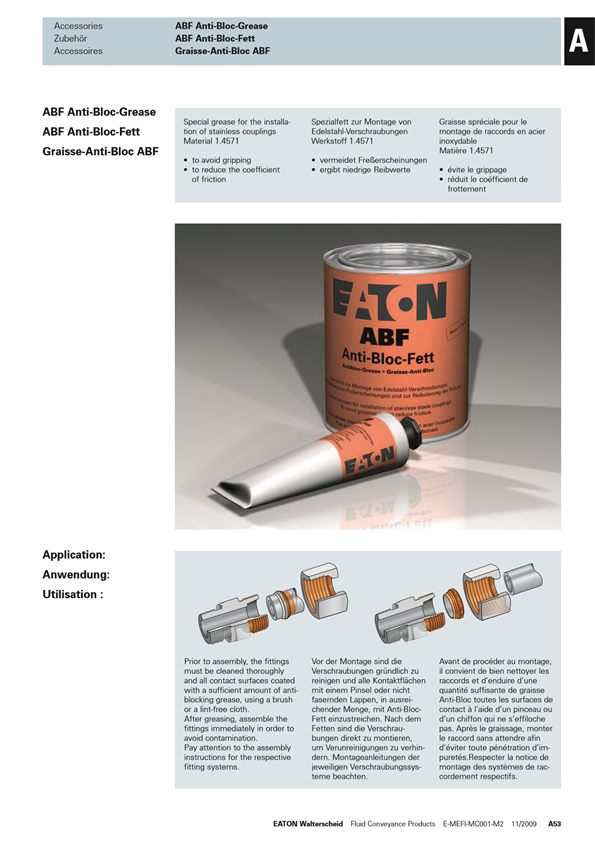
The product page is page A53 of the Eaton Walterscheid fluid conveyance catalogue (document E‑MEFI‑MC001‑M2), in English, German and French. Ask and we will send the safety data sheet with it.
Related: ferrule fittings and compression fittings in stainless · SS316 tube · O‑rings.
Tell us the pack form and what you are assembling.
If the fittings are plated carbon steel we will say you do not need it. A product specialist replies within two working hours.