
Home › Products › Accessories › Bonded seals
GS Hydro · ready stockGS Hydro bonded seals to ISO 6162‑2 & ISO 6164, 1/2" to 8"
A metal ring with an elastomer bonded to it — the seal in a non‑welded GS flange joint. SS302 carrier with NBR or FPM (Viton®), in ANSI B36.10, ANSI B36.19 and metric sizes. What pressure the joint actually takes, class by class, and why a bonded seal is not a retain ring — below.
Get a quotation within 2 working hours
Send the part number, standard, size or quantity. Stock in Malaysia or Singapore, ISO 9001:2015 certified.
What a bonded seal is, and when you need one
It is the seal in the joint — not the ring that holds the joint together.
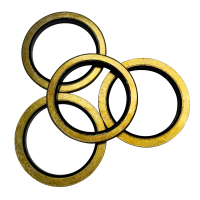
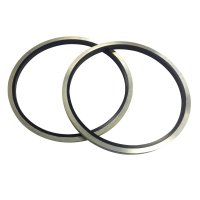
A bonded seal is a metal carrier ring with an elastomer permanently bonded to it. The metal fixes the geometry and takes the clamping load; the rubber does the sealing. Because the seal carries its own seat, it can be clamped between two plain faces — no machined groove, and no chance of pinching the seal out of position while the bolts come up. That is exactly what a fitter needs when the joint is being made on a pipe rack rather than on a machine bed.
You need one wherever a flange joint has to be made without welding: the GS Hydro system it belongs to covers 10 to 690 bar and pipe from 16 to 600 mm, assembled cold. That makes it the standard answer on offshore, marine and mining work, where hot work permits, weld inspection and downtime cost more than the fittings do.
Bonded seal, retain ring, Dowty seal — three different parts
These three get used as if they were synonyms, including in older copy on this site. They are not. Two of them sit in the same joint doing different jobs, and the third belongs somewhere else entirely.
| Bonded seal | Retain ring | Dowty seal | |
|---|---|---|---|
| What it does | Seals the joint face | Grips the pipe OD so the flange can clamp without welding | Seals under a bolt head or threaded port |
| Carries load? | No — it is a seal | Yes — it is structural | No |
| Size range | 1/2" to 8" | 1/2" to 14" | 1/8" to 3" |
| Material | SS302 + NBR or FPM | SS302, special treated | SS316 or steel |
| Standard | ISO 6162‑2 · ISO 6164 | ISO 6162‑2 · ISO 6164 | Inch and metric ranges |
| Ordered by | Flange size and class | Pipe outside diameter | Thread or bolt size |
| Interchangeable | No | No | No |
The seal and the ring are both in the box on a GS joint. If you are ordering spares and only say “GS ring”, we will ask which one you mean — the retain ring is ordered on pipe OD and the seal on flange size and class, so one figure will not do for both.
Specification
Everything that has to be on the enquiry, in one table.
| Property | Specification |
|---|---|
| Size range | 1/2" to 8". Outside that, made to order |
| Design standard | ISO 6162‑2 · ISO 6164 |
| Size specifications | ANSI B36.10 · ANSI B36.19 · metric |
| Carrier ring | SS302 (AISI 302) stainless steel |
| Elastomer | NBR nitrile · FPM (Viton®) |
| Working pressure | 350 to 400 bar normal maximum in the retain ring system; up to 690 bar in special applications |
| Brand | GS Hydro — the originator of the non‑welded system |
| Typical duty | Offshore, marine, mining, pulp & paper, metals, sugar, test rigs |
| What we need to quote | Flange size, the pressure class (SAE 3000 / 6000 / ISO 6164) and the fluid |
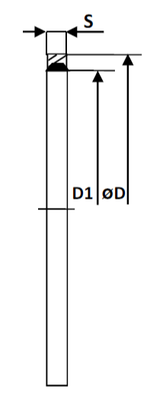
What one looks like, and the three figures we order on.
Buying bonded seals in Malaysia and Singapore
Where the stock sits, what it costs to get it to you, and how fast it moves.
Stock, delivery and ordering
- Where the stock is — the office is in Kuala Lumpur, and seals are held in two warehouses: Johor Bahru and Singapore. Addresses and direct lines are on the contact page.
- Dispatch — stock items leave the same or next working day.
- Delivery within Malaysia — 3 to 5 working days after dispatch. On an urgent stocked item, message us on WhatsApp and say it is urgent.
- Delivery cost — already inside the product price, along with transport, currency conversion, duties and taxes. Nothing is added afterwards.
Shutdown work. Seals are a consumable on a planned strip‑down, so tell us the shutdown date and the joint count and we will hold the quantity rather than have you find the shelf empty on the day.
How a bonded seal enquiry runs
Four things and we can price it without going back and forth:
- Flange size — 1/2" to 8", and whether the pipe is to ANSI B36.10, B36.19 or metric.
- Pressure class — SAE 3000, SAE 6000 or ISO 6164. This is the one people leave out.
- Fluid and temperature — it decides NBR against FPM (Viton).
- Quantity — and whether it is one repair or a shutdown spares list.
A product specialist prices it within two working hours. Only have the old part? Send a photo beside a rule — and say whether you also need the retain ring, because the two are ordered on different figures.
Where the seal sits in the GS flange system
Three flange systems, one purpose: a pipe joint made without a welder.
GS Hydro’s piping system exists to remove welding from the joint. It covers 10 to 690 bar and pipe from 16 to 600 mm, and it comes in three flange systems — the retain ring and 37° flare for high pressure, the 90° flare for low. A bonded seal is the sealing element in the high‑pressure two.
| System | Max working pressure | Flange sizes | Seal | How the joint is made |
|---|---|---|---|---|
| Retain ring | 350–400 bar 690 bar in special applications | 1/2"–3" · 2"–12" (ISO 6164) | NBR or FPM | A serrated stainless ring grips the pipe OD; the flange clamps over it |
| 37° flare | 420 bar | 1/2"–10" | NBR or FPM | The pipe end is flared at 37° and clamped |
| 90° flare | 10–40 bar | 1/2"–8" · 1/2"–24" (ANSI/JIS/BS/DIN) | Chosen on the medium | The pipe end is flared at 90° — class III, low pressure |
Pipe material matters more than you would expect. GS qualifies the retain ring method for carbon steel, stainless, duplex, super duplex and titanium, and more generally for any pipe with an elongation above 20% — that ductility is what lets the ring bite in without starting a crack. Outside that, the joint is the wrong choice, and no seal fixes it.
What pressure it will actually take
One figure gets quoted everywhere. The maker publishes three.
You will see “up to 690 bar” attached to this product all over the trade, including in our own older copy. It is not wrong, but it is the special‑application ceiling, not the everyday rating. GS Hydro’s own wording is that the retain ring system has a maximum allowable working pressure of 350 to 400 bar, and that in special applications it can be used as high as 690 bar. Specify against the class, not the headline.
| Pressure class | Working pressure | Flange size | Pipe size range |
|---|---|---|---|
| SAE 3000 | 210–350 bar | 1/2" to 3" | 26×6 – 97×12 mm |
| SAE 6000 | 420 bar | 1/2" to 2" | 26×6 – 66×8.5 mm |
| ISO 6164 | 210–690 bar | 2" to 12" | 60.3×11.04 – 355.6×41.4 mm |
Note what the classes do not share. SAE 6000 carries more pressure than SAE 3000 but stops at 2"; the big sizes live in ISO 6164, which is also the only class reaching 690 bar. So “higher pressure” and “bigger bore” are not the same request, and a drawing asking for both at once needs checking before it is ordered.
NBR or FPM (Viton)?
The ring is always SS302. The elastomer is the decision.
NBR nitrile — the default
Right for mineral hydraulic oil, diesel, grease and water at moderate temperature, which is most of what these joints carry. It is also the cheaper seal, and it is what comes as standard unless the enquiry says otherwise.
Wrong for phosphate ester (HFD) fluid and for prolonged ozone or UV exposure. If the system runs a fire‑resistant fluid, say so on the enquiry.
FPM / Viton® — heat and chemistry
Right where the temperature is above what nitrile takes, or the medium is a fuel, solvent or aggressive chemical. GS lists it as the alternative elastomer across the retain ring and 37° flare systems, so it is a catalogue option rather than a special.
Not automatically the better seal: FPM stiffens at low temperature sooner than NBR, and it is the wrong choice for hot water and steam. Tell us the fluid and the peak temperature and we will pick it.
The carrier ring is SS302 either way, special treated. That is a spring‑temper austenitic stainless — chosen because it holds its shape under repeated clamping rather than for corrosion alone. It is not the same grade as the SS316 in our Dowty seals or O‑ring hardware, so do not cross‑reference on material alone.
How to identify a bonded seal you already have
Measure the metal, not the rubber.
Three measurements
- Outside diameter of the metal ring — the rubber has taken a set and will read small; the steel has not.
- Inside diameter — it should correspond to the flange bore, which is how we cross it to a size.
- Overall thickness — measure across the metal, away from the bonded rubber.
Then tell us the pressure class. Two seals can share a bore and belong to different classes, and the class is not stamped on the seal.
Read the failure while you have it out
- Rubber hardened or crazed — it ran hotter than the compound takes. Move NBR to FPM.
- Rubber swollen or soft — wrong elastomer for the fluid.
- Rubber lifting off the metal — bond failure. Usually over‑torque or a reused seal.
- Scored flange faces — fix the faces, or the new seal will weep too.
Send a photo with the seal beside a rule, or post us the old part, to info@rfshydraulics.com or on WhatsApp. Say whether you also need the retain ring — on a strip‑down most people need both, and they are ordered on different figures.
Fitting it
Four steps. The seal is the cheap part; the strip‑down is not.
The four steps, in order
1. Fit a new seal. Not the one you took out. It has taken a set under load and the rubber‑to‑metal bond is the part you cannot inspect.
2. Clean and check both faces. Scoring, pitting or weld spatter across a sealing face is a leak path the seal will not bridge. Deal with it while the joint is open.
3. Check the seal sits flat and square. The metal ring locates it, so if it is not seating, something else is wrong — wrong class, wrong size, or debris under it.
4. Torque evenly, across the diagonal, in stages. Opposite bolts each time so the seal compresses squarely. Over‑torque is what breaks the bond between rubber and metal.
Why the non‑welded joint earns its keep
No welding means no hot work permit, no weld inspection and no NDT on the joint — which on an offshore or shutdown job is usually the real cost, not the fittings. It also means the joint can be made by a fitter rather than a coded welder.
Because nothing is fused, the joint comes apart and goes back together. You renew the seal, inspect the faces and it is as good as new — the same argument as an O‑ring flange, but on a pipe run that was never welded in the first place.
And the system is clean by design: no weld slag or scale introduced into the bore, which is why it turns up on hydraulic and test‑rig work where contamination is the enemy.
Why buy bonded seals from RFS Hydraulics
Six things that decide whether a seal order goes smoothly.
Ready stock, not ordered in
Common sizes across 1/2" to 8" held in Johor Bahru and Singapore, dispatching the same or next working day.
GS Hydro, named
The seals are GS Hydro — the originator of the non‑welded system — so a repeat order is the same part from the same source, not a look‑alike.
The ring as well as the seal
We hold the retain rings too, so one order covers the joint instead of two suppliers and two lead times.
We ask for the class
Size alone will not do it. We check the pressure class and the fluid before quoting, because that is where wrong‑part orders come from.
Shutdown quantities
Tell us the shutdown date and the joint count and we hold the quantity, rather than have you find the shelf empty on the day.
Quoted in two working hours
A product specialist prices it within two working hours. More about RFS Hydraulics.
Delivery within Malaysia is already inside the price. See the FAQ or the terms and conditions.
Frequently asked questions
Nine, starting with the one that causes the most wrong orders.
Is a bonded seal the same thing as a retain ring?
No, and they are not interchangeable. They are two different parts of the same joint. The retain ring is a serrated stainless ring that grips the pipe’s outside diameter so the flange can be clamped on without welding — it carries load. The bonded seal is the seal in that joint: a metal ring with an elastomer bonded to it, which does the sealing. Ordering one when you need the other is the commonest mistake on this product, and older literature that calls them the same thing is wrong.
What pressure will a bonded seal take?
It follows the joint it sits in, not the seal on its own. In the GS retain ring system the normal maximum allowable working pressure is 350 to 400 bar, and GS Hydro states that in special applications the system can run as high as 690 bar. By pressure class: SAE 3000 is 210–350 bar, SAE 6000 is 420 bar, and ISO 6164 covers 210–690 bar. Quote us the class and the size and we will confirm against the maker’s table rather than a headline figure.
What is a bonded seal made of?
A metal carrier ring with an elastomer bonded to it — the metal sets the geometry and takes the clamping load, the elastomer does the sealing. Our GS Hydro seals use an SS302 (AISI 302) stainless ring. The elastomer is NBR for mineral oil or FPM (Viton®) where the fluid or the temperature rules nitrile out.
Why use a bonded seal instead of a plain O‑ring?
Because the metal ring gives the seal a fixed, repeatable position and a hard stop. An O‑ring needs a machined groove to sit in and to be held against extrusion; a bonded seal carries its own seat, so it can be used on a face that has no groove and it cannot be pinched out of place on assembly. On a non‑welded flange joint that is the point — the fitter is clamping two faces together in the field, not machining a groove.
What is the difference between a bonded seal and a Dowty seal?
Scale and where it goes. A Dowty seal is a small bonded washer, 1/8" to 3", in SS316 or steel, that sits under a bolt head or a threaded port fitting. A GS Hydro bonded seal is a flange‑face seal, 1/2" to 8", in SS302, made to ISO 6162‑2 and ISO 6164 for a non‑welded pipe joint. Same principle, different job — and the terms get used loosely in the trade, so give us the application rather than only the name.
What sizes do you hold?
1/2" to 8", to ISO 6162‑2 and ISO 6164, in ANSI B36.10, ANSI B36.19 and metric pipe sizes. Sizes outside that range can be made to order, so tell us the size before you design around a special.
Can a bonded seal be reused?
Treat it as a consumable. The elastomer has taken a set under clamping load, and the bond between rubber and metal is the part you cannot inspect. On anything holding pressure, fit a new one and check the flange faces for scoring while the joint is open — the seal is the cheapest item in the joint and the second strip‑down is not.
What is the GS Hydro system, and do I have to buy all of it?
It is a non‑welded piping system — three flange systems covering 10 to 690 bar and pipe from 16 to 600 mm, assembled without a welder on site. The retain ring and 37° flare systems are the high‑pressure ones; the 90° flare is for low pressure. You do not have to buy the system to buy the seal — we supply the bonded seals as spares against an existing installation, which is most of what moves.
Which pipe materials does the joint work with?
GS Hydro qualifies the retain ring method for carbon steel, stainless steel, duplex, super duplex and titanium — and more generally for any quality pipe material with an elongation above 20%, which is the property that lets the ring bite without cracking the pipe. If your pipe is outside that, the joint is the wrong choice, not the seal.
Catalogue
Direct PDF download — no form, no email address.
The pressure classes, flange sizes and pipe ranges on this page are taken from the GS Hydro flange system catalogue. For a size or class we have not tabulated, send it to us and we will confirm it against the maker’s table before you order.
Building the whole joint? The matching component data is on retain rings, and the small threaded‑port equivalent is on Dowty seals.
Send the flange size, the class and the fluid.
Or a photo of the old seal beside a rule. Say whether you need the retain ring as well — a product specialist comes back within two working hours.