
Home › Products › Accessories › Stauff test couplings
STAUFF · ready stockSTAUFF test couplings to ISO 15171‑2, Test 20 and Test 15 series
A permanent test point in the circuit. A ball check or piston valve stays leak‑tight until a gauge or test hose is screwed on, so pressure can be read, the line vented or a fluid sample taken without tools and without shutting down. Rated 630 bar / 9137 psi — but note the figure that matters on site: connecting under pressure is limited to 400 bar.
Get a quotation within 2 working hours
Send the part number, standard, size or quantity. Stock in Malaysia or Singapore, ISO 9001:2015 certified.
What a test coupling is, and when you need one
A designed‑in place to put a gauge, so nobody has to break a joint to take a reading.
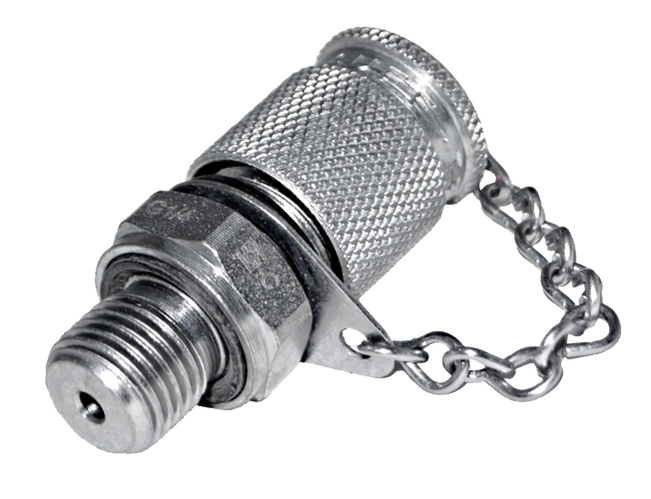
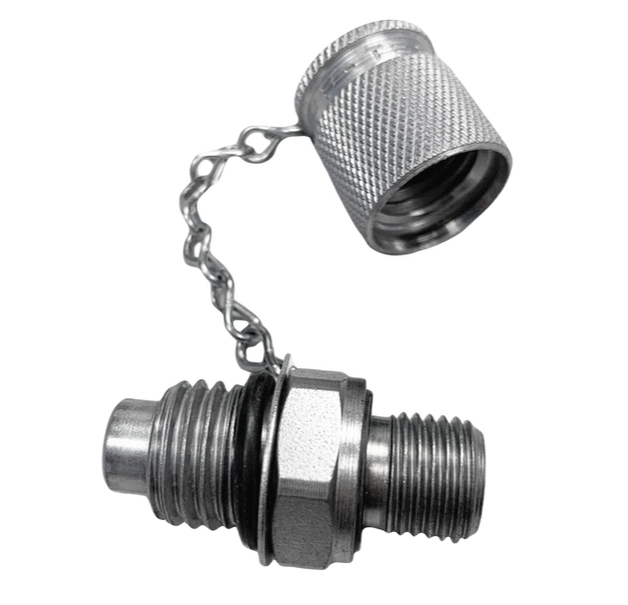
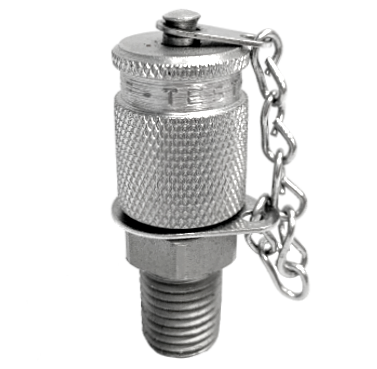
A test coupling is a small valved port built into the circuit. Inside is a ball check or a piston valve held shut by a spring, so the point is sealed until something is connected to it. Screw on a test hose or a gauge adaptor and the valve opens; take it off and it closes again. The thread is to ISO 15171‑2, so hoses and adaptors from the range fit any coupling in it, and a self‑locking metal protective cap keeps dirt out between readings.
They are normally planned into suitable positions during the design of a machine, but they are just as often added later when retrofitting or upgrading — and that is when the value shows. Once a test point exists, a fitter can monitor pressure, vent the system, or draw a representative fluid sample for contamination analysis, without cracking a fitting, losing oil or introducing dirt. One portable gauge then serves every point on the machine, which is a different economy from fitting a gauge at each one.
| Test coupling (this page) | A permanently fitted gauge | Cracking a fitting | |
|---|---|---|---|
| Reading available | On demand, when you connect | Always visible | Only while it is leaking |
| Instruments needed | One, shared across every point | One per point | None, and no reading either |
| Can it be done under pressure? | Yes, to 400 bar | Not applicable | Never safely |
| Oil lost | None | None | Some, every time |
| Dirt introduced | None — capped between uses | None | Yes |
| Also does | Venting and fluid sampling | Nothing else | — |
| Use it when | Several points need checking occasionally | One value must be on show constantly | Never, if a test point can be fitted instead |
Specification
Everything an enquiry needs, in one place.
| Function | Permanent valved test point for pressure monitoring, venting and fluid sampling in high and low pressure systems |
| Series | Test 20 (SMK‑20, SKK‑20, SSK‑20 and adaptors) and Test 15 (SMK‑15, SSK‑15 and adaptors) |
| Valve types | Ball check or piston valve — see which series offers which |
| Connection thread | ISO 15171‑2 — so any hose or adaptor in the range fits any coupling in it |
| Max working pressure | 630 bar / 9137 psi. On the Type G and Type K couplings, the fitting manufacturer’s recommended working pressure must also be observed |
| Connection under pressure | 400 bar / 5801 psi maximum — a lower limit than the rating, and the one that governs on site |
| Metal parts | W3 steel, zinc/nickel plated (standard) · W4 stainless 1.4305 / AISI 303 · W5 stainless 1.4571 / AISI 316Ti, both on request |
| Ball | Stainless steel in every build |
| Seal types | B NBR (Buna‑N) −20/+100 °C · V FKM (Viton) −20/+200 °C · E EPDM −40/+150 °C, for brake fluid |
| Internal seals | FKM, even on the standard NBR build — worth knowing before assuming a nitrile part throughout |
| Vibration safety | A vibration safety O‑ring in NBR stops the protective cap unscrewing itself under vibration |
| Protection cap | Self‑locking metal cap; a hexagonal steel cap or a plastic cap are both available across the Test‑20 SMK range |
| Media | Hydraulic oils and other mineral‑oil‑based fluids — check the seal type against the fluid. Contact STAUFF for other liquid media |
| Identification | Colour marking rings are optional across the Test 20 and Test 15 steel and stainless ranges |
Buying Stauff test couplings in Malaysia and Singapore
Where the stock sits, what it costs to get it to you, and how fast it moves.
Stock, delivery and ordering
- Where the stock is — the office is in Kuala Lumpur, and couplings are held in two warehouses: Johor Bahru and Singapore. Addresses and direct lines are on the contact page.
- Dispatch — stock items leave the same or next working day.
- The running items are the SMK‑20 male threaded stud couplings in W3 steel with NBR seals, plus the matching test hoses and gauge adaptors. Stainless W4 and W5, EPDM seals and the JIC and ORFS variants are more often brought in.
- Buy the hose and adaptor with the couplings. A test point with nothing to connect to it is not a measurement — and the whole range shares the ISO 15171‑2 interface, so one hose serves them all.
- Delivery cost — already inside the product price, along with transport, currency conversion, duties and taxes. Nothing is added afterwards.
Fitting out a machine? Colour marking rings let each test point be identified at a glance — pump, pilot, return — which pays for itself the first time somebody reads the wrong port.
How a test coupling enquiry runs
Five things and we can price it without going back and forth:
- What it screws into — a male threaded stud into a port, a 24° or 37° JIC fitting, ORFS, or a bulkhead.
- Series — Test 20 or Test 15, and whether you need the ball check or the piston valve version.
- Working pressure — and whether anyone will need to connect while the system is live, because that caps at 400 bar.
- Material — W3 steel, or W4 / W5 stainless for washdown, marine and chemical duty.
- Seal — NBR, Viton, or EPDM if the fluid is brake fluid.
A product specialist prices it within two working hours. Add the hoses and gauge adaptors to the same list and we will make sure the set actually mates.
The series, and what each one connects to
Two sizes, two valve types, and a connection to suit whatever is already there.
STAUFF builds the range in two series — Test 20 and Test 15 — and in two valve styles. Ball check is the common one; the piston valve version covers a different part of the range. What varies most is the connection at the other end, because a test point has to attach to whatever is already in the circuit.
| Part | What it is | Connects by | Valve |
|---|---|---|---|
| SMK‑20 | Test coupling | Male threaded stud — screws into a port. Optional colour marking ring | Ball check |
| SMK‑20 Type G | Test coupling | Straight 24° fitting | Ball check and piston valve |
| SMK‑20 Type K | Test coupling | 24° taper / O‑ring (DKO) | Ball check |
| SMK‑20‑JIC Type K | Test coupling | 37° JIC | Ball check |
| SMK‑20‑JIC Type G | Test coupling | Straight 37° JIC | Ball check |
| SMK‑20 Type ORFS | Test coupling | ORFS (O‑ring face seal) | Ball check |
| SSK‑20 | Bulkhead | Through a panel or plate | Ball check |
| SKK‑20 · SKK‑20 Type K | Test coupling | Male threaded stud · 24° taper / O‑ring (DKO) | Piston valve |
| SMK‑15 family | Test coupling | Male threaded stud, straight 24°, or 24° taper / O‑ring | Piston valve |
| SSK‑15 | Bulkhead | Through a panel or plate | Piston valve |
| SGV‑JIC Type FM | Swivel run tee | 37° JIC | Both series |
| SAD‑20 · SAD‑15 | Test adaptor | Adapts between test points and instruments | — |
| SMA / SMD ‑20 and ‑15 | Gauge adaptor | Puts a gauge onto a test point | — |
- The swivel run tee is the retrofit answer. An SGV‑JIC Type FM goes into an existing 37° JIC joint and adds a test point without moving anything — no new port to drill and tap.
- On Type G and Type K, two pressure limits apply. The coupling is rated 630 bar, but STAUFF states that on these the fitting manufacturer’s recommended working pressure must also be noted. The joint is limited by whichever is lower.
- Adaptors are part of the system, not an afterthought. SAD test adaptors and SMA / SMD gauge adaptors are what turn a sealed port into a reading, and they are separate order lines.
Two pressure figures, and the lower one is the important one
630 bar is what the coupling holds. 400 bar is what you can connect at.
This is the single most important thing on the page, and the one most often got wrong. A STAUFF test coupling is rated at a maximum working pressure of 630 bar / 9137 psi — that is what it will hold, sealed, indefinitely. But connecting a hose or gauge to a live system is limited to 400 bar / 5801 psi. Above that, the system has to come down before anything is attached.
| Figure | Value | What it governs |
|---|---|---|
| Max working pressure | 630 bar / 9137 psi | What the coupling holds when sealed and capped, and while a connection is made up |
| Connection under pressure | 400 bar / 5801 psi max | The ceiling for attaching or removing a hose or adaptor while the circuit is live |
| Type G and Type K | Whichever is lower | On these the fitting manufacturer’s recommended working pressure also applies, and the joint takes the lower of the two |
- Why the two differ. Holding pressure on a closed ball check is a static job. Pushing a mating nipple past that ball while the system is live is a dynamic one, against full line force, with a person’s hands on the fitting — so the limit for doing it is set lower on purpose.
- Plan the test points around it. If a circuit runs above 400 bar and readings will be taken with the machine running, the test point wants to be somewhere the pressure can be isolated — behind a needle valve, for instance.
- The old rule of thumb is wrong. “You can connect at full system pressure” is not what the catalogue says, and at 500 or 600 bar it is a real hazard rather than a technicality.
Materials and seals
Three metals, three seals, and one detail about the internal seals worth knowing.
| Code | Metal parts | Availability | Suits |
|---|---|---|---|
| W3 | Steel, zinc/nickel plated | Standard | General hydraulics, enclosed machinery. The volume choice |
| W4 | Stainless 1.4305 / AISI 303 | On request | Washdown and light corrosion duty |
| W5 | Stainless 1.4571 / AISI 316Ti | On request | Marine, offshore and chemical service — the grade to specify near salt water |
| Seal code | Material | Temperature range | Specify it for |
|---|---|---|---|
| B | NBR (Buna‑N) | −20 to +100 °C (−4 to +212 °F) | Standard mineral hydraulic oil |
| V | FKM (Viton) | −20 to +200 °C (−4 to +392 °F) | Hot oil and more aggressive fluids |
| E | EPDM | −40 to +150 °C (−40 to +302 °F) | Brake fluid — STAUFF names it specifically, and the widest cold‑end range |
- ⭐ The internal seals are FKM even on the standard NBR build. STAUFF notes it on the datasheet, and it is worth knowing before anyone assumes a “nitrile” coupling is nitrile throughout — it is not.
- The ball is stainless steel in every version, including the W3 steel body. The sealing element is not the part that corrodes.
- The vibration safety O‑ring is NBR on all builds, including the Viton one. It is a mechanical retainer for the cap rather than a fluid seal.
- Media: hydraulic oils and other mineral‑oil‑based fluids as standard, with the seal chosen to match. For anything else — water glycol, synthetic esters, phosphate esters — the fluid needs confirming rather than assuming.
What is inside, and why it matters
Six parts, and three of them are the reason this is not just a plug.
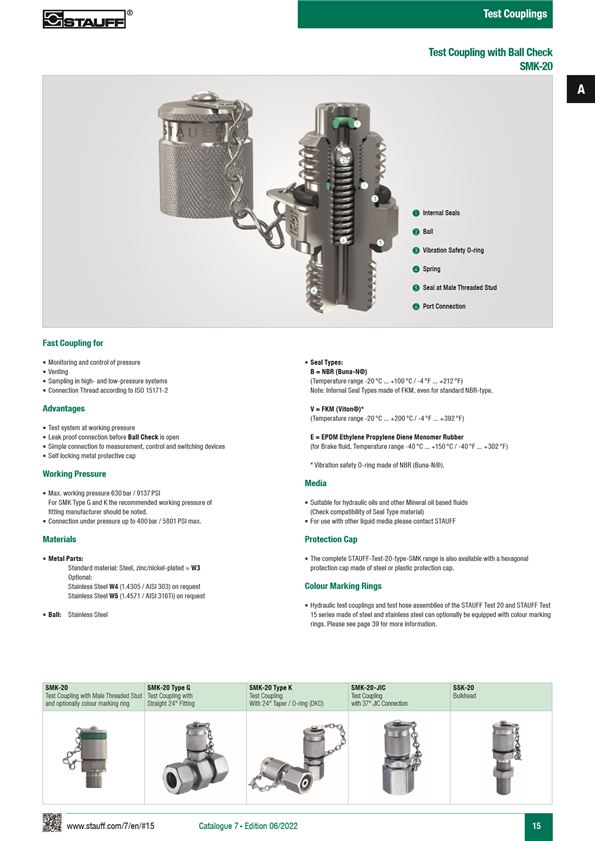
The cutaway on STAUFF’s own datasheet labels six components: the internal seals, the ball, the vibration safety O‑ring, the spring, the seal at the male threaded stud, and the port connection. Three of those are worth understanding, because they are what separates a test coupling from a blanking plug someone unscrews.
The three that earn their place
- The ball and spring. The ball is held on its seat by the spring, so the port is leak‑proof before the ball check is open. The mating nipple pushes the ball off its seat only once it has itself sealed — which is the whole reason a connection can be made without losing fluid.
- The vibration safety O‑ring. Its only job is to stop the protective cap unscrewing itself under machine vibration. A cap that has walked off is how dirt gets into a test point, and how the point stops being trustworthy.
- The self‑locking metal cap. Chained to the body so it cannot be lost, and locking so it stays put. Steel hexagonal caps and plastic caps are both available across the Test‑20 SMK range.
How it is built
- The body is closed with a threaded nipple in an automated process — it is not crimped shut after the valve components and seals go in.
- That matters for permanent‑load service: a threaded closure keeps its preload where a crimp relies on deformation holding.
- The connection thread is ISO 15171‑2, so the interface is a published standard rather than a house pattern — hoses, adaptors and gauges from the range all mate.
- Colour marking rings are optional across the Test 20 and Test 15 steel and stainless ranges, so points can be identified by circuit at a glance.
Three jobs, not one
Most people fit these for pressure. Two of the other uses are what make them pay.
| Job | What you connect | Why the test point beats the alternative |
|---|---|---|
| Pressure monitoring and control | A gauge via a gauge adaptor, or a test hose to a portable instrument. Digital devices for continuous logging | One instrument serves every point. No gauge to buy, mount, protect and eventually replace at each location |
| Venting | Nothing, or a hose run to a container | Air comes out of a designed point at the top of the circuit rather than by slackening the nearest fitting and hoping |
| Fluid sampling | A sampling hose or bottle adaptor | A representative sample drawn from the live system, uncontaminated by the act of taking it — which is the only kind worth sending for contamination analysis |
- Sampling is where the discipline shows. A sample taken by cracking a joint into a jar tells you about the joint, not the oil. Drawn from a capped test point under pressure, it tells you about the system — which is the difference between condition monitoring and guessing.
- Suitable for high and low pressure systems alike. The valve does not need pressure to seal, so a return or pilot line test point works exactly as well as one on the pump outlet.
- Plan them in. STAUFF’s own framing is that test points are chosen during machine design, or added when retrofitting. Either works — but on a new build the marginal cost of a test point is a fraction of what it costs to add one later.
Fitting and using it
No tools to connect. A few habits worth keeping.
Fitting the coupling
- Put it where a person can reach it with a gauge in one hand. A test point behind a guard is a test point nobody uses.
- Prefer the high point for venting and a flowing line for sampling — a dead leg gives an unrepresentative sample.
- Match the connection to what is there — male stud into a spare port, or an SGV‑JIC swivel run tee into an existing 37° JIC joint if there is no port to spare.
- Observe the fitting maker’s torque on Type G and Type K versions, and their pressure rating too.
- Consider colour marking rings at install time. Retro‑identifying test points on a finished machine is thankless work.
Taking a reading
- Check the pressure first. Connecting live is fine up to 400 bar; above that, bring the system down.
- Wipe the nipple before connecting. The cap keeps dirt out, but whatever is on the outside will be dragged in by the mating hose.
- Screw the cap back on every time. The vibration safety O‑ring only helps a cap that is actually fitted.
- Do not use it as a bleed screw for a joint that leaks — fix the joint.
- Keep one hose and adaptor set per machine if you can. It is the item that goes missing, and without it a full set of test points reads nothing.
How to identify one you already have
The series, the connection and the metal, in that order.
| Look at | What it tells you |
|---|---|
| The part number prefix | SMK or SKK is a test coupling, SSK a bulkhead, SAD a test adaptor, SMA or SMD a gauge adaptor, SGV a swivel run tee |
| The ‑20 or ‑15 suffix | Which series it belongs to, and therefore which hoses and adaptors mate with it |
| Type G, K, JIC or ORFS | The connection at the circuit end — straight 24° fitting, 24° taper with O‑ring (DKO), 37° JIC, or O‑ring face seal |
| W3, W4 or W5 | The metal — plated steel, 1.4305 stainless, or 1.4571 stainless |
| B, V or E | The seal — NBR, Viton, or EPDM. If the machine runs brake fluid it should be E |
| A colour ring | Somebody has identified the circuit — and the scheme is worth finding out before you change one |
If there is no part number to read, the thread and the connection style are enough for us to work from. The test‑side interface is ISO 15171‑2 across the range, so the question is almost always what the other end has to screw into.
Why buy Stauff test couplings from RFS Hydraulics
Six things that decide whether the order is right first time.
Ready stock on the running items
The SMK‑20 male stud couplings in W3 steel with NBR seals, plus matching hoses and gauge adaptors, are held in Johor Bahru and Singapore and dispatch the same or next working day.
We quote the set, not the part
A test point needs something to connect to it. We put the coupling, the test hose and the gauge adaptor on the same quote, so what arrives actually mates.
We tell you the 400 bar limit
The coupling is rated 630 bar, but connecting under pressure caps at 400 bar. That is a safety figure, not a footnote, and it is not on most suppliers’ pages.
The right metal for the environment
W3 plated steel for general plant, W5 (1.4571 / AISI 316Ti) where it is marine, offshore or chemical. We ask where the machine lives before quoting.
Seals matched to the fluid
NBR, Viton, or EPDM for brake fluid — and we will flag that the internal seals are FKM even on the standard NBR build, which catches people out on compatibility checks.
One price, delivered
Transport, currency, duties and taxes are already inside the figure we quote. Nothing is added at the end, and delivery within Malaysia is included.
Frequently asked questions
Twelve, starting with the pressure figure that matters most.
Can I really connect a gauge while the system is running?
Yes, up to 400 bar / 5801 psi. That is the catalogue limit for making or breaking a connection on a live system, and it is lower than the coupling's 630 bar working pressure on purpose — holding pressure on a closed ball check is a static job, pushing a nipple past that ball against full line force with your hands on the fitting is not. Above 400 bar, bring the pressure down first. Anyone who tells you that you can connect at full system pressure is quoting the wrong number.
Will it leak when I take the gauge off?
No. The ball is held on its seat by a spring, and the mating hose or adaptor only pushes it off that seat after it has itself sealed. Disconnecting reverses the sequence, so the port is closed before the connection breaks. That is the whole design intent — a leak-proof connection before the ball check is open — and it is why a test point loses no oil and admits no dirt.
Do I need tools to connect?
No. The connection is hand-made, without tools, which is the point of a designed test port — a fitter with a hose can take a reading anywhere on the machine. The protective cap unscrews by hand too. Tools only come into it when the coupling itself is being installed into the circuit, and on the Type G and Type K versions you should use the fitting manufacturer's torque figure for that.
What is the difference between the Test 20 and Test 15 series?
They are the two sizes in the range, and each has its own family of couplings, bulkheads, test adaptors and gauge adaptors — SMK-20, SKK-20, SSK-20, SAD-20, SMA-20 and SMD-20 against SMK-15, SSK-15, SAD-15, SMA-15 and SMD-15. What matters in practice is that hoses and adaptors have to match the series, so it is worth standardising on one across a machine or a site rather than mixing them.
Ball check or piston valve — which do I want?
The ball check version covers most of the range and is the usual choice, including all the JIC and ORFS connections and the bulkheads in the Test 20 series. The piston valve version covers the SKK-20 and the SMK-15 family. In practice the decision is usually made for you by which connection you need rather than by preference — tell us what the coupling has to screw into and we will name the part.
Which connection do I need at the circuit end?
Whatever is already there. The options are a male threaded stud into a spare port, a straight 24 degree fitting (Type G), a 24 degree taper with O-ring, DKO (Type K), a 37 degree JIC, an ORFS face seal, or a bulkhead through a panel. If there is no spare port at all, the SGV-JIC Type FM swivel run tee inserts a test point into an existing 37 degree JIC joint without drilling anything.
Steel or stainless?
W3 steel with zinc/nickel plating is the standard and right for enclosed machinery. For corrosion duty there are two stainless grades on request: W4 (1.4305 / AISI 303) for washdown and light exposure, and W5 (1.4571 / AISI 316Ti) for marine, offshore and chemical service. Note that the ball is stainless steel in every version including W3, so the sealing element is not what corrodes.
Which seal for my fluid?
B, NBR (Buna-N), minus 20 to plus 100 degrees C, for ordinary mineral hydraulic oil. V, FKM (Viton), minus 20 to plus 200 degrees C, for hot oil and more aggressive fluids. E, EPDM, minus 40 to plus 150 degrees C, which STAUFF names specifically for brake fluid and which also has the widest cold-end range. The couplings suit hydraulic oils and other mineral-oil-based fluids as standard; for anything else the fluid needs confirming rather than assuming.
Are the internal seals the same material as the ordered seal type?
No, and this is worth knowing. STAUFF states on its own datasheet that the internal seal types are made of FKM even on the standard NBR build. So a coupling ordered as seal type B is not nitrile throughout. It rarely causes a problem — FKM is the more capable material — but if you are doing a formal fluid compatibility check, check against FKM as well as against the seal code you ordered.
What stops the cap vibrating off?
A vibration safety O-ring, in NBR, fitted specifically to prevent the protective cap self-loosening under machine vibration. The cap is also self-locking and chained to the body, so it cannot be mislaid. It matters more than it sounds: a cap that has walked off is how dirt reaches a test point, and a dirty test point is one nobody trusts. Steel hexagonal caps and plastic caps are both available.
Can I take an oil sample through one?
Yes, and it is one of the better reasons to fit them. A sample drawn from a capped test point on a live, flowing line is representative of the system; a sample taken by cracking a joint into a jar tells you mostly about the joint. If the point of the exercise is contamination analysis, the difference is the difference between data and noise. Pick a point on a flowing line rather than a dead leg.
Can I add test points to a machine that is already built?
Yes — STAUFF's own framing is that test couplings are either designed in from the start or added later when retrofitting or upgrading. Where there is a spare port, a male threaded stud coupling screws straight in. Where there is not, the swivel run tee inserts a test point into an existing 37 degree JIC joint with nothing to drill or tap. The marginal cost is small next to what it saves the first time somebody needs a reading.
Catalogues
Direct PDF download — no form, no email address.
Related: pressure gauges to read them with · needle valves for gauge isolation · Stauff level gauges.
Send what the coupling has to screw into, and the working pressure.
Add the fluid and whether readings will be taken with the machine running. A product specialist confirms the parts within two working hours.