
Home › Products › High pressure fittings › Quick release couplings
ISO 7241 · ready stockQuick release couplings, 1/4" to 2", to 950 bar
For lines that are connected and disconnected often — hydraulic and pneumatic. Three families: ISO 7241‑A and ISO 7241‑B push‑in, and the 203 Series TGW screw‑locking type that reaches 950 bar. SS316, carbon steel and brass, with NBR, Viton or EPDM seals. The smaller the size, the higher the pressure — and the standard matters as much as the size.
Get a quotation within 2 working hours
Send the part number, standard, size or quantity. Stock in Malaysia or Singapore, ISO 9001:2015 certified.
What a quick release coupling is
Two halves that make a sealed joint without tools.
A quick release coupling mates a fluid line to equipment that has to be connected and disconnected frequently. It comes in two halves — a nipple (male) and a coupler (female) — and on the push‑in types the nipple simply pushes into the coupler to make a secure, leak‑tight joint. That is why they are also called push‑in connects. You will hear them called quick couplers, quick couplings and quick connect couplings; they are the same thing.
Inside, the sealing and shut‑off is done by a poppet valve or a ball closing system, so both halves close when they come apart and the line does not drain. On the ISO types a metal perch or metal‑to‑metal valve stop keeps the valve aligned and stops flow going the wrong way.
- Hydraulic and pneumatic both. The same principle serves either — the difference is the pressure class and the seal.
- The coupler sleeve and nipple body are hardened to resist the knocks that come with a part being handled every day.
- Standard end connections are female pipe thread — NPT or BSPP — with straight‑thread versions available.
- Safety factor 4 across the range.
- Made to several standards, and they are not interchangeable with each other. Which is which.
Where it is the right choice
- Attachments that change — a breaker for a bucket, a different implement on a tractor.
- Test and commissioning points where a gauge or a pump goes on and off.
- Equipment that is moved — jacks, portable power packs, cleaning gear.
- Anywhere a spanner is impractical or the joint is made by an operator, not a fitter.
Where something else is better
- A joint that never comes apart — use a forged pipe fitting or a compression fitting. A coupling is more parts and more cost for no benefit.
- Maximum flow for the bore — the internal valve costs you pressure drop that a plain fitting does not.
- Very high pressure with big bore — the rating falls steeply with size; check the table before assuming.
Specification
Everything an enquiry needs, in one place.
| Type | Quick release coupling — nipple and coupler, with poppet valve or ball closing system |
| Standards | ISO 7241‑A · ISO 7241‑B · 203 Series TGW (Gromelle 6000 / Hansen W6000 pattern) |
| Size range | 1/4" to 2" |
| Working pressure | To 350 bar ISO 7241‑A · to 400 bar ISO 7241‑B · to 950 bar 203 Series TGW — by size |
| Connection type | Push‑in on both ISO series · screw locking on 203 Series TGW |
| End threads | BSPP · NPT — female pipe thread as standard |
| Materials | Stainless steel AISI 316 · carbon steel EN‑10277‑3 · brass DIN‑EN 12164 — all three, in all three standards |
| Seal materials | NBR −30 to +100 °C · Viton −10 to +200 °C · EPDM −40 to +150 °C |
| Safety factor | 4 |
| Valve design | Poppet valve or ball closing system, with a metal valve stop to keep alignment |
| Accessories | Dust plugs and caps, colour coded, with tether straps — why they matter |
| Stock | Held in Johor Bahru and Singapore |
The mistake to avoid: quoting 950 bar without the size and the standard. 950 bar is the 203 Series TGW at 1/4". The same series at 2" is 300 bar, and an ISO 7241‑B at 2" is 100 bar. Size and standard together decide it — and the three families do not connect to each other.
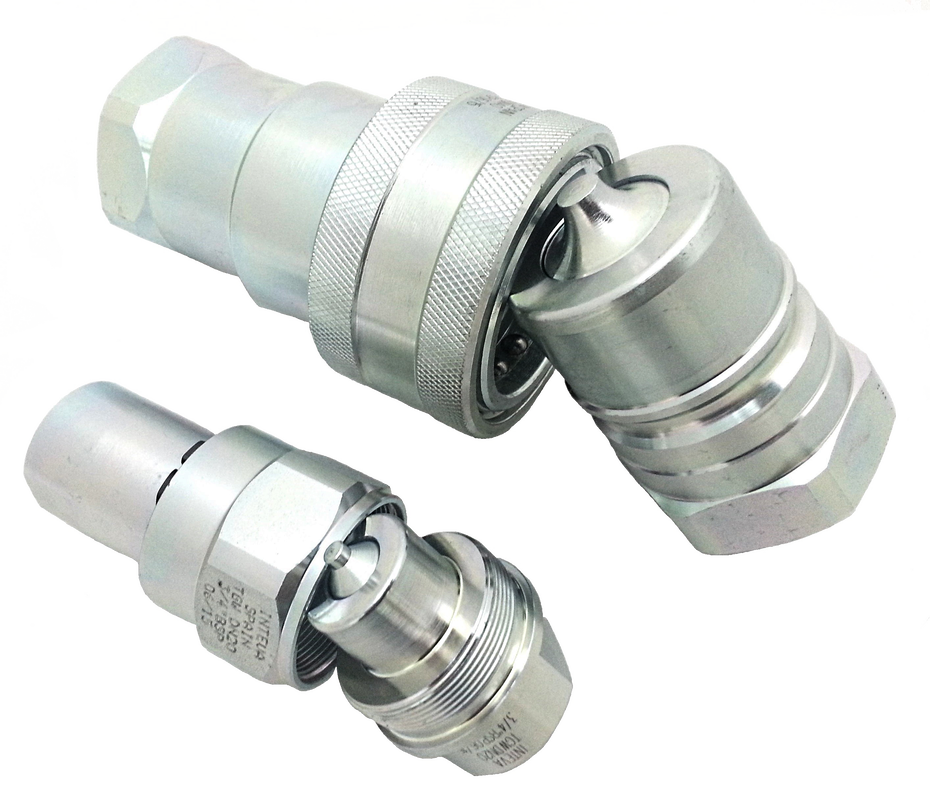
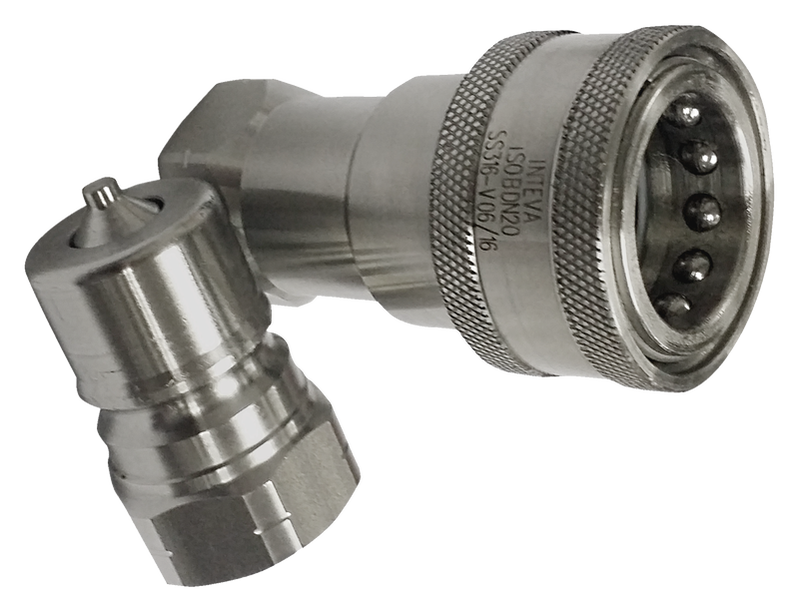
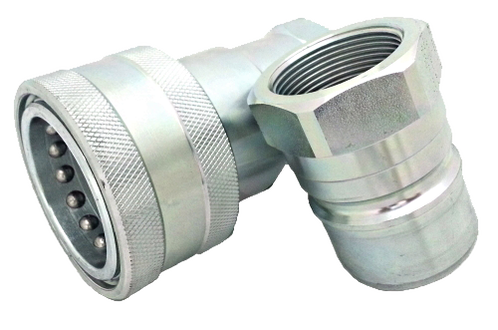
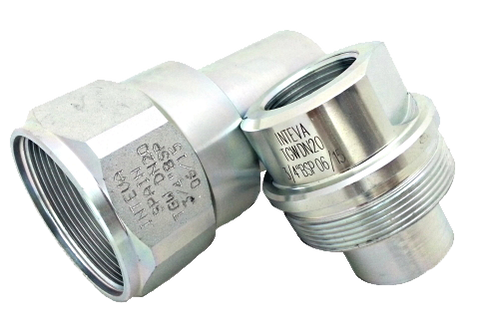
What the two halves look like, and how to tell the three families apart.
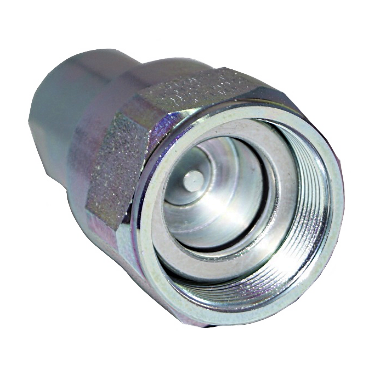
Buying quick release couplings in Malaysia and Singapore
Where the stock sits, and the five things we need.
Stock, delivery and ordering
- Running sizes in all three standards are held in Johor Bahru and Singapore.
- On a stocked item, order to delivery can be under three working days.
- Nipples and couplers sell separately — useful when you need three nipples to one coupler on a machine.
- Dust plugs and caps supplied alongside, colour coded and tethered.
- One price, delivered — transport, currency, duties and taxes are inside the quoted figure.
What we need from you
- Which standard — ISO 7241‑A, ‑B or 203 TGW. If you do not know, tell us what is already on the machine.
- Size, and whether you need the nipple, the coupler or both.
- Working pressure — so we can check it against the size, not just the series.
- Material and fluid — and the temperature, which decides the seal.
- End thread — BSPP or NPT.
Pressure by size and standard
The smaller the coupling, the more pressure it takes.
This is the table to design from. Within every family the rating falls as the size rises, because a bigger bore carries more end load at the same pressure. Read across your size, then down to your standard.
| Size | ISO 7241‑A | ISO 7241‑B | 203 Series TGW |
|---|---|---|---|
| 1/4" | 350 bar | 400 bar | 950 bar |
| 3/8" | 300 bar | 380 bar | 750 bar |
| 1/2" | 300 bar | 350 bar | 750 bar |
| 3/4" | 250 bar | 320 bar | 650 bar |
| 1" | 230 bar | 300 bar | 450 bar |
| 1‑1/4" | 230 bar | 280 bar | 450 bar |
| 1‑1/2" | 200 bar | 140 bar | 300 bar |
| 2" | 130 bar | 100 bar | 300 bar |
Bars are drawn to the same scale across all three columns, as a share of the 950 bar maximum, so you can compare the families at a glance.
- The screw‑locking type is in a different league. At 1/4" the 203 Series TGW carries 950 bar against 350 and 400 for the push‑in ISO types — more than double.
- B is not always higher than A. ISO 7241‑B leads at the small end, but crosses below A at 1‑1/2" (140 against 200) and stays lower at 2" (100 against 130). Read the table; do not assume.
- Every family loses most of its rating across the range. ISO 7241‑A goes from 350 bar to 130; the 203 series from 950 to 300. A size increase is a pressure decision.
- Safety factor 4 applies throughout, so these are working pressures with margin already in them — not burst figures.
The three families, and which one you have
They do not connect to each other. Identify before you order.
The single most useful thing to establish is which family is already on the machine. A half from one family will not mate with a half from another, whatever the size says.
| ISO 7241‑A | ISO 7241‑B | 203 Series TGW | |
|---|---|---|---|
| Connection | Push‑in | Push‑in | Screw locking |
| Maximum pressure | To 350 bar | To 400 bar | To 950 bar |
| Valve design | Poppet valve or ball closing, with a metal perch holding alignment | Poppet valve with a metal‑to‑metal valve stop | Screw locking sleeve — built for shock and vibration |
| Standard ends | Female pipe and straight thread, NPT or BSPP | Female pipe thread, NPT or BSPP | Female pipe thread, NPT or BSPP |
| Best suited to | General hydraulic duty — equipment maintenance and operating systems. The versatile choice | Steady pressure, lower life cycle, no severe cyclic fluctuation | High impulse and inline high pressure — hydraulic shock, vibration, hose bending |
| Materials | All three: stainless AISI 316 · carbon steel EN‑10277‑3 · brass DIN‑EN 12164 | ||
| Seals | All three: NBR −30/+100 °C · Viton −10/+200 °C · EPDM −40/+150 °C | ||
- ISO 7241‑A is the general‑purpose one — if nobody can tell you what the machine has and it is ordinary hydraulic duty, this is the likely answer. Confirm before you buy.
- ISO 7241‑B wants steady pressure. It is specified where the operating cycle holds a fairly constant pressure — mine roof supports, hydraulic jacks, high pressure fluid transfer. It is not the choice where pressure spikes repeatedly.
- 203 Series TGW is the heavy‑duty answer. The screw locking mechanism gives exceptional resistance to severe hydraulic loads, which is why it is used where shocks, system vibration or hose bending are expected. It follows the Gromelle 6000 / Hansen W6000 pattern.
- Cross‑reference, if you are replacing something. ISO 7241‑A corresponds to the Faster ANV, Aeroquip FD56, Parker 6600 and Snap‑Tite 61 patterns; ISO 7241‑B to Faster H, Aeroquip FD45, Parker 60 and Snap‑Tite 72; the 203 series to Gromelle 6000, Tuthill 6000 and Hansen W6000. Tell us what is on the machine and we will match the family.
Where each family is used
Typical duty, by standard.
ISO 7241‑A
- Industrial hydraulics
- Agricultural machinery
- Snow plough and seasonal attachments
- Truck and trailer connections
- Mobile applications
ISO 7241‑B
- Industrial hydraulic lines
- Offshore
- Steam systems
- Cleaning equipment
- Food and chemical processing
- Water and coolant lines
203 Series TGW
- Mobile applications
- Industrial
- Construction
- Oil and gas
- Material handling
- Systems under heavy mechanical loads and high pressure
Steam and food processing appear under ISO 7241‑B, and both are seal questions as much as pressure questions — tell us the medium and we will specify NBR, Viton or EPDM against it rather than defaulting.
Seals and temperature
Three compounds, and they are not ranked simply better or worse.
The seal is available in all three families, so this choice is independent of the standard. Note that no one compound wins on both ends of the temperature range.
| Seal | Minimum | Maximum | Reach for it when |
|---|---|---|---|
| NBR nitrile | −30 °C | +100 °C | Ordinary hydraulic oil duty. The default |
| Viton (FKM) | −10 °C | +200 °C | It runs hot — twice the NBR ceiling. But the worst of the three in the cold |
| EPDM | −40 °C | +150 °C | The widest span, and the coldest. Good with water, coolant and steam |
- Viton is the hot one, EPDM is the cold one. Viton reaches +200 °C but stops at −10 °C; EPDM goes down to −40 °C and up to +150. If your duty swings both ways, EPDM has the widest window.
- The fluid matters as much as the temperature. EPDM is the usual choice for water, coolant and steam; it is not the choice for mineral oil. Tell us the medium.
- Seal choice does not change the pressure rating — that comes from the size and the family. See the table.
- See O‑rings for the wider seal range we stock.
Dust plugs and caps
The cheapest part on the list, and the one that decides how long a coupling lasts.
When the nipple and coupler are apart, both sealing faces are open to the environment. On a machine working in dirt, that is the failure mechanism: grit gets onto the face, then gets driven into the seal on the next connection. A dust plug and cap covers the connecting surfaces whenever the halves are separated, and it is not an optional extra on site work.
What they do
- Keep contaminants out of the fluid system — anything on the face ends up inside.
- Protect from environmental dirt and grit, which prolongs coupling life and keeps the fitting in working condition.
- Colour coded, so connecting lines can be identified visually — no more guessing which of four hoses is the return.
- Tether straps keep the plug and cap to hand when the coupling halves are connected, instead of in the mud.
Specify them with the coupling
- They are sized to the coupling, so order them together and you will not be hunting for a fit later.
- Colour code the pairs on a machine with several identical couplings — it prevents cross‑connection, which on a hydraulic circuit is more than an inconvenience.
- Replace a lost cap. A coupling running uncapped in a dirty environment is on borrowed time.
Identifying what you already have
Look at the sleeve, then read the stamping.
Two things tell you the family. How the halves lock — a knurled sleeve you pull back, or a threaded collar you screw — and what is stamped on the body. These are marked with the maker, the standard, the bore and the material.
- Sleeve first, stamping second. Knurled sleeve means push‑in and one of the two ISO families; a threaded collar means the 203 series. That halves the question before you read anything.
- DN is the bore in millimetres — DN20 is the 3/4" size. It appears alongside the pipe thread on the same stamping.
- Nipple and coupler are ordered separately. A machine with one power pack and four attachments needs one coupler and four nipples, not four pairs.
- Still unsure? Photograph the sleeve and the stamped flat, and send us both. We will identify the family.
Why buy quick release couplings from us
The right family first, then the right size.
We identify the family before quoting
Send a photo of what is on the machine. Three families that do not intermate is the expensive mistake on this product, and it is avoidable.
Pressure checked against the size
Not the series headline. 950 bar is 1/4" in the 203 series; the same series at 2" is 300. We check the table for you.
Halves sold separately
Nipples and couplers individually, so one power pack can serve four attachments without buying four pairs.
Seal specified to the medium
NBR, Viton or EPDM chosen against your fluid and temperature — water and steam are not oil, and EPDM is not a default.
Caps and plugs supplied with it
Colour coded and tethered, sized to the coupling. They cost little and they are what makes a coupling last on a dirty site.
Landed pricing, local stock
Johor Bahru and Singapore, and one delivered figure with transport, currency, duties and taxes already in it.
Questions we get asked
The ones that come up on the phone.
What is a quick release coupling?
A two‑part fitting for a line that has to be connected and disconnected often, in hydraulic or pneumatic service. A nipple and a coupler mate to make a leak‑tight joint — on the ISO types by pushing in, which is why they are also called push‑in connects. A poppet valve or ball closing system inside means both halves shut when they part, so the line does not drain. Also sold as quick couplers, quick couplings and quick connect couplings.
Will an ISO 7241-A coupling connect to an ISO 7241-B?
No. The three families do not intermate — ISO 7241‑A, ISO 7241‑B and the 203 Series TGW are separate patterns, and a half from one will not mate with a half from another whatever the nominal size. This is the most expensive mistake on this product. Establish what is already on the machine first — send us a photo of the sleeve and the stamping and we will tell you.
Which one goes to 950 bar?
The 203 Series TGW, and only at 1/4". It is a screw‑locking type rather than push‑in, which is where the strength comes from. At 3/8" and 1/2" it is 750 bar, at 1" it is 450, and at 2" it is 300 bar. The push‑in ISO types top out at 350 bar (A) and 400 bar (B). Always quote the size with the pressure.
Why does the pressure drop as the size goes up?
Because a larger bore carries more end load at the same pressure — force is pressure times area. So every family loses most of its rating across the range: ISO 7241‑A goes from 350 bar at 1/4" to 130 bar at 2". Treat a size increase as a pressure decision, and check the table rather than the series headline.
Is ISO 7241-B always higher rated than A?
No, and this catches people out. B leads at the small end — 400 against 350 bar at 1/4" — but the two cross over at 1‑1/2", where B is 140 bar against A at 200 bar, and B stays lower at 2" (100 against 130). Read the table for your actual size instead of assuming a ranking holds across the range.
Which family should I choose for a new system?
ISO 7241‑A for general hydraulic duty — equipment maintenance, operating systems, agricultural and mobile work. ISO 7241‑B where the pressure is steady through the cycle and the life cycle is lower — jacks, mine roof supports, fluid transfer. 203 Series TGW where there is hydraulic shock, vibration or hose bending, or you need pressure the push‑in types cannot reach.
What does the safety factor 4 mean?
That the pressures quoted are working pressures with a factor of four already applied — they are not burst figures. It does not license running above the tabulated figure: the factor covers the ordinary uncertainties of service, not deliberate over‑pressure. Design to the number in the table for your size and family.
Which seal do I need?
NBR for ordinary hydraulic oil, −30 to +100 °C. Viton if it runs hot — up to +200 °C, but note it is the worst of the three in the cold, stopping at −10 °C. EPDM for the widest span, −40 to +150 °C, and for water, coolant and steam — but not for mineral oil. Tell us the medium and the temperature and we will pick it rather than defaulting.
Do I really need dust caps?
On site work, yes. When the halves are apart both sealing faces are open to the environment, and grit that lands on a face gets driven into the seal at the next connection — and then into the system. Caps keep contaminants out, prolong coupling life, come colour coded so you can identify lines at a glance, and have tether straps so they stay with the coupling instead of in the mud. They are the cheapest part on the order.
Can I get them in stainless?
Yes — stainless AISI 316 is available in all three families, alongside carbon steel to EN‑10277‑3 and brass to DIN‑EN 12164. Stainless is the choice for offshore, washdown, food and chemical duty. Material does not change the pressure rating; that comes from the size and the family.
Do I order the nipple, the coupler, or both?
Whichever you actually need — they are sold separately. A common case is one coupler on the power pack and a nipple on each attachment, so one coupler and four nipples rather than four pairs. Tell us how the machine is arranged and we will quote the right count. Add caps for the couplers and plugs for the nipples at the same time.
Do you deliver to Singapore, and what does delivery cost?
Yes. We hold stock in Johor Bahru and Singapore, and a stocked item can be delivered in under three working days. Our quote is a landed price — transport, currency, duties and taxes are already in the figure, so what you approve is what you pay.
Catalogue
Direct PDF download — no form, no email address.
 Quick release couplings — all three families, every size and pressureInteva · PDFPDF
 Quick release couplings — the STAUFF rangeSTAUFF · PDFPDF
Related: test couplings for gauge and diagnostic points · JIC fittings for the hose end · pipe adapters where the port thread does not match · O‑rings for seal replacement · high pressure ball valves to isolate before you disconnect.
Tell us which family is on the machine
A photo of the sleeve and the stamping is enough. Then the size, the pressure and the medium, and we will quote the halves and the caps together. Stock in Johor Bahru and Singapore.