
Tubeclo — pipe clamps to DIN 3015.
Tubeclo is our exclusive pipe clamp brand: standard, heavy, twin and rubber‑insert series to DIN 3015, from 6 mm up to 406 mm clamped diameter. One brand, one standard — and the specification, the testing and the stock under one roof.
The four series
All to DIN 3015 — the difference is the duty and the body.
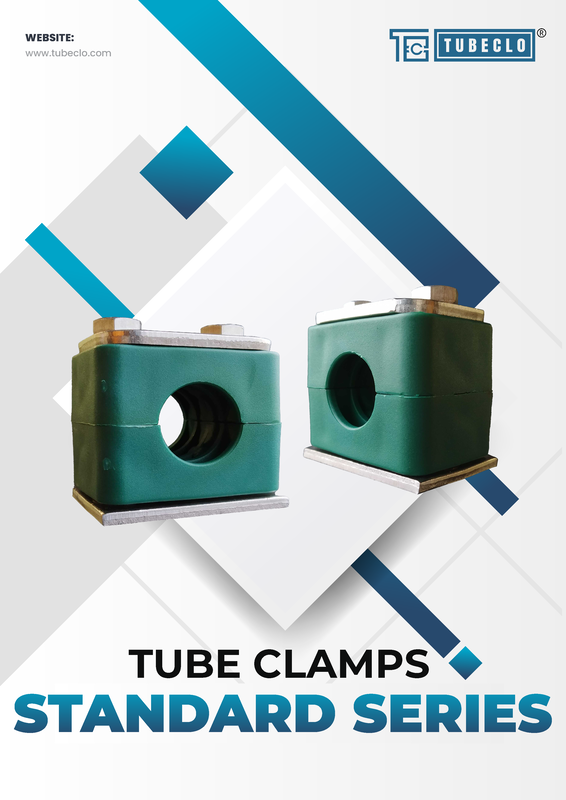
Standard series
The everyday clamp for hydraulic tube and pipe. Sizes 6 mm to 102 mm.
Reduces the effect of mechanical shock and vibration, and keeps the run tidy and accessible.
Sizes and brackets →Heavy series
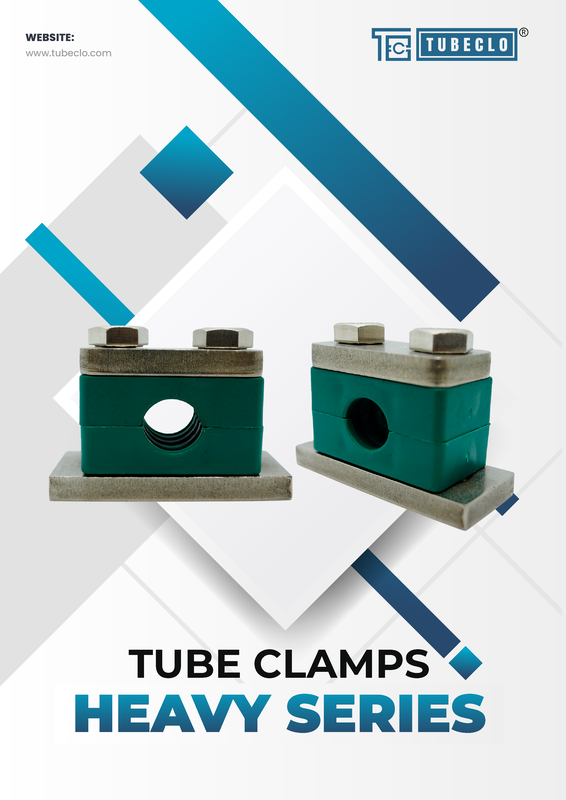
For larger bores and heavier duty — sizes 6 mm to 406 mm.
Same DIN 3015 body geometry, sized and specified for the loads that come with large pipe.
Sizes and brackets →Twin series
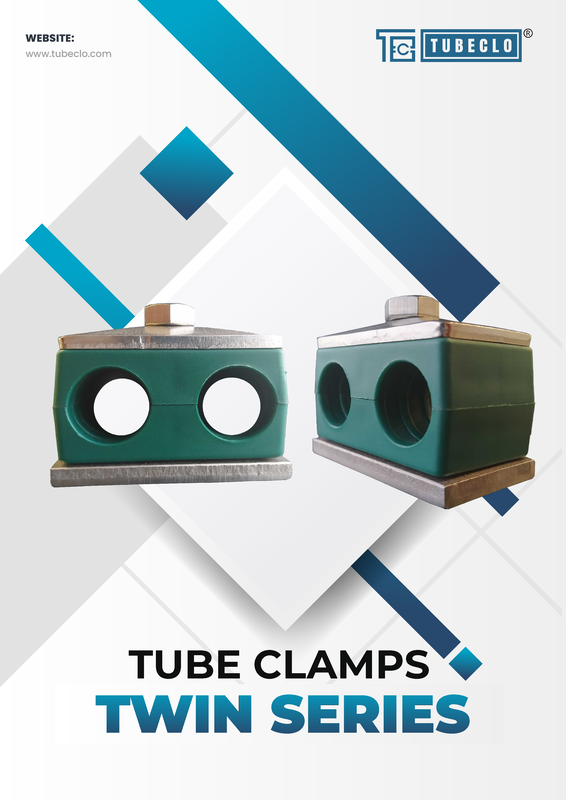
Two runs held in one clamp body, for parallel lines on a single weld plate. Sizes 6 mm to 42 mm.
Saves plate, bolts and bench space where lines run together.
Twin series detail →Rubber insert series
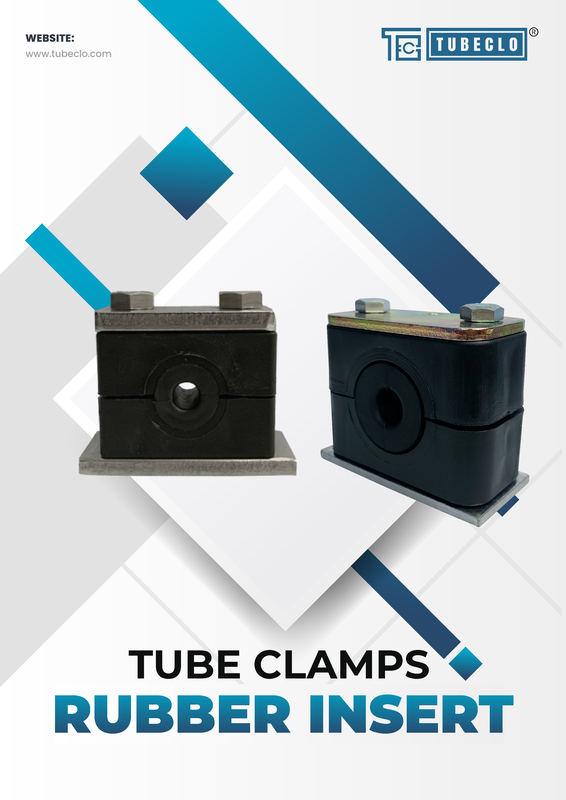
A thermoplastic elastomer insert for extra‑gentle installation of tube, pipe, hose and cable. Standard series 6 mm to 32 mm, heavy series 6 mm to 172 mm.
The insert is what damps vibration and noise, and protects a finished surface.
Rubber insert clamps →Specifying one
Two codes decide what you get: the body, and the hardware finish.
Body material and temperature range
- PP — polypropylene · −30 °C to +90 °C. Profile inside, with tension clearance. Green.
- PA — polyamide · −40 °C to +120 °C. Profile inside, with tension clearance. Black.
- PPH — polypropylene · smooth inside, without tension clearance. Green.
- PAH — polyamide · smooth inside, without tension clearance. Black.
- AL — aluminium · up to +300 °C, where the line runs hot. Silver.
Accessories — weld plates, cover plates, bolts — are available in stainless steel SS316 and galvanized steel.
Hardware finish codes
- W1 — carbon steel ST37, untreated
- W2 — carbon steel ST37, phosphated
- W3 — carbon steel ST37, zinc/nickel coated
- W4 — stainless steel A2, 1.4301/1.4305 (AISI 304/303)
- W5 — stainless steel A4, 1.4401/1.4571 (AISI 316/316Ti)
If the clamp is going offshore or into a washdown area, the finish code matters more than the body material. Tell us the environment and we will specify it.
Why DIN 3015 is the whole point
A clamp standard is a promise about what it will fit.
What the standard fixes
- DIN 3015 fixes the geometry — the body sizes, the weld plate, the bolt pattern and the stacking system — in three parts: Part 1 is the standard series, Part 2 the heavy series, Part 3 the twin series.
- Because the geometry is standardised, the hardware interchanges. A DIN 3015 clamp body from one maker sits on another maker’s weld plate of the same series and size.
- Stacking is part of the system — bodies build upward on the same rails and cover plates, so a second run can be added above the first without new welding.
What that means when you switch
- Tubeclo drops straight in where Stauff was specified. Same DIN 3015 series and sizes — no new weld plates, no new bolt pattern, no redrawn bracket. The comparison is on our Stauff page.
- The part numbering carries the size group, so an old bill of materials converts line for line.
- Mixed installations are fine. Because the plates and bolts interchange, replacing clamps one at a time during maintenance works — you do not have to strip the run.
We control the development, sourcing, warehousing, testing and stock of every Tubeclo part — so the specification does not change between orders, and neither does the lead time.
What that means for you
- It drops straight in. Tubeclo is DIN 3015 in the same series and sizes as Stauff, so specifying it does not mean new weld plates, a new bolt pattern or a redrawn bracket.
- Tested before it ships. Tubeclo parts are checked on our own equipment, not just accepted on a supplier certificate.
- Consistent specification. We work with manufacturers held to our standard, so a repeat order matches the first one.
- Held in stock. Dispatched from stock in Malaysia or Singapore, same or next working day.
Tubeclo catalogues
Full dimension tables and part numbers, free to download — no form.
Tubeclo, asked and answered
The questions buyers actually send us.
What is DIN 3015, in one sentence?
The German standard that fixes the geometry of hydraulic pipe clamps — body sizes, weld plates, bolt patterns and stacking — in three parts: Part 1 standard series, Part 2 heavy series, Part 3 twin series. Because the geometry is fixed, any maker’s DIN 3015 clamp of the same series and size fits the same installation.
Will Tubeclo fit where Stauff was specified?
Yes — that is the point of the standard. Tubeclo is DIN 3015 in the same series and sizes, so the weld plates, bolt patterns and stacking hardware carry over, and an old bill of materials converts line for line. The side‑by‑side comparison is here.
Which body material should I choose?
PP (polypropylene) for general duty from −30 to +90 °C; PA (polyamide) where it runs colder or hotter, −40 to +120 °C; aluminium up to +300 °C. The PPH and PAH variants have a smooth bore without tension clearance — specified for hose and cable rather than rigid tube. For a finished or painted surface, use the rubber insert series.
What do the W1 to W5 codes mean?
They are the hardware finish — the bolts, plates and rails, not the plastic body. W1 untreated carbon steel, W2 phosphated, W3 zinc/nickel coated, W4 stainless A2 (304), W5 stainless A4 (316). Offshore or washdown installations should be specified W4 or W5 — on a corroding installation it is almost always the hardware that fails first, not the body.
Is Tubeclo really your brand?
Tubeclo is exclusive to our group: we control the development, sourcing, testing and stock, and RFS is the authorised distributor — the authorisation certificate is published on the tube clamps page. In practice that means the specification does not drift between orders, and the parts are checked on our own equipment before they ship.
What is stocked, and where?
The four series from 6 mm to 406 mm clamped diameter, with weld plates, cover plates and bolts — held in Malaysia or Singapore and dispatched same or next working day. Send the tube OD, the series and the environment and a product specialist prices it within two working hours.
What comes in the system besides clamp bodies?
The hardware that makes it a system: weld plates, cover plates and bolts, available in galvanized steel or stainless SS316, in the W1–W5 finish codes. Because the geometry is DIN 3015, the accessories fit any body of the same series and size — order them together and the kit arrives matched.
Can the clamps be stacked?
Yes — stacking is part of the DIN 3015 system. Bodies build upward on the same plates and bolts, so a second run can be added above the first without new welding. Tell us how many levels and we include the stacking bolts and cover plates in the quotation.
How do I convert an existing Stauff bill of materials?
Send it as it is. Because Tubeclo follows the same DIN 3015 series and size groups, an existing bill of materials converts line for line — body for body, plate for plate — and we return the converted list on the quotation so you can check every line before ordering. The comparison is here.
Are the clamps suitable for offshore or washdown areas?
Specify the hardware, not just the body. The polymer bodies do not corrode, but the plates and bolts do — so for offshore, coastal or washdown installations order W4 (stainless A2/304) or W5 (stainless A4/316) hardware and SS316 accessories. On a corroding installation it is almost always the hardware that fails first.
Will the clamp mark a finished surface?
Use the rubber insert series where the surface matters — the thermoplastic elastomer insert grips without marking, and damps vibration and noise at the same time. It is the right choice for polished stainless, painted pipe, hose and cable as well as tube.
What should be on the order?
Five things: the tube or pipe OD, the series (standard, heavy, twin or rubber insert), the body material (PP, PA or aluminium — or PPH/PAH for hose and cable), the hardware finish (W1–W5), and the quantity with accessories — weld plates, cover plates, bolts, stacking if any. Send the environment too and we check the finish code for you.
Send the tube OD, the series and the environment.
One clamp or a full bill of materials — priced by a product specialist within two working hours.