
Home › Products › Pipe clamps › Tubeclo rubber insert clamps
DIN 3015 · exclusive to usTubeclo rubber insert clamps, 6 mm to 172 mm
A DIN 3015 clamp with a thermoplastic elastomer insert between the shell and the line — for extra vibration and noise reduction, and for the gentle installation of hose and cable. Shells in polypropylene or polyamide, metal parts galvanized or SS316. Body and insert are separate order codes, so the wear part is a spare, not a whole clamp.
Get a quotation within 2 working hours
Send the part number, standard, size or quantity. Stock in Malaysia or Singapore, ISO 9001:2015 certified.
What a rubber insert clamp is
A DIN 3015 clamp with an elastomer liner between the shell and the line.
A Tubeclo rubber insert clamp is a two‑part assembly: a clamp body in two identical halves, and a thermoplastic elastomer insert that sits inside it and actually touches the line. The shell does the holding; the insert does the cushioning. It is built to DIN 3015 and comes in the standard and heavy series.
You specify it when a rigid bore is too harsh — for extra‑gentle installation of tubes, pipes and hoses, and for extra vibration and noise reduction where an ordinary clamp would transmit more than you want. The elastomer takes movement a rigid plastic bore cannot.
- It is two order lines, not one. The clamp body and the insert have separate order codes, and you can buy either on its own — which is how you replace a worn insert without replacing the clamp. Both codes, by size.
- ⚠ The size numbering does not follow the ordinary series. Tubeclo states it plainly: the relation between tube outside diameter and rubber insert clamp size does not match that of the standard series. A group 4 RI clamp is not the same size bracket as a group 4 plain clamp. Read the RI table, not the standard one.
- The insert is rated hotter than the shell. The elastomer takes −40 to +125 °C, but a polypropylene shell stops at +90 °C. The assembly is limited by whichever is lower — so the shell material, not the insert, usually sets your ceiling. The insert data.
- Also called rubber insert clamps, cushioned clamps, RI clamps. Same product. This is the Tubeclo line, which we hold as the authorised distributor.
Tubeclo rubber insert clamps — the specification
Everything that goes on a purchase order, in one table.
| Standard | DIN 3015, standard and heavy series |
| Standard series | 6 mm to 32 mm outside diameter — size groups 4 and 6 |
| Heavy series | 6 mm to 172 mm outside diameter — size groups 4S, 5S, 6S, 7S, 8S, 9S, 10S |
| Assembly | One clamp body (two identical halves) plus one elastomer insert — ordered as a set or as separate parts |
| Shell materials | PPR polypropylene, green · PA polyamide, black |
| Shell temperature | PPR −30 to +90 °C · PA −40 to +120 °C |
| Insert material | Thermoplastic elastomer (TPE), black, code RI — 73 Shore‑A |
| Insert temperature | −40 to +125 °C — but the shell is usually the limit |
| Metal parts | Galvanized carbon steel ST37 (W3) or stainless steel SS316 (W5) |
| Metal parts supplied | Top plate · base weld plate · hexagon bolts |
| Part number suffix | GS galvanized steel or SS stainless SS316 — the full code |
| Stock | Held in Johor Bahru, with some orders shipping from Singapore |
Two things to get right before you order. The size group, which on this product does not follow the ordinary series numbering — and whether you need the complete set, the insert only or the clamp body only, because that is a separate field in the part number.
The assembled clamp, what is in a complete set, and the two shell materials.
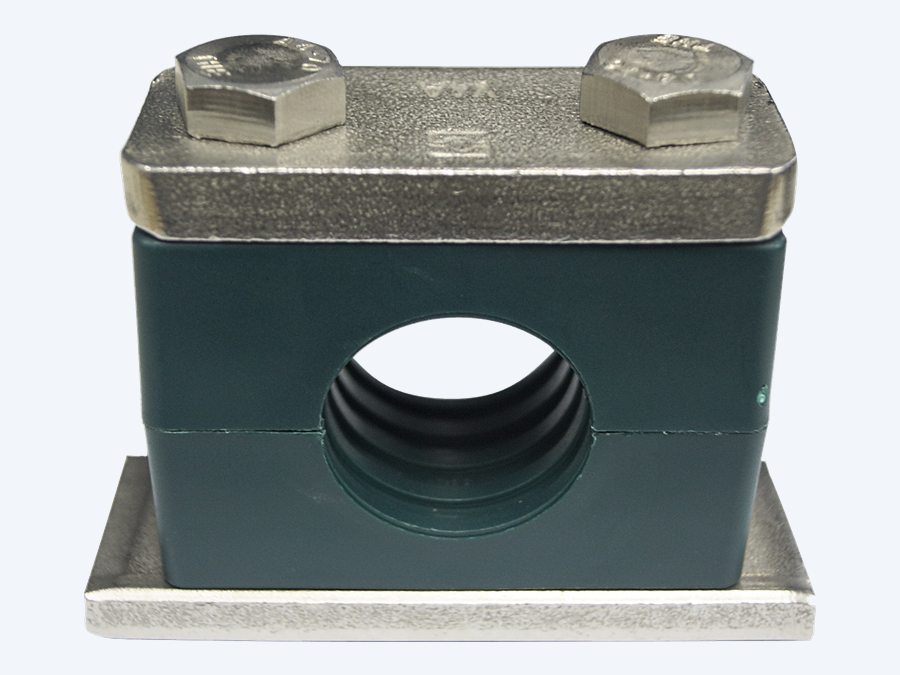
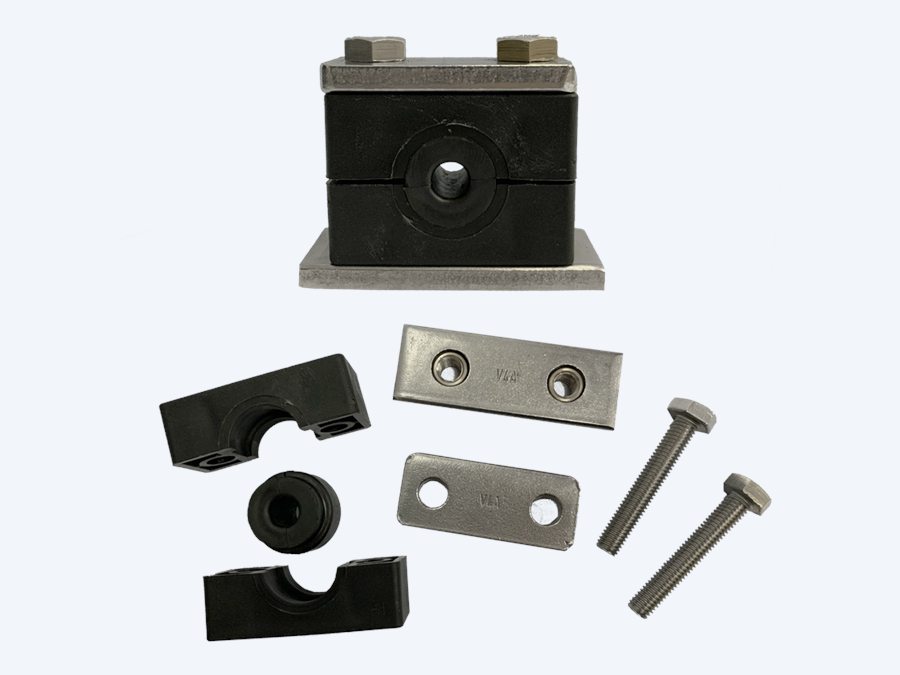
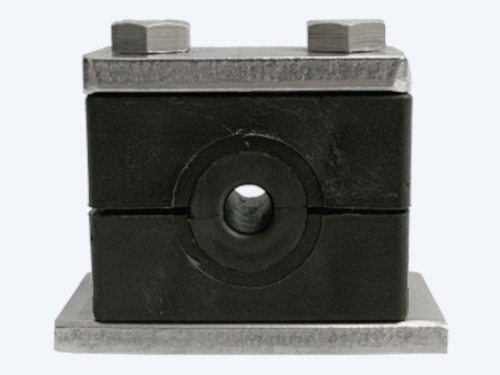
Photography on this line is thinner than on the rest of the range — ask us for a photo of the exact group and shell material if it matters for your submittal.
Buying rubber insert clamps in Malaysia and Singapore
What we need, and what comes back.
Five things and we can quote
- The outside diameter in mm of the tube, pipe or hose — measured over the hose cover, not the bore.
- Set, insert or body — a complete assembly, replacement inserts, or shells only.
- Shell material, PPR or PA, which is really a temperature question.
- The environment, which decides GS galvanized or SS stainless SS316 on the metal parts.
- The run length, so we quote a clamp count rather than one clamp.
What comes back
- Both order codes written out — body and insert — so a repeat order needs no catalogue.
- A landed price: transport, currency, duties and taxes already inside the figure.
- Stock from Johor Bahru, some orders from Singapore, and under three working days on a stocked item.
- A straight answer on whether you need the insert at all — on a rigid steel tube run, often you do not.
The elastomer insert
Thermoplastic elastomer, 73 Shore‑A. The part that does the work.
Thermoplastic elastomer (TPE) is a copolymer — or a physical blend of polymers — with both rubbery and thermoplastic properties. It stretches to moderate elongation and returns close to its original shape, which is what gives it a longer life than a plain rubber in this duty, and it can be injection moulded, which is why the insert is a precise fit rather than a wrapped strip.
| Property | Value | Method |
|---|---|---|
| Shore hardness | 73 A | — |
| Modulus of elasticity | 16 N/mm² at 23 °C | ASTM D 412 |
| Tensile strength | 8.3 N/mm² | ASTM D 412 |
| Temperature resistance | −40 °C to +125 °C | — |
Chemical resistance
| Exposure | Rating |
|---|---|
| Weak acids, solvents | Consistent |
| Benzene, mineral oils | Conditionally consistent |
| Alcohol, other oils, seawater | Consistent |
- ⚠ The shell is the temperature limit, not the insert. The elastomer is good to +125 °C, but a PPR shell stops at +90 and a PA shell at +120. Specify on the lower of the two. If you need the insert’s full range you want the polyamide shell.
- Mineral oil is the one to check. Weak acids, solvents, alcohol and seawater are rated consistent; benzene and mineral oils are only conditionally consistent. On a hydraulic line the fluid is inside the tube, so this matters for splash and washdown, not the contents — but tell us if the clamp will sit in standing oil.
- Seawater is rated consistent, which is why this clamp turns up in marine and offshore work. Pair it with SS316 metal parts, not galvanized.
- 73 Shore‑A is firm, not soft. It is roughly a shoe‑sole hardness — enough to damp movement and absorb a pulse, not so soft that the line can creep in the clamp.
Shell material and metal parts
Two shells, two metal options. The colour tells you which shell.
| Part | Material | Code | Colour | Temperature |
|---|---|---|---|---|
| Clamp body | Polypropylene | PPR | Green | −30 to +90 °C |
| Clamp body | Polyamide | PA | Black | −40 to +120 °C |
| Insert | Thermoplastic elastomer | RI | Black | −40 to +125 °C |
Note the shell code on this line is PPR, not the PP used on the ordinary Tubeclo range. Same polypropylene; different code on the order.
Metal parts
| Option | Material | Part-number field |
|---|---|---|
| W3 | Galvanized carbon steel ST 37 | GS |
| W5 | Stainless steel SS316 | SS |
- Only two metal options on this line — W3 galvanized or W5 SS316. The wider W1 to W5 code range on the ordinary Tubeclo clamps does not all apply here.
- Ask for SS by name for marine, offshore or washdown. The insert is rated consistent in seawater; galvanized plates are not the part you want failing around it.
- Every set includes a top plate, a base weld plate and hexagon bolts. Those are the metal parts — the shell and insert are the plastic ones.
Sizes and order codes
Read this table, not the ordinary series one. Both codes are here.
Every size gives you two order codes: one for the clamp body and one for the rubber insert. Find your outside diameter and take both.
Standard series
| Group | Outside diameter (mm) | Clamp body code | Insert code |
|---|---|---|---|
| 4 | 6 | 406‑R | RI‑06‑4/4S |
| 4 | 8 | 408‑R | RI‑08‑4/4S |
| 4 | 10 | 410‑R | RI‑10‑4/4S |
| 4 | 12 | 412‑R | RI‑12‑4/4S |
| 4 | 12.7 | 412.7‑R | RI‑12.7‑4/4S |
| 4 | 14 | 414‑R | RI‑14‑4/4S |
| 4 | 15 | 415‑R | RI‑15‑4/4S |
| 4 | 16 | 416‑R | RI‑16‑4/4S |
| 4 | 17.2 | 417.2‑R | RI‑17.2‑4/4S |
| 4 | 18 | 418‑R | RI‑18‑4/4S |
| 4 | 19 | 419‑R | RI‑19‑4/4S |
| 6 | 20 | 620‑R | RI‑20‑6/5S |
| 6 | 21.3 | 621.3‑R | RI‑21.3‑6/5S |
| 6 | 22 | 622‑R | RI‑22/5S |
| 6 | 25 | 625‑R | RI‑25/5S |
| 6 | 26.9 | 626.9‑R | RI‑26.9/5S |
| 6 | 28 | 628‑R | RI‑28/5S |
| 6 | 30 | 630‑R | RI‑30/5S |
| 6 | 32 | 632‑R | RI‑32/5S |
Heavy series
| Group | Outside diameter (mm) | Clamp body code | Insert code |
|---|---|---|---|
| 4S | 6 · 8 · 10 · 12 · 12.7 · 14 · 15 · 16 · 17.2 · 18 · 19 | 4006‑R to 4019‑R | RI‑06‑4/4S to RI‑19‑4/4S |
| 5S | 20 · 21.3 · 22 · 25 · 26.9 · 28 · 30 · 32 | 5020‑R to 5032‑R | RI‑20‑6/5S to RI‑32‑6/5S |
| 6S | 32 · 33.7 · 35 · 38.7 · 40 · 42 · 45.5 · 48 · 51 · 53.4 · 56.4 | 6032‑R to 6056.4‑R | RI‑32‑6S to RI‑56.4‑6S |
| 7S | 55 · 57 · 60 · 63.5 · 65 · 70 · 72 · 76 | 7055‑R to 7076‑R | RI‑55‑7S to RI‑76‑7S |
| 8S | 80 · 88.9 · 102 | 8080‑R · 8088.9‑R · 8102‑R | RI‑80‑8S · RI‑88.9‑8S · RI‑102‑8S |
| 9S | 114 · 133 · 140 | 9114‑R · 9133‑R · 9140‑R | RI‑114‑9S · RI‑133‑9S · RI‑140‑9S |
| 10S | 150 · 165 · 168 · 172 | 10150‑R to 10172‑R | RI‑150‑10S to RI‑172‑10S |
- ⚠ Do not size this from the ordinary series table. Tubeclo says it directly: the relation between tube outside diameter and rubber insert clamp size does not match that of the standard series. On RI, 6 to 19 mm is group 4 and 20 to 32 mm is group 6 — there is no group 1, 2, 3 or 5 on this line.
- The insert is shared between two clamp groups. Read the insert codes: RI‑xx‑4/4S fits both standard group 4 and heavy group 4S, and RI‑xx‑6/5S fits standard group 6 and heavy 5S. Tubeclo confirms this — so one insert part number covers a standard and a heavy clamp at the same bore.
- The body code carries the size in it. 419‑R is group 4, 19 mm. 6053.4‑R is group 6S, 53.4 mm. Once you see it, the codes read themselves.
- 32 mm appears twice — as standard group 6 (632‑R) and heavy 6S (6032‑R). Either holds a 32 mm line; the heavy one carries more.
- Above 32 mm it is heavy series only. Standard stops at 32; heavy runs to 172 mm.
Reading the part number
Seven fields — and the third one is not what you would guess.
| Field | What it is | Options |
|---|---|---|
| I | Type of item | PC — pipe clamp |
| II | Series | S — standard |
| III | Clamp body material | PP polypropylene · PA polyamide |
| IV | What you are buying | 1 complete set · 2 rubber insert · 3 clamp body |
| V | Size group | 4 or 6 standard · 4S, 5S, 6S, 7S, 8S, 9S, 10S heavy |
| VI | Pipe OD | Metric size in mm, e.g. 006, 021.3, 172 |
| VII | Metal parts | GS galvanized steel · SS stainless SS316 |
Worked example
PC‑S‑PP‑1‑4‑012‑GS
- A pipe clamp, standard series
- Polypropylene shell, so green, −30 to +90 °C
- 1 — complete set: shell halves, insert, top plate, base plate, bolts
- Size group 4, for a 12 mm outside diameter
- Galvanized metal parts — change to SS for SS316
Field IV is the one people get wrong
- On the ordinary Tubeclo range, field IV is a set configuration chosen from 13, 10 or 6 numbered options.
- On the rubber insert line it means something else entirely — just three options: the complete set, the insert alone, or the body alone.
- So PC‑S‑PP‑2‑4‑012‑GS is replacement inserts, not a clamp. If a delivery arrives as a bag of rubber, this is why.
- And note the last field is GS here, where the ordinary range uses C for carbon steel.
Where rubber insert clamps get used
Wherever a rigid bore would pass too much through.
Vibration and noise reduction
The primary case. The elastomer absorbs pulsation and structure‑borne noise that a rigid plastic bore would pass into the bracket and on into the structure. Specified where crews work close to the line, or where a panel would otherwise drum.
Gentle installation of hose and cable
Hose and cable have compressible covers that a rigid bore can nip. The insert spreads the load and lets the line move a little without chafing. This is the clamp to use where a hose flexes in service rather than sitting still.
Rail, vehicles and energy
Rail transportation, energy technology, and commercial and special‑purpose vehicles — alongside mobile and industrial hydraulic machinery. Anywhere the whole assembly moves and the line has to stay put without being punished.
Marine, oil and gas, food and chemical
Used in marine and oil and gas work, and in food and chemical processing. The insert is rated consistent in seawater and in weak acids, solvents and alcohol — specify SS316 metal parts to match. Chemical table.
- Excellent weather resistance even under extreme conditions, which is the other reason it appears outdoors and offshore rather than only inside plant.
- When you do not need it: a rigid steel tube run, indoors, with no vibration problem. There the plain Tubeclo clamp is cheaper and does the job. We will tell you that rather than sell you the insert.
Why buy Tubeclo rubber insert clamps from us
Our own authorised line, and we will tell you when you do not need it.
Authorised distributor
Tubeclo Pte Ltd certifies us as its Authorized Distributor — the certificate is on the clamps page. No allocation to wait on, which is why we stock the line in depth.
Both codes, every time
Body and insert have separate order codes, and quotations carry both. That is what makes a replacement‑insert order a two‑minute job next year instead of a catalogue hunt.
We check the group for you
The RI size numbering does not follow the ordinary series, and it catches people. Send the outside diameter and we return the group and both codes.
Shell matched to temperature
The insert takes +125 °C; the shell may not. We specify on the lower of the two and say so on the quotation, rather than quoting the insert figure and leaving you to find out.
Inserts as a spare line
The elastomer is the wear part. Order inserts on their own as a maintenance stock item — field IV of the part number, option 2.
Landed price, stock both sides
Johor Bahru, with some orders from Singapore, at a landed price — transport, currency, duties and taxes already inside the figure. Under three working days on a stocked item.
Questions we get asked
The ones that come up on the phone.
What does the rubber insert actually do?
It is the part that touches the line. The shell holds, the insert cushions. A thermoplastic elastomer at 73 Shore‑A absorbs pulsation and structure‑borne noise that a rigid plastic bore would pass straight into the bracket, and it lets a hose move slightly without chafing. Use it for extra vibration and noise reduction, and for the gentle installation of hose and cable.
Why is the size group different from the ordinary Tubeclo clamps?
Because it genuinely is, and Tubeclo says so in the catalogue: the relation between tube outside diameter and rubber insert clamp size does not match that of the standard series. On the RI line there is no group 1, 2, 3 or 5 — standard is group 4 (6 to 19 mm) and group 6 (20 to 32 mm), and heavy runs 4S to 10S. Size it from the RI table and nothing else.
Can I order just the inserts?
Yes, and you should keep some. The insert is the wear part, and it has its own order code — RI‑xx‑<group>. On the part number it is field IV, option 2: PC‑S‑PP‑2‑4‑012‑GS is a box of inserts, not clamps. Option 3 is the clamp body only and option 1 the complete set.
Does one insert fit more than one clamp?
Yes, and it is worth knowing for stock. The insert codes carry two groups for a reason: RI‑xx‑4/4S fits both standard group 4 and heavy group 4S, and RI‑xx‑6/5S fits standard group 6 and heavy 5S. So one insert part number covers a standard and a heavy clamp at the same bore — you carry fewer spares than you might expect.
What temperature can it take?
Whichever is lower — and it is usually the shell. The elastomer insert takes −40 to +125 °C, but a polypropylene (PPR) shell stops at +90 °C and a polyamide (PA) shell at +120 °C. If you need the insert’s full range, specify the PA shell. Do not read the insert figure off the datasheet and assume the assembly matches it.
PPR or PA — which shell?
It is a temperature and cost question. PPR is polypropylene, green, −30 to +90 °C and the everyday choice. PA is polyamide, black, −40 to +120 °C — thirty degrees more at the top and ten more at the bottom. Note the code is PPR on this line where the ordinary Tubeclo range uses PP. Same material, different code on the order.
Is it suitable for seawater and washdown?
The insert is, and that is why the clamp turns up in marine and offshore work. The elastomer is rated consistent against seawater, weak acids, solvents, alcohol and other oils; benzene and mineral oils are only conditionally consistent. Pair it with SS316 metal parts — the SS suffix, not GS — because galvanized plates are then the weak point, not the rubber. Chemical table.
How big does it go?
172 mm outside diameter, on the heavy series at group 10S. The standard series stops at 32 mm, so anything above that is heavy series by default. At the small end both series start at 6 mm. If you need a rubber‑insert clamp above 172 mm, talk to us — the answer is usually a plain heavy clamp with a different approach to damping.
What is thermoplastic elastomer, and why not ordinary rubber?
TPE is a copolymer or physical blend with both rubbery and thermoplastic properties. Practically: it stretches to moderate elongation and returns close to its original shape, which gives a longer life in this duty than a plain rubber, and it can be injection moulded, so the insert is a precise moulded fit rather than a wrapped strip. Published figures are 73 Shore‑A, modulus 16 N/mm² at 23 °C and tensile strength 8.3 N/mm², both to ASTM D 412.
Do I need the insert at all?
Often not, and we will say so. On a rigid steel tube run, indoors, with no vibration or noise problem, a plain Tubeclo clamp is cheaper and does the job. The insert earns its money where there is pulsation, structure‑borne noise, a flexing hose, or a compressible cover that a rigid bore would nip. Tell us the duty and we will give you the honest answer.
How does it mount?
The same way as the rest of the DIN 3015 family. Every set comes with a top plate, a base weld plate and hexagon bolts — weld or bolt the base plate down, sit the lower shell half on it, lay the line into the insert, close with the upper half and the top plate, and bolt. The three mounting methods on the ordinary range apply here too.
Do you deliver to Singapore, and what does it cost?
Yes. Stock is held in Johor Bahru and some orders ship from Singapore — both our own stock, neither bought in against your enquiry. A stocked item can be delivered in under three working days. The quote is a landed price: transport, currency, duties and taxes are already inside the figure, so what you approve is what you pay.
Catalogue
Direct PDF download — no form, no email address.
 Rubber insert clamps — both series, every size, both order codes, with dimensionsTubeclo · 7.6 MBPDF
Related: Tubeclo pipe clamps where a rigid bore is fine · anti‑corrosion clamps for the harshest environments · STAUFF pipe clamps · hydraulic steel tube and stainless steel tube to clamp · compression fittings for the joints between.
Send the outside diameter and the duty
We will read off the group, give you both order codes, match the shell to your temperature and quote a landed price. And if you do not need the insert, we will say so. Stock in Johor Bahru and Singapore.