
Home › Products › Pipe clamps › STAUFF ACT clamps
Anti‑Corrosion TechnologySTAUFF ACT anti‑corrosion clamps, 6 mm to 25.4 mm
A DIN 3015 clamp designed to stop the clamp itself corroding your tube. The body is flame‑retardant PPV0 with integrated anti‑corrosion elastomer strips that keep seawater from sitting between clamp and pipe, and drainage channels that let it run away. Hardware in V4A / W55 stainless. Specified for sub‑sea, top‑side and rig work to NORSOK, API and NACE norms.
Get a quotation within 2 working hours
Send the part number, standard, size or quantity. Stock in Malaysia or Singapore, ISO 9001:2015 certified.
What an ACT clamp is
ACT stands for Anti‑Corrosion Technology. The name is the specification.
An ACT clamp is a STAUFF clamp to DIN 3015, redesigned around one problem: the clamp is what corrodes the tube. It does the ordinary job — structural support, less vibration and noise — but the body and the hardware are chosen so that the clamp does not become the place where a stainless line starts to pit. Available in standard and twin series only, and only from 6 mm to 25.4 mm.
You will also see it called an anti‑crevice tubing support, which is the more descriptive name. It is specified for sub‑sea, top‑side and oil rig installations, and anywhere a stainless tube run has to survive salt for years rather than months.
- The body is flame‑retardant PPV0, tested and classified V0 to UL94, and resistant to fire, rain, oil and seawater. Not PVC — and that distinction matters more than it sounds.
- Integrated elastomer strips, not a separate insert. They are moulded into the bore, and their job is to stop seawater accumulating between the clamp and the pipe. The way they move creates drainage channels so trapped water runs out instead of sitting there.
- Hardware is V4A / W55 stainless — corrosion resistance raised by excluding metallic and non‑metallic impurities during production, processing and handling, not just by alloy choice.
- It is a narrow range on purpose. 6 to 25.4 mm covers the instrument and hydraulic tube sizes that actually suffer this problem. Need wider? Tubeclo polypropylene and polyamide clamps run 6 to 406 mm — without the anti‑corrosion design.
STAUFF ACT clamps — the specification
Everything that goes on a purchase order, in one table.
| Standard | DIN 3015 — derived from the original STAUFF clamp |
| Series | Standard and twin only — there is no heavy series in ACT |
| Size range | 6 mm to 25.4 mm — 1/4" to 1". Other diameters on request |
| Body material | Flame‑retardant PPV0 — tested and classified V0 to UL94; resistant to fire, rain, oil and seawater |
| Body temperature | −25 °C to +80 °C · −13 °F to +176 °F, continuous exposure |
| Anti‑corrosion feature | Integrated elastomer strips in the bore, forming drainage channels that disperse trapped water |
| Hardware material | Stainless steel V4A, W55 — impurities excluded through production, processing and handling |
| Hardware available | Cover plate · hexagon head bolt · single weld plate · hammerhead bolt · self‑locking nut |
| Design norms | NORSOK Z‑010 (Norwegian offshore) · API RP 552 · NACE SP 0108‑2008 · standard tubing installation |
| Typical duty | Sub‑sea · top‑side · oil rigs — preventing pit corrosion on stainless tube |
| Stacking | Yes — safety locking plate (SIG) and stacking bolt (AF) |
| Stock | Held in Johor Bahru, with some orders shipping from Singapore |
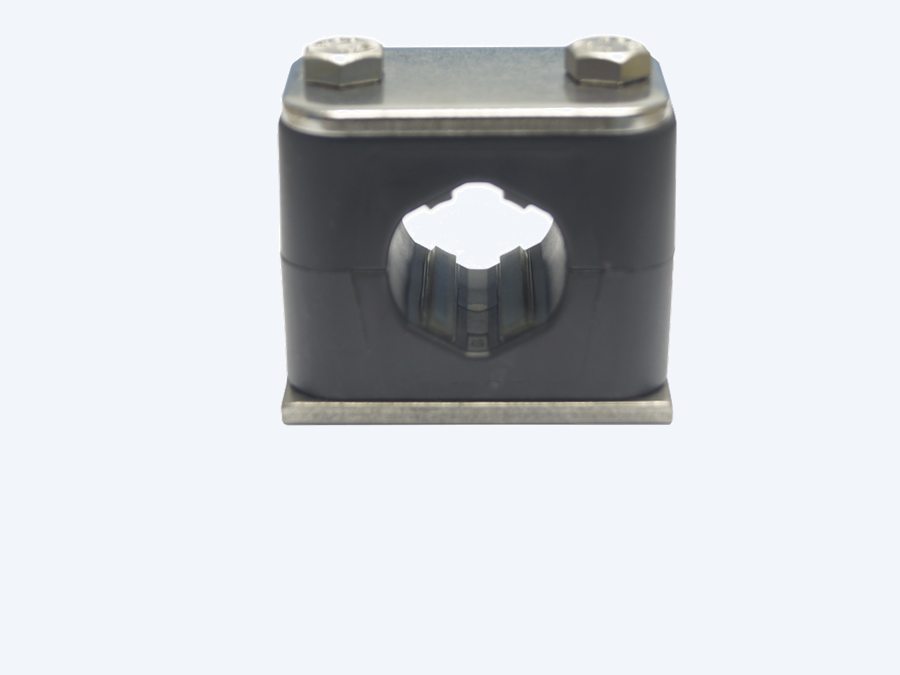
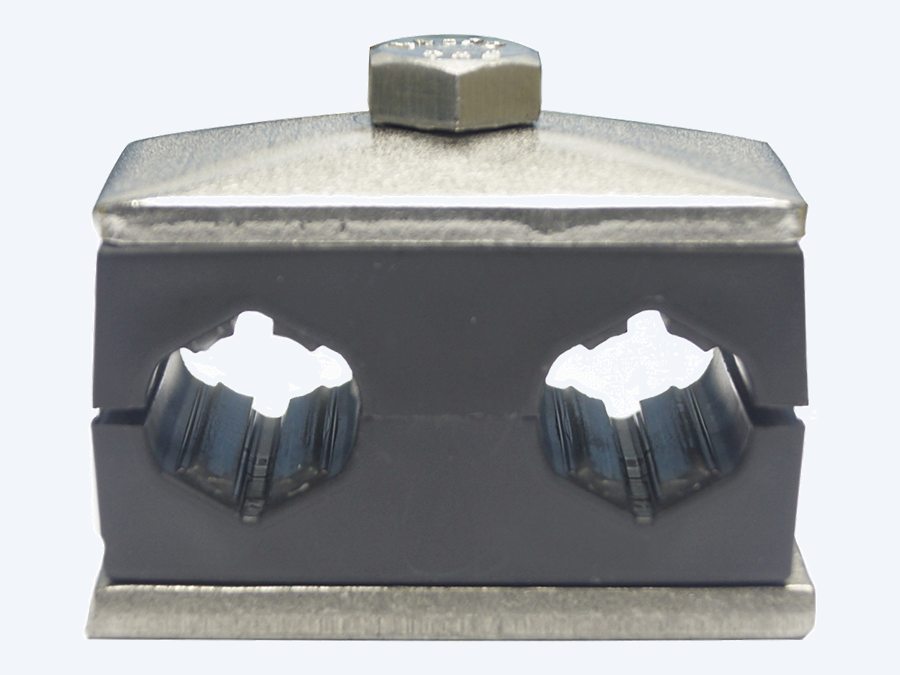
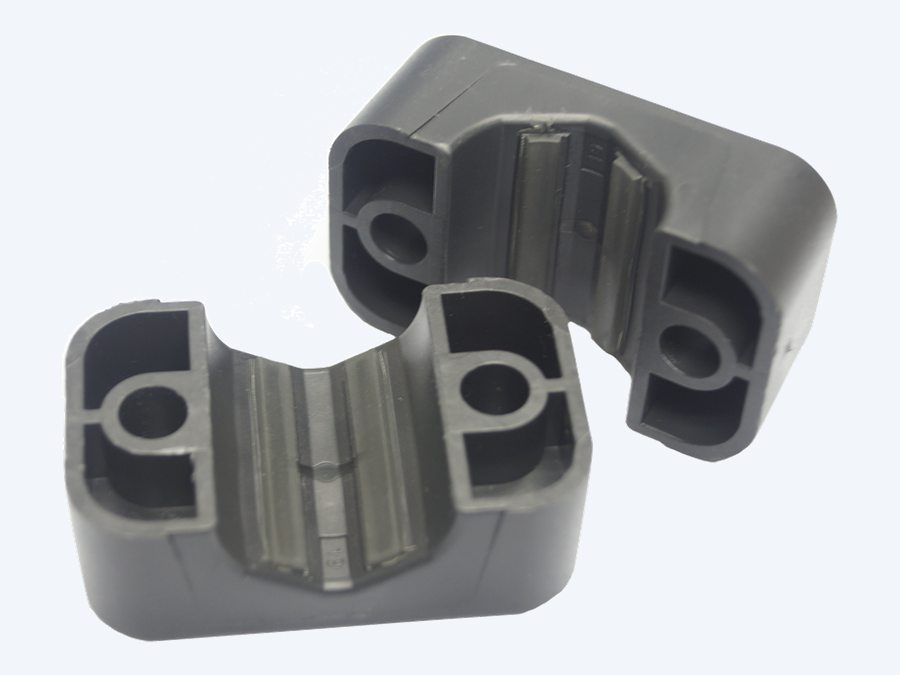
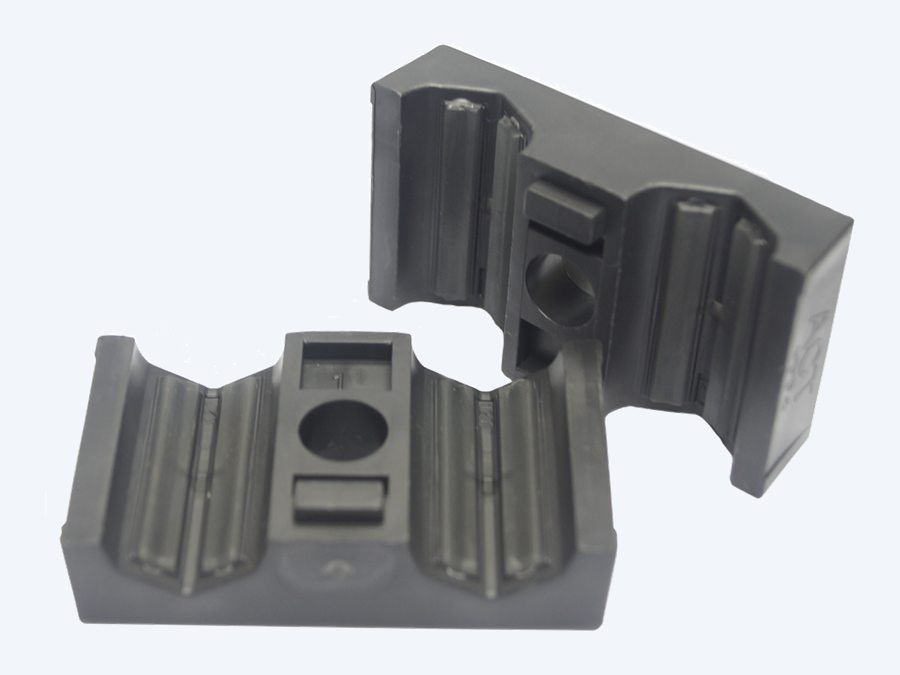
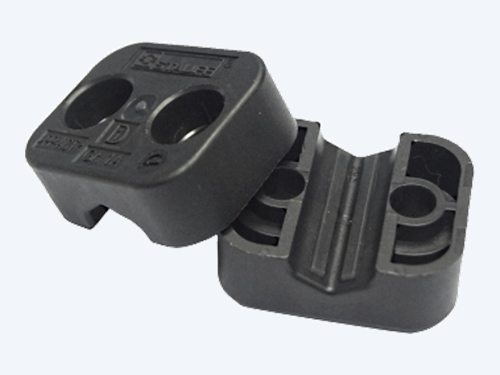
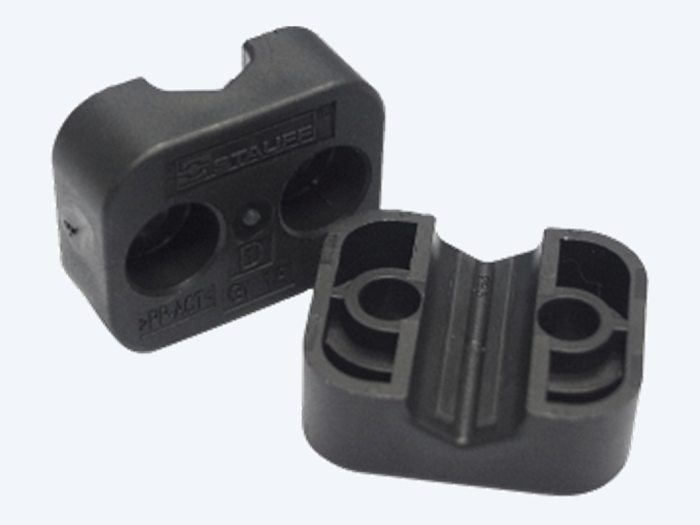
Both series, and the bore that does the anti‑corrosion work.
Why an ordinary clamp corrodes stainless tube
Two mechanisms, and the clamp is implicated in both.
Stainless steel does not rust evenly. It fails locally, in small places, and a pipe clamp creates exactly the conditions those places need. This is the whole reason ACT exists, and it is worth understanding before you specify anything else.
1 — Pitting corrosion
Under specific conditions — particularly chlorides such as the sodium chloride in seawater, made worse by elevated temperature — small pits form in the material surface.
Those pits keep growing. Given long enough they perforate the tube wall and it leaks, while the majority of the surface stays uninjured. That is what makes it dangerous: the tube looks fine. A single pit deepens, pits join up, and only then is it visible to the unaided eye.
2 — Crevice corrosion
The one the clamp causes. Clamps made of PVC plastic have been particularly prone to it, because the plastic deforms around the tubing and creates an even tighter crevice — the clamp closes the gap it needs to leave open.
It starts with a change in the local chemistry inside that shielded area, associated with a stagnant solution at micro‑environmental level. Consequences are serious: perforation of the tube wall thickness and the escape of highly flammable liquids and chemicals.
What happens inside the crevice
- A shift to acid conditions in the shielded area.
- Trapped seawater becomes stagnant — it stops exchanging with the water outside.
- Depletion of inhibitor and oxygen, so the passive film cannot repair itself.
- Build‑up of aggressive ions, such as the sodium chloride in seawater.
Read that list again and the design brief writes itself. Do not let water sit still against the tube, and do not close the gap. That is precisely what the ACT body does.
How the ACT body answers it
Elastomer strips, drainage channels, and the right plastic.
The body carries integrated anti‑corrosion elastomer strips. Their first job is to avoid the accumulation of seawater between the clamp body and the pipe. Their second is subtler: the dynamics of these strips create drainage channels that aid the dispersal of water — so water that does get in runs out again rather than going stagnant.
That is why the bore in the photographs is lobed rather than round. The tube sits on the crowns of the ribs, the gaps between them are open paths to the outside, and there is no broad flat contact area for a stagnant film to form in.
The plastic is chosen, not inherited
PPV0 — flame retardant, tested and classified V0 to UL94, and resistant to fire, rain, oil and seawater. Explicitly not PVC, which is the material with the crevice‑corrosion history.
The stainless is cleaner than standard
V4A / W55, with corrosion resistance improved by practically excluding metallic and non‑metallic impurities during production, processing and handling. Inclusions are where pitting starts, so removing them is the point.
It saves time and intervals
The design gives time reduction during installation and long‑term cost savings through extended service intervals — which on a rig is the number that actually matters, not the unit price of a clamp.
- ⚠ The temperature range is narrower than ordinary clamps. ACT is −25 to +80 °C continuous. A polypropylene clamp goes to +90 and polyamide to +120. If your line runs hot, ACT is not the answer — check the duty before specifying it.
- It protects the tube, not itself. The point is the stainless line lasting. The clamp is the means.
The norms it is designed to
Four references, and they are the reason it gets specified.
STAUFF states that the material and the design for ACT clamps are chosen in compliance with the following. On an offshore submittal these are usually what the reviewer is looking for.
| Reference | What it covers |
|---|---|
| NORSOK Z‑010 | Norwegian offshore standard — the one that usually drives this specification in North Sea work |
| API RP 552 | American Petroleum Institute recommended practice |
| NACE SP 0108‑2008 | Corrosion control norms from NACE |
| UL 94 | Flammability — the body is tested and classified V0 |
| DIN 3015 | The clamp geometry itself, so it fits the same plates and rails family |
| Standard tubing installation | General good practice for tube support |
- Ask us for the documentation with the quotation, not after. If your submittal needs the UL94 classification or the NORSOK reference in writing, say so on the enquiry and it comes back with the price.
- DIN 3015 still applies. ACT is a redesign of the STAUFF clamp, not a different product family — so the geometry sits in the same standard as the rest of the range.
How it goes together
Three configurations per series, and one instruction people skip.
ACT clamps come in different types of configuration. The body is the same; what changes is how it is fixed and what closes it.
| Configuration | Standard series | Twin series |
|---|---|---|
| Welded, bolted cover | Single weld plate SP + cover plate DP + hexagon head bolts AS | Single weld plate SP + cover plate GD + hexagon head bolts AS |
| Hammerhead bolt | Cover plate DP + hammerhead bolts HKS + self‑locking nuts MUS‑HKS | Cover plate GD + hammerhead bolts HKS + self‑locking nuts MUS‑HKS |
| Stacked | Safety locking plate + stacking bolts | Safety locking plate + stacking bolts |
Note the cover plate code changes with the series: DP on standard, GD on twin. Everything else carries across.
The sequence
- Mark the alignment of the weld plates as you install them. STAUFF puts this first and it is the step that gets skipped — get the plates out of line and the run fights you for the rest of the job.
- Push in the bottom half of the ACT clamp onto the plate.
- Install the tubing into the bore.
- Mount the top half together with the cover plate and bolts.
Stacking
The stacking design increases installation flexibility. Combining the specially designed safety locking plate (SIG) with a stacking bolt (AF) makes it possible to mount multiple clamp bodies of identical size directly on top of one another. On a rig that is space back, and it gives the designer freedom in the pipework layout.
Buying ACT clamps in Malaysia and Singapore
What we need, and when we will tell you not to buy them.
Five things and we can quote
- Tube outside diameter in mm or inches — ACT covers 6 to 25.4 mm only.
- Standard or twin, and how many lines run together.
- How it fixes — welded plate with hex bolts, hammerhead bolts with self‑locking nuts, or stacked.
- The temperature, because +80 °C is the ceiling and it is lower than an ordinary clamp.
- What documentation the submittal needs — UL94, NORSOK, NACE.
What comes back
- A landed price: transport, currency, duties and taxes already inside the figure.
- The configuration written out by component code — SP, DP or GD, AS or HKS with MUS‑HKS.
- An honest steer. If your run is not in salt and not on a rig, we will point you at a Tubeclo clamp instead and save you the money.
- Stock from Johor Bahru, some orders from Singapore.
ACT is a specialist item rather than a shelf line — tell us the quantity and the date and we will confirm the lead time with the price rather than after it.
Why buy ACT clamps from us
We sell the alternative too, which is why the advice is worth something.
We will talk you out of it
ACT costs more and tops out at +80 °C and 25.4 mm. If the duty does not call for it, we say so — Tubeclo covers 6 to 406 mm for less. We would rather quote the right clamp twice than the wrong one once.
And we know when it is right
Stainless tube, salt, sub‑sea or top‑side — then the clamp genuinely is the risk, and the pit that perforates a tube wall costs far more than the clamp did. The mechanism.
The norms, in writing
NORSOK Z‑010, API RP 552, NACE SP 0108‑2008, UL94 V0. Ask on the enquiry and the references come back with the quotation, in time for your submittal.
Configuration by code
Quotations name the parts — SP, DP or GD, AS or HKS with MUS‑HKS — so the next order matches the last one without anyone guessing.
The whole clamp family
ACT for the harsh end, Tubeclo for the range, rubber insert where damping matters, STAUFF alongside. One enquiry, the right answer.
Landed price, both sides
Johor Bahru, some orders from Singapore, at a landed price — transport, currency, duties and taxes already inside the figure.
Questions we get asked
The ones that come up on the phone.
What does ACT stand for?
Anti‑Corrosion Technology. It is a STAUFF clamp built to DIN 3015 and redesigned so that the clamp does not become the place where a stainless tube starts to corrode. You will also see it called an anti‑crevice tubing support, which describes the job more precisely. Standard and twin series, 6 to 25.4 mm.
How can a plastic clamp corrode a steel tube?
By trapping water against it. Two mechanisms. Pitting: chlorides — the sodium chloride in seawater — plus elevated temperature start small pits that keep growing until they perforate the tube wall, while most of the surface still looks fine. Crevice corrosion: a clamp creates a shielded gap where the solution goes stagnant, turns acid, loses its oxygen and inhibitor, and concentrates aggressive ions. The full mechanism.
Why is PVC specifically a problem?
Because it deforms around the tubing and creates an even tighter crevice. STAUFF is direct about it: clamps made of PVC plastic have been particularly prone to producing crevice corrosion. The clamp closes the very gap that needed to stay open and drain. The ACT body is PPV0, not PVC, and its bore is lobed rather than round so the tube sits on rib crowns with open channels between them.
What do the elastomer strips actually do?
Two things. They avoid the accumulation of seawater between the clamp body and the pipe — there is no broad flat contact face for a film to sit on. And the dynamics of the strips create drainage channels that aid the dispersal of water, so what does get in runs out again instead of going stagnant. They are moulded into the body, not a separate insert you fit.
What is the body made of, and is it fire rated?
Flame‑retardant PPV0, tested and classified V0 to UL94 — the top of that flammability classification. It is also resistant to fire, rain, oil and seawater. If your submittal needs the UL94 classification in writing, ask on the enquiry and it comes back with the quotation.
What temperature can ACT take?
−25 °C to +80 °C continuous — or −13 °F to +176 °F. Note that is narrower than an ordinary clamp: polypropylene runs to +90 °C, polyamide to +120, aluminium to +300. So if the line runs hot, ACT is the wrong choice even in a corrosive environment — tell us the temperature and we will work out what fits.
What sizes does it come in?
6 mm to 25.4 mm — 1/4 inch to 1 inch — in both standard and twin series, covering the common metric and imperial instrument and hydraulic tube diameters. Other diameters are available on request. If you need larger and do not need the anti‑corrosion design, polypropylene and polyamide clamps run 6 to 406 mm.
Is there a heavy series?
No. ACT is standard and twin series only. That is a deliberate limit — the range covers the tube sizes that actually suffer pitting and crevice corrosion on offshore installations. For heavier duty or larger bore you are into the ordinary STAUFF or Tubeclo heavy series, without the ACT body.
What stainless is the hardware?
V4A / W55. What matters is not just the alloy designation: the corrosion resistance is enhanced by practically excluding metallic and non‑metallic impurities during production, processing and handling. Inclusions in the steel are where pitting starts, so a cleaner melt and cleaner handling is the point — not simply picking a grade off a list.
Which standards is it designed to?
The material and design are chosen in compliance with the Norwegian offshore NORSOK Z‑010 standard, API RP 552, standard tubing installation practice, and NACE SP 0108‑2008. The body is separately classified V0 to UL94, and the clamp geometry itself is DIN 3015. All of them, listed.
How does it fix to structure?
Three configurations, in both series. Single weld plate (SP) with a cover plate and hexagon head bolts (AS); or cover plate with hammerhead bolts (HKS) and self‑locking nuts (MUS‑HKS) where you cannot weld; or stacked, using a safety locking plate and stacking bolts. The cover plate is DP on standard and GD on twin. The sequence, and the step people skip.
Can ACT clamps be stacked?
Yes, and it is one of the reasons to choose them on a crowded rig. The stacking design increases installation flexibility: combining the specially designed safety locking plate (SIG) with a stacking bolt (AF) lets you mount multiple clamp bodies of identical size directly on top of one another. That gives the designer room in the pipework layout and gets space back where there is none.
Catalogue
Direct PDF download — no form, no email address.
Related: Tubeclo pipe clamps for the full 6–406 mm range · rubber insert clamps where damping matters more than corrosion · STAUFF pipe clamps · stainless steel tube and stainless steel pipe to clamp · compression fittings for the joints between.
Tell us the tube size and where it is going
If it is stainless tube in salt, sub‑sea or top‑side, ACT is probably right and we will quote it with the norms attached. If it is not, we will say so and quote you a Tubeclo clamp instead. Stock in Johor Bahru and Singapore.