
Home › Products › High pressure fittings › Compression fittings
DIN 2353 · ready stockCompression fittings to DIN 2353 and ISO 8434‑1, 4 mm to 42 mm
Flareless cutting‑ring tube fittings. Three parts — body, nut and cutting ring — on a 24° tube port, in three series: LL to 100 bar, L to 500 bar and S to 800 bar. Stainless steel, steel and brass — bodies, nuts and cutting rings held in stock in Malaysia and Singapore, with BSPP, metric, NPT and UN/UNF thread ends. The figure that actually applies to your joint is set by the size, not the series — the table below gives it.
Get a quotation within 2 working hours
Send the part number, standard, size or quantity. Stock in Malaysia or Singapore, ISO 9001:2015 certified.
What a compression fitting is, and what it is not
Three parts, one cone, and a ring that bites into the tube.
A DIN 2353 compression fitting is a flareless connection: the tube goes in as it comes off the saw, with no flare, no weld and no formed end. Three parts do the work — a body with a 24° internal cone, a union nut, and a cutting ring (also called a profile ring or bite ring). As the nut is tightened, the ring is driven into the cone, contracts onto the tube, and two cutting edges bite into the tube surface, raising a collar of material ahead of the ring. That collar is what holds the tube against pressure and pull‑out; the ring’s top face seals against the body.
Because the bite is made by the fitter tightening a nut, the quality of the joint depends on how far that nut is turned — which is why the assembly section below matters more than any other part of this page, and why a pre‑assembly tool earns its cost on any real volume of work.
Where it is the right answer
- Hydraulic oil systems — the range is designed for commercial hydraulic oils.
- Field work and repairs, because it needs no power and no machine.
- Mixed sizes in small numbers, where tooling up would not pay.
- Anywhere a joint has to be broken and remade for service — with a fresh ring.
Where something else is better
- High volume assembly — a Walform machine forms the profile into the tube and takes the fitter’s judgement out of it.
- Instrumentation and gas, where a twin‑ferrule fitting is the usual choice.
- Very high pressure above the S series ceiling, or where the tube is too thin‑walled for a ring to bite without collapsing.
We supply all three. Send the duty and we will say which one we would fit.
DIN 2353 against the alternatives
| System | The joint | Where it earns its place |
|---|---|---|
| DIN 2353 cutting ring · this page | 24° cone, ring bites the tube | Hydraulic oil systems, field work and repairs, mixed sizes in small numbers |
| JIC | 37° flare | Where the drawing calls for a flare — common on mobile plant |
| Twin ferrule | Two ferrules grip and seal | Instrumentation and gas |
| Walform | Cold‑formed tube end, no cutting ring | High‑volume assembly — the machine takes the fitter’s judgement out of it |
The systems do not mix in one joint: a 24° cone will not seal a 37° flare. If you are matching existing pipework, identify what is fitted first — the identification section shows how.
Specification
Everything an enquiry needs, in one place.
| Type | Flareless compression (cutting‑ring) tube fitting, three‑piece |
| Standards | DIN 2353 · ISO 8434‑1 |
| Tube outside diameter | 4 mm to 42 mm |
| Series | LL extra light · L light · S heavy — these are dimensional series (wall and thread), not pressure classes. The pressure follows from the dimensions at each size |
| Working pressure | LL to 100 bar · L to 500 bar · S to 800 bar — the figure for a given size is lower, see the table |
| Port form | 24° internal cone in the fitting body |
| Components | Fitting body · union nut (type EN) · cutting ring (type ES) |
| Materials | Stainless steel · steel · brass |
| Temperature — stainless | −60 °C to +400 °C (DIN 17440) |
| Temperature — steel | −40 °C to +120 °C (DIN 3859) |
| Temperature — brass | −60 °C to +175 °C |
| Nut threads | M8×1.0 at 4 mm up to M52×2.0 at 42 mm — full list |
| Media | Designed for commercial hydraulic oils. Anything else — water glycol, phosphate ester, gas, chemicals — tell us and we will confirm the material |
| Thread ends available | BSPP parallel · metric parallel · metric tapered · NPT tapered · UN/UNF unified, with plain, ED ring, O‑ring or DKI sealing |
| Stock | Held in Johor Bahru and Singapore |
Two figures on this page are commonly quoted wrongly. 800 bar is the ceiling of the S series, reached only at the small end — and the temperature limit is not free: above +20 °C on stainless, and at any point on brass, you give back a percentage of the rated pressure. Both are set out below.
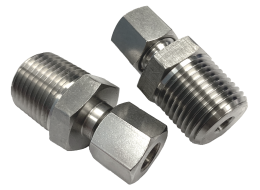
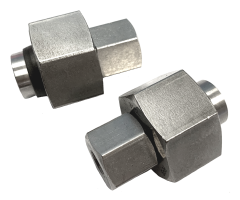
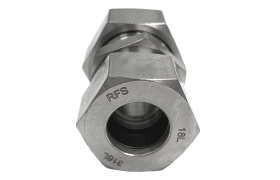
What the parts look like, and what the stamping tells you.
Buying compression fittings in Malaysia and Singapore
Where the stock sits, what it costs to get to you, and how fast it moves.
Stock, delivery and ordering
- Running sizes in steel and stainless are held in Johor Bahru and Singapore, with nuts and cutting rings on the same shelf.
- On a stocked item, order to physical delivery can be under three working days.
- Rings and nuts sell separately. They are consumables — a reused ring is the commonest cause of a weeping joint, and a ring never moves to a new tube. Maintenance stock is rings and nuts, not bodies — order spares with the fittings.
- One price, delivered — transport, currency, duties and taxes are inside the figure we quote.
How to specify a DIN 2353 fitting
Six things pin the fitting down — send what you have and we fill the gaps:
- Tube OD and wall thickness.
- Working pressure.
- The fluid, and its temperature at the fitting.
- Port thread at the other end: BSPP, metric, NPT or UN/UNF.
- How it seals there — plain, ED ring, O‑ring or DKI.
- Material — steel, stainless or brass.
We come back with the series — LL, L or S — confirm the size carries your pressure, and quote the body, nut and ring as a set, flagging anything that needs a pre‑assembly tool.
Send your list →The DIN 2353 series — LL, L and S — and why the size sets the pressure
The series gives a ceiling. The size gives the number you design to.
LL, L and S are dimensional series — they define wall thickness and thread, not a pressure class. Pressure is a consequence of those dimensions at each size, which is why the series headline — LL to 100 bar, L to 500 bar, S to 800 bar — is the top of the whole range and not the rating of the fitting in your hand. Within a series the rating steps down as the tube gets bigger, because a larger bore carries more end load at the same pressure. The table below is the straight union, and it shows how the bands actually fall.
| Series | Nominal pressure | Tube outside diameters |
|---|---|---|
| LL extra light | PN 100 | 4 · 6 · 8 · 10 · 12 mm |
| L light | PN 315 | 6 · 8 · 10 · 12 · 15 · 18 mm |
| L light | PN 160 | 22 · 28 · 35 · 42 mm |
| S heavy | PN 630 | 6 · 8 · 10 · 12 · 14 mm |
| S heavy | PN 400 | 16 · 20 · 25 · 30 mm |
| S heavy | PN 315 | 38 mm |
The bar under each figure is that band’s pressure as a share of the PN 630 ceiling, so you can see the rating fall as the tube gets bigger.
- Read this before you quote a pressure. An S‑series fitting at 30 mm is PN 400, not 800 — and at 38 mm it is PN 315, the same as an L‑series 6 mm. The series letter alone tells you very little.
- Overlapping sizes are deliberate. 6, 8, 10 and 12 mm exist in all three series. Same tube OD, three different pressure classes and three different nut threads — so a size on its own is not enough to order from.
- These are the figures for the straight union, and it is the union that sets the practical ceiling: PN 630 in S and PN 315 in L. The 500 and 800 bar headline figures belong to other body styles at the small end of the range — so do not design a union joint to 800 bar. Tell us the body style and we will confirm the number against the maker’s table before you commit.
- Then apply the temperature reduction from the section below, which comes off these numbers rather than off the series ceiling.
- Source: these bands are the straight‑union table in the RFS compression fittings catalogue. Ask us and we will send the page for the exact body style you are ordering.
Which series should I start from?
| Your working pressure | Start from | Watch for |
|---|---|---|
| Up to 100 bar, small bore | LL extra light | Stops at 12 mm |
| Up to 315 bar — 160 bar above 18 mm | L light | The only series that reaches 42 mm |
| Above 315 bar | S heavy | PN 630 only to 14 mm, PN 400 to 30 mm, stops at 38 mm |
Start from, not order from. The number you design to is the size band in the table above, minus the temperature reduction in the next section. Send the duty and we confirm the series before you commit.
Sizes, nut threads and the 24° port
What to measure, and what the thread on the nut tells you.
Every size in every series has its own nut thread. That is the quickest way to identify a fitting you already have, and the reason an unmarked nut is worth putting a caliper on before ordering.
| Tube OD | LL series nut | L series nut | S series nut |
|---|---|---|---|
| 4 mm | M 8 × 1.0 | — | — |
| 6 mm | M 10 × 1.0 | M 12 × 1.5 | M 14 × 1.5 |
| 8 mm | M 12 × 1.0 | M 14 × 1.5 | M 16 × 1.5 |
| 10 mm | M 14 × 1.0 | M 16 × 1.5 | M 18 × 1.5 |
| 12 mm | M 16 × 1.0 | M 18 × 1.5 | M 20 × 1.5 |
| 14 mm | — | — | M 22 × 1.5 |
| 15 mm | — | M 22 × 1.5 | — |
| 16 mm | — | — | M 24 × 1.5 |
| 18 mm | — | M 26 × 1.5 | — |
| 20 mm | — | — | M 30 × 2.0 |
| 22 mm | — | M 30 × 2.0 | — |
| 25 mm | — | — | M 36 × 2.0 |
| 28 mm | — | M 36 × 2.0 | — |
| 30 mm | — | — | M 42 × 2.0 |
| 35 mm | — | M 45 × 2.0 | — |
| 38 mm | — | — | M 52 × 2.0 |
| 42 mm | — | M 52 × 2.0 | — |
- The 24° cone is the interface. The tube port in the body is a 24° included cone, which is what makes the range interchangeable across makers to DIN 2353 — and what distinguishes it from a 37° JIC flare or a 60° port.
- Two sizes share M 52 × 2.0 — L series 42 mm and S series 38 mm. The thread matches; the tube bore does not. Measure the tube, not just the nut.
- LL stops at 12 mm, S stops at 38 mm, and only L reaches 42 mm. If you need 42 mm you are in the L series at PN 160, whatever the pressure on the drawing says.
Temperature, and the pressure it costs you
The limit is not the whole story — heat takes a percentage off the rating.
Each material has a temperature window, and within that window the fitting gives back a share of its rated pressure as it gets hotter. This is the step most often skipped: a stainless fitting is quoted at PN 400 and then run at 200 °C, where a fifth of that rating is gone.
| Material | Working temperature | Pressure reduction |
|---|---|---|
| Stainless steel DIN 17440 | −60 °C to +400 °C | Rises with temperature — up to 33%, see the table below |
| Steel DIN 3859 | −40 °C to +120 °C | None across its whole range |
| Brass | −60 °C to +175 °C | 35% across its whole range |
Stainless steel — what each temperature costs you
| At temperature | Pressure reduction |
|---|---|
| up to +20 °C | none |
| up to +50 °C | 4% |
| +100 °C | 11% |
| +200 °C | 20% |
| +300 °C | 29% |
| +400 °C | 33% |
- These are the metal’s limits, not the joint’s. DIN 17440 is a stainless material standard, so +400 °C describes the steel, not a certified assembly. In practice the seal, the tube and the fluid govern long before that — an ED ring or O‑ring at the port, and the oil itself, are the real ceiling. Above about 120 °C, treat the duty as one to confirm part by part rather than reading off this table.
- Brass carries a flat 35% reduction. That is a large number and it applies over the whole range, so a brass fitting is a low‑pressure choice whatever the body is rated at.
- Steel publishes no reduction across its range — but that is because the range itself is the narrowest, stopping at +120 °C. It does not mean steel is unaffected by heat; it means the window has been kept inside the region where no allowance is called for. Hot oil on a hard‑working machine gets closer to that limit than people expect.
- Take the reduction off the size rating, not off the series ceiling. An S‑series 20 mm stainless fitting is PN 400 cold; at +200 °C it is 320 bar.
- Measure at the fitting. Tank temperature and the temperature at a fitting on a hot manifold are not the same number.
- Source: the working temperatures and reduction percentages above are the maker’s tables in the RFS compression fittings catalogue. They are material figures — for a specific grade, alloy or fatigue duty, ask and we will go back to the manufacturer.
Assembling a DIN 2353 cutting‑ring fitting
The one place where the fitter, not the fitting, decides whether it leaks.
Before you start
- Cut the tube square and deburr it inside and out. A burr shaves material off the ring and takes the bite with it.
- Check the tube wall. Too thin for the series and the tube collapses instead of taking the bite.
- Nut and ring on the tube the right way round, before anything else. The ring is directional.
- Use a new ring. A ring that has already bitten will not bite the same way twice.
Making the joint
- Insert the tube to the abutment in the body or the pre‑assembly tool, and hold it there.
- Tighten the nut to the turn count in the assembly instruction for that size and series — that number is what forms the collar.
- Back the nut off and look. A visible collar of material must stand ahead of the ring, all the way round. No collar means no joint.
- Final make‑up: nut down until torque rises noticeably, then the final part‑turn.
Hold the body, turn the nut. Rotating the body drags the ring round the tube and destroys the seal it just cut.
- Use a pre‑assembly tool for anything beyond a handful of joints. It sets the same collar every time, off the machine rather than off the fitter’s wrist, and it lets you form rings on the bench instead of in the machine.
- Turn counts are per size and per series and they come from the maker’s assembly instruction. Ask us and we will send the sheet for the fittings you have bought — we would rather you worked from that than from a number remembered off a website.
- Some ring designs are gauged, not counted. Not every cutting ring is qualified on turns — some are checked with a gauge on the formed collar instead, and mixing the two methods is how a shop ends up with joints that pass a visual and weep in service. Work to the method the instruction for that ring specifies.
- On remake, the joint can be broken and remade with the same ring in the same position a limited number of times, and only ever back onto the same tube. Moving a bitten ring to a new tube, or a new ring onto an already‑bitten tube, gives a joint that looks right and weeps.
- If you are making these in quantity, look at the Walform system instead: the profile is cold‑formed into the tube by machine, the cutting ring disappears, and the pressure point at make‑up is unmistakable.
What is in the range
Body styles, by what they do rather than by part number.
Tube to tube
Straight union (EU) joins two tubes of the same size. With elbows, tees and crosses for changes of direction and branches, all on the same 24° port.
Tube to male port
Male connectors in BSPP parallel (EMC‑GB), metric parallel (EMC‑MB), metric tapered (EMC‑MK) and unified (EMC‑UF) — with plain, ED ring (EMC‑GE, EMC‑ME) or O‑ring (EMC‑MF) sealing.
Tube to female port
Female connectors in BSPP (EFC‑G), metric parallel (EFC‑M), NPT tapered (EFC‑N) and with a DKI ring (EFC‑GG).
Adapters
Male‑female adapters (EMFAD, EMFAE) in BSPP parallel, plain or with an ED ring — for changing thread form or adding length at a port.
Banjo fittings
Banjo (EBA‑G, EBA‑M) and high pressure banjo (EBAH‑G, EBAH‑M) with an EKA ring, where the tube has to leave the port at an angle you cannot reach with an elbow.
Closing off
Blanking plugs with an O‑ring (EVSTI‑MF), tube port plugs (EVKA) and tube caps (ECA) — for capping a port during commissioning or blanking an unused one for good.
Nuts and rings
Union nuts (EN) and cutting rings (ES) as separate line items in every size and series. These are the consumables — keep them on the shelf.
Not in this range
If the drawing calls for a 37° flare it is JIC; a twin ferrule is ferrule fittings; a threaded pipe fitting is forged pipe fittings. We stock all of them — ask and we will point you at the right page.
Identifying a fitting you already have
Four measurements and you have the part, without the old paperwork.
What to measure
- Tube outside diameter — on the tube, with a caliper. This is the size the fitting is called by.
- Nut thread — diameter and pitch. With the OD, this pins down the series, because 6 mm is M12×1.5 in L and M14×1.5 in S.
- The port thread at the other end — BSPP, metric, NPT or UN/UNF, and its size.
- How it seals at that port — a plain face, an ED ring in a groove, an O‑ring, or a tapered thread with no seal at all.
Read the failure while it is off
- No visible collar ahead of the ring — it was never tightened far enough. The joint was living on friction.
- Collar on one side only — the tube was not square, or not held to the abutment.
- Ring spun on the tube, bright ring of rub marks — someone turned the body instead of the nut.
- Tube waisted or crushed behind the ring — wall too thin for the series, or badly over‑tightened.
- Cone in the body scored — replace the body. A scored 24° cone will weep against any new ring.
Send a photo with the fitting beside a rule, or post us the old part, to info@rfshydraulics.com or on WhatsApp. Include the tube OD and the nut thread and we can usually name the part without seeing anything else.
What a compression fitting does
Under two minutes: the parts, the specification and the pre‑assembly.
- 0:08 what a compression fitting is · 0:22 the specification · 0:49 pre‑assembly · 1:08 connecting the tube to the fitting.
- The pre‑assembly step at 0:49 is the one worth watching twice — it is where the cutting ring is formed, and where most failed joints start.
Why buy compression fittings from RFS Hydraulics
Six things that decide whether the joint holds.
We check the size against your pressure
The series ceiling is not the fitting’s rating. We work from the size band — PN 630, 400 or 315 in S; 315 or 160 in L — so the number on your quote is the number that applies.
We apply the temperature reduction
If the duty is hot, we take the percentage off before quoting rather than after you ask. On brass that is 35%, every time.
Nuts and rings held, not just bodies
The consumables are the parts that stop a job. Rings and nuts in stock in Johor Bahru and Singapore, in every size and series we sell.
We ask about the far end
Half of all wrong fittings are wrong at the port, not the tube. We will ask whether it seals on an ED ring or an O‑ring before we quote, because the two are not interchangeable.
Assembly instructions with the order
Turn counts per size and series, from the maker’s own sheet, so your fitters work from the document rather than from memory.
One price, delivered
Transport, currency, duties and taxes are already inside the figure. Nothing is added at the end, and delivery within Malaysia is included.
Frequently asked questions
Thirteen, starting with the one that catches most people.
Is an S‑series fitting really good for 800 bar?
No — not as a union. 800 bar is the published ceiling of the S series across every body style, and on the straight union the bands are PN 630 at 6 to 14 mm, PN 400 at 16 to 30 mm and PN 315 at 38 mm. So an S‑series 30 mm union is a 400 bar part and a 38 mm one is 315 bar — the same as an L‑series 6 mm. Design to the size and the body style, never to the series letter, and ask us to confirm the figure for the exact part.
What is the difference between LL, L and S?
Wall thickness of the fitting and therefore pressure. LL is extra light, to 100 bar, and only exists from 4 to 12 mm. L is light, to 500 bar at the top of the range, covering 6 to 42 mm. S is heavy, to 800 bar, covering 6 to 38 mm. They also have different nut threads at the same tube size, which is what stops you fitting the wrong one by accident — and what makes the nut thread so useful for identification.
Can I use the same fitting on 6 mm tube in any series?
No. 6 mm exists in all three series but the parts are different: the nut is M10×1.0 in LL, M12×1.5 in L and M14×1.5 in S. Same tube, three incompatible fittings at three pressure classes. This is exactly why a size on its own is never enough to order from — we need the size and the series, or the pressure so we can pick it.
How much pressure do I lose to temperature?
On stainless: nothing up to +20 °C, then 4% to +50 °C, 11% at +100, 20% at +200, 29% at +300 and 33% at +400 °C. On brass a flat 35% across its whole range. On steel, no reduction — but its ceiling is only +120 °C. Take the percentage off the size rating, not the series ceiling.
Can I reuse a cutting ring?
Treat it as no. A ring that has bitten has cut a groove and work‑hardened; put it on a fresh tube and it will not raise a proper collar. A joint can be broken and remade a limited number of times with the same ring back onto the same tube in the same position, which is what service work relies on. Anything else — new tube, new position, ring swapped between joints — needs a new ring. They are the cheapest part of the assembly.
How do I know the joint is properly made?
Back the nut off after pre‑assembly and look at the tube. There must be a visible collar of material standing ahead of the ring, right the way round. That collar is the joint. If it is missing, or only on one side, the nut was not turned far enough or the tube was not square and held to the abutment — and no amount of extra torque at final make‑up will fix it.
Do I need a pre‑assembly tool?
For a handful of joints, no — the fitting body itself can be used. For any volume, yes, and it pays for itself quickly. It forms the collar to the same depth every time, lets you make rings up on the bench rather than in an awkward corner of the machine, and it saves the fitting body: pre‑assembling in the body wears the 24° cone that then has to seal.
Why must I hold the body and turn the nut?
Because turning the body drags the cone round against the ring, which spins the ring on the tube and wipes out the bite it has just cut. You get a joint that feels tight and leaks under pressure, and a ring with a bright rubbed band on it. Two spanners, every time: one holding the body, one on the nut.
Which material should I choose?
Steel for ordinary hydraulic oil duty — no pressure derating and the lowest cost, but limited to +120 °C. Stainless where there is corrosion, washdown, or temperature above that — it reaches +400 °C, at a pressure cost. Brass for low pressure and compatible media only, remembering the flat 35% reduction. Tell us the fluid and the environment and we will choose it with you.
Will these fit another maker’s DIN 2353 fittings?
Generally yes — that is the point of the standard. The 24° cone, the nut threads and the tube sizes are defined by DIN 2353 and ISO 8434‑1, so a body from one maker takes a nut and ring from another of the same size and series. In practice we still recommend keeping ring and body from the same source on a critical joint: the tolerances are shared but the ring geometry and hardness are where makers differ.
What can I run through them?
The range is designed for commercial hydraulic oils. Water glycol, phosphate ester, fuel, compressed air, gas or anything chemical is a material question, not a pressure one — the fitting may be fine and the seal, or the brass, may not. Tell us the medium, the concentration and the temperature, and we will confirm the material before you order rather than after.
What does the tube itself have to meet?
More than people expect, and it is the commonest reason a joint that was assembled correctly still leaks. Three things matter. Outside diameter tolerance — the ring is cutting to a designed depth, so a tube on the low limit gives a shallow bite and one on the high limit over‑stresses the ring. Wall thickness — too thin for the series and the tube waists or collapses instead of taking the bite; this is what decides whether you are in LL, L or S as much as the pressure does. Hardness — a tube harder than the ring will not let the ring bite at all, and a very soft one lets it cut too deep. Cold‑drawn seamless hydraulic tube to a recognised tolerance standard is what the fittings are designed around. Send us the tube specification you are buying and we will check it against the fittings before you commit — a mismatch here is invisible until the system is up to pressure.
Can I put a compression fitting on a tube that was cut with a hacksaw?
Only if it is then squared and deburred properly. A hacksaw leaves the end out of square and burred inside and out: the out‑of‑square end stops the tube seating on the abutment so the collar forms unevenly, and the internal burr breaks off into the system later. Square it, deburr both sides, clean the swarf out — then fit.
Catalogue
Direct PDF download — no form, no email address.
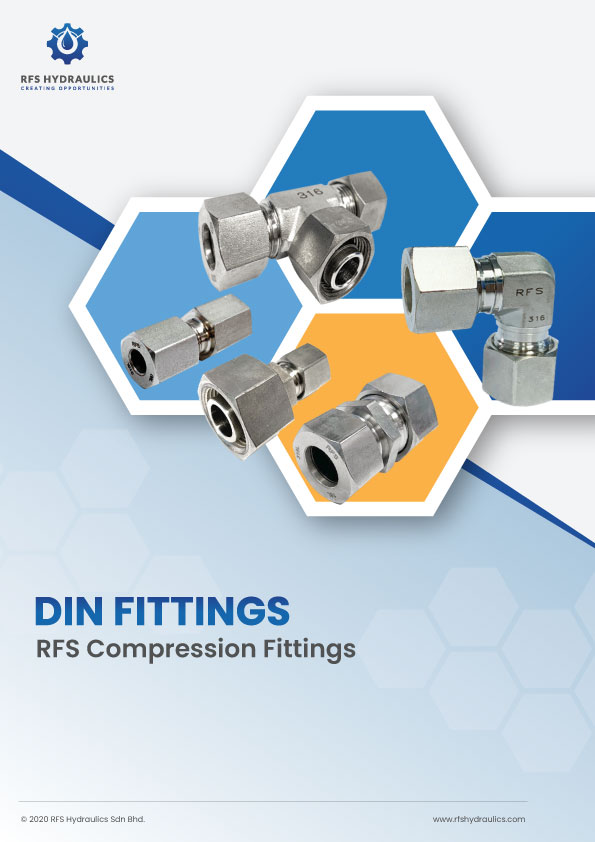 Compression fittings — every body style, size and dimensionRFS Hydraulics · PDFPDF
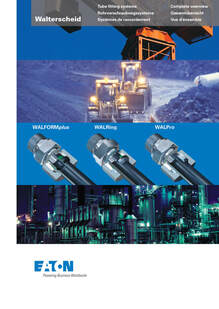 Compression fittings — the manufacturer catalogueEaton · PDFPDF
Weighing DIN 2353 against another connection, or specifying the whole run? Related: ferrule fittings for instrumentation duty · JIC fittings for a 37° flare · Walform machine for volume assembly · hydraulic steel tube and stainless steel tube to run with them · tube clamps to support the run.
Send the tube OD, the wall thickness and the working pressure.
We will come back with the series, confirm the size carries the pressure — including the temperature reduction if the line runs hot — and quote the body, nut and ring as a set. Add the fluid and the port thread, and the quotation needs no follow‑up questions. A product specialist answers within two working hours.