
Home › Products › Low pressure fittings › Camlock fittings
EN 14420‑7 · no toolsCamlock fittings, 1/2" to 4", to EN 14420‑7
Quick‑release hose and pipe couplings that connect by hand, with no tools. Eight types from A to F plus dust cap and plug, in SS316, aluminium ZLD104 or brass HPB57‑3, up to 250 PSI. Made to EN 14420‑7, which is interchangeable with the American standard — so a European coupler mates an American adapter.
Get a quotation within 2 working hours
Send the part number, standard, size or quantity. Stock in Malaysia or Singapore, ISO 9001:2015 certified.
What a camlock fitting is
Two halves, four cam arms, and no spanner.
A camlock fitting connects two pipes or hoses together, and it does it by hand. A coupler (the female half) receives an adapter (the male half); you push the two together and force down the cam arms, which compress the coupler gasket to make a tight seal. That is the whole mechanism. It requires no tools for installation, and it replaces the traditional time‑consuming methods with something a single operator can do in seconds.
The standard camlock fitting is made to EN 14420‑7, which specifies the materials, dimensions, design and marking requirements — and the European standard is interchangeable with the American one, which is why couplings from different sources still mate.
- Designed to hold under vibration. Camlocks are designed to prevent loosening against vibration and accidental breaking — and the more the line is pressurised, the harder the cam arms are held down, because line pressure increases the locking leverage.
- The seal decides the temperature, not the body. The O‑ring material is what determines the overall temperature range of the fitting. Get the body right and the seal wrong and you have specified the wrong coupling. Four seal materials.
- Pressure falls as size rises. 250 PSI is the maximum, not the rating for every size — a 4" camlock is 100 PSI. By size and material.
- Accessories matter: safety pin, ring, handles and pin. The safety clip through the holes above the handle is what stops a handle being knocked open.
Camlock fittings — the specification
Everything that goes on a purchase order, in one table.
| Standard | EN 14420‑7 — materials, dimensions, design and marking. Interchangeable with the American standard |
| Size range | 1/2" to 4" |
| Types | A · B · C · D · E · F, plus DC dust cap and DP dust plug |
| Body materials | Stainless steel SS316 · aluminium ZLD104 · brass HPB57‑3 |
| Maximum working pressure | 250 PSI — but it varies with size and material, see the table |
| Connection types | Threaded (NPT or BSPT) · hose shank |
| Seal materials | NBR · EPDM · Viton · PTFE (Teflon) — the seal sets the temperature range |
| Temperature | From −50 °C (NBR) to +200 °C (Viton), depending on seal |
| Accessories | Safety pin · ring · handles · pin |
| Installation | By hand — no tools required |
| Stock | Held in Johor Bahru, with some orders shipping from Singapore |
The six working types, in stainless steel SS316. The same six come in aluminium and brass.
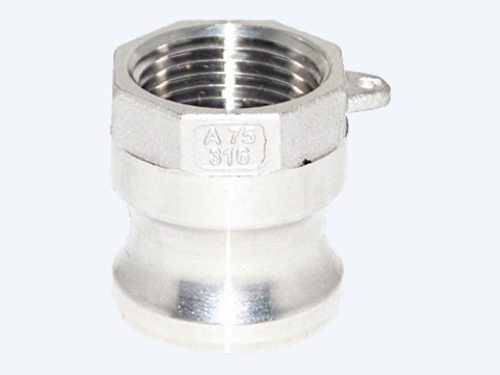
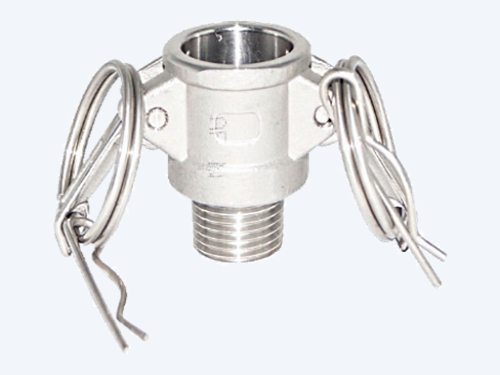
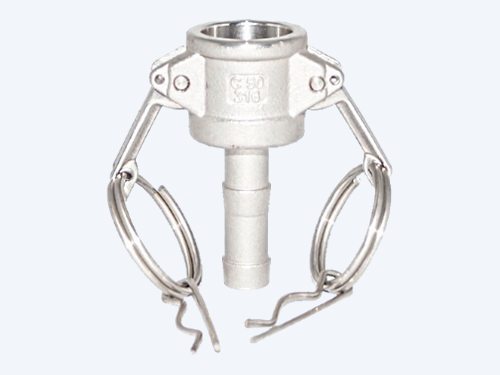
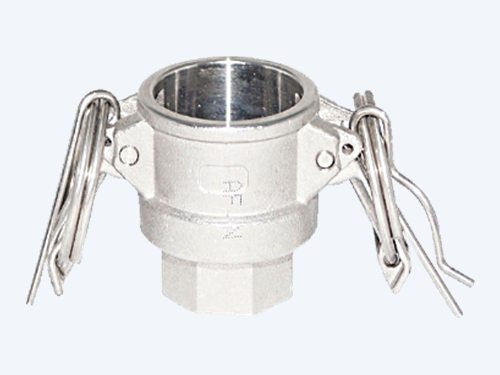
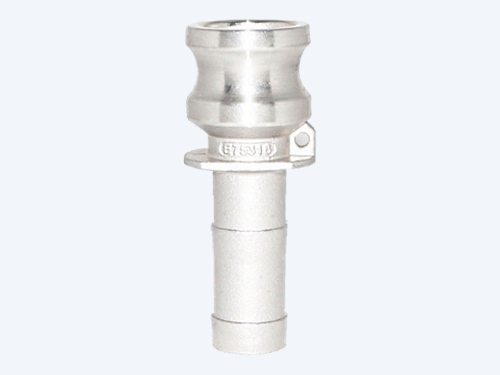
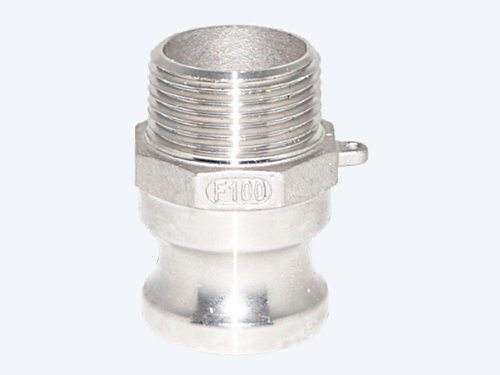
Not shown: DC the dust cap, which closes a coupler, and DP the dust plug, which closes an adapter. Order them with the fittings — an open camlock on a dusty site is a contaminated line.
The eight types
Two halves, four ways to terminate each. Get this right and nothing else is hard.
Every camlock is either a coupler (the half with the cam arms) or an adapter (the half that goes into it). What varies is how the other end terminates — male thread, female thread or hose shank. That is all the letters mean.
| Type | Connection | Which half |
|---|---|---|
| A | Female thread × male adaptor | Adapter |
| B | Male thread × female coupler | Coupler |
| C | Hose shank × female coupler | Coupler |
| D | Female thread × female coupler | Coupler |
| E | Hose shank × male adapter | Adapter |
| F | Male thread × male adapter | Adapter |
| DC | Dust cap — closes a coupler | Coupler |
| DP | Dust plug — closes an adapter | Adapter |
- A coupler only mates an adapter. So a working pair is always one of B, C, D with one of A, E, F. Two couplers will not join, and neither will two adapters — the commonest ordering mistake on camlocks.
- C and E are the hose pair. A hose assembly is normally C on one end, E on the other, so any two hoses join without an extra part.
- The dust cap closes the coupler; the dust plug closes the adapter. They are not interchangeable, and you need both if you have both halves in the field.
- Type A is a male adaptor with a female thread — read that twice. The letter describes the camlock end; the other end can be the opposite sex. It is the part of the naming that catches people.
Working pressure, by size and material
250 PSI is the maximum, not the rating.
Camlock fittings work at a maximum pressure of 250 PSI — but the figure that applies to your fitting depends on size and on body material. It falls as the size rises, and above 2" the stainless and the brass/aluminium figures part company.
| Size | Stainless steel SS316 | Brass / aluminium |
|---|---|---|
| 1/2" | 150 PSI | 150 PSI |
| 3/4" | 250 PSI | 250 PSI |
| 1" | 250 PSI | 250 PSI |
| 1 1/2" | 250 PSI | 250 PSI |
| 2" | 250 PSI | 250 PSI |
| 2 1/2" | 225 PSI | 150 PSI |
| 3" | 200 PSI | 125 PSI |
| 4" | 100 PSI | 100 PSI |
- ⚠ 1/2" is not the strongest. The peak is 3/4" to 2" at 250 PSI; 1/2" is only 150. Pressure does not simply fall with size on this product — read the row.
- Above 2", stainless is worth real money. At 2 1/2" it is 225 against 150 PSI, and at 3" it is 200 against 125 — the stainless carries roughly half again. If you are near the limit at those sizes, the material is the decision.
- At 4" they converge at 100 PSI. Material makes no difference to pressure at the top size, so choose it on corrosion and weight instead.
- These are figures before any temperature derating. Multiply by the factor for your service temperature. The derating table.
Temperature derating
Multiply the pressure by the factor for your temperature.
Working pressure is affected by the working environment, and temperature in particular. These are the derating factors by body material. A factor of 1.00 means the full pressure from the table above still applies.
| Temperature | Stainless steel | Aluminium | Brass |
|---|---|---|---|
| 37.8 °C 100 °F | 1.00 | 1.00 | 1.00 |
| 65.6 °C 150 °F | 1.00 | 1.00 | 1.00 |
| 93.3 °C 200 °F | 1.00 | 1.00 | 1.00 |
| 121.1 °C 250 °F | 1.00 | 0.81 | 1.00 |
| 148.9 °C 300 °F | 1.00 | not offered | 0.97 |
| 176.7 °C 350 °F | 1.00 | not offered | 0.95 |
| 204.4 °C 400 °F | 1.00 | not offered | 0.92 |
| 232.2 °C 450 °F | 1.00 | not offered | 0.90 |
| 260.0 °C 500 °F | 1.00 | not offered | not offered |
- Stainless does not derate at all. 1.00 the whole way to 500 °F (260 °C) — on temperature grounds the body is simply not the limiting part.
- ⚠ Aluminium falls off a cliff. Full pressure to 200 °F, then 0.81 at 250 °F, and not offered above that at all. A 2" aluminium camlock at 250 °F is 250 × 0.81 = 202 PSI, not 250.
- Brass derates gently — 0.97, 0.95, 0.92, 0.90 across 300 to 450 °F — and stops after 450.
- But the seal will usually stop you first. These are body factors. The O‑ring determines the overall temperature range of the fitting, and the best of them tops out at +200 °C. There is no point in a stainless body rated to 260 °C with a seal rated to 100. Seal ranges.
Seal materials
The O‑ring determines the overall temperature range. Choose it deliberately.
| Seal | Temperature | Where it belongs |
|---|---|---|
| NBR Buna N | −50 to +120 °C | The standard seal in metal camlock couplings. Resistant to oil‑base hydraulic fluid, fats, animal and vegetable oil, flame‑retardant liquids, grease, water and air. Widest cold range of the four. |
| EPDM | −40 to +145 °C | The standard seal in polypropylene couplings. Resistant to ozone, heat, steam, strong acid, alcohol and alkalis. Not for greases, oils or aromatic hydrocarbons. |
| Viton | −20 to +200 °C | Excellent against mineral oils, aromatics, greases, chlorinated hydrocarbons, petrol, diesel and silicone oils, and many corrosive duties. Best on temperature, weathering and gas permeability. Not for amines, esters, steam or low temperature. |
| PTFE Teflon | −25 to +100 °C | Good resistance to almost all chemicals and good temperature capability. But it has limited flow capability and makes a rubber filler essential. |
- NBR is the default, and it is usually right — it covers oil, water and air, and it goes coldest at −50 °C.
- Viton buys heat, and costs cold. Best top end at +200 °C but the worst bottom end at −20, and it is explicitly not for steam. Do not default to it just because it is the expensive one.
- ⚠ EPDM and oil do not mix. It is the standard seal in polypropylene couplings and it is excellent on steam, acid and alkali — and unsuitable for greases, oils and aromatic hydrocarbons. If the line carries oil, EPDM is the wrong seal even though it is a standard one.
- PTFE is the chemical answer, not the flow answer. Good against almost everything, but the limited flow capability and the need for a rubber filler are real constraints — specify it because the fluid demands it, not as an upgrade.
- Tell us the fluid and the temperature and we will name the seal. It is the field most often left blank on an enquiry and the one most likely to cause a failure.
Connecting and disconnecting
Three steps on, four steps off. The first one off is a safety step.
To connect
- Open the coupler — pull back the locking lever above the cam handles while rotating the handles away from the coupler body.
- Place the adaptor plug into the coupler.
- Close the coupler by rotating the cam handles towards the body. It is locked when the handles are closed, and closed properly when the locking levers on both handle assemblies are flush to the body.
- Insert the safety clip through the holes above the handle for extra security. Safety locks are recommended in normal condition.
To disconnect
- ⚠ Make sure the hose coupling connection is depressurised first. This is the step, and it is first for a reason — line pressure is actively holding the cams down.
- Open the coupler — pull back the locking lever above the cam handles while rotating the handles away from the body.
- Withdraw the adapter from the coupler.
- Cap and plug both halves — DC on the coupler, DP on the adapter — if the line is going to stand open.
- Line pressure works in your favour when connected. It moves the coupler and adapter individually and increases the locking leverage — the joint gets tighter under pressure, which is also exactly why it must be depressurised before you open it.
- Both locking levers flush is the check. One lever down and one proud is a joint that is not properly closed, and it looks connected.
- The coupler and adapter together minimise fluid turbulence and the abrasion from dry products — which is why camlocks are used on powder and granule transfer as well as liquid.
Buying camlock fittings in Malaysia and Singapore
Five things, and the maker’s own list is the same five.
To select the correct camlock, the user has to list out the information below — and it is worth doing properly, because on this product the wrong seal or the wrong half is a delivery you cannot use.
What we need
- Camlock size — the outside diameter — and what it has to mate with on the other side.
- Temperature range in service, which decides the seal before it decides the body.
- Material — SS316, aluminium or brass.
- Application, and what the fluid or product actually is.
- Pressure, so we can check it against the size and material table and any derating.
What comes back
- The type letter for each half — and a check that you have one coupler and one adapter, not two of the same.
- The seal named, with its temperature range, rather than left as standard.
- The derated pressure where temperature affects it, not just the catalogue maximum.
- Dust caps and plugs quoted alongside, because they are what keeps a disconnected line clean.
- A landed price: transport, currency, duties and taxes already inside the figure.
Why buy camlock fittings from us
The parts are commodity. The specification is not.
We check coupler against adapter
The most common camlock order error is two halves that cannot mate. We read the type letters back to you before anything ships.
We name the seal
The O‑ring determines the temperature range of the whole fitting. Tell us the fluid and we specify NBR, EPDM, Viton or PTFE — and we will tell you when EPDM is wrong because there is oil in the line.
Derated pressure, not catalogue pressure
250 PSI is a maximum. We quote the figure for your size, your material and your temperature — a 2" aluminium camlock at 250 °F is 202 PSI, and you should know that.
Three materials, priced honestly
SS316, aluminium ZLD104, brass HPB57‑3. Above 2" stainless carries meaningfully more pressure; at 4" it carries no more at all. We say which applies.
EN 14420‑7, so it mates
Made to the European standard, which is interchangeable with the American — so what we supply connects to what is already on your site.
Landed price, stock both sides
Johor Bahru, some orders from Singapore. Under three working days on a stocked item, at a landed price.
Questions we get asked
The ones that come up on the phone.
What is a camlock fitting?
A quick‑release coupling for joining two hoses or pipes. A coupler receives an adapter; you push them together and force down the cam arms by hand, which compress the coupler gasket to make a tight seal. It requires no tools. The standard camlock is made to EN 14420‑7, which specifies materials, dimensions, design and marking — and is interchangeable with the American standard.
Are all camlock fittings the same?
No — there are eight types. Six working types, A to F, plus DC dust cap and DP dust plug. Each is either a coupler (the half with the cam arms) or an adapter, and the letter tells you how the other end terminates — male thread, female thread or hose shank. The full table.
Which two types do I order to make a joint?
One coupler and one adapter — always. Couplers are B, C and D; adapters are A, E and F. Two couplers will not join, and neither will two adapters, and that is the commonest ordering mistake on this product. For hose, the usual pair is C on one end and E on the other, so any two hoses connect without an extra part.
What pressure can a camlock take?
250 PSI maximum, but that is not the rating for every size. The peak is 3/4" to 2" at 250 PSI; 1/2" is only 150; and it falls off at the top — 2 1/2" is 225 in stainless but 150 in brass or aluminium, 3" is 200 against 125, and 4" is 100 in all three. Then apply any temperature derating. The table.
Does temperature reduce the pressure rating?
For aluminium and brass, yes. Stainless does not derate at all — 1.00 the whole way to 500 °F / 260 °C. Aluminium is full pressure to 200 °F, 0.81 at 250 °F, and not offered above that. Brass derates gently — 0.97, 0.95, 0.92, 0.90 from 300 to 450 °F — and stops after 450. Multiply the pressure by the factor. The factors.
Which seal material should I choose?
It depends on the fluid, and it matters more than the body: the O‑ring determines the overall temperature range of the fitting. NBR (−50 to +120 °C) is the standard in metal couplings and handles oil, water, grease and air. EPDM (−40 to +145) is for steam, acid, alkali and alcohol — not oil. Viton (−20 to +200) for mineral oils, fuels and aromatics. PTFE (−25 to +100) for almost any chemical. Full detail.
Can I use EPDM if the line carries oil?
No. EPDM is a standard seal material — it is the standard in polypropylene couplings — and it is excellent against ozone, heat, steam, strong acid, alcohol and alkalis. But it is explicitly not suitable for greases, oils and aromatic hydrocarbons. For oil, use NBR as the default or Viton if you also need the heat. Being a standard material does not make it the right one for your fluid.
Do camlock fittings leak?
Not when closed properly. The design is made to give a leak‑proof connection, and the cams compress the gasket to seal it. The check is that the locking levers on both handle assemblies are flush to the body — one lever down and one proud looks connected but is not. Then insert the safety clip through the holes above the handle. The full sequence.
Will vibration shake it loose?
They are designed to prevent loosening against vibration and accidental breaking, and there is a mechanism working for you: line pressure moves the coupler and adapter individually and increases the locking leverage, so a pressurised joint is held harder than an unpressurised one. Use the safety clip as well — safety locks are recommended in normal condition.
How do I disconnect one safely?
Depressurise first. Ensure the hose coupling connection is depressurised before disconnecting — line pressure is actively holding the cams down, so opening a live joint is how people get hurt. Then pull back the locking lever above the cam handles while rotating the handles away from the body, withdraw the adapter, and cap both halves with DC and DP if the line will stand open.
What are dust caps and plugs for, and do I need them?
DC closes a coupler; DP closes an adapter. They are not interchangeable, so if you have both halves in the field you need both. On a dusty or wet site an open camlock is a contaminated line — and on powder and granule duty the abrasion matters. We quote them alongside the fittings rather than waiting to be asked.
Where are camlocks used?
Broadly. Petroleum, chemistry, steel, medicines, food, agriculture and shipping — anywhere product has to be transferred from one end to another and the connection has to be made and broken often. It is recognised as a reliable coupling for oil and gas work. Because the coupler and adapter together minimise fluid turbulence and abrasion from dry products, they suit powders and granules as well as liquids.
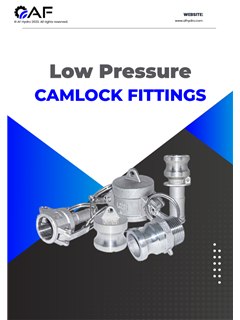
Catalogue
Direct PDF download — no form, no email address.
Related: class 150 threaded fittings for permanent low‑pressure pipework · push‑in fittings for small‑bore plastic tube · hydraulic quick couplings for pressurised hydraulic lines · high pressure fittings · low pressure valves to go in the run.
Send the size, the fluid and the temperature
We will name the type letters for both halves, specify the seal, give you the derated pressure rather than the catalogue maximum, and quote a landed price. Stock in Johor Bahru and Singapore.