
Home › Products › Accessories › Dowty seals
RFS Hydraulics · ready stockDowty seals in steel and stainless, M8 to M48 and 1/8" to 3"
A bonded washer — a metal ring with nitrile rubber bonded to its inside edge — that goes under a bolt head or into a threaded port and seals it. The metal takes the clamp load so the rubber cannot be over‑compressed or extruded, which is why a Dowty seal tolerates being done up tight where a plain O‑ring would be destroyed. Metric M8–M48 and BSP 1/8" to 3", with the torque figure for every thread size below.
Get a quotation within 2 working hours
Send the part number, standard, size or quantity. Stock in Malaysia or Singapore, ISO 9001:2015 certified.
What a Dowty seal is, and when you need one
A washer that seals, and cannot be crushed while doing it.
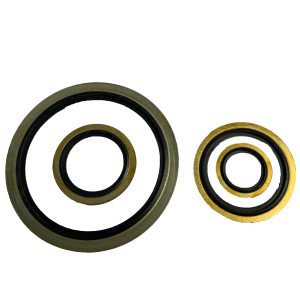
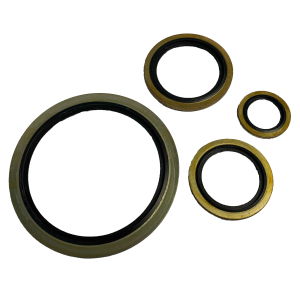
A Dowty seal is a metal washer with a nitrile rubber lip bonded to its inner bore. It sits under a bolt head, a plug or a fitting, and when the joint is tightened the metal ring bottoms out and carries the clamp load while the rubber is squeezed just enough to seal the face. That division of work is the whole point: the rubber has a hard stop, so it cannot be over‑compressed or extruded out of the joint however enthusiastically the bolt is done up. It is also called a bonded washer or a bonded seal washer.
Use one wherever a threaded joint has to seal on a flat face rather than on the thread — hydraulic port plugs, banjo bolts, drain and filler plugs, gauge and sensor ports, hydraulic manifolds, gearbox and engine covers. It works at both high and low pressure, and because the metal sets the compression it is far more tolerant of an operator with a long spanner than a bare O‑ring is. Note the naming trap: a Dowty seal is not the same part as a flange‑face bonded seal, even though both work on the same bonded principle.
| Dowty seal (this page) | A plain copper or aluminium washer | A bare O‑ring | |
|---|---|---|---|
| What seals | Bonded rubber lip, on a metal carrier | The soft metal itself, deforming | The elastomer, squeezed in a groove |
| What takes the clamp load | The metal ring — a hard stop | The washer, which crushes | Nothing. The groove has to control it |
| Can it be over‑tightened? | Very difficult to — that is the design intent | Yes, and it thins each time | Easily — it extrudes and then leaks |
| Needs a machined groove? | No — a flat face is enough | No | Usually yes |
| Reusable? | Treat as single use, like any seal | Sometimes, after annealing | No |
| Pressure | High and low | High, if the face is good | Depends entirely on the groove |
| Best for | Port plugs, banjo bolts, drain plugs, gauge ports | Spark plugs, injectors, simple sumps | Designed housings with a proper groove |
Specification
Everything an enquiry needs, in one place.
| Function | Bonded washer seal for a threaded joint sealing on a flat face. Prevents leakage and gives a tight end‑to‑end connection |
| Construction | Metal ring with nitrile rubber (NBR) bonded to it — the metal carries the load, the rubber seals |
| Metal ring material | Steel or stainless steel |
| Elastomer | NBR (nitrile) as standard |
| Metric size range | M8 to M48 |
| Nominal size range | 1/8" to 3" — DN6 to DN80 |
| Standard sizes tabulated | 25, from M8 up to 2½" BSP — see the dimension table. Above that, on request |
| Torque | 5.3 Nm at M8 rising to 79 Nm at M27 and above — full table below |
| Pressure | Suitable for both high and low pressure systems |
| Sealing face | A flat, clean spotface. No machined O‑ring groove needed |
| Key benefit | The rubber and metal combination prevents over‑compression and extrusion — a safe way of avoiding overfitting |
| Identification | Each size carries a size reference number — 866 for M8, 836 for 2" BSP. See how to read it |
Buying Dowty seals in Malaysia and Singapore
Where the stock sits, what it costs to get it to you, and how fast it moves.
Stock, delivery and ordering
- Where the stock is — the office is in Kuala Lumpur, and seals are held in two warehouses: Johor Bahru and Singapore. Addresses and direct lines are on the contact page.
- Dispatch — stock items leave the same or next working day.
- The running sizes are the small metric and BSP seals, M8 to M22 and 1/8" to 1/2" BSP — the ones that go into port plugs and banjo bolts by the hundred.
- Buy them in quantity — they are a consumable. Fitting a used one to save a few sen is how a rebuilt manifold ends up weeping.
- Delivery cost — already inside the product price, along with transport, currency conversion, duties and taxes. Nothing is added afterwards.
Steel or stainless? Steel for enclosed hydraulics; stainless for washdown, marine and anywhere the head of the bolt is exposed to weather.
How a Dowty seal enquiry runs
Four things and we can price it without going back and forth:
- Thread size — metric (M8 to M48) or BSP (1/8" to 3"). The seal is sized on the thread it sits under.
- Metal — steel or stainless, decided by the environment rather than the pressure.
- Quantity — these are consumables and the price steps with volume.
- The size reference if you have it — a three‑digit number like
866or836identifies the seal exactly.
A product specialist prices it within two working hours. Not sure of the size? Measure the bore and the outside diameter of the old one and read it off the table.
Sizes and dimensions
Twenty‑five standard sizes, metric and BSP, each with its own reference number.
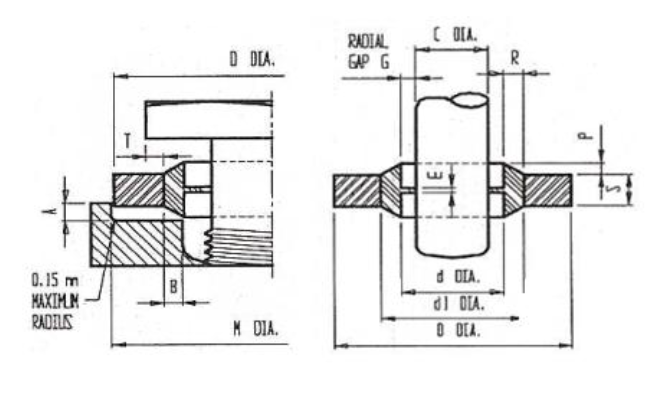
d is the seal bore, C the centralising lip diameter, D the outside diameter and S the ring thickness. All in millimetres. Note that the metric and BSP sizes interleave — an M16 and a 3/8" BSP are almost the same bore but not the same seal, so work from the thread you actually have.
| Thread size | Size reference | Bore d | Centralising lip C | Outside dia. D | Thickness S |
|---|---|---|---|---|---|
| M8 | 866 | 8.70 | 6.40 | 14.00 | 1.00 |
| 1/8" BSP | 820 | 10.37 | 8.26 | 15.88 | 2.00 |
| M10 | 708 | 10.70 | 8.05 | 16.08 | 1.50 |
| M12 | 867 | 12.70 | 9.73 | 19.00 | 1.50 |
| 1/4" BSP | 821 | 13.74 | 11.18 | 20.57 | 2.00 |
| M14 | 868 | 14.70 | 11.39 | 22.00 | 1.50 |
| 5/8" | 869 | 16.51 | 12.90 | 25.40 | 2.00 |
| M16 | 870 | 16.70 | 13.41 | 24.00 | 1.50 |
| 3/8" BSP | 823 | 17.28 | 14.76 | 23.80 | 2.00 |
| 11/16" | 871 | 18.16 | 14.50 | 25.40 | 2.50 |
| M18 | 872 | 18.70 | 14.76 | 26.00 | 1.50 |
| M20 | 873 | 20.70 | 16.76 | 28.00 | 1.50 |
| 1/2" BSP | 825 | 21.54 | 18.24 | 28.58 | 2.50 |
| M22 | 874 | 22.70 | 18.74 | 30.00 | 2.00 |
| 5/8" BSP | 826 | 23.49 | 20.27 | 31.75 | 2.50 |
| M24 | 875 | 24.70 | 20.11 | 32.00 | 2.00 |
| 3/4" BSP | 827 | 27.05 | 23.83 | 34.93 | 2.50 |
| 7/8" BSP | 829 | 30.81 | 27.51 | 38.10 | 2.50 |
| 1" BSP | 830 | 33.89 | 29.92 | 42.80 | 3.20 |
| 1¼" BSP | 832 | 42.93 | 38.45 | 52.38 | 3.20 |
| 1½" BSP | 833 | 48.44 | 44.45 | 58.60 | 3.20 |
| 1¾" BSP | 834 | 54.89 | 50.42 | 69.85 | 3.20 |
| 2" BSP | 836 | 60.58 | 56.26 | 73.03 | 3.20 |
| 2¼" BSP | 838 | 66.68 | 62.36 | 79.50 | 3.20 |
| 2½" BSP | 839 | 76.08 | 71.50 | 90.17 | 3.20 |
Tolerances from the datasheet: d ±0.13, D +0.13, S ±0.10. The datasheet also fixes the housing figures E, P and R across the range — ask for the sheet if you are machining a seat to it. Sizes above 2½" BSP and up to the 3" nominal ceiling are quoted on request.
Torque by thread size
The figure that makes a Dowty seal work — and the reason it forgives you if you miss it.
A bonded washer wants to be tightened to a real figure. Too loose and the rubber never reaches the face; too tight and, on any other seal, you would be extruding it out of the joint. The Dowty design gives you a metal hard stop, so the practical window is wide — but the numbers below are what the seal is designed around, and worth using where a torque wrench is to hand.
| Metric thread | Imperial | BSP | Torque (lbf·in) | Torque (Nm) |
|---|---|---|---|---|
| Up to M8 | 5/16" | — | 47 | 5.3 |
| M10 | 3/8" | 1/8" | 63 | 7.1 |
| M11 | 7/16" | — | 105 | 11.8 |
| M12 | 1/2" | 1/4" | 140 | 15.8 |
| M14 | 9/16" | 0.60 × 19 | 200 | 22.6 |
| M16 | 5/8" | 3/8" | 270 | 30.5 |
| M18 | 3/4" | 0.75 × 14 | 360 | 40.7 |
| M20 | 0.825" | 1/2" | 500 | 56.5 |
| M22 | 7/8" | 5/8" | 600 | 67.8 |
| M24 | 1" | — | 650 | 73.4 |
| M27 and above | 1.041" | 3/4" | 700 | 79 |
- The curve flattens at the top. From M8 to M20 the required torque climbs roughly tenfold, then barely moves — 73.4 Nm at M24 and 79 Nm from M27 up. Once the metal ring is thick enough, more torque buys nothing.
- Match the row to the thread, not to the spanner. The three thread columns are alternatives for the same seal size, which is why an M10, a 3/8" and a 1/8" BSP all take 7.1 Nm.
- These figures are for the seal, not the fastener. If the bolt or plug has its own lower torque limit, that limit wins.
Steel or stainless, and why nitrile
Two choices, and only one of them is about pressure.
The metal ring is offered in steel or stainless steel, and the elastomer is NBR (nitrile) bonded to it. Choosing between the metals is an environment decision rather than a pressure one — both carry the clamp load perfectly well, but only one of them survives being rained on.
| Steel ring | Stainless ring | |
|---|---|---|
| Where it suits | Enclosed hydraulics, gearboxes, indoor plant — anywhere the joint is protected | Washdown, marine, offshore, food plant, and any exposed bolt head |
| Clamp load | The same. The metal is there to stop the rubber being crushed, and both do that | |
| Corrosion | Will rust if it gets wet, and a rusted washer face is a leak path | Holds up — the reason to pay the difference |
| Elastomer | NBR (nitrile) as standard, bonded to the inner bore | |
| Cost | The volume choice for port plugs and banjo bolts | Specified where the environment demands it |
- Why nitrile. NBR is the standard hydraulic elastomer — good with mineral oil, cheap, and stable at ordinary machine temperatures. For hot oil, phosphate esters or other aggressive media, tell us the medium: a different compound may be the right answer, and it is worth asking before rather than after.
- The bond is the part you cannot inspect. A Dowty seal is a single manufactured item, not a washer with an O‑ring dropped on it. If the rubber has lifted or perished at the bond line, the seal is finished — there is nothing to service.
The face it seals against
No groove needed. But the face and the corner radius do matter.
The great advantage of a bonded washer is that it seals on a plain flat face — no O‑ring groove to machine, no counterbore tolerance to hold. That said, the datasheet does specify the housing, and two figures on it are worth knowing because they are the ones that cause trouble in practice.
What the drawing specifies
- d — the seal bore, which clears the thread or shank it sits on.
- C — the centralising lip, the step that keeps the seal concentric so the rubber sits square on the face.
- D and S — outside diameter and thickness, which set the spotface you need and the height the joint gains.
- Radial gap G — the clearance around the seal in its recess.
- 0.15 mm maximum corner radius at the bottom of the counterbore. A bigger radius lifts the seal off the face at exactly the point it needs to bear.
What actually goes wrong
- A rounded or burred corner where the face meets the bore. The seal rides up on it and never beds down.
- A spotface smaller than D. The washer overhangs the flat and cocks under load.
- A rough or scored face — the rubber will follow small marks but not a machining scar across the sealing band.
- Paint on the face. It compresses, then relaxes, and the joint loosens a month later.
- Stacking two seals to make up a gap. Use the right thickness; two rings cannot both be a hard stop.
How to identify a Dowty seal you already have
Two measurements, or one reference number.
Bonded washers are not marked — there is no room. So identification is by measurement or by the reference number from the paperwork:
| Route | How it works |
|---|---|
| Bore and outside diameter | The reliable method. Measure d and D and read them off the size table — the pair is unique. A 16.70 bore in a 24.00 outside diameter is an M16; 17.28 in 23.80 is a 3/8" BSP. They are close, and they are not interchangeable. |
| The thread it came off | Quicker, if the joint is still apart. The seal is sized on the thread, so an M20 plug takes the M20 seal — reference 873. |
| The size reference | A three‑digit number on the packet or the parts list. The metric sizes run 866, 708, 867, 868, 870, 872, 873, 874, 875 and the BSP sizes 820 to 839 — not in size order, so read it off the table rather than inferring it. |
| Thickness S | A useful cross‑check. Metric sizes are mostly 1.50 mm while BSP sizes are 2.00 mm or more, so a thick washer on a small bore is usually a BSP part. |
If the old seal is squashed out of shape, measure the counterbore instead and work back from D. And if you are ordering for a rebuild, order by thread size for every port on the drawing rather than counting the ones that happened to survive removal.
Fitting it
Simple, but there are four ways to get it wrong.
Doing it right
- New seal every time. It is a consumable and the cheapest part of the joint. A used one has already taken its set.
- Clean the face — no old sealant, no paint, no burrs, no swarf. The rubber follows the surface it is given.
- Rubber side towards the face being sealed. The bonded lip has to meet the flat, not the underside of the bolt head.
- Let the centralising lip do its job. Push the seal square onto the shank so it sits concentric before the bolt goes down.
- Tighten to the figure, or to the fastener's own limit if that is lower.
What people get wrong
- Fitting it the wrong way round. The seal works in one orientation. Reversed, the metal meets the face and the joint simply weeps.
- Adding sealant as well. It is unnecessary, it contaminates the system, and it hides a joint that was never right.
- Reusing a seal on a high‑pressure port because it looked fine. It looked fine before it went in the first time too.
- Using an M‑size seal on a BSP thread because the bore looked close. An M16 and a 3/8" BSP differ by 0.58 mm of bore and 0.20 mm of outside diameter — enough to sit wrong.
- Blaming the seal for a bad face. If a new seal weeps twice in the same port, the port is the problem.
Why buy Dowty seals from RFS Hydraulics
Six things that decide whether the order is right first time.
Ready stock on the consumable sizes
The small metric and BSP seals — M8 to M22, 1/8" to 1/2" — are held in Johor Bahru and Singapore and dispatch the same or next working day. These are the ones a workshop gets through.
We size on the thread, not the guess
Metric and BSP sizes interleave within a millimetre and are not interchangeable. Tell us the thread, or measure the bore and outside diameter, and we will name the exact reference.
The torque figure comes with it
Every size has a designed torque, 5.3 Nm at M8 to 79 Nm at M27 and above. We publish the whole table rather than leaving a fitter to guess how hard is hard enough.
Steel or stainless, chosen properly
The metal is an environment decision, not a pressure one. We ask where the joint lives, because a rusted washer face is a leak path nobody looks for.
Priced as a consumable
These get used in quantity, and the price steps with volume. We quote the whole rebuild list rather than a single line, so a manifold does not get reassembled on old seals.
One price, delivered
Transport, currency, duties and taxes are already inside the figure we quote. Nothing is added at the end, and delivery within Malaysia is included.
Frequently asked questions
Twelve, starting with the naming confusion that causes the most wrong orders.
Is a Dowty seal the same as a bonded seal?
They work on the same principle — rubber bonded to metal — but they are different parts for different jobs. A Dowty seal is a small washer, M8 to M48 or 1/8 inch to 3 inch, that goes under a bolt head or into a threaded port. A bonded seal in the flange sense is a flange-face seal, 1/2 inch to 8 inch, used on ISO 6162 and ISO 6164 joints. If someone asks for a bonded seal, check which one they mean before quoting.
Which way round does it go?
Rubber side towards the face you are sealing. The bonded lip has to meet the flat spotface; the plain metal side goes against the underside of the bolt head or the fitting. Fitted the other way round the metal meets the face, the rubber never touches anything, and the joint weeps from new. It is the single commonest fitting error on this part.
How tight should I do it up?
There is a designed figure for every size, from 5.3 Nm at M8 up to 79 Nm at M27 and above — the full table is on this page. The good news is that the metal ring is a hard stop, so the practical window is wide and it is very difficult to over-tighten one to destruction. If the bolt or plug has its own lower torque limit, that limit wins.
Do I need to machine a groove for it?
No — and that is a large part of why it is used. A Dowty seal seals on a plain flat face, so there is no O-ring groove to cut and no groove tolerance to hold. What does matter is that the spotface is flat, clean and at least as big as the seal outside diameter, and that the corner where the face meets the bore has a radius no bigger than 0.15 mm. A rounded corner lifts the seal off the face exactly where it needs to bear.
Can I reuse one?
Treat it as single use. The rubber has taken its compression set and will not seal to the same standard again, and the seal is the cheapest item in the joint by a wide margin. On a rebuild, order by thread size for every port on the drawing rather than counting the ones that survived removal — that is how manifolds end up back on the bench.
What size do I need?
Work from the thread the seal sits under — M8 to M48, or 1/8 inch to 3 inch BSP. If you only have the old seal, measure the bore d and the outside diameter D and read the pair off the size table; the combination is unique. Be careful with the near-misses: an M16 is 16.70 in 24.00 and a 3/8 inch BSP is 17.28 in 23.80, which are close enough to confuse and not close enough to work.
What is the three-digit number for?
It is the size reference, and it identifies the seal exactly — 866 is the M8, 873 the M20, 836 the 2 inch BSP. It is the quickest thing to quote if you have it on a packet or a parts list. Note that the numbers are not in size order across the two series, so read it off the table rather than trying to infer a size from a nearby number.
Steel or stainless — does it change the pressure rating?
No. Both carry the clamp load perfectly well; the metal ring is there to stop the rubber being over-compressed, not to hold pressure. The choice is about environment: steel for enclosed hydraulics and indoor plant, stainless for washdown, marine, offshore and any exposed bolt head. A rusted washer face is a slow leak that nobody thinks to look for.
Will it handle high pressure?
Yes — these are specified for both high and low pressure systems, which is one of the reasons they are used so widely on hydraulic port plugs and banjo bolts. The limiting factor in practice is almost never the seal: it is the flatness and finish of the face it is asked to seal against, and whether the fastener is tightened to a sensible figure.
Can I use sealant as well, to be safe?
Don't. It is unnecessary — the seal does the job on its own — and it has two real downsides: it contaminates the hydraulic system, and it masks a joint that was never right, so the underlying problem shows up later somewhere less convenient. If a new, correctly fitted seal weeps twice in the same port, the port face is the problem, not the sealing method.
Is NBR the only rubber available?
NBR (nitrile) is the standard and it is right for mineral hydraulic oil at ordinary machine temperatures. For hot oil, phosphate esters, or other aggressive media a different compound may be needed — tell us the medium and the temperature with the enquiry and we will confirm what is available rather than sending the default and hoping.
What if I need bigger than 2 1/2 inch?
The tabulated range runs to 2 1/2 inch BSP, with a nominal ceiling of 3 inch (DN80), and the sizes in between are quoted on request. Above that you are usually into flange-face territory rather than bonded washers — at which point the part you want is a flange bonded seal or a machined O-ring, and we can advise which.
Catalogues
Direct PDF download — no form, no email address.
Related: flange bonded seals for ISO 6162 and ISO 6164 joints · O‑rings · retain rings.
Send the thread sizes and the quantities.
Or the bore and outside diameter of the old seal. A product specialist confirms the references within two working hours.