
Home › Products › Low pressure fittings › Push‑in fittings
AF Hydro · 4–12 mmPush‑in fittings for nylon and PU tube, 4 mm to 12 mm
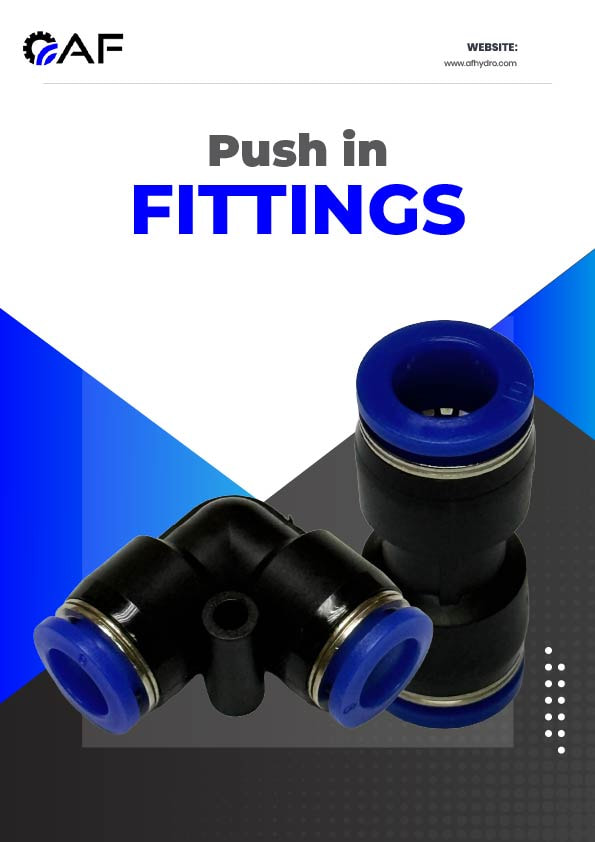
Tool‑free connections for nylon flexible tube and PU tube, 4 mm to 12 mm tube OD, with a working pressure of 0 to 1.0 MPa and a working temperature of −20 °C to 70 °C. Eight shapes — tee, reducing tee, elbow, straight coupling, reducing union, Y‑splitter, reducing Y and cross. Push the tube in and it is connected; press the collar and it releases.
Get a quotation within 2 working hours
Send the part number, standard, size or quantity. Stock in Malaysia or Singapore, ISO 9001:2015 certified.
What push‑in fittings are
A connection you make by hand, with no thread and no tool.
A push‑in fitting joins flexible plastic tube without a thread, a nut or a tool. You cut the tube square, push it into the port until it stops, and the fitting holds it. To take it apart you press the collar in and pull the tube out. The same fitting can be used again.
They are the standard connection on compressed air and low‑pressure fluid lines — pneumatic circuits, air tooling, machine services, instrument lines — anywhere there is a lot of small‑bore tube and the layout changes. These are the AF Hydro range, in 4, 6, 8, 10 and 12 mm tube OD.
- Two parts do the holding and the sealing. A stainless steel spring washer grips the outside of the tube, and an NBR O‑ring seals against it. Pressure pushing the tube outward makes the washer bite harder, so the joint tightens under load rather than loosening. The full material list.
- Tube, not pipe. These take nylon flexible tube or PU tube to a nominal outside diameter. They are not a pipe fitting and there is no thread form to match — the tube OD is the whole specification.
- Low pressure, and that is the point. Working pressure is 0 to 10 kgf/cm² (0 to 1.0 MPa). If your line is rated in hundreds of bar you want high pressure fittings or compression fittings instead.
- They also hold vacuum. The catalogue lists a negative pressure figure of 750 mmHg (10 Torr), so the same fitting works on a suction line.
Push‑in fittings — the specification
Everything that goes on a purchase order, in one table.
| Size range | 4 mm to 12 mm tube OD — 4, 6, 8, 10 and 12 mm |
| Working pressure | 0 to 10 kgf/cm² — 0 to 1.0 MPa |
| Negative pressure | 750 mmHg — 10 Torr |
| Working temperature | −20 °C to 70 °C |
| Applicable tubing | Nylon flexible tube or PU tube |
| Colour | Gray / black |
| Body material | Listed in the catalogue as aluminium alloy; the part numbers are coded POM. Component‑by‑component list |
| Sealing | NBR O‑ring and NBR rubber pad — no tape, no sealant |
| Gripping | Stainless steel spring washer onto the tube OD |
| Shapes | Union tee · union reducing tee · union elbow · union coupling · reducing union · Y‑splitter · reducing Y‑splitter · union cross |
| Design and manufacture | To industry standard, per the AF Hydro catalogue |
| Part number format | F‑P‑POM‑AF‑C‑<type>‑<size> — for example F‑P‑POM‑AF‑C‑PE‑08 is an 8 mm union tee |
| Brand | AF Hydro |
The catalogue’s main technical parameter table also carries a high pressure figure of 1.6 MPa alongside the 0–1.0 MPa working range. Both are reproduced here as printed — tell us your line pressure and we will confirm which figure applies to the part you need.
The eight shapes
Every one of them is tube‑to‑tube — no threaded ports in this range.
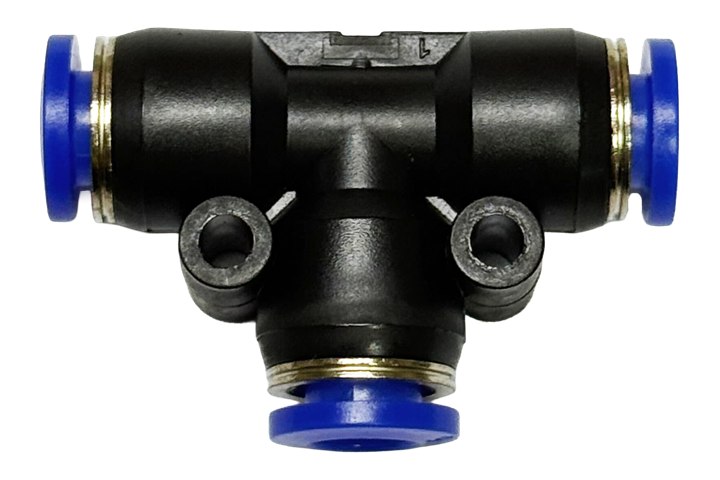
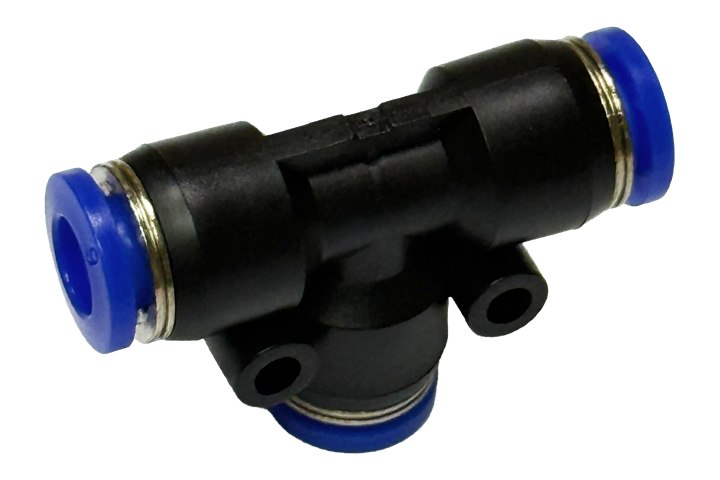
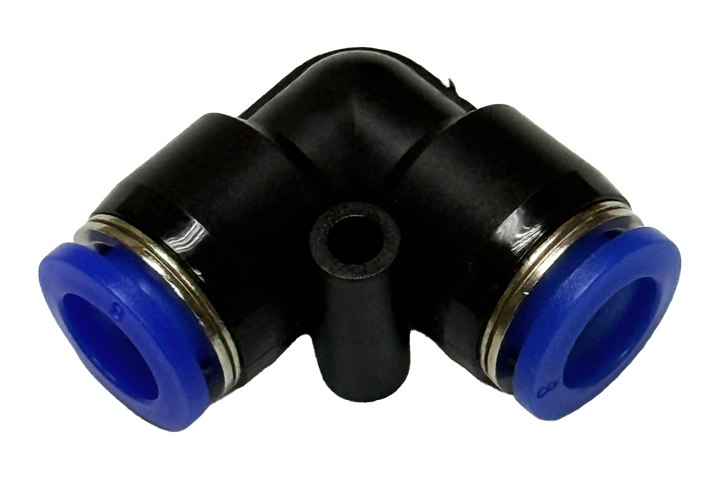
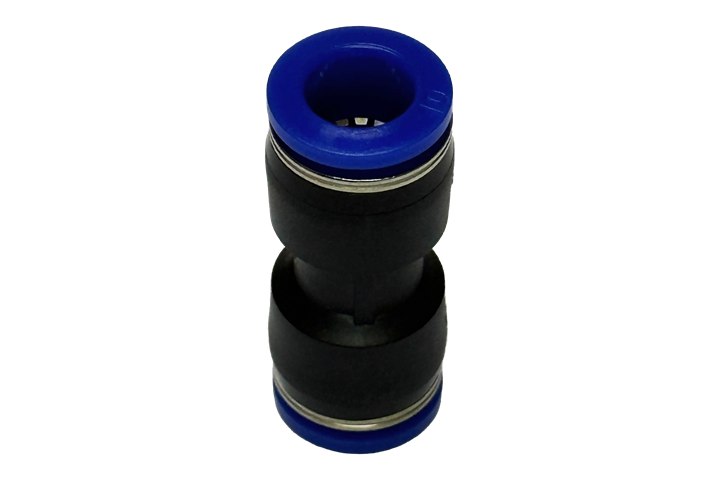
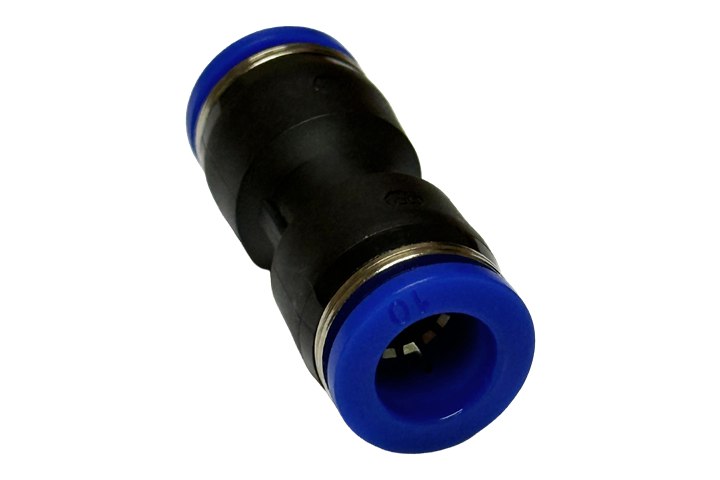
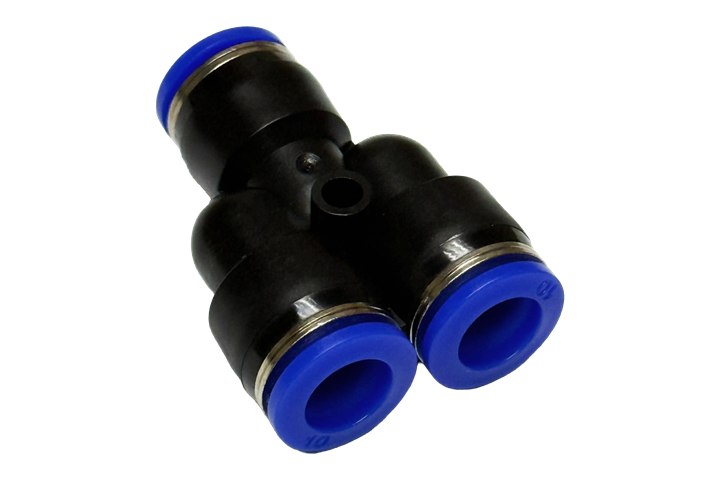
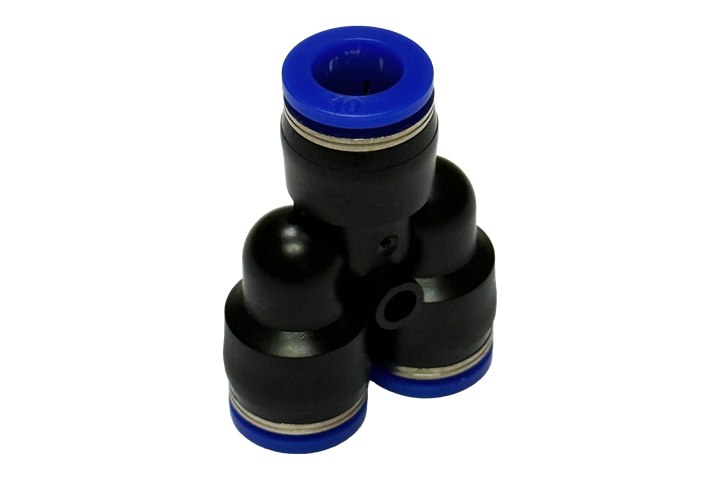
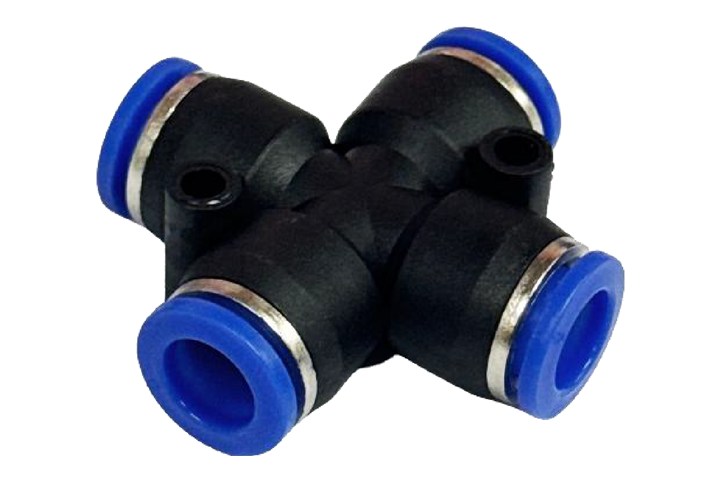
All eight take tube on every port. There is no threaded version in this range, so the only thing to get right is the tube OD — and, on the reducing shapes, which leg is which. Dimensions for all eight are in the tables below.
Part numbers
All 34, exactly as the catalogue lists them.
| Part no | Description |
|---|---|
| F-P-POM-AF-C-PE-04 | 4MM POM PUSH IN UNION TEE |
| F-P-POM-AF-C-PE-06 | 6MM POM PUSH IN UNION TEE |
| F-P-POM-AF-C-PE-08 | 8MM POM PUSH IN UNION TEE |
| F-P-POM-AF-C-PE-10 | 10MM POM PUSH IN UNION TEE |
| F-P-POM-AF-C-PE-12 | 12MM POM PUSH IN UNION TEE |
| F-P-POM-AF-C-PEG-06-04 | 6MM x 4MM POM PUSH IN UNION RED TEE |
| F-P-POM-AF-C-PEG-08-06 | 8MM x 6MM POM PUSH IN UNION RED TEE |
| F-P-POM-AF-C-PEG-10-08 | 10MM x 8MM POM PUSH IN UNION RED TEE |
| F-P-POM-AF-C-PV-04 | 4MM POM PUSH IN UNION ELBOW |
| F-P-POM-AF-C-PV-06 | 6MM POM PUSH IN UNION ELBOW |
| F-P-POM-AF-C-PV-08 | 8MM POM PUSH IN UNION ELBOW |
| F-P-POM-AF-C-PV-10 | 10MM POM PUSH IN UNION ELBOW |
| F-P-POM-AF-C-PV-12 | 12MM POM PUSH IN UNION ELBOW |
| F-P-POM-AF-C-PU-04 | 4MM POM PUSH IN UNION COUPLING |
| F-P-POM-AF-C-PU-06 | 6MM POM PUSH IN UNION COUPLING |
| F-P-POM-AF-C-PU-08 | 8MM POM PUSH IN UNION COUPLING |
| F-P-POM-AF-C-PU-10 | 10MM POM PUSH IN UNION COUPLING |
| F-P-POM-AF-C-PU-12 | 12MM POM PUSH IN UNION COUPLING |
| F-P-POM-AF-C-PG-06-04 | 6MM X 4MM POM PUSH IN RED UNION |
| F-P-POM-AF-C-PG-08-06 | 8MM x 6MM POM PUSH IN RED UNION |
| F-P-POM-AF-C-PG-10-08 | 10MM x 8MM POM PUSH IN RED UNION |
| F-P-POM-AF-C-PY-04 | 4MM POM PUSH IN Y-SPLITER |
| F-P-POM-AF-C-PY-06 | 6MM POM PUSH IN Y-SPLITER |
| F-P-POM-AF-C-PY-08 | 8MM POM PUSH IN Y-SPLITER |
| F-P-POM-AF-C-PY-10 | 10MM POM PUSH IN Y-SPLITER |
| F-P-POM-AF-C-PY-12 | 12MM POM PUSH IN Y-SPLITER |
| F-P-POM-AF-C-PYW-06-04 | 6MM x 4MM POM PUSH IN RED Y-SPLITER |
| F-P-POM-AF-C-PYW-08-06 | 8MM x 6MM POM PUSH IN RED Y-SPLITER |
| F-P-POM-AF-C-PYW-10-08 | 10MM x 8MM POM PUSH IN RED Y-SPLITER |
| F-P-POM-AF-C-PZ-04 | 4MM POM PUSH IN UNION CROSS |
| F-P-POM-AF-C-PZ-06 | 6MM POM PUSH IN UNION CROSS |
| F-P-POM-AF-C-PZ-08 | 8MM POM PUSH IN UNION CROSS |
| F-P-POM-AF-C-PZ-10 | 10MM POM PUSH IN UNION CROSS |
| F-P-POM-AF-C-PZ-12 | 12MM POM PUSH IN UNION CROSS |
Descriptions are reproduced as printed in the catalogue. The dimension tables below carry a few reducing combinations that are not in this part list — PEG12‑8, PEG12‑10, PG8‑4, PG10‑6, PG12‑8, PG12‑10, PYW12‑8 and PYW12‑10. Ask us and we will confirm availability on those before you specify one.
What the fitting is made of
Eight components, and each one has a job.
Material list
| No. | Part name | Material |
|---|---|---|
| 1 | Rubber interface | POM |
| 2 | Positioning ring | Aluminium alloy |
| 3 | Spring washer | Stainless steel |
| 4 | Positioning seat | POM |
| 5 | O‑ring | NBR |
| 6 | Body | Aluminium alloy |
| 7 | Rubber pad | NBR |
| 8 | Hex socket screw | Aluminium alloy |
Which part matters when
- Stainless steel spring washer — the ring of teeth that grips the tube OD. Stainless rather than plated steel is what stops it rusting into the tube on a humid line.
- NBR O‑ring — the seal. NBR is good with air, water and mineral oil. If your medium is anything else, tell us before you order.
- POM positioning seat and rubber interface — the collar you press to release, and the guide that keeps the tube square in the port.
- −20 °C to 70 °C is a limit of the seals and the plastics, not of the body. It is the number to check against a hot compressor discharge or an outdoor line in a cold store.
The catalogue’s features page lists the body as aluminium alloy, while the part numbers carry a POM code. Both are shown here as printed; we will confirm the material of the specific part on the quotation.
Dimensions
Millimetres, and weight in grams — straight from the catalogue.
Union tee — PE
| Series | ΦD | ΦP | K | E | ΦJ | JB | Weight (g) |
|---|---|---|---|---|---|---|---|
| PE4 | 4 | 9 | 14 | 17 | 3.2 | 6.5 | 3.1 |
| PE6 | 6 | 12.5 | 16.5 | 20 | 3.2 | 8 | 6.1 |
| PE8 | 8 | 15 | 18.5 | 23 | 4.3 | 9.5 | 8.8 |
| PE10 | 10 | 18 | 21 | 26.5 | 4.3 | 11 | 13.8 |
| PE12 | 12 | 21 | 23 | 30 | 4.3 | 13 | 21 |
Union reducing tee — PEG
| Series | ΦDA | ΦDB | ΦP | KA | KB | EA | EB | ΦJ | JB | Weight (g) |
|---|---|---|---|---|---|---|---|---|---|---|
| PEG6-4 | 6 | 4 | 12.5 | 16.5 | 14 | 20.0 | 19.5 | 3.2 | 8 | 7 |
| PEG8-6 | 8 | 6 | 15 | 18.5 | 16.5 | 22.5 | 22 | 4.3 | 9.5 | 22.8 |
| PEG10-8 | 10 | 8 | 18 | 21 | 18.5 | 25.5 | 25.5 | 4.3 | 11 | 15.1 |
| PEG12-8 | 12 | 8 | 21 | 23 | 18.5 | 29 | 28.5 | 4.3 | 13 | 2.2 |
| PEG12-10 | 12 | 10 | 21 | 23 | 21 | 29 | 29 | 4.3 | 13 | 21.5 |
Union elbow — PV
| Series | ΦD | ΦP | K | E | ΦJ | JB | Weight (g) |
|---|---|---|---|---|---|---|---|
| PV4 | 4 | 9 | 14 | 17 | 3.2 | 6.5 | 1.9 |
| PV6 | 6 | 12.5 | 16.5 | 20 | 3.2 | 8 | 4.2 |
| PV8 | 8 | 15 | 18.5 | 23 | 4.3 | 9.5 | 6 |
| PV10 | 10 | 18 | 21 | 26.5 | 4.3 | 11 | 9.3 |
| PV12 | 12 | 21 | 23 | 30 | 4.3 | 13 | 14.6 |
Union coupling — PU
| Series | ΦD | ΦP | K | A | Weight (g) |
|---|---|---|---|---|---|
| PU4 | 4 | 9 | 14 | 29.5 | 1.7 |
| PU6 | 6 | 12.5 | 16.5 | 34 | 3.6 |
| PU8 | 8 | 15 | 18.5 | 38.5 | 5 |
| PU10 | 10 | 18 | 21 | 43 | 8.1 |
| PU12 | 12 | 21 | 23 | 47 | 12 |
Reducing union — PG
| Series | ΦDA | ΦDB | ΦPA | ΦPB | KA | KB | A | Weight (g) |
|---|---|---|---|---|---|---|---|---|
| PG6-4 | 6 | 4 | 12.5 | 9 | 16.5 | 14 | 33.5 | 2.7 |
| PG8-4 | 8 | 4 | 15 | 12.5 | 18.5 | 14 | 37.5 | 4.5 |
| PG8-6 | 10 | 6 | 15 | 12.5 | 18.5 | 16.5 | 38 | 4.5 |
| PG10-6 | 10 | 6 | 18 | 15 | 21 | 16.5 | 42 | 6.9 |
| PG10-8 | 10 | 8 | 18 | 15 | 21 | 18.5 | 42.5 | 6.7 |
| PG12-8 | 12 | 8 | 21 | 18 | 23 | 18.5 | 46.5 | 10.3 |
| PG12-10 | 12 | 10 | 21 | 18 | 23 | 21 | 47 | 10.2 |
Y‑splitter — PY
| Size | ΦD | ΦP | C | K | ΦJ | JA | DC | Weight (g) |
|---|---|---|---|---|---|---|---|---|
| 4 mm | 4 | 9 | 31.5 | 14 | 3.2 | 13 | 10 | 3 |
| 6 mm | 6 | 12.5 | 37 | 16.5 | 3.2 | 15.5 | 12 | 6 |
| 8 mm | 8 | 15 | 42.5 | 18.5 | 3.2 | 17 | 14.5 | 8.6 |
| 10 mm | 10 | 18 | 48.5 | 21 | 4.3 | 19.5 | 18 | 14 |
| 12 mm | 12 | 21 | 54.5 | 23 | 4.3 | 21 | 20.5 | 21.2 |
The catalogue labels the Y‑splitter dimension rows with the PE series names; they are listed here by tube OD so they are not confused with the union tee. Order by part number — F‑P‑POM‑AF‑C‑PY‑<size>.
Reducing Y‑splitter — PYW
| Series | ΦDA | ΦDB | C | ΦP | KA | KB | ΦJ | JA | DC | Weight (g) |
|---|---|---|---|---|---|---|---|---|---|---|
| PYW6-4 | 6 | 4 | 36.5 | 12.5 | 16.5 | 14 | 3.2 | 15 | 12 | 5.8 |
| PYW8-6 | 8 | 6 | 42 | 15 | 18.5 | 16.5 | 3.2 | 16.5 | 14.5 | 9.1 |
| PYW10-8 | 10 | 8 | 48.5 | 18 | 21 | 18.5 | 4.3 | 19 | 18 | 14.1 |
| PYW12-8 | 12 | 8 | 54 | 21 | 23 | 18.5 | 4.3 | 20.5 | 20.5 | 22.3 |
| PYW12-10 | 12 | 10 | 54.5 | 21 | 23 | 21 | 4.3 | 21 | 20.5 | 21.7 |
Union cross — PZ
| Series | ΦD | A | ΦP | K | ΦJ | JB | JC | Weight (g) |
|---|---|---|---|---|---|---|---|---|
| PZ4 | 4 | 34 | 9 | 14 | 3.2 | 6.5 | 13 | 3.9 |
| PZ6 | 6 | 39.5 | 12.5 | 16.5 | 3.2 | 8 | 16 | 7.9 |
| PZ8 | 8 | 46 | 15 | 18.5 | 4.3 | 9.5 | 19 | 11.1 |
| PZ10 | 10 | 52.5 | 18 | 21 | 4.3 | 11 | 22 | 17.5 |
| PZ12 | 12 | 59.5 | 21 | 23 | 4.3 | 13 | 26 | 26.6 |
ΦD is the tube OD the port accepts. ΦP is the outside diameter of the collar, which is what decides whether two fittings will sit side by side on a manifold. All dimensions in millimetres and weights in grams, as printed in the AF Hydro catalogue.
Fitting the tube, and getting it out again
Four steps, and the first one decides the other three.
| Step | What to do |
|---|---|
| 1 | Cut the tube square, with a tube cutter. A slanted or crushed end is the most common cause of a leaking push‑in joint — the O‑ring seals on the tube OD, so it needs a clean, round, undamaged surface to seal against. |
| 2 | Push the tube in until it stops. There is a shoulder inside the port. If the tube is short of it, the grip washer is holding only the very end of the tube. |
| 3 | Pull back on the tube to check it is held. It should not move. That takes a second and catches a short insertion before the line is pressurised. |
| 4 | To release: depressurise first, then press the collar in and hold it while you pull the tube out. Pulling without pressing the collar makes the washer bite harder, not less. |
- ⚠ Depressurise before releasing a fitting. A tube released under pressure whips. On a compressed air line that is an injury, not a nuisance.
- Do not use tape or sealant. There is no thread here. The seal is the O‑ring against the tube OD, and anything smeared on that surface makes it worse rather than better.
- Reuse the fitting, inspect the tube. The fitting is designed to be released and remade. The tube is not — the grip washer leaves marks in the outside surface, so cut back past the marked section before you re‑insert the same length.
- Support the run. A push‑in fitting holds the tube, but it is not a clamp. A long unsupported run puts a bending load on the port — use tube clamps on anything that will see vibration.
Where they get used
Small‑bore lines that get moved.
Compressed air
Shop air drops, air tooling and blow‑off lines. The pressure is low, the tube count is high, and the layout changes every time a machine moves — which is the case push‑in fittings exist for.
Pneumatic circuits
Cylinders, valves and actuators on production machinery. The Y‑splitter and reducing tee earn their place here, where one feed serves several devices inside a tight cabinet.
Machine service lines
Coolant, low‑pressure lubrication and drain lines around a machine tool — where a joint needs to come apart for service and nobody wants to cut and re‑make tube to do it.
Instrument and sensing lines
Small‑bore runs to gauges, switches and transmitters. Vacuum too: the catalogue rates the fitting to 750 mmHg negative pressure.
Water and dosing
Low‑pressure water, filtration and dosing lines in nylon or PU tube. NBR seals are fine with water — tell us if the medium is a chemical and we will check it before you order.
Test rigs and temporary work
Anything that has to be plumbed today and changed tomorrow. No thread to cut, no tool to find, and the fittings go back in the box afterwards.
Why buy push‑in fittings from us
A small part, bought in the right quantities.
The whole range, one order
Eight shapes, 4 to 12 mm, 34 part numbers. Tees, reducing tees, elbows, couplings, reducing unions, Y‑splitters, reducing Ys and crosses — one supplier rather than three.
We price it as a schedule
Nobody buys one push‑in fitting. Send the count by shape and by size and we will price the lot together, which is always better than line by line.
We check the tube against the fitting
Tell us what you are running — nylon or PU, and the OD — and we will confirm it against the fitting before the order goes in rather than after.
AF Hydro, named on the quotation
An AF Hydro line with a published catalogue you can download below. You get the part number, not a generic description.
Catalogue and confirmed are not the same thing
The reducing combinations that appear in the dimension tables but not in the standard part list are flagged on this page rather than quietly quoted. We confirm availability before you specify one.
Landed price
Transport, currency, duties and taxes are already inside the figure, so what you approve is what you pay. Delivery into Malaysia and Singapore.
Questions we get asked
The ones that come up on the phone.
What sizes do push-in fittings come in?
4, 6, 8, 10 and 12 mm tube OD. The size is the outside diameter of the tube — not a thread and not a bore. The reducing shapes — reducing tee, reducing union and reducing Y — combine two of those sizes in one part, and the standard part list carries 6×4, 8×6 and 10×8.
What pressure will they hold?
The catalogue gives a working pressure range of 0 to 10 kgf/cm², which is 0 to 1.0 MPa, and a negative pressure figure of 750 mmHg (10 Torr) for vacuum service. Its main technical parameter table also lists a high pressure figure of 1.6 MPa. Both are reproduced here as printed — send us your line pressure and we will confirm which applies to the part you need before you order.
What tube do they take?
Nylon flexible tube or PU tube, to the nominal OD of the fitting. The tube has to be round, cut square and undamaged on the outside surface, because that is where the O‑ring seals. They are not intended for metal tube or for hose.
How do I get the tube out again?
Depressurise the line first. Then press the collar in and hold it while you pull the tube out. Pulling without pressing the collar makes the stainless grip washer bite harder rather than release — that is the same mechanism that holds the joint under pressure. All four steps.
Can I reuse the fitting?
Yes — the fitting is designed to be released and remade. The tube is the part to watch: the grip washer leaves a ring of marks in the outside surface, and that section will not seal reliably a second time. Cut the tube back past the marks before you push it in again.
What temperature can they run at?
−20 °C to 70 °C. That limit belongs to the NBR seals and the plastic components rather than to the body, so it is the number to check against a hot compressor discharge or an outdoor line in a cold store.
What are they made of?
Eight components. The body and positioning ring are aluminium alloy, the rubber interface and positioning seat are POM, the spring washer is stainless steel, and the O‑ring and rubber pad are NBR. The features page describes the body as aluminium alloy while the part numbers carry a POM code; both are shown here as the catalogue prints them, and we confirm the material of the specific part on the quotation. The full list.
Why is my push-in joint leaking?
Almost always the tube end. The O‑ring seals on the outside surface of the tube, so a cut that is slanted, crushed by pliers or scored will leak no matter how far in it goes. Cut it square with a tube cutter, push it in until it stops against the internal shoulder, and pull back to check it is held. Do not add tape or sealant — there is no thread here, and it makes the seal worse.
Do you have a threaded version — push-in to BSP?
The range on this page is tube‑to‑tube only — all eight shapes take tube on every port. If you need a push‑in port on a threaded boss, tell us the thread and the tube size and we will quote it separately rather than substitute something that looks close.
Is the union cross worth it over two tees?
Usually, yes. Two tees need a short length of tube between them, which is one more joint to leak and roughly twice the space. The union cross — PZ4 to PZ12 — puts four equal ports on one body. Dimensions.
Can I get these delivered to Singapore?
Yes. We supply into Malaysia and Singapore. The quote is a landed price — transport, currency, duties and taxes already inside the figure, so what you approve is what you pay. Send the list and we will confirm availability and lead time with the price rather than afterwards.
Where do these sit against your other fittings?
Push‑in fittings are for small‑bore plastic tube at low pressure. For threaded stainless pipework at 150 lb see class 150 fittings; for hose that gets connected and disconnected see camlock couplings; for steel tube at working pressure see compression fittings; and for rated hydraulic duty see high pressure fittings.
Catalogue
Direct PDF download — no form, no email address.
Related: class 150 fittings for threaded stainless pipework · camlock fittings for quick‑release hose · compression fittings for steel tube · tube clamps to support the run · about AF Hydro.
Send the shape, the size and the tube
Tell us which shapes, which sizes, and whether you are running nylon or PU tube, and we will price the schedule at a landed price — and confirm availability on anything outside the standard part list before you commit to it.