
Home › Products › Pipes and tubes › Copper pancake coils
AF Hydro · ready stockCopper pancake coils to JIS H3300 C1220T, 6 mm to 15 mm
6 mm to 15 mm, or 1/4" to 3/4" OD, in phosphorus deoxidised copper. Annealed (soft) temper, so it bends by hand and takes a flare — and being coiled, a run can be made with no joints at all. Supplied with an EN 10204 3.1 certificate.
Get a quotation within 2 working hours
Send the part number, standard, size or quantity. Stock in Malaysia or Singapore, ISO 9001:2015 certified.
What a copper pancake coil is, and when you need it
The same copper as straight pipe — annealed and coiled, which changes how you install it.
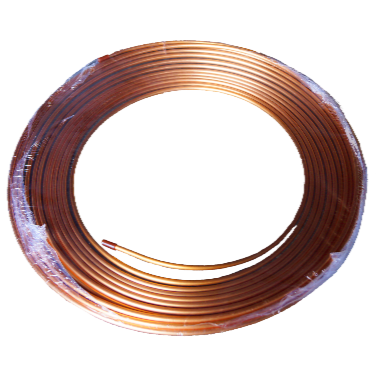
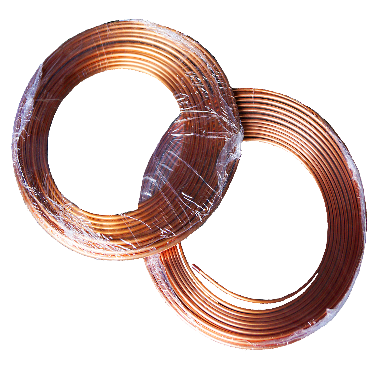
A pancake coil is phosphorus deoxidised copper in alloy C1220T to JIS H3300, 6 to 15 mm OD, wound flat as a coil and supplied in annealed — soft — temper. The anneal is the point of it: the tube bends by hand without a former and takes a flare, so it can be routed round obstructions and terminated without a fitting at the end.
Being continuous is the other half. A run made from one coil has no joints in it at all — and in a sealed refrigerant circuit every joint is a place that can weep years later, so removing them is worth more than the labour it saves. That is why this is the form used for air‑conditioning, refrigeration and capillary work. Bending and flaring practice is in Temper and bending below.
| Copper pancake coil | Copper pipe | |
|---|---|---|
| Form | Coiled — continuous length | Straight 6 m lengths |
| Temper | Annealed, soft — bends by hand | Supplied as straight lengths; ask if you need it annealed |
| Terminating | Takes a flare — no fitting needed at the end | Fitting, braze or thread |
| Joints in a run | None, if one coil covers it | One at every change of direction |
| Size range held | 6 to 15 mm · 1/4" to 3/4" | 6 to 54 mm · 1/8" to 4" NB |
| Wall choice | Single wall per size | Type K, L or M at the same OD |
| Best for | Refrigeration, air‑conditioning, capillary, tight routing | Risers, mains, long straight runs above 15 mm |
Above 15 mm, or want a choice of wall at one diameter? That is copper pipe. The metal and the standard are the same — what changes is the temper, the form and therefore the way the run gets built. We stock both.
Specification
Everything that has to be on the enquiry, in one table.
| Property | Specification |
|---|---|
| Outer diameter | 6 mm to 15 mm · 1/4" to 3/4" OD |
| Material | Copper, alloy C1220T |
| Dimensional standard | JIS H3300 |
| Finish | Phosphorus deoxidised |
| Temper | Annealed — soft type |
| Form | Pancake coil. Straight lengths are on copper pipes |
| Certification | EN 10204 3.1 inspection certificate as standard |
JIS H3300 covers wrought copper and copper alloy seamless tube and pipe of round section. Because the coil is rolled up flat it looks like a pancake — hence the name. Wall thickness and diameter are chosen to suit the project; we hold 6 mm to 15 mm in metric and 1/4" to 3/4" in imperial. Ours come from AF Hydro.
The reason to buy a coil rather than straight lengths is joints. A coil lets a run follow the building in one continuous piece — and every joint you do not make is a joint that cannot leak. On refrigerant work that is not a convenience, it is the whole point.
Buying copper coil in Malaysia
Where the stock sits, what it costs to get it to you, and how fast it moves.
Stock, delivery and ordering
- Where the stock is — our office is in Kuala Lumpur, and copper is held in two warehouses: Johor Bahru and Singapore. Which one your order ships from depends on what is on the floor that week; the quoted price already covers transport, duty and tax. Addresses are on the contact page.
- Dispatch — stock items leave the same or next working day.
- Delivery within Malaysia — 3 to 5 working days after dispatch, or under 3 on an urgent stocked item if you say so on WhatsApp.
Copper is priced off the metal market, so a quote has a shorter shelf life than it does on steel. If you are budgeting rather than buying, say so and we will tell you how long the figure holds.
How a coil enquiry runs
Three things and we can price it without going back and forth:
- Outer diameter — metric or imperial, either is fine.
- Wall thickness — or tell us the service and we will pick.
- Coil length and quantity — how many metres per coil and how many coils.
A product specialist prices it within two working hours. Coils are normally supplied in 15 metre lengths — tell us if you need something else.
Material certification and traceability
What comes with the coil as standard, and what the numbers on it mean.
Our copper coil is supplied with an EN 10204 3.1 inspection certificate as standard. A 3.2, countersigned by a nominated third‑party inspector, can be arranged where the contract demands it — ask before the order.
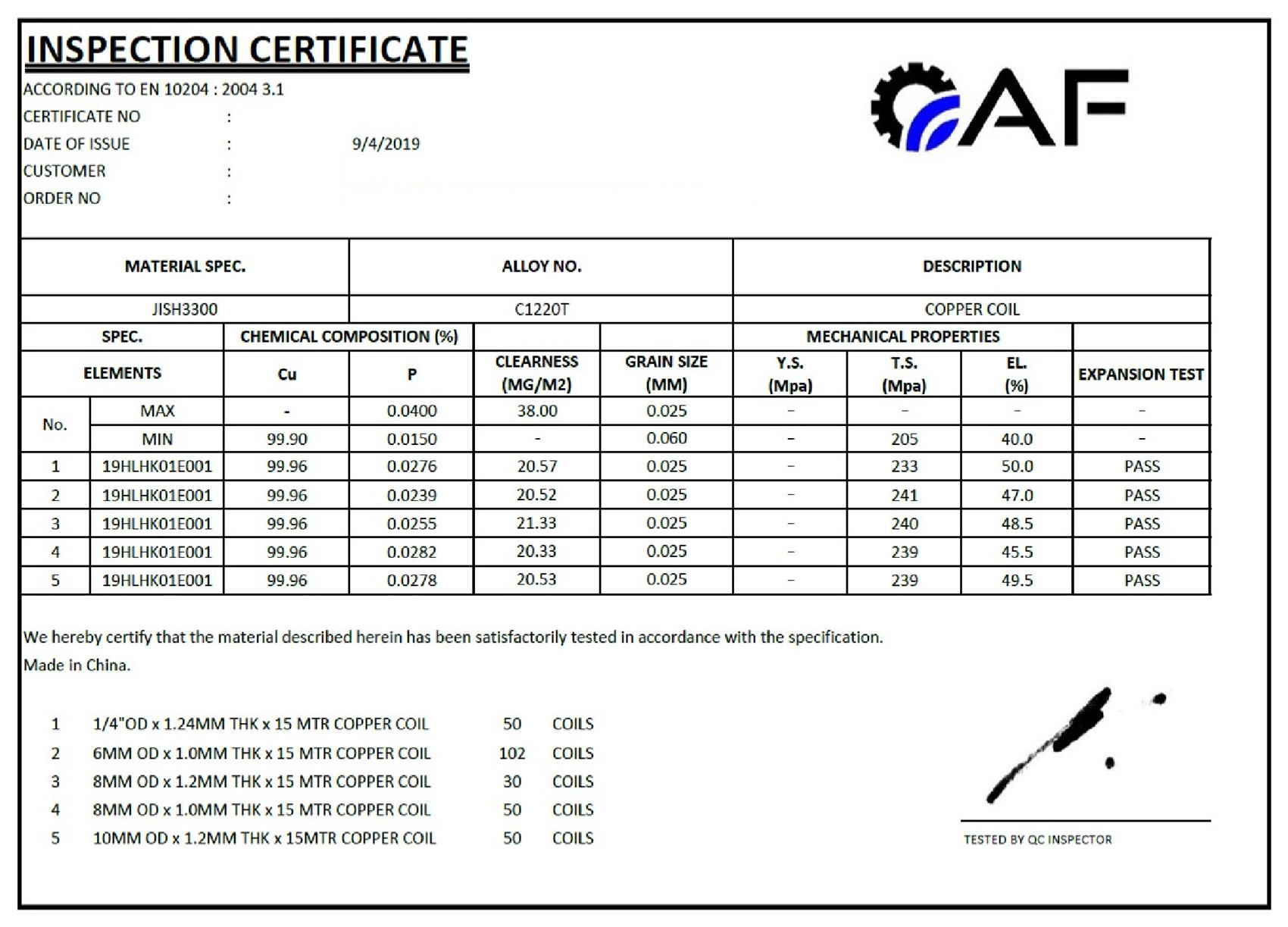
Elongation is the figure to read on a coil. Tensile strength tells you what it takes to break the tube; elongation tells you how far it will stretch before it does — which is what governs whether it will take a hand bend or a flare without cracking. At 45–50% against a 40% floor, this material has real margin for site work. The grain size and clearness columns are also reported: clearness is a measure of residual oil and dirt inside the bore, and on a refrigerant line a dirty bore contaminates the whole circuit.
Alloy C1220T: composition and why phosphorus
Two elements on the certificate, and both of them matter.
| Alloy C1220T | Copper (Cu) | Phosphorus (P) |
|---|---|---|
| Minimum | 99.90% | 0.015% |
| Maximum | — | 0.040% |
Phosphorus is there to remove oxygen, and that changes what the tube can do. Deoxidising clears porosity out of the metal and drops the copper oxide level. The practical consequences are the three things you actually need from a coil:
Flares without splitting
Excellent flaring capability — the tube end can be belled out to form its own seal. That is what the expansion test on the certificate verifies.
Bends without cracking
Excellent bending capability. At 6–15 mm in soft temper the coil takes a hand bend, so the run follows the building.
Welds and brazes cleanly
Excellent welding capability. Copper with oxygen still in it goes brittle when heated — which is precisely what a brazed joint does to it.
Removing the oxygen also improves corrosion resistance. Copper is already a good conductor and a durable, economical material; the deoxidising is what makes it a good pipe.
Soft or hard? Temper decides
The same alloy behaves very differently depending on how it was finished.
Strength and hardness are set by temper, and the piping trade splits it two ways: annealed temper, called soft tube, and drawn temper, called hard tube.
Soft — annealed temper
This is what we carry in coil. Annealing after drawing relieves the work hardening, so the tube is soft enough to bend by hand and to flare on site.
Normally joined with flare fittings and compression fittings, and equally happy soldered, brazed or welded with capillary fittings.
Soft temper is the reason a coil is useful. A hard tube could not be coiled and paid out without kinking.
Hard — drawn temper
Left in the drawn condition, so it is stronger and stiffer but will not bend by hand. Supplied as straight lengths rather than coils.
If a job needs rigid copper — an exposed riser that has to stay straight, for example — that is copper pipe territory rather than coil.
Same alloy, same standard. Only the temper and the form differ.
Making a capillary joint, step by step
How solder gets pulled into a gap it has no business entering.
Capillary fittings have a socket end that closes the tolerance gap between the coil and the fitting. Clean and flux both, assemble, and you are left with a small, even gap. Heat the solder until it melts and adhesion and cohesion pull it into that gap — against gravity if need be — giving a strong, watertight joint.
Solder or braze? Soldering suits water lines and sanitary drainage. Brazing is preferred where greater joint strength is needed, or where service temperature reaches 350 °F (176 °C) — and it is the normal method in air conditioning and refrigeration.
The six steps
- 1. Measure and cut. Neither too short nor too long — the socket depth has to be filled for the joint to be sound.
- 2. Clean and flux. Sandpaper or steel wool on both the coil and the fitting, then a thin, even coat of flux on the mating surfaces to keep dust and dirt out of the capillary gap.
- 3. Heat the joint. The solder should melt on contact with the coil. If it does not, keep heating — and fill the gap all the way round.
- 4. Do not overdo the solder. Excess forms a bead at the bottom of the joint, or worse, runs inside the coil and travels through the system. Rule of thumb: a length of solder roughly equal to the tube diameter fills a joint on small sizes.
- 5. Let it cool undisturbed so the solder solidifies without being moved.
- 6. Wipe the outside with a cloth to take off the excess flux — left on, it will corrode the tube it was protecting.
Why the flux matters more than people think
Flux does two jobs: it keeps contamination out of the capillary gap, and it keeps the copper from re‑oxidising while it is hot. Skip it and the solder will not wet the surface, so it sits as a bead instead of being drawn in.
But leftover flux on the outside is corrosive. Step 6 is not cosmetic — it is the step that decides whether the joint is still sound in five years.
Not soldering at all? Compression fittings need no flame and no hot work permit, which on an occupied building is often the deciding factor.
Applications
Where copper coil earns its place.
HVAC and refrigeration
The main use. Refrigerant lines where a continuous, jointless run matters, and the reason brazing rather than soldering is the norm here.
General plumbing
Water lines and sanitary drainage, soldered with capillary fittings. Economical and quick to install.
Heat exchangers
Copper’s thermal conductivity is why it is in the coil of almost every heat exchanger — and a coil is already the shape a heat exchanger wants.
Gas and water supply
Gas pipe and water supply runs, and chemical service where copper’s corrosion resistance suits the fluid.
Why buy copper coil from RFS Hydraulics
Six things that decide whether a copper order goes smoothly.
Ready stock, not ordered in
We stock across the 6 mm to 15 mm range in Johor Bahru and Singapore rather than buying in against your enquiry, and stock items dispatch the same or next working day.
Soft temper, so it works on site
Annealed rather than drawn, so it bends by hand and flares without splitting — verified by the expansion test on every certificate.
3.1 certificate as standard
An EN 10204 3.1 inspection certificate comes with the coil, reporting copper, phosphorus, tensile, elongation, grain size and clearness per lot. There is a real one on this page.
Metric or imperial
6–15 mm and 1/4"–3/4" both held, so the coil matches the drawing rather than forcing a conversion at the fitting.
Coils and straight lengths
Coil here, or straight copper pipe in 6–54 mm where the run has to stay rigid. Same alloy, two forms.
The fittings as well
We stock the compression fittings and pipe clamps that go with it. More about RFS Hydraulics.
Delivery within Malaysia is already inside the price. See the FAQ or the terms and conditions.
Watch the coils
Copper pancake coils, in the warehouse.
Frequently asked questions
Eleven, from temper through jointing and weight to delivery.
What is a copper pancake coil?
Copper tube to JIS H3300 supplied rolled up flat rather than in straight lengths — it looks like a pancake, hence the name. The standard covers wrought copper and copper alloy seamless tube of round section. We hold 6 mm to 15 mm and 1/4" to 3/4" OD.
What is the difference between soft and hard copper?
Temper. Annealed temper is called soft tube — annealing relieves the work hardening left by drawing, so it bends by hand and flares without splitting. Drawn temper is called hard tube — stronger and stiffer, but it will not bend by hand and cannot be coiled. Our coils are soft, annealed temper; hard copper is supplied as straight lengths.
What is the chemical composition of C1220T copper?
Copper 99.90% minimum and phosphorus 0.015% to 0.040%. On the certificate reproduced above the actual figures are Cu 99.96% and P 0.024–0.028% across five lots.
Why is the copper deoxidised with phosphorus?
Phosphorus removes oxygen, which clears porosity from the metal and lowers the copper oxide level. That gives excellent flaring, bending and welding capability and better corrosion resistance. Copper that still contains oxygen goes brittle when heated — exactly what happens at a brazed joint — which is why plumbing copper is a deoxidised grade.
How is copper coil joined?
Usually with capillary fittings, soldered or brazed: the socket end closes the gap, and molten solder is drawn into it by capillary action to give a watertight joint. It also takes flare fittings and compression fittings, which need no flame at all. Full step‑by‑step is on this page.
Should I solder or braze copper coil?
Solder for water lines and sanitary drainage. Braze where you need greater joint strength, or where service temperature reaches 350 °F (176 °C) — and brazing is the normal method in air conditioning and refrigeration.
Why buy a coil instead of straight lengths?
Joints. A coil lets you run a continuous length that follows the building, so there is no joint to make and none to leak. On refrigerant work that is the whole reason coil exists. Where the run has to stay rigid and straight, copper pipe is the better choice.
What length are copper coils supplied in?
15 metres per coil is the normal supply, and that is what the lots on the certificate above were made to. Other lengths can be arranged — tell us the metres per coil and the number of coils at enquiry, because it affects how the material is drawn rather than just how it is cut.
How do I work out the weight of a copper coil?
kg/m = 0.02809 × wall × (OD − wall), both in mm, taking the density of copper as 8.94 g/cm³, then multiply by the coil length. A 10 mm OD coil with a 1.2 mm wall is 0.297 kg/m, so a 15 metre coil weighs about 4.5 kg. Useful for a freight estimate, and for checking a supplier’s quoted coil weight before paying it.
Can copper coil be used for air conditioning and refrigerant lines?
Yes — it is the main use. Soft temper means the coil follows the building in one continuous piece, so a refrigerant run can often be made with no joints at all between the units. Where joints are needed, brazing rather than soldering is the normal method in air conditioning and refrigeration. Note the clearness figure on the certificate: it measures residual oil and dirt in the bore, and on a sealed refrigerant circuit a dirty bore contaminates the whole system.
What is grain size on the certificate, and why does it matter?
Grain size is a measure of the copper’s crystal structure, reported in millimetres — our lots come in at 0.025 mm. It is the number that predicts how the tube will behave when you work it: a fine, even grain bends and flares smoothly, while a coarse grain tends to give an orange‑peel surface on the outside of a bend and can crack at a flare. Together with elongation, it is the pair of figures that tells you whether a coil will survive site work rather than just pass a pull test.
Catalogue
Full dimension and wall thickness tables. Direct PDF download — no form, no email address.
Diameters and wall thicknesses are in the catalogue; stock and price are not, so send us the list and we will confirm both.
Related: copper pipes · stainless steel tubes · hydraulic steel tubes · compression fittings · pipe clamps
Send the diameter, the wall and the metres per coil.
One coil or a full bill of materials — priced by a product specialist within two working hours.