
Home › Products › Accessories › Stauff filler breathers
STAUFF · ready stockSTAUFF tank filler breathers, types SPB and SMBB, plastic and metal
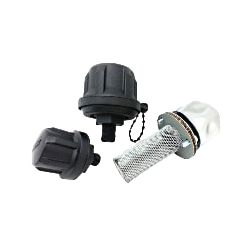
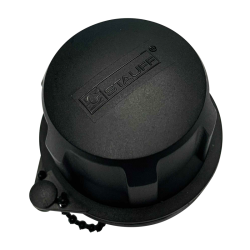
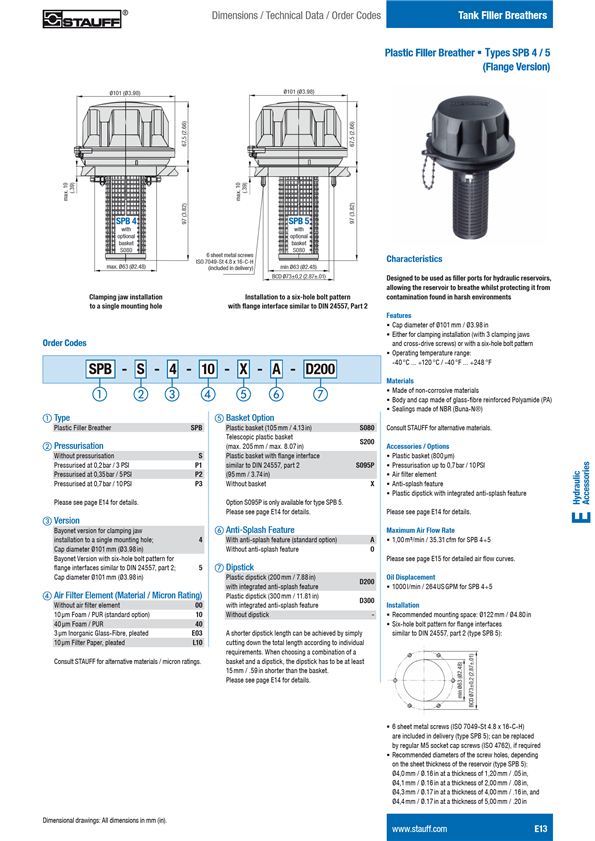
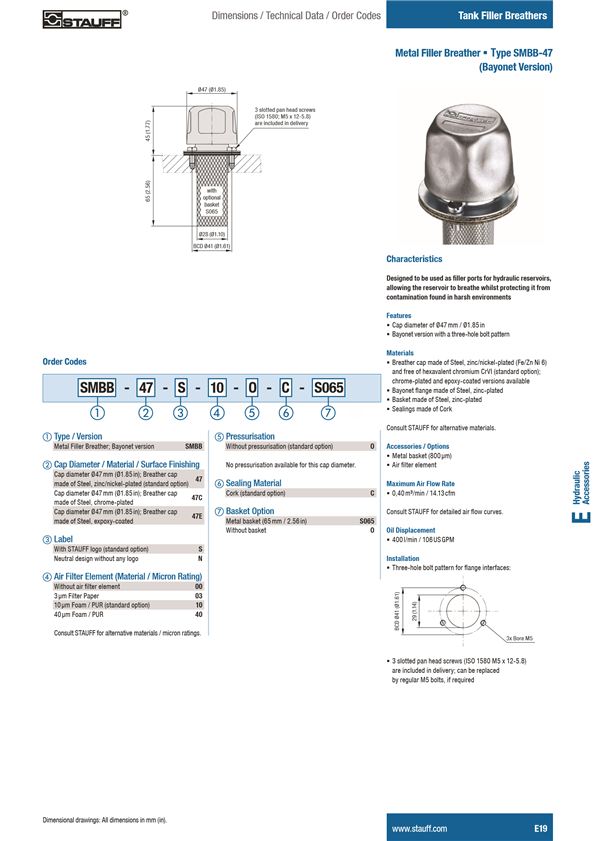
The filler port on a hydraulic reservoir has to do two jobs at once: let the tank breathe as oil goes in and out, and keep dirt out while it does. Two families cover it — the plastic SPB with a Ø101 mm cap, 1.00 m³/min of air and pressurisation to 0.7 bar, and the metal SMBB‑47 with a Ø47 mm cap for smaller tanks. Filter elements from 3 µm to 40 µm.
Get a quotation within 2 working hours
Send the part number, standard, size or quantity. Stock in Malaysia or Singapore, ISO 9001:2015 certified.
What a filler breather is, and why the tank needs one
Every litre of oil that leaves the tank is a litre of air coming in. That air has to be filtered.
As cylinders extend the oil level in the reservoir drops, and the tank pulls in an equal volume of air. Retract them and it pushes that air back out. A reservoir with an open filler is therefore inhaling workshop air all day — dust, grinding swarf, salt, moisture — straight onto the surface of the oil. A filler breather is the part that lets the tank breathe whilst protecting it from the contamination found in harsh environments, and it doubles as the port you fill through.
Two figures decide whether one is big enough. The air flow rate has to cover the fastest rate at which oil leaves the tank, and STAUFF quotes an oil displacement figure for exactly that comparison — 1000 l/min for the SPB and 400 l/min for the SMBB‑47. Undersize it and the tank either draws air past the seals or, worse, pulls a partial vacuum against the pump.
| Filler breather (this page) | An open filler cap | A sealed cap | |
|---|---|---|---|
| Tank can breathe? | Yes, through a filter | Yes, through nothing | No — pressure or vacuum builds |
| Filters the air | 3 to 40 µm, depending on element | Nothing | Not applicable |
| Doubles as a filler | Yes — that is the port | Yes | Yes |
| Strainer basket option | Yes, 800 µm, to catch debris while filling | No | No |
| Dipstick option | Yes, 200 or 300 mm with anti‑splash | Sometimes | Sometimes |
| Can pressurise the tank? | Yes — SPB to 0.7 bar | No | Uncontrolled |
| Result over time | Clean oil, stable pressure | Contaminated oil | Stressed seals, cavitation risk |
Specification
The two families side by side. Everything an enquiry needs.
| SPB 4 / SPB 5 — plastic | SMBB‑47 — metal | |
|---|---|---|
| Cap diameter | Ø101 mm / 3.98 in | Ø47 mm / 1.85 in |
| Max air flow rate | 1.00 m³/min · 35.31 cfm | 0.40 m³/min · 14.13 cfm |
| Oil displacement covered | 1000 l/min · 264 US gpm | 400 l/min · 106 US gpm |
| Mounting | SPB 4 clamping jaws into a single hole · SPB 5 six‑hole bolt pattern, flange similar to DIN 24557 part 2 | Three‑hole bolt pattern, bayonet version |
| Body and cap | Glass‑fibre reinforced polyamide (PA) | Cap steel, zinc/nickel plated (Fe/Zn Ni 6), free of hexavalent chromium CrVI; chrome‑plated and epoxy‑coated versions available. Flange steel, zinc plated |
| Sealings | NBR (Buna‑N) | Cork |
| Operating temperature | −40 °C to +120 °C (−40 to +248 °F) | Consult STAUFF |
| Air filter elements | 10 µm foam/PUR (standard), 40 µm foam/PUR, 3 µm inorganic glass‑fibre pleated, 10 µm filter paper pleated, or none | 10 µm foam/PUR (standard), 40 µm foam/PUR, 3 µm filter paper, or none |
| Pressurisation | 0.2, 0.35 or 0.7 bar (3, 5 or 10 psi), or none | None available at this cap diameter |
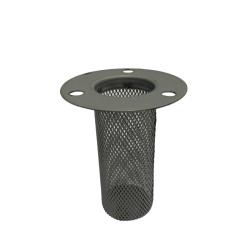
| Strainer basket | 105 mm, telescopic to 205 mm, or a 95 mm flanged version (SPB 5 only). 800 µm plastic | 65 mm steel, zinc plated, 800 µm |
| Dipstick | 200 or 300 mm plastic, with integrated anti‑splash feature | — |
| Anti‑splash feature | Fitted as standard, or omitted to order | — |
| Mounting space | Recommended Ø122 mm / 4.80 in | Bolt circle Ø41 mm, hole Ø28 mm |
| Fixings supplied | 6 sheet metal screws ISO 7049‑St 4.8×16‑C‑H (SPB 5); replaceable by M5 socket cap screws to ISO 4762 | 3 slotted pan head screws ISO 1580 M5×12‑5.8; replaceable by regular M5 bolts |
Buying Stauff filler breathers in Malaysia and Singapore
Where the stock sits, what it costs to get it to you, and how fast it moves.
Stock, delivery and ordering
- Where the stock is — the office is in Kuala Lumpur, and breathers are held in two warehouses: Johor Bahru and Singapore. Addresses and direct lines are on the contact page.
- Dispatch — stock items leave the same or next working day.
- The running items are the SPB with the 10 µm foam element, anti‑splash and no pressurisation, and the SMBB‑47 in the standard zinc/nickel finish. Pressurised versions, 3 µm elements and the telescopic basket are built to order.
- Order spare elements. The filter element is the service item — it is the part that stops working first, and it is the cheapest thing on the reservoir.
- Delivery cost — already inside the product price, along with transport, currency conversion, duties and taxes. Nothing is added afterwards.
Replacing an existing one? Measure the cap diameter and count the fixing holes — one hole with clamping jaws is an SPB 4, six holes is an SPB 5, three holes on a Ø41 mm circle is an SMBB.
How a breather enquiry runs
Five things and we can price it without going back and forth:
- How fast oil leaves the tank in l/min — that sets whether the 400 l/min SMBB or the 1000 l/min SPB is needed.
- Mounting — a single hole, a six‑hole flange, or a three‑hole pattern, and the reservoir sheet thickness.
- Filtration — 3, 10 or 40 µm, driven by the environment rather than by the oil.
- Pressurised or not — and if so, at 0.2, 0.35 or 0.7 bar.
- Basket and dipstick — and if both, remember the 15 mm rule.
A product specialist prices it within two working hours. If the tank is new, send the sheet thickness too — it changes the recommended screw hole diameter.
Plastic SPB or metal SMBB?
Air flow decides it first, then the mounting, then the finish.
These are not two versions of the same part — they are different sizes for different tanks. The plastic SPB moves two and a half times the air of the metal SMBB and can be pressurised; the metal SMBB is smaller, more robust to knocks and available in three finishes.
| Choose the | When | Because |
|---|---|---|
| Plastic SPB 4 | Oil displacement up to 1000 l/min and the tank has one mounting hole | Clamping‑jaw installation to a single hole — nothing to drill but the one aperture, and 3 clamping jaws with cross‑drive screws hold it |
| Plastic SPB 5 | Same flow, but the tank has a flanged aperture | Six‑hole bolt pattern to a flange interface similar to DIN 24557 part 2, which is what most fabricated reservoirs are built to |
| Metal SMBB‑47 | Oil displacement up to 400 l/min, or the breather will take knocks | Smaller Ø47 mm cap on a three‑hole pattern, in steel rather than polyamide — and it is the only one offered chrome‑plated or epoxy‑coated |
- Only the SPB can be pressurised. STAUFF states plainly that no pressurisation is available at the SMBB’s cap diameter. If the reservoir needs a slight positive pressure to keep humid air out, that decides the family on its own.
- Only the SPB takes a dipstick. The 200 and 300 mm plastic dipsticks with integrated anti‑splash are an SPB option; on a smaller tank with an SMBB you would use a level gauge instead.
- The metal one has a cork seal. Worth knowing on a fluid‑compatibility check — the SPB seals on NBR, the SMBB on cork.
- The SMBB cap finish is a real choice. Standard is zinc/nickel plated and free of hexavalent chromium; chrome‑plated and epoxy‑coated versions exist for appearance or for harsher exposure.
Which filter element
The environment picks this, not the oil.
The element in the cap is what stops the tank inhaling the workshop. Choosing it is a judgement about where the machine lives rather than about the fluid inside it: a clean assembly hall and a cement plant need different answers, and the finer element is not automatically the right one because it also restricts air flow.
| Code | Element | Family | Specify it for |
|---|---|---|---|
| 10 | 10 µm foam / PUR | Both | The standard option, and right for ordinary industrial environments |
| 40 | 40 µm foam / PUR | Both | Clean surroundings, or where maximum air flow matters more than fine filtration |
| E03 | 3 µm inorganic glass‑fibre, pleated | SPB | Dusty and abrasive environments — cement, quarrying, foundries, grinding shops |
| L10 | 10 µm filter paper, pleated | SPB | Where a pleated paper element is the plant standard; more media area than foam at the same rating |
| 03 | 3 µm filter paper | SMBB | The fine option on the metal breather |
| 00 | No element | Both | Only where the port is a filler and the tank breathes somewhere else |
- Finer is not always better. A 3 µm element passes less air than a 40 µm one, and the breather still has to keep up with the oil displacement of the circuit. Match the rating to the environment, then check the flow.
- Pleated beats foam on capacity. A pleated element has far more media area in the same space, so it holds more dirt before it restricts — which on a dirty site means longer between changes rather than better filtration.
- The element is the service item. Everything else on a breather lasts the life of the machine. Buy spares, and change them on a schedule rather than when somebody notices the tank breathing hard.
- Alternative materials and ratings are available — STAUFF invites enquiries for both. If your site standard names a rating that is not in the list, ask.
Pressurisation — and when it is worth it
Three settings on the SPB, and a reason to use them that has nothing to do with pressure.
A pressurised breather holds a small positive pressure in the reservoir instead of letting it breathe freely both ways. The tank vents when it exceeds the setting and holds pressure below it, which means the volume of ambient air drawn in over a day falls sharply — and with it the amount of moisture that condenses out onto cool oil. In a humid climate that is usually the real argument for it.
| Code | Setting | Effect |
|---|---|---|
| S | Without pressurisation | Free breathing through the element both ways. The default, and right for most machines |
| P1 | 0.2 bar / 3 psi | A light positive pressure — reduces the in‑breath without stressing anything |
| P2 | 0.35 bar / 5 psi | The middle setting |
| P3 | 0.7 bar / 10 psi | The maximum. Check the reservoir is built for it |
- ⚠️ The tank has to be designed for it. Pressurising a reservoir that was built as a vented box loads every seam, seal and sight glass — including the level gauge, which on the STAUFF SNA is limited to 2 bar. Confirm the whole tank before specifying P3.
- No pressurisation on the metal SMBB. STAUFF states it is not available at that cap diameter, so a pressurised requirement means the plastic SPB family.
- It is not a substitute for filtration. A pressurised breather still has an element, and still breathes when it vents. Pressurisation reduces how much air comes in; the element decides what is in the air that does.
The order codes
Seven fields each, and they do not share a layout.
Both families use a seven‑field code, but the fields are in a different order, so it is worth reading the right one. SPB‑S‑4‑10‑X‑A‑D200 is an unpressurised SPB 4 with a 10 µm foam element, no basket, anti‑splash, and a 200 mm dipstick. SMBB‑47‑S‑10‑0‑C‑S065 is a standard‑finish metal breather with the STAUFF logo, 10 µm foam, no pressurisation, cork seal and the 65 mm basket.
| # | SPB — plastic | SMBB — metal |
|---|---|---|
| 1 | Type — SPB | Type / version — SMBB, bayonet |
| 2 | Pressurisation — S none, P1 0.2 bar, P2 0.35 bar, P3 0.7 bar | Cap dia / material / finish — 47 zinc/nickel plated, 47C chrome‑plated, 47E epoxy‑coated |
| 3 | Version — 4 clamping jaw, single hole · 5 six‑hole bolt pattern | Label — S with STAUFF logo, N neutral |
| 4 | Air filter element — 00, 10, 40, E03, L10 | Air filter element — 00, 03, 10, 40 |
| 5 | Basket — S080 105 mm, S200 telescopic to 205 mm, S095P flanged 95 mm (SPB 5 only), X none | Pressurisation — 0 only. None available at this cap diameter |
| 6 | Anti‑splash — A with (standard), 0 without | Sealing — C cork |
| 7 | Dipstick — D200 200 mm, D300 300 mm, - none | Basket — S065 65 mm metal, 0 none |
- One option is version‑locked: the flanged
S095Pbasket is SPB 5 only, because it uses the same DIN 24557 flange interface as the mounting. - Alternative materials and micron ratings are available on both families — STAUFF asks to be consulted rather than listing them.
Baskets, dipsticks and the 15 mm rule
Two options that interfere with each other, and one number that stops them doing it.
The strainer basket hangs below the port and catches debris while oil is being poured in — the moment a reservoir is most exposed, because somebody has the cap off and a can in their hand. The dipstick reads the level. Both hang down the same aperture, which is where the one real gotcha on this product lives.
| Option | Size | Notes |
|---|---|---|
| S080 plastic basket | 105 mm / 4.13 in | The standard strainer. Plastic, 800 µm |
| S200 telescopic basket | to 205 mm / 8.07 in max | Telescopic — reaches deeper into a tall tank |
| S095P flanged basket | 95 mm / 3.74 in | Flange interface similar to DIN 24557 part 2. SPB 5 only |
| S065 metal basket | 65 mm / 2.56 in | Steel, zinc plated, 800 µm. The SMBB option |
| D200 dipstick | 200 mm / 7.88 in | Plastic, with integrated anti‑splash feature |
| D300 dipstick | 300 mm / 11.81 in | Can be cut down to suit — a shorter length is achieved by simply shortening the total length |
- ⭐ The 15 mm rule. When you order a basket and a dipstick, the dipstick has to be at least 15 mm / 0.59 in shorter than the basket. Otherwise the dipstick fouls the bottom of the strainer and neither works properly. STAUFF states it explicitly, and it is the constraint most often missed when both boxes get ticked.
- The dipstick can be shortened, the basket cannot. So on a shallow tank, order the basket to fit and trim the dipstick — keeping the 15 mm clearance.
- The anti‑splash feature is standard. It comes fitted unless you order it out with code
0. It is what stops returning oil splashing up into the breather element and blinding it.
Fitting it
Three mounting patterns, and screw holes sized by the sheet you are fixing to.
The three patterns
- SPB 4 — single hole. Clamping installation with 3 clamping jaws and cross‑drive screws. Nothing to drill but the aperture itself, which makes it the retrofit choice.
- SPB 5 — six‑hole flange similar to DIN 24557 part 2: bolt circle Ø73 ±0.2 mm around a minimum Ø63 mm aperture. Six sheet metal screws (ISO 7049‑St 4.8×16‑C‑H) are included, and can be replaced by M5 socket cap screws to ISO 4762.
- SMBB‑47 — three‑hole pattern: bolt circle Ø41 mm, aperture Ø28 mm, 3× M5. Three slotted pan head screws (ISO 1580 M5×12‑5.8) are included and can be swapped for regular M5 bolts.
- Allow Ø122 mm / 4.80 in of mounting space around an SPB — the cap is Ø101 mm and it has to be turned.
Screw holes by sheet thickness
On the SPB 5, STAUFF recommends the screw hole diameter according to the thickness of the reservoir sheet:
- Ø4.0 mm at 1.20 mm sheet
- Ø4.1 mm at 2.00 mm sheet
- Ø4.3 mm at 4.00 mm sheet
- Ø4.4 mm at 5.00 mm sheet
Sheet metal screws form their own thread as they go in, so the hole has to match the material they are forming. Too small and the head shears; too large and it never grips. If you would rather not rely on that, use the M5 socket cap screws into tapped holes instead — STAUFF allows for it.
How to identify one you already have
Cap diameter, then count the holes.
| Look at | What it tells you |
|---|---|
| Cap diameter | Ø101 mm is the plastic SPB family; Ø47 mm is the metal SMBB‑47 |
| Number of fixings | None — clamping jaws in a single hole is an SPB 4. Six screws is an SPB 5. Three screws on a Ø41 mm circle is an SMBB |
| Material | Black glass‑fibre reinforced polyamide is the SPB; plated, chromed or epoxy‑coated steel is the SMBB |
| Is there a dipstick? | Only the SPB takes one — 200 or 300 mm, possibly cut down |
| Is there a basket? | Length identifies it: 65 mm metal (SMBB), 95 mm flanged or 105 mm plastic, or telescopic to 205 mm |
| Does it hold pressure? | A pressurised unit is an SPB — P1, P2 or P3. The SMBB has none available |
Send the cap diameter, the fixing pattern and the reservoir sheet thickness, plus a photo. If you are only after a replacement element, the family and the micron rating are all we need — and that is the part worth keeping on the shelf.
Why buy Stauff filler breathers from RFS Hydraulics
Six things that decide whether the order is right first time.
Ready stock on the running builds
The SPB with a 10 µm element and anti‑splash, and the standard‑finish SMBB‑47, are held in Johor Bahru and Singapore and dispatch the same or next working day.
We size it on oil displacement
The figure that matters is how fast oil leaves the tank — 1000 l/min for the SPB against 400 l/min for the SMBB. Choosing on cap diameter alone is how a breather ends up undersized.
Element chosen for the environment
3, 10 or 40 µm, decided by where the machine lives rather than by the oil in it — and we will point out that a finer element passes less air, which the flow calculation has to allow for.
We flag the 15 mm rule
Order a basket and a dipstick together and the dipstick must be at least 15 mm shorter than the basket. It is the constraint most often missed, and it is easier to fix on a quote than on a tank.
Spare elements on the same order
The element is the only service item on a breather and the cheapest thing on the reservoir. We put spares on the quote so nobody runs a blinded element for a year.
One price, delivered
Transport, currency, duties and taxes are already inside the figure we quote. Nothing is added at the end, and delivery within Malaysia is included.
Frequently asked questions
Twelve, starting with how to size one.
How do I know if a breather is big enough?
Compare its oil displacement figure with how fast oil actually leaves your reservoir. STAUFF quotes it directly for that purpose: the SPB covers 1000 l/min / 264 US gpm and the SMBB-47 covers 400 l/min / 106 US gpm. The matching air flow rates are 1.00 and 0.40 m3/min. Undersize it and the tank either draws air past the seals or pulls a partial vacuum against the pump — and a fine filter element makes that worse, not better.
Which filter element should I choose?
Pick it on where the machine lives, not on the oil. 10 µm foam is the standard and right for ordinary industrial surroundings. 40 µm suits clean environments or where air flow is the priority. 3 µm — glass-fibre pleated on the SPB, filter paper on the SMBB — is for genuinely dusty and abrasive places like cement, quarrying and grinding shops. Remember that a finer element passes less air, so check it still covers your oil displacement.
Plastic or metal?
Air flow decides first: the plastic SPB moves two and a half times the air of the metal SMBB. After that, the SPB is the one that can be pressurised and the only one that takes a dipstick; the SMBB-47 is smaller, is steel rather than polyamide so it stands knocks better, and is the only one offered chrome-plated or epoxy-coated. On a large reservoir it is usually the SPB; on a small power pack, the SMBB.
What is the anti‑splash feature for?
It stops returning oil splashing up into the breather from below. That matters because oil on the element blinds it — the air path closes up and the tank stops breathing properly, which is the failure nobody notices until seals start weeping. It is fitted as standard on the SPB and has to be actively ordered out. The plastic dipsticks have the same feature integrated.
Can I fit both a basket and a dipstick?
Yes, but there is a rule: the dipstick must be at least 15 mm / 0.59 in shorter than the basket. Otherwise it fouls the bottom of the strainer and neither part works properly. Since the dipstick can be cut down and the basket cannot, the sensible order is to size the basket for the tank and then trim the dipstick to keep that 15 mm of clearance.
Should I pressurise the reservoir?
Only if the tank was built for it. Pressurisation — 0.2, 0.35 or 0.7 bar on the SPB — cuts the volume of ambient air drawn in, which in a humid climate mostly means less moisture condensing onto the oil. But it loads every seam, seal and sight glass on the reservoir, including the level gauge, which is limited to 2 bar. Confirm the whole tank before specifying the 0.7 bar setting. And note that no pressurisation is available on the metal SMBB.
What temperature will it take?
The plastic SPB is rated minus 40 to plus 120 degrees C (minus 40 to plus 248 degrees F), which is a wider range than most people expect from a polyamide part — the body and cap are glass-fibre reinforced. For the metal SMBB, the sealing is cork rather than NBR and STAUFF asks to be consulted on temperature, so tell us the duty and we will confirm it rather than assume.
What holes do I drill?
Depends on the version. The SPB 4 needs only the aperture — it clamps in with three clamping jaws. The SPB 5 needs a six-hole pattern on a 73 mm bolt circle around a minimum 63 mm aperture, to a flange interface similar to DIN 24557 part 2. The SMBB-47 needs three M5 holes on a 41 mm circle around a 28 mm aperture. Allow 122 mm of clear mounting space around an SPB so the cap can be turned.
Why does the screw hole size depend on the sheet thickness?
Because the screws supplied with the SPB 5 are sheet metal screws that form their own thread as they go in, so the hole has to suit the material they are forming. STAUFF recommends 4.0 mm at 1.20 mm sheet, 4.1 mm at 2.00 mm, 4.3 mm at 4.00 mm and 4.4 mm at 5.00 mm. Too small and the head shears off; too large and it never grips. If you would rather not rely on that, the supplied screws can be replaced by M5 socket cap screws into tapped holes.
Are the fixing screws included?
Yes. The SPB 5 comes with six sheet metal screws (ISO 7049-St 4.8x16-C-H) and the SMBB-47 with three slotted pan head screws (ISO 1580 M5x12-5.8). Both can be substituted — M5 socket cap screws to ISO 4762 on the SPB, regular M5 bolts on the SMBB — if your build standard prefers a cap head or a tapped hole.
How often should the element be changed?
On a schedule rather than on symptoms, because the symptom of a blinded element is a tank that struggles to breathe, and by then it has already been drawing air past seals. The interval depends entirely on the environment — a clean assembly hall and a cement plant are not comparable. A pleated element holds more dirt than foam at the same rating, so it buys longer intervals on a dirty site. Keep spares on the shelf; it is the cheapest part on the reservoir.
Can I get a different micron rating or material?
Yes — STAUFF invites enquiries for alternative materials and micron ratings on both families, and for alternative body materials on the SPB. If your site standard names a rating that is not in the list, or the fluid or environment is unusual, send the detail and we will come back with what is available rather than substituting the nearest catalogue item.
Catalogues
Direct PDF download — no form, no email address.
 Tank filler breathers — the full rangeSTAUFF · PDFPDF
 Plastic filler breather — types SPB 4 and SPB 5STAUFF · PDFPDF
 Metal filler breather — type SMBB‑47STAUFF · PDFPDF
Related: Stauff level gauges for the same reservoir · Stauff test couplings for sampling the oil · pressure gauges.
Send the oil displacement, the mounting pattern and the sheet thickness.
Add the environment and we will pick the element. A product specialist confirms the order code within two working hours.