
Home › Products › High pressure fittings › Pipe adapters
PN 420 · ready stockPipe adapter fittings, 1/8" to 2", BSPP and NPT
The fitting for when two threads have to meet and do not match — a different form, a different size, or both. 1/8" to 2" in SS316 and carbon steel A105, rated to 420 bar, in BSPP and NPT. Straight adapters are turned from cold‑drawn bar; elbows and tees are machined from close‑grain forgings. Odd combinations are machined to order.
Get a quotation within 2 working hours
Send the part number, standard, size or quantity. Stock in Malaysia or Singapore, ISO 9001:2015 certified.
What a pipe adapter is for
Joining two connections that were never designed to meet.
A pipe adapter is the interface between two ends with no direct compatibility. It is used to extend or terminate a run, and to get flow from one thread form or size into another without rebuilding the pipework either side. Where the two ends are far apart in size — a 1/2" male into a 1" female, say — the trade calls it a big jump, and an adapter is the only sensible answer.
- Any combination of ends. Male × female, male × male, female × female — in BSPP or NPT, at equal or unequal sizes.
- Odd sizes are the whole point. This is the range you reach for when the two ends do not appear together in any standard catalogue item.
- Made to order where needed. If the combination does not exist, it can be machined — which is often faster than redesigning the line.
- Male threads ship with a plastic cap fitted, so the thread arrives undamaged.
- Where it is used: process systems, power instrumentation, and general industrial pipework — anywhere a joint has to be made between things that do not match.
Where it is the right choice
- Two different thread forms — BSPP one side, NPT the other.
- A big size jump in one fitting instead of a stack of bushes.
- Terminating a run — a plug with a proper seal rather than an improvised blank.
- Instrumentation and process control between tube and pipe sizes.
Where something else is better
- Same size, same thread, in line — that is a coupling, not an adapter. The difference.
- Nominal bore pipe at class 3000 or 6000 — forged pipe fittings.
- Onto tube — compression or ferrule fittings.
- Onto hose — JIC, on a 37° flare.
Do not stack three adapters to reach a size. Send us both ends and we will quote one part.
Specification
Everything an enquiry needs, in one place.
| Type | Threaded pipe adapter fitting — male, female or mixed, equal or reducing |
| Size range | 1/8" to 2", and the two ends need not match |
| Working pressure | Up to 420 bar, determined at an ambient of 37 °C (100 °F) and subject to the temperature derating factor |
| Threads | BSPP · NPT — in any combination across the two ends |
| Materials | Stainless steel SS316 · carbon steel A105 · brass |
| Straight adapters | Turned from cold‑drawn bar stock to the applicable ASTM grade |
| Elbows and tees | Machined after close‑grain forging — 90° elbows, three‑way tees |
| Body temperature ceiling | 537 °C SS316 · 204 °C carbon steel · 190 °C brass — grades and figures |
| Seals, where fitted | SAE O‑ring in FKM · bonded seal in NBR or FKM · copper gasket — temperature limits |
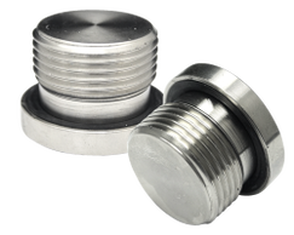
| Body styles | Male × female adapters · hex nipples · plugs, including hex‑socket head plugs with a seal |
| Thread protection | Male threads supplied with a plastic cap |
| Custom | Machined to order where the combination you need is not a catalogue item |
| Stock | Held in Johor Bahru and Singapore |
Two things to get right on an adapter. Say which end is which — “1/2 × 1" does not tell us whether the 1/2" is the male or the female. And 420 bar is the figure at 37 °C; above that you give some of it back, and how much depends on the material.
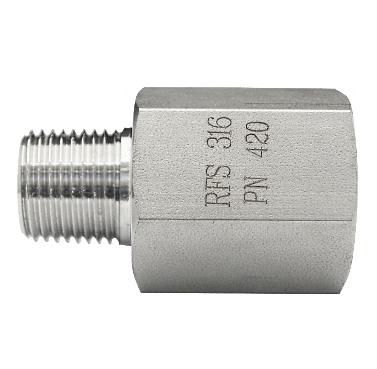
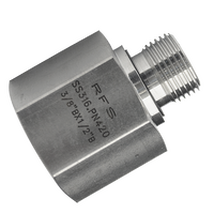
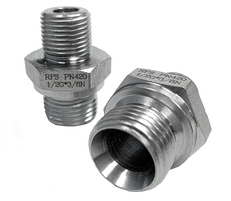
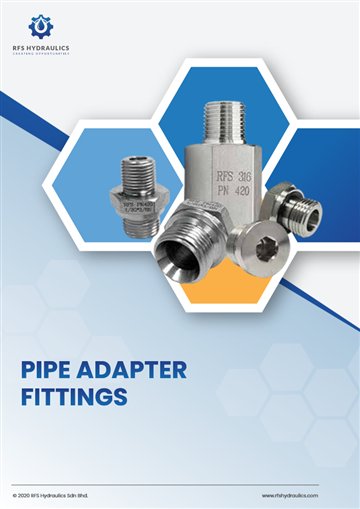
What the ends look like, and what the stamping gives you.
Buying pipe adapters in Malaysia and Singapore
Where the stock sits, and the four things we need.
Stock, delivery and ordering
- Running combinations in SS316 and carbon steel are held in Johor Bahru and Singapore.
- On a stocked item, order to delivery can be under three working days.
- Anything can be machined. Odd size pairs and mixed thread forms are made to order — we quote the lead time with the price.
- One price, delivered — transport, currency, duties and taxes are inside the quoted figure.
What we need from you
- Both sizes, and which is male — for example 1/2" male × 1" female, not 1/2 × 1.
- Thread form at each end — BSPP or NPT. They can differ.
- Material — SS316, carbon steel or brass — and the fluid.
- Working pressure and temperature, so we can apply the derating before you order rather than after.
Adapter, coupling or hex bush?
Three words used loosely, for three different parts.
These get mixed up on enquiries constantly, and the wrong word puts the wrong part on the van.
| Part | Ends | What it does |
|---|---|---|
| Coupling (socket) | Female × female, equal | A straight connector joining two pipes of the same size, in line, with no change of flow area |
| Reducing coupling | Female × female, unequal | Joins a larger pipe to a smaller one, reducing the flow area. Both ends female |
| Hex bush | Female × male | The standard stepping part, where the male size is bigger than the female |
| Adapter | Any combination | Whatever the other three cannot do — female bigger than male, equal male and female, mixed thread forms, or a big jump |
- The distinguishing case: a standard hex bush always has the male end larger. If you need the female larger than the male, or both the same size, that is an adapter — and it may be a machined part.
- A coupling never changes the thread form. If BSPP has to become NPT, no coupling will do it, whatever the size.
- When in doubt, describe the two ports. Tell us what is on the machine and what is on the pipe, and let us name the part.
Material grades, and how the part is made
Bar stock for straights, forgings for anything with a corner in it.
How an adapter is made follows its shape. Straight adapters are turned from cold‑drawn bar. Anything that changes direction — a 90° elbow, a three‑way tee — is machined after close‑grain forging, because you cannot get sound metal round a corner by turning it from bar.
| Material | Bar stock grade | Forging grade | Maximum body temperature |
|---|---|---|---|
| Stainless steel SS316 | ASTM A479 Type 316 ASTM A276 Type 316 | ASTM A182 F316 | 537 °C 1000 °F |
| Carbon steel | ASTM A108 JIS G4051 S20C–S45C | ASTM A105 JIS G3201 SF440A | 204 °C 400 °F |
| Brass | ASTM B16 C36000 JIS H3250 C3604 | ASTM B283 C37700 JIS H3250 C3771 | 190 °C 375 °F |
- SS316 reaches 537 °C — two and a half times the carbon steel ceiling. On anything hot, the material choice is made for you.
- Carbon steel stops at 204 °C and brass at 190 °C. Those are hard ceilings for the body, before any derating is applied.
- These are body limits, not joint limits. If the adapter carries a seal, the seal is almost always the lower number — see below.
- Both ASTM and JIS grades are covered, which matters if your specification is written to one or the other.
Pressure at temperature
420 bar is the figure at 37 °C. Above that you give some back.
Pressure ratings for this range are determined at an ambient of 37 °C (100 °F). Run hotter and the rating comes down by a factor. Take the rating for your part, multiply by the factor for your material and temperature, and that is the joint.
| Temperature | SS316 | Carbon steel | Brass |
|---|---|---|---|
| 38 °C (100 °F) | 1.000 | 1.000 | 1.000 |
| 93 °C (200 °F) | 1.000 | 0.940 | 0.780 |
| 149 °C (300 °F) | 1.000 | 0.900 | 0.690 |
| 204 °C (400 °F) | 0.960 | 0.860 | 0.130 |
- Worked example. An SS316 adapter rated 420 bar, running at 204 °C: 420 × 0.960 = 403 bar.
- SS316 loses nothing to 149 °C. Carbon steel is already down 6% at 93 °C, and brass down 22%.
- Brass falls off a cliff. From 0.690 at 149 °C to 0.130 at 204 °C — and note that 204 °C is already above the 190 °C body ceiling, so treat brass as unsuitable anywhere near it.
- Above 204 °C, only SS316 remains, and the factor has to come from the maker’s table for the specific part. Ask us — we will not interpolate it for you.
If a seal is fitted, check the seal too
Where the adapter carries a seal rather than sealing on the thread, the seal caps the temperature — and the lower of the two figures is the one you have.
| Seal | Material | Minimum | Maximum |
|---|---|---|---|
| SAE O‑ring | FKM | −28 °C (−20 °F) | 204 °C (400 °F) |
| Bonded seal gasket | NBR | −25 °C (−13 °F) | 110 °C (230 °F) |
| Bonded seal gasket | FKM | −15 °C (5 °F) | 204 °C (400 °F) |
| Copper gasket | Copper | −198 °C (−325 °F) | 204 °C (400 °F) |
- NBR is the low one at 110 °C. If the line runs hotter, ask for FKM — same fitting, different gasket.
- Copper is the cryogenic answer. Down to −198 °C, where every elastomer here has long since stopped working. Note it goes hard, not soft, so the joint must be made up properly.
- Everything except NBR tops out at 204 °C. So even in SS316, a sealed adapter is a 204 °C part — the 537 °C body figure only applies where the thread itself seals.
- See O‑rings and bonded seals for the full seal range, and tell us the fluid as well as the temperature.
Identifying an adapter you already have
The stamping usually gives you the whole part.
These are marked with the maker, the material and the pressure — and often the two sizes with a letter for each thread form. Read it before you measure.
- PN 420 on the part is the 37 °C figure. It is not what the fitting will do at temperature — apply the factor.
- B and N are the thread forms, not sizes: B is BSPP, N is NPT. A marking with both letters is a mixed‑form adapter.
- Still unsure? Photograph the flats where the stamping is, put a caliper across both threads, and send us the pair.
Why buy pipe adapters from us
The part that solves the problem, not three parts stacked.
We quote one part, not a stack
Send us both ports and we will find or make a single adapter. Stacking bushes adds joints, adds length and adds leaks.
Anything can be machined
Female bigger than male, equal sizes, mixed BSPP and NPT — if it is not a catalogue item we will have it made and quote the lead time up front.
Derating applied before you order
Give us the pressure and temperature and we apply the factor, so the 420 bar on the stamp does not become a surprise at commissioning.
The seal chosen for the duty
NBR, FKM or copper — specified against your temperature and fluid, not defaulted.
Stock on both sides of the causeway
Johor Bahru and Singapore, in SS316 and carbon steel — so a stocked combination can be on site in under three working days.
Landed pricing
One figure, delivered — transport, currency, duties and taxes already inside it.
Questions we get asked
The ones that come up on the phone.
What is the difference between an adapter and a coupling?
A coupling is a straight connector joining two pipes of the same size in line, female at both ends, with no change of flow area. A reducing coupling joins a larger pipe to a smaller one, still female both ends. An adapter is anything those cannot do — mixed male and female, mixed thread forms, a female larger than the male, or a big size jump. Full comparison.
How is an adapter different from a hex bush?
A standard hex bush always has the male end larger than the female. That covers stepping a port up. If you need the female larger than the male, or both ends the same size, a hex bush cannot do it — that is an adapter, and it may be a machined part rather than a shelf item.
Can one adapter go from BSPP to NPT?
Yes — that is one of the main reasons the range exists. We stock and machine adapters with BSPP one end and NPT the other, at equal or different sizes. On the part the two forms are marked with a letter: B for BSPP, N for NPT. It saves you fitting a nipple and an adapter, which is one less threaded joint.
What does PN 420 on the fitting mean?
The nominal pressure, 420 bar — and it is the figure at an ambient of 37 °C. It is not what the fitting will carry hot. Multiply it by the derating factor for your material and temperature: an SS316 adapter at 204 °C is 420 × 0.960 = 403 bar. And if the adapter carries a seal, check the seal limit as well.
How much pressure do I lose to temperature?
Depends entirely on the material. SS316 loses nothing up to 149 °C and only 4% at 204 °C. Carbon steel is down 6% at 93 °C, 10% at 149 °C and 14% at 204 °C. Brass loses 22% by 93 °C, 31% by 149 °C and then collapses. Above 204 °C only SS316 is still in play, and the factor has to come from the maker’s table for the specific part — ask us rather than interpolating.
What is the maximum temperature?
For the body: 537 °C in SS316, 204 °C in carbon steel, 190 °C in brass. But if the adapter seals on a gasket or O‑ring rather than on the thread, the seal is the real limit — and every seal in the range except NBR tops out at 204 °C, with NBR at 110 °C. So a sealed SS316 adapter is a 204 °C part, not a 537 °C one.
Which seal should I specify?
NBR for ordinary duty to 110 °C. FKM where it runs hotter — to 204 °C, as an O‑ring or a bonded seal. Copper for extreme cold: it goes down to −198 °C, where no elastomer here still works. Tell us the fluid as well as the temperature, because solvents and steam rule out materials the temperature alone would allow.
Why are straight adapters made from bar and elbows from forgings?
Because of the shape. A straight adapter can be turned from cold‑drawn bar with the grain running along the part. Anything that changes direction — a 90° elbow, a three‑way tee — cannot be produced soundly that way, so it is machined after close‑grain forging, which puts the grain around the corner instead of across it.
Can you make a size combination that is not in the catalogue?
Yes. These are machined and customised to order, and it is often quicker than redesigning the pipework. Send us both ends — size, thread form, and which is male — and we will quote the part and the lead time together. A sketch helps if the geometry is unusual.
What size range do you cover?
1/8" to 2", in BSPP and NPT, and the two ends do not have to match — that is the point of an adapter. Above 2" you are into forged pipe fittings and flanged connections. Materials are SS316, carbon steel A105 and brass.
How should I describe what I need?
Give us both ports, and say which is male. “1/2 × 1” is ambiguous — we cannot tell whether the 1/2" is the male or the female, and the two are different parts. The ideal enquiry reads like “1/2" BSPP male × 1" NPT female, SS316, 250 bar at 120 °C”. If you would rather not name the part, just describe what is on the machine and what is on the pipe.
Do you deliver to Singapore, and what does delivery cost?
Yes. We hold stock in Johor Bahru and Singapore, and a stocked item can be delivered in under three working days. Our quote is a landed price — transport, currency, duties and taxes are already in the figure, so what you approve is what you pay.
Catalogue
Direct PDF download — no form, no email address.
Related: forged pipe fittings for nominal bore pipe at class 3000 and 6000 · JIC fittings for hose and a 37° flare · compression fittings and ferrule fittings for tube · bonded seals and O‑rings for the sealed ends · high pressure ball valves to isolate the line.
Send both ends, and say which one is male
Size, thread form and which end is which is enough for a landed price — or for a machined part if the combination does not exist. Stock in Johor Bahru and Singapore.