
Home › Products › High pressure valves › ISO 6164 ball valves
MHA Zentgraf · ready stockISO 6164 ball valves to ISO 6164‑1 & ISO 6164‑2, 1/2" to 8"
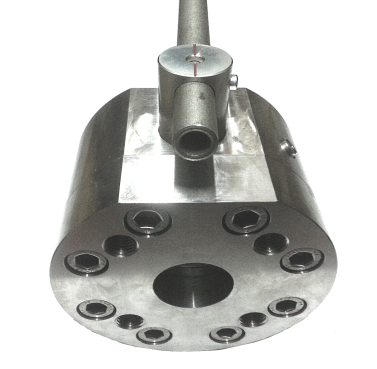
Two‑way isolating ball valves with a round body and a four‑bolt ISO flange face at each end — the pattern used where an SAE flange runs out of size or pressure. MHA type KH‑ISO, DN13 to DN200, in steel or stainless, on the ISO250 or ISO400 pattern plus the wider ISO320. The number to check is not the pattern name: the valve rating changes with bore, and the table is below.
Get a quotation within 2 working hours
Send the part number, standard, size or quantity. Stock in Malaysia or Singapore, ISO 9001:2015 certified.
What an ISO 6164 ball valve is, and when you need one
The big‑bore, high‑pressure flange pattern. Four bolts, square, metric.
Mechanically this is an ordinary two‑way, quarter‑turn ball valve — open or shut, no throttling. What sets it apart is the connection: a square four‑bolt flange face to ISO 6164, the international high‑pressure hydraulic flange standard, on a round body. ISO 6164 exists for the part of the range where the SAE pattern runs out: it is defined in metric sizes with metric bolts, and it carries a higher pressure at a given size than the equivalent SAE code 62 joint.
You want it when the line is large bore and high pressure at the same time — press lines, steel mill and forging hydraulics, marine deck machinery, mining, and big power packs. Below about 3" you have a genuine choice between this and a SAE flange end ball valve; above it, the SAE pattern simply stops and ISO 6164 (or the wider ISO320 face) is what remains.
| ISO 6164 ball valve (this page) | SAE flange end ball valve | |
|---|---|---|
| Flange standard | ISO 6164‑1 (ISO250) and 6164‑2 (ISO400), plus ISO320 | ISO 6162‑1 (Code 61) and 6162‑2 (Code 62) |
| Face and bolts | Square, four metric bolts (eight above DN80) | Rectangular, four bolts, metric or UNC |
| Size range | DN13 to DN200, 1/2" to 8" | DN13 to DN80, 1/2" to 3" |
| Body shape | Round — the flange face is machined into the body ends | Square or round, with screwed‑on flange adapters on the smaller ranges |
| Top pressure | 400 bar on the ISO400 pattern | 420 bar body PN on the 6162‑2 ranges |
| Stem at large sizes | Duplex from DN65 up in steel | Duplex on the KH range |
| Reach for it when | Bore above 3", or a metric ISO‑flanged plant standard | Bore up to 3" on an SAE‑flanged machine |
Specification
Everything an enquiry needs, in one place.
| Type | KH‑ISO — flange ball valve with ISO connection, MHA Zentgraf |
| Function | Two‑way, quarter‑turn isolating ball valve. Open or shut, not for throttling |
| Size range | DN13 to DN200, 1/2" to 8" |
| Flange patterns | ISO 6164‑1 (ISO250) · ISO 6164‑2 (ISO400) · ISO320, which MHA states is not part of ISO 6164 |
| Valve body PN | 100 to 400 bar depending on pattern and bore — see the table. Highest is 400 bar; the ISO250 line runs 350 / 315 / 250 as the bore grows |
| Bolting | 4 × M8 to 4 × M30 from DN13 to DN80; 8 × M24 to 8 × M36 on the DN100 to DN200 ISO320 sizes |
| Body and ball | Steel, or stainless steel throughout |
| Stem | Steel at DN15–50 · duplex at DN65–200 in the steel ranges · stainless in the stainless ranges |
| Ball seats | POM across every material code |
| O‑rings | NBR or FPM (Viton), selected by the material code |
| Material codes | Steel 212A / 2128 (DN15–50) and 282A / 2828 (DN65–200) · stainless 442A / 4428 |
| Temperature | −10 °C to +100 °C on every material code |
| Lever | Aluminium, zinc or steel by size. On the steel‑lever sizes MHA warns the lever must be fixed centrally during operation |
| Accessories | Locking devices, actuators, mounting holes, position switches, combinations and detent — see below |
| Weight | 2.90 kg at DN13 to 395 kg at DN200 — lifting is a real consideration on the large sizes |
Buying ISO 6164 ball valves in Malaysia and Singapore
Where the stock sits, what it costs to get it to you, and how fast it moves.
Stock, delivery and ordering
- Where the stock is — the office is in Kuala Lumpur, and valves are held in two warehouses: Johor Bahru and Singapore. Addresses and direct lines are on the contact page.
- Dispatch — stock items leave the same or next working day.
- What is realistic on this product. ISO 6164 is a project item, not a shelf item, once you are past the small bores — a DN150 weighs 225 kg and a DN200 is 395 kg. The smaller bodies move; the large sizes and the stainless codes come back with a lead time on the quote rather than a shelf figure.
- Delivery cost — already inside the product price, along with transport, currency conversion, duties and taxes. Nothing is added afterwards.
What moves where. Singapore is mostly marine, offshore and shipyard work, usually stainless. Malaysia is heavy hydraulics, mills and mining, mostly steel.
How a valve enquiry runs
Five things and we can price it without going back and forth:
- Bore — DN13 to DN200, or the inch size.
- Flange pattern — ISO250, ISO400 or ISO320. The one people leave out, and the one that decides whether it bolts on.
- Working pressure — checked against the table for your bore, not against the pattern name.
- Material — steel or stainless, and NBR or Viton for the medium.
- Accessories — locking, actuation, mounting holes or a position switch. Cheap now, awkward later.
A product specialist prices it within two working hours. Replacing an existing valve? Send a photo of the body marking and one of the flange face with a rule across the bolt centres.
ISO250, ISO400 or ISO320?
Two are ISO 6164. The third is not, and it is the one that reaches 8".
MHA offers the KH‑ISO on three flange faces. ISO250 is ISO 6164‑1 and ISO400 is ISO 6164‑2 — the two parts of the standard, and the pattern names come from their nominal pressure classes. The third, ISO320, MHA labels plainly in its own catalogue as not part of ISO 6164. It matters because ISO320 is the only one of the three that carries the range up to DN200 (8") — the two proper ISO 6164 patterns stop at DN63 and DN80 respectively.
| ISO250 | ISO400 | ISO320 | |
|---|---|---|---|
| Standard | ISO 6164‑1 | ISO 6164‑2 | Not part of ISO 6164 |
| Sizes offered | DN13 to DN63 | DN13 to DN80 | DN15 to DN200 |
| Valve PN range | 350 down to 250 bar | 400 bar, with exceptions | 350 bar, with one exception |
| Bolting | 4 × M8 to 4 × M20 | 4 × M8 to 4 × M30 | 4 × M10 to 8 × M36 |
| Bolt circle | 42 to 145 mm | 42 to 175 mm | 54 to 315 mm |
| Heaviest valve | 36.9 kg (DN63) | 63 kg (DN80) | 395 kg (DN200) |
| Choose it when | The plant is built to 6164‑1 and the duty is at or under 250 bar in the larger bores | You need the full 400 bar and the bore is 3" or less | You need a bore above 3", or you are matching existing ISO320 flanges |
- The pattern name is not the valve rating. An ISO250 valve at DN13 is rated 350 bar, well above its own class name, while the same pattern at DN32 and above is 250 bar. And ISO320 valves are rated 350 bar, not 320. Read your own row.
- Check what you are bolting to. MHA prints the warning on its own sheet: “Please note the pressure ratings of the connection flanges!” A 400 bar valve on 250 bar flanges is a 250 bar joint.
- The DN13 face is rotated 45°. Both ISO 6164 patterns note it against the DN13 bolt circle — worth knowing before a bracket is made.
Pressure by size — the number the pattern name hides
Same valve family, three faces, and a rating that moves from 100 to 400 bar.
This is the table to read before anything else on the page. The pattern is called ISO250 or ISO400, but what the valve is actually rated at depends on its bore — and in two places it drops sharply. Note in particular DN70 on the ISO400 face at 315 bar, and the two different DN80 builds, one at 100 bar and one at 400. These figures are identical for the steel and the stainless codes.
| ISO 6164‑1 — the ISO250 face | |||||
|---|---|---|---|---|---|
| Type | Bore LW | Bolt circle | Bolting | Weight | Valve PN |
| KH‑DN13‑ISO250 | 15 | 42 (rotated 45°) | 4 × M8 | 2.90 kg | 350 bar |
| KH‑DN19‑ISO250 | 20 | 50 | 4 × M8 | 6.80 kg | 350 bar |
| KH‑DN25‑ISO250 | 25 | 62 | 4 × M10 | 7.20 kg | 315 bar |
| KH‑DN32‑ISO250 | 32 | 73 | 4 × M12 | 12.50 kg | 250 bar |
| KH‑DN38‑ISO250 | 38 | 85 | 4 × M16 | 16.60 kg | 250 bar |
| KH‑DN51‑ISO250 | 48 | 98 | 4 × M16 | 24.90 kg | 250 bar |
| KH‑DN56‑ISO250 | 48 | 118 | 4 × M20 | 26.60 kg | 250 bar |
| KH‑DN63‑ISO250 | 63 | 145 | 4 × M20 | 36.90 kg | 250 bar |
| ISO 6164‑2 — the ISO400 face | |||||
|---|---|---|---|---|---|
| Type | Bore LW | Bolt circle | Bolting | Weight | Valve PN |
| KH‑DN13‑ISO400 | 15 | 42 (rotated 45°) | 4 × M8 | 2.90 kg | 400 bar |
| KH‑DN19‑ISO400 | 20 | 50 | 4 × M8 | 6.80 kg | 400 bar |
| KH‑DN25‑ISO400 | 25 | 62 | 4 × M10 | 7.20 kg | 400 bar |
| KH‑DN32‑ISO400 | 32 | 73 | 4 × M12 | 12.50 kg | 400 bar |
| KH‑DN38‑ISO400 | 38 | 85 | 4 × M16 | 16.60 kg | 400 bar |
| KH‑DN51‑ISO400 | 48 | 98 | 4 × M16 | 24.90 kg | 400 bar |
| KH‑DN56‑ISO400 | 48 | 118 | 4 × M20 | 26.60 kg | 400 bar |
| KH‑DN63‑ISO400 | 65 | 145 | 4 × M24 | 42.53 kg | 400 bar |
| KH‑DN70‑ISO400 | 65 | 160 | 4 × M24 | 43.00 kg | 315 bar |
| KH‑DN80‑ISO400 (PN100) | 76 | 175 | 4 × M30 | 51.00 kg | 100 bar |
| KH‑DN80‑ISO400 (PN400) | 76 | 175 | 4 × M30 | 63.00 kg | 400 bar |
| ISO320 — not part of ISO 6164, and the only face above 3" | ||||
|---|---|---|---|---|
| Type | Bolt circle | Bolting | Weight | Valve PN |
| KH‑DN15‑ISO320 | 54 | 4 × M10 | On request | 350 bar |
| KH‑DN20‑ISO320 | 64 | 4 × M12 | 6.80 kg | 350 bar |
| KH‑DN25‑ISO320 | 72 | 4 × M12 | 7.20 kg | 350 bar |
| KH‑DN32‑ISO320 | 80 | 4 × M16 | 12.50 kg | 350 bar |
| KH‑DN40‑ISO320 | 98 | 4 × M16 | 16.60 kg | 350 bar |
| KH‑DN50‑ISO320 | 118 | 4 × M20 | 24.90 kg | 350 bar |
| KH‑DN65‑ISO320 | 145 | 4 × M24 | 36.00 kg | 350 bar |
| KH‑DN80‑ISO320 (PN100) | 175 | 4 × M30 | 34.26 kg | 100 bar |
| KH‑DN100‑ISO320 | 200 | 8 × M24 | 70.00 kg | 350 bar |
| KH‑DN125‑ISO320 | 245 | 8 × M30 | 209.00 kg | 350 bar |
| KH‑DN150‑ISO320 | 245 | 8 × M30 | 225.00 kg | 350 bar |
| KH‑DN200‑ISO320 | 315 | 8 × M36 | 395.00 kg | 350 bar |
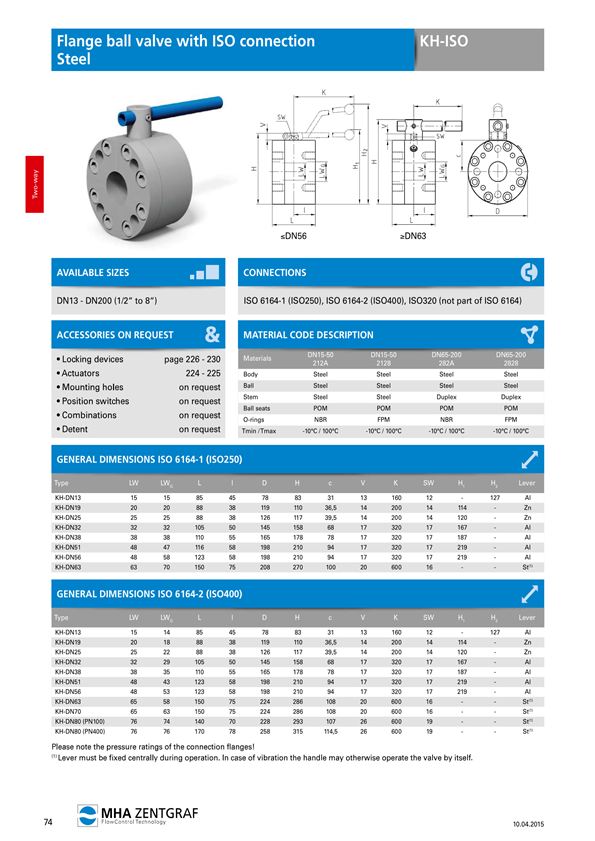
MHA Zentgraf KH‑ISO catalogue sheets dated 10.04.2015, steel and stainless. Bolt circle and weight in mm and kg. The stainless codes carry exactly the same ratings and dimensions as the steel — only the order numbers change, so there is no pressure penalty for specifying stainless on this valve.
Dimensions and the space it needs
Overall length, body diameter, and how far the lever sweeps.
L is the face‑to‑face length, D the body diameter, H the height to the top of the stem boss and K the lever length — which is the figure that catches people out, because a DN63 needs a 600 mm sweep to operate. SW is the spanner size across the stem.
| Type | Length L | Body dia. D | Height H | Lever K | Stem SW | Lever material |
|---|---|---|---|---|---|---|
| KH‑DN13 | 85 | 78 | 83 | 160 | 12 | Aluminium |
| KH‑DN19 | 88 | 119 | 110 | 200 | 14 | Zinc |
| KH‑DN25 | 88 | 126 | 117 | 200 | 14 | Zinc |
| KH‑DN32 | 105 | 145 | 158 | 320 | 17 | Aluminium |
| KH‑DN38 | 110 | 165 | 178 | 320 | 17 | Aluminium |
| KH‑DN51 | 116–123 | 198 | 210 | 320 | 17 | Aluminium |
| KH‑DN56 | 123 | 198 | 210 | 320 | 17 | Aluminium |
| KH‑DN63 | 150 | 208–224 | 270–286 | 600 | 16 | Steel |
| KH‑DN70 | 150 | 224 | 286 | 600 | 16 | Steel |
| KH‑DN80 | 140–170 | 228–258 | 293–315 | 600 | 19 | Steel |
Dimensions in mm. Where a range is shown, the ISO250 and ISO400 versions differ slightly — ask for the exact figure if the envelope is tight. The three steel‑lever sizes carry MHA’s own warning: “Lever must be fixed centrally during operation. In case of vibration the handle may otherwise operate the valve by itself.” On a 600 mm lever that is not a trivial risk.
Material codes — what the four digits mean
The code covers body, ball, stem, seats and seals as a set. Six of them apply here.
MHA describes a whole build in one code, and on the KH‑ISO there are six. What changes between them is the metal, the stem and the O‑ring compound — the ball seats are POM in every one, and so is the temperature range. Note the point that matters most: the large‑bore steel codes get a duplex stem, because the torque needed to turn a 3" ball under pressure is what breaks stems.
| Code | Sizes | Body & ball | Stem | Seats | O‑rings | Temperature |
|---|---|---|---|---|---|---|
212A | DN15–50 | Steel | Steel | POM | NBR | −10 / +100 °C |
2128 | DN15–50 | Steel | Steel | POM | FPM (Viton) | −10 / +100 °C |
282A | DN65–200 | Steel | Duplex | POM | NBR | −10 / +100 °C |
2828 | DN65–200 | Steel | Duplex | POM | FPM (Viton) | −10 / +100 °C |
442A | All | Stainless steel | Stainless steel | POM | NBR | −10 / +100 °C |
4428 | All | Stainless steel | Stainless steel | POM | FPM (Viton) | −10 / +100 °C |
- The last digit is the seal.
Ais NBR and8is FPM (Viton) across the whole family — so2128is the Viton version of212A, nothing else changes. Viton for hot oil, phosphate esters and aggressive media; NBR for ordinary mineral hydraulic oil. - 282A and 2828 are steel, not stainless. They are the large‑bore steel codes with a duplex stem. The stainless codes are 442A and 4428. It is an easy pair to mix up, and it changes both the price and the corrosion behaviour.
- No pressure penalty for stainless. 442A and 4428 carry the same PN and the same dimensions as the steel codes at every size — unlike the threaded check valve range, where the stainless body is capped lower.
- POM seats set the real limit. The temperature ceiling of +100 °C is the same on all six codes because it is the seats and the seals doing the sealing, not the body metal.
Bore, flow and what a class change costs you
Moving up to ISO400 buys pressure. It can also cost you bore.
The KH‑ISO publishes two bore figures: LW, the bore through the valve, and LW G, the bore through the flange connection. On the ISO250 face the two are effectively the same. On the ISO400 face LW G is consistently smaller — the higher‑pressure flange has more metal in it, so the hole through it is tighter. It is a small effect, but on a long run of large‑bore pipework it adds up, and it is the kind of thing that gets missed when a system is uprated from 250 to 400 bar.
| Type | Valve bore LW | Flange bore, ISO250 | Flange bore, ISO400 | What the class change costs |
|---|---|---|---|---|
| KH‑DN13 | 15 | 15 | 14 | 1 mm |
| KH‑DN19 | 20 | 20 | 18 | 2 mm |
| KH‑DN25 | 25 | 25 | 22 | 3 mm |
| KH‑DN32 | 32 | 32 | 29 | 3 mm |
| KH‑DN38 | 38 | 38 | 35 | 3 mm |
| KH‑DN51 | 48 | 47 | 43 | 4 mm |
| KH‑DN56 | 48 | 58 | 53 | 5 mm |
| KH‑DN63 | 63–65 | 70 | 58 | 12 mm |
- Going up a class does not give you more flow. It gives you more pressure. If the flow is what is short, go up a bore size instead — and check the PN table, because the larger bores on the ISO250 face come down to 250 bar.
- The DN63 is the one to watch. The flange bore falls from 70 to 58 mm between the two classes, which is a real restriction on a 2½" line. If you are uprating rather than building new, take the drop into account.
Accessories — decide these with the order
All of them are factory items. None of them is a retrofit.
MHA lists six accessory groups against the KH‑ISO, and they are worth going through at enquiry stage rather than after delivery: every one of them changes the valve itself, and a 225 kg DN150 is not something you want to send back for a mounting hole.
| Accessory | What it does | When you need it |
|---|---|---|
| Locking devices | Padlock the valve open or shut | Lock‑out procedures, safety isolation, anywhere the position must not be changed by hand |
| Actuators | Powered operation in place of the lever | Remote or automatic operation — and on the large bores, where manual torque is genuinely high |
| Mounting holes | Threaded holes in the body so the valve can be bolted to a frame or bracket | Any valve that has to be supported rather than hang on its pipework. Essential on the heavy sizes |
| Position switches | Electrical confirmation of open or shut | Interlocks, control systems, anything that must prove the valve state rather than assume it |
| Detent | A positive stop the lever clicks into | Where vibration could walk the lever off position — the same problem as the steel‑lever warning |
| Combinations | Two or more of the above, built together | Typically a locking device plus a position switch on a safety‑critical isolation |
All listed by MHA as on request, which in practice means confirmed with the factory at quotation. If you are specifying a bank of valves, decide the accessories once for the whole set — mixing them across a line is what creates spares problems later.
How to identify an ISO 6164 valve you already have
Count the bolts, measure the circle, read the code.
Three measurements place almost any KH‑ISO without needing the paperwork:
| Look at | What it tells you |
|---|---|
| The bolt count | Four bolts means DN13 to DN80 on any of the three faces. Eight bolts means one of the large ISO320 sizes — DN100, DN125, DN150 or DN200. That single observation halves the search. |
| The bolt circle | A rule across opposite bolt centres separates the three faces at the same nominal size. At 1" the circle is 62 mm on ISO250 and ISO400 but 72 mm on ISO320; at 1¼" it is 73 against 80. |
| The bolt thread | M8, M10, M12, M16, M20, M24, M30 or M36 — it climbs with size and, for a given size, with pattern. A 1¼" valve on M12 is ISO250 or ISO400; on M16 it is ISO320. |
| The body marking | MHA stamps the type, the size, the pattern and the material code. The code is where the useful detail is: 212A or 2128 for a small steel body, 282A or 2828 for a large steel one with a duplex stem, 442A or 4428 for stainless. |
| The lever | Aluminium up to DN13 and DN32–DN56, zinc on DN19 and DN25, steel and 600 mm long from DN63 up. A steel lever on a valve means you are in the big sizes. |
If the marking has worn away, send a photo of the flange face with a rule across the bolt centres and one of the body from the side. Between the bolt circle, the thread and the body diameter we can place it from the dimension table.
Fitting it
Two of these matter far more on a 200 kg valve than on a 3 kg one.
Before it goes in
- Confirm the pattern against the port — bolt count, bolt circle and thread. ISO250, ISO400 and ISO320 are three different faces and they do not interchange.
- Check the flange rating, not just the valve. MHA prints the reminder itself: the joint is limited by whichever half is weaker.
- Support the valve, do not hang it. From DN63 up you are bolting tens of kilograms into a pipe run; from DN125 up it is hundreds. Specify mounting holes and use them.
- Plan the lever sweep. A DN63 and above needs a 600 mm arc clear of structure, guards and other pipework — check it on the drawing, not on site.
- Clean both faces. An ISO flange joint seals on an O‑ring against a flat face; a scratch across the groove will weep however hard the bolts are pulled.
Operating it
- It is an isolator, not a regulator. Quarter turn, fully open or fully shut. Leaving a ball valve part open erodes the seat on the downstream edge and wrecks the shut‑off.
- Fix the lever centrally. On the steel‑lever sizes MHA warns that vibration can let the handle operate the valve by itself. Where that is a real risk, order the detent or a locking device.
- Expect real torque on the big bores. Turning a 3" ball against 400 bar is hard work, which is why the large steel codes use a duplex stem and why actuators are a listed accessory.
- Pull the flange bolts down evenly, in a cross pattern, to the flange maker’s torque for that size and pattern — not to the valve, which is not the sealing element.
- Watch the temperature. POM seats and the O‑rings cap the valve at +100 °C whatever the body is made of.
Why buy ISO 6164 ball valves from RFS Hydraulics
Six things that decide whether a valve order goes smoothly.
We read the pressure table for you
The pattern name is not the rating — an ISO250 valve runs from 350 down to 250 bar across its own range, and there are two different DN80 builds at 100 and 400 bar. We check your duty against your actual bore before quoting.
We get the material code right
282A and 2828 are steel with a duplex stem, not stainless — the stainless codes are 442A and 4428. It is the commonest confusion on this valve, and it changes both price and corrosion life.
Accessories decided up front
Locking devices, actuators, mounting holes, position switches and detent are all factory items. We raise them at quotation, because none of them can be added to a 225 kg valve after it lands.
German‑made and marked
MHA Zentgraf, with the type, size, pattern and material code stamped on the body — not an unbranded valve with a figure on the box. Works documentation on request.
Honest about lead time
This is a project product above the small bores. We tell you which sizes are on the floor and which come with a factory lead time, rather than quoting a shelf date on a 395 kg valve.
One price, delivered
Transport, currency, duties and taxes are already inside the figure we quote. Nothing is added at the end, and delivery within Malaysia is included.
Frequently asked questions
Thirteen, starting with the one that decides whether the valve bolts on.
What is the difference between ISO 6164‑1, ISO 6164‑2 and ISO320?
ISO 6164-1 is the ISO250 face and ISO 6164-2 is the ISO400 face — the two parts of the standard, named after their nominal pressure classes. ISO320 is a third face that MHA states plainly is not part of ISO 6164, and it matters because it is the only one of the three that carries the range above 3 inch, all the way to DN200 (8 inch). The three are different bolt circles and do not interchange: at 1 inch the circle is 62 mm on ISO250 and ISO400 but 72 mm on ISO320.
Is an ISO250 valve rated 250 bar?
Not necessarily — the pattern name is a class, not the valve rating. On the ISO250 face the valve is rated 350 bar at DN13 and DN19, 315 bar at DN25 and 250 bar from DN32 up. The ISO320 face is rated 350 bar, not 320. So the small sizes are better than their class name suggests and the large ones are exactly at it. Always read the row for your own bore.
Why are there two DN80 valves at different pressures?
Because MHA builds two: KH-DN80-ISO400 (PN100) at 100 bar and KH-DN80-ISO400 (PN400) at 400 bar. They share the same 175 mm bolt circle and the same 4 x M30 bolting, but the 400 bar version is heavier — 63 kg against 51 kg — because there is more metal in it. They look similar and they are not interchangeable in duty, so the PN has to be on the order. The ISO320 face has the same split at DN80.
How big does it go?
DN200, which is 8 inch — but only on the ISO320 face. The two proper ISO 6164 patterns stop at DN63 (ISO250) and DN80 (ISO400). Be ready for the weight: a DN150 is 225 kg and a DN200 is 395 kg, and above DN80 the flange goes to eight bolts rather than four.
Does the stainless version cost me pressure?
No. The stainless codes 442A and 4428 carry exactly the same PN and the same dimensions as the steel codes at every size — only the order numbers differ. That is worth knowing because it is not true of the threaded high pressure check valve range, where the stainless body is capped at 350 bar against 500 for the steel.
What do 212A, 2128, 282A, 2828, 442A and 4428 mean?
They are MHA material codes covering the whole build. 212A and 2128 are steel body, ball and stem at DN15 to DN50. 282A and 2828 are steel with a duplex stem at DN65 to DN200. 442A and 4428 are stainless throughout. The last character is the seal: A is NBR, 8 is FPM (Viton). Ball seats are POM and the temperature range is minus 10 to plus 100 degrees C in all six.
Are 282A and 2828 the stainless codes?
No — they are steel. They are the large‑bore steel codes, and the thing that changes at DN65 and above is the stem, which becomes duplex to carry the higher torque needed to turn a big ball under pressure. The stainless codes are 442A and 4428. This is the single commonest mix‑up on this product and it changes both the price and the corrosion behaviour, so it is worth confirming on the order.
Why does the stem change to duplex on the big sizes?
Torque. The force needed to break a ball away from its seats rises with the square of the bore and with the pressure behind it, and the stem is where all of that is concentrated. Duplex stainless has roughly double the yield strength of a standard austenitic grade, so MHA uses it from DN65 up in the steel ranges. It is also why actuators are a listed accessory on the large bores rather than a luxury.
Does moving from ISO250 to ISO400 give me more flow?
No, and it can cost you a little. The valve bore is much the same, but the flange bore is smaller on the ISO400 face because the higher‑pressure flange has more metal in it — 22 mm against 25 at DN25, and 58 mm against 70 mm at DN63. Going up a class buys pressure capability. If flow is what is short, go up a bore size and check the pressure table for the larger body.
Can it be used to throttle flow?
No. A ball valve is an isolator: fully open or fully shut. Held part open, the flow accelerates past the edge of the ball and erodes both the ball and the downstream seat, and once that has happened the valve will not shut off properly either. If you need to set a flow, use a needle valve and isolate separately with the ball valve.
How much room does the lever need?
More than people allow for. The lever length runs from 160 mm at DN13 to 600 mm from DN63 up, and it has to sweep a quarter circle clear of structure, guards and adjacent pipework. It is worth checking on the drawing. The same table gives the height to the top of the stem boss, from 83 mm to 315 mm, which is the other clearance people miss.
What is the warning about the lever and vibration?
MHA prints it against the steel‑lever sizes — DN63 and above: “Lever must be fixed centrally during operation. In case of vibration the handle may otherwise operate the valve by itself.” On a 600 mm lever with real mass on the end of it, vibration can walk the valve off position. Where that is a genuine risk, order the detent or a locking device — both are factory accessories and neither can be retrofitted.
Can I add mounting holes or an actuator later?
Not practically. Locking devices, actuators, mounting holes, position switches, detent and combinations are all listed by MHA as on request, meaning they are built into the valve at the factory. Decide them at enquiry stage — a 225 kg DN150 is not something you want to ship back for a threaded hole. If you are buying a bank of valves, settle the accessory specification once for the whole set.
Catalogues
Direct PDF download — no form, no email address.
Related: SAE flange end ball valves for the SAE pattern · threaded high pressure ball valves · bonded seals and retain rings for ISO 6164 joints.
Send the bore, the flange pattern, the pressure and the material.
Or a photo of the flange face with a rule across the bolt centres. A product specialist confirms the part number within two working hours.