
Home › Products › Accessories › GS Hydro retain rings
GS Hydro · ready stockGS Hydro retain rings in SS302 to ISO 6162 & ISO 6164, 1/2" to 14"
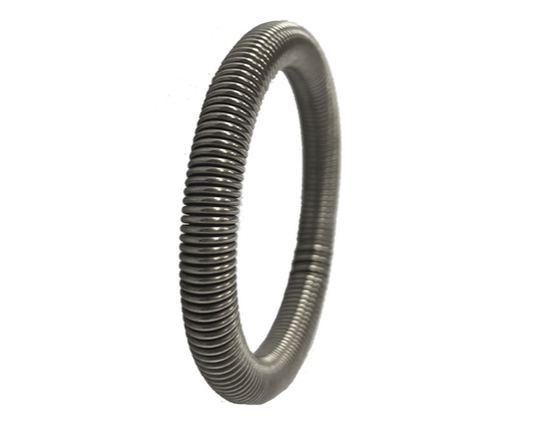
A stainless spring ring that drops into a machined groove on the pipe end and holds the flange there — so a high‑pressure pipe joint can be made up without welding. Flange sizes 1/2" to 14" on pipe from 26 mm to 355.6 mm, in SS302. The ring is only half the joint: it carries the load, and a separate seal does the sealing.
Get a quotation within 2 working hours
Send the part number, standard, size or quantity. Stock in Malaysia or Singapore, ISO 9001:2015 certified.
What a retain ring is, and when you need one
A spring in a groove, doing the job a weld would otherwise do.
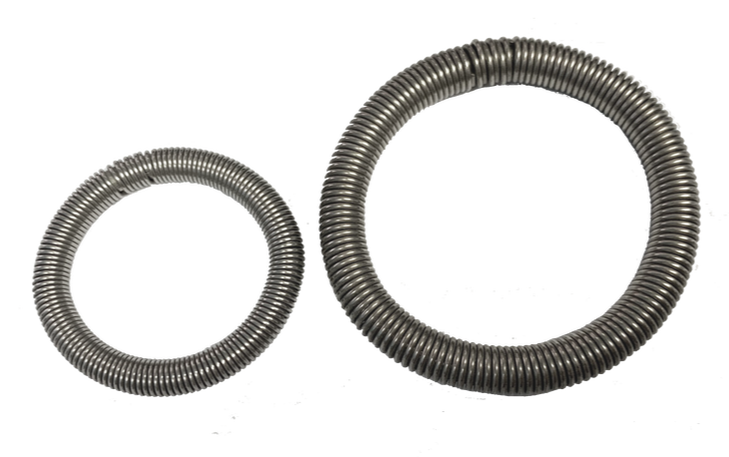
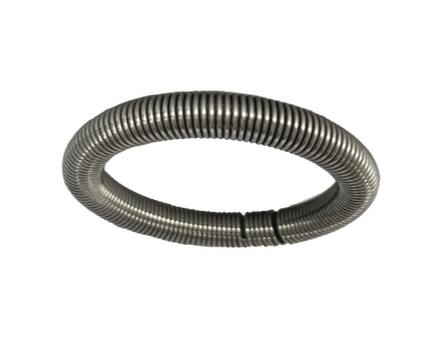
A retain ring is a close‑coiled stainless steel spring formed into a ring. A groove is machined round the outside of the pipe end, the flange is slid on, and the ring is stretched over the pipe and released into the groove behind the flange. From that moment the flange cannot come off, and when the bolts are pulled up the ring takes the axial load while the flanges and screws absorb shock. GS Hydro built a whole non‑welded piping system around this idea, and it runs to 690 bar on the ISO 6164 sizes.
The reason to use one is that it removes welding from the joint. No hot work permit, no weld inspection, no scale and slag to flush out of a hydraulic system afterwards, and the groove can be cut in a workshop or on site. It is used in pulp and paper, metals and mining, marine and offshore, sugar and test rigs — anywhere system integrity, fast installation and inherent cleanliness all matter at once. The one thing it does not do is seal: that is the bonded seal’s job.
| Retain ring (this page) | Bonded seal | A welded joint | |
|---|---|---|---|
| What it does | Holds the flange to the pipe and carries the axial load | Seals the face between the two pipe ends | Both, permanently |
| What it is | SS302 spring ring in a machined groove | Metal ring with rubber bonded to it | Weld metal |
| Hot work | None | None | Required, with a permit |
| Cleanliness | Inherently clean — no scale or slag to flush | Clean | Scale and spatter to remove |
| Can it be undone? | Yes — unbolt, slide the flange, lift the ring out | Yes, it is a wear part | No, it is cut out |
| Pressure here | To 690 bar on ISO 6164 | To 420 bar on SAE 6000 | Pipe‑limited |
| You need | Both a ring and a seal for every joint. Ordering one without the other is the commonest mistake on this product. | ||
Specification
Everything an enquiry needs, in one place.
| Function | Retaining ring for a non‑welded flanged pipe joint. Holds the flange to the pipe and carries the axial load |
| Maker | GS Hydro — the originator of the non‑welded GS piping system |
| Design standards | ISO 6162 (SAE J518) and ISO 6164 |
| Flange size range | 1/2" to 14" |
| Pipe size range | 26 mm to 355.6 mm outside diameter, by system — see the table |
| Working pressure | 210–350 bar on SAE 3000 · 420 bar on SAE 6000 · 210–690 bar on ISO 6164 |
| Ring material | SS302 stainless steel |
| Pipe end sizing | Metric pipe ends, or ANSI B36.10 / B36.19 pipe ends — different ring for each, same flange size |
| Seal | Separate part. Viton or NBR; a fire‑safe seal is used on process piping |
| Flange material | Hot‑dip galvanised or electro‑zinced carbon steel, stainless steel, or titanium |
| Suitable pipe | Any pipe with elongation above 20% — see which materials qualify |
| Fittings in the system | The same joint covers 3‑way tees, elbows and threaded adaptors, not just straight runs |
| Duty | Hydraulics, lubrication, hydrocarbon, high pressure air, water cleaning lines, mud and cement |
Buying GS retain rings in Malaysia and Singapore
Where the stock sits, what it costs to get it to you, and how fast it moves.
Stock, delivery and ordering
- Where the stock is — the office is in Kuala Lumpur, and rings are held in two warehouses: Johor Bahru and Singapore. Addresses and direct lines are on the contact page.
- Dispatch — stock items leave the same or next working day.
- The running sizes are the smaller ISO 6162 rings, 1/2" to 2". The large ISO 6164 rings and the 12" and 14" sizes come back with a lead time on the quote.
- Order the seal at the same time — a joint needs a ring and a bonded seal. They are separate part numbers.
- Delivery cost — already inside the product price, along with transport, currency conversion, duties and taxes. Nothing is added afterwards.
What moves where. Singapore is mostly marine, offshore and shipyard work. Malaysia is mills, mining and heavy hydraulics, where the non‑welded joint earns its keep on shutdown work.
How a retain ring enquiry runs
Five things and we can price it without going back and forth:
- Pipe outside diameter and wall — not the flange size on its own. The ring is sized on the pipe.
- Metric or ANSI pipe end — a 2" metric ring and a 2" ANSI ring are different parts.
- Which system — SAE 3000, SAE 6000 or ISO 6164. It sets the pressure and the flange.
- Working pressure — checked against the system, because 690 bar is an ISO 6164 figure and not a general one.
- Quantity of joints — so the seals and flanges can be quoted alongside.
A product specialist prices it within two working hours. Replacing rings on an existing system? Send the pipe OD and wall, and a photo of the groove if you have one open.
SAE 3000, SAE 6000 or ISO 6164?
Three systems. The pipe you have usually decides, and the pressure confirms it.
The retain ring joint exists in three flange systems, and they do not overlap much. The two SAE systems cover the smaller pipe at high pressure; ISO 6164 covers large bore and reaches the highest figure. Note that 690 bar belongs to ISO 6164 only — it is a specific‑application ceiling for that system, not a rating you can quote across the range.
| SAE 3000 | SAE 6000 | ISO 6164 | |
|---|---|---|---|
| Working pressure | 210–350 bar | 420 bar | 210–690 bar |
| Pipe outside diameter | 26–97 mm | 26–66 mm | 60.3–355.6 mm |
| Pipe wall | 6–12 mm | 6–8.5 mm | 11.04–41.4 mm |
| Flange size | 1/2"–3" | 1/2"–2" | 2"–12" |
| Flange standard | ISO 6162 / SAE J518 | ISO 6164 | |
| Choose it when | Standard high‑pressure hydraulics on pipe up to 3" | You need 420 bar and the pipe is 2" or under | The bore is 2" or larger, or you need above 420 bar |
- The heavy wall on ISO 6164 is not optional. A 690 bar joint needs 11 mm of wall at the bottom of the range and up to 41.4 mm at the top — the groove has to be cut into metal that is still thick enough afterwards.
- Flange size is not pipe size. A 2" flange sits on 66 mm metric pipe or 60.3 mm ANSI pipe, and the ring differs between the two. Always quote the pipe, not just the inch figure.
Sizes, part numbers and dimensions
Four tables, because the ring is sized on the pipe end — and pipe ends come metric or ANSI.
D is the ring inside diameter and S the wire section. The part number is the flange size in sixteenths of an inch — 08 is 1/2", 32 is 2", 48 is 3" — and on the ANSI rings the pipe outside diameter is appended, so 32/60.3 is a 2" ring for 60.3 mm pipe.
| ISO 6162 (SAE J518) — metric pipe ends | ||||
|---|---|---|---|---|
| Flange size | Part no. | Pipe (OD × wall) | Ring bore D | Wire S |
| 1/2" | 08 | 26 × 6 | 30 | 4 |
| 3/4" | 12 | 36 × 8 | 39.3 | 4 |
| 1" | 16 | 39 × 7.5 | 44 | 5 |
| 1¼" | 20 | 46 × 8 | 51 | 5 |
| 1½" | 24 | 56 × 8.5 | 61 | 5 |
| 2" | 32 | 66 × 8.5 | 71 | 5 |
| 2½" | 40 | 80 × 10 | 85 | 5 |
| 3" | 48 | 97 × 12 | 103 | 6 |
| ISO 6162 (SAE J518) — ANSI B36.10 / B36.19 pipe ends | ||||
|---|---|---|---|---|
| Flange size | Part no. | Pipe (OD × wall) | Ring bore D | Wire S |
| 1/2" | 08/21.3 | 21.3 × 7.5 | 25.5 | 4 |
| 3/4" | 12/26.7 | 26.7 × 7.8 | 30.4 | 4 |
| 1" | 16/33.4 | 33.4 × 9.1 | 38.4 | 5 |
| 1¼" | 20/42.2 | 42.2 × 9.7 | 47.4 | 5 |
| 1½" | 24/48.3 | 48.3 × 10.2 | 53.4 | 5 |
| 2" | 32/60.3 | 60.3 × 11.1 | 65.2 | 5 |
| 2½" | 40/73 | 73.0 × 14.02 | 77.9 | 5 |
| 3" | 48/88.9 | 88.9 × 15.2 | 94.7 | 6 |
| ISO 6164 — metric pipe ends | ||||
|---|---|---|---|---|
| Flange size | Part no. | Pipe (OD × wall) | Ring bore D | Wire S |
| 2" | 32 | 66 × 8.5 | 71 | 5 |
| 2½" | 40 | 80 × 10 | 85 | 5 |
| 3" | 48 | 97 × 12 | 103 | 6 |
| 4" | 56 | 115 × 15 | 123 | 8 |
| 4½" | 60 | 130 × 15 | 138 | 8 |
| 5" | 64 | 150 × 15 | 158 | 8 |
| 6" | 80 | 190 × 20 | 200 | 10 |
| 8" | 88 | 220 × 20 | 231.1 | 12 |
| 10" | 96 | 250 × 25 | 262 | 12 |
| ISO 6164 — ANSI B36.10 / B36.19 pipe ends | ||||
|---|---|---|---|---|
| Flange size | Part no. | Pipe OD | Ring bore D | Wire S |
| 2" | 32/60.3 | 60.3 | 65.2 | 5 |
| 2½" | 40/73.0 | 73.0 | 77.9 | 5 |
| 3" | 48/88.9 | 88.9 | 94.7 | 6 |
| 4" | 56 | 114.3 | 122.3 | 8 |
| 5" | 64/141.3 | 141.3 | 149.3 | 8 |
| 6" | 80/168.3 | 168.3 | 178.3 | 10 |
| 8" | 88 | 219.1 | 231.1 | 12 |
| 10" | 160 | 273.0 | 285 | 12 |
| 12" | 192/323.9 | 323.9 | On request | |
| 14" | 224/355.6 | 355.6 | On request | |
Dimensions in mm. Note that 2", 2½" and 3" appear in both standards with the same ring — the difference at those sizes is the flange, not the ring. The 12" and 14" sizes are quoted on request; they are the reason the headline range reaches 14" while the ISO 6164 flange table stops at 12".
What each part of the joint is made of
Four components, four material choices, and only one of them is the ring.
A retain ring joint is a set rather than a single part, and the material choice is made per component. The ring is always stainless; the flange and the seal are chosen for the environment and the medium.
| Part | Materials available | What decides it |
|---|---|---|
| Retain ring | Stainless steel — SS302 | Nothing to choose. It is stainless in every build, because it sits in a groove where corrosion would be invisible |
| Flange | Hot‑dip galvanised carbon steel, electro‑zinced carbon steel, stainless steel or titanium | The external environment. Galvanised for general plant, stainless or titanium for marine, offshore and chemical service |
| Seal | Viton (FPM) or NBR. A fire‑safe seal is used on process piping | The medium and the temperature. Viton for hot oil and aggressive media, NBR for ordinary mineral hydraulic oil |
| Pipe | See which pipe materials qualify | Elongation — the pipe has to be able to take a groove and stay sound |
- The ring is stainless for a reason. Once the flange is bolted up, the ring is buried in the groove and cannot be inspected. A carbon steel ring rusting in there would be a hidden failure, so it is not offered.
- The seal is the wear part. If a joint weeps, the seal is the first thing to change — the ring itself only fails if it has been kinked, over‑stretched or fitted into a groove that is out of tolerance.
Which pipe can take a retain ring groove
One number governs it: elongation above 20%.
Cutting a groove and then stretching a spring into it puts local strain into the pipe wall, and the pipe has to accommodate that without cracking. GS Hydro states the qualification plainly: any pipe material with elongation above 20%. That takes in a wider range of metals than most people expect, which is the reason the system turns up in chemical and offshore work as well as ordinary hydraulics.
| Pipe material | Typical use |
|---|---|
| Mild steel | The default for hydraulics and general plant |
| Galvanised steel | Water lines and washdown areas |
| Stainless and duplex | Corrosive service, food and chemical plant |
| Super duplex | Seawater and high‑chloride offshore service |
| Copper‑nickel | Marine seawater systems |
| Aluminium and brass | Weight‑sensitive and non‑sparking applications |
| Titanium | Offshore, chemical, and where weight and corrosion both matter |
| 4130 alloy steel | High‑strength duty — and the clearest example of the rule, since it qualifies on elongation rather than on grade |
- Check elongation, not the name. The list above is what GS Hydro names, but the governing figure is the 20% elongation in the pipe’s own certificate. A grade that fails that number is not suitable however familiar it looks.
- The wall matters as much as the material. The groove takes metal out, so the wall thickness ranges for each system are minimums to work to, not suggestions.
How the joint goes together
Five steps, no heat, and the load path is worth understanding before you cut anything.
| Step | What happens |
|---|---|
| 1 | Both pipe ends are pre‑worked: faced square, and a groove machined round the outside a set distance back from the end |
| 2 | The seal is placed between the two pipe ends — this is the only part that does any sealing |
| 3 | A flange is slid onto each pipe end, over the groove |
| 4 | The retain ring is stretched over the pipe and released into the groove, behind the flange. The flange can now no longer come off |
| 5 | The flange screws and washers are tightened, pressing the two pipe ends onto the seal |
Where the load goes
Understanding this is what stops a joint being assembled wrongly:
- The retain ring creates the tightness — it is the element holding the flange against the pressure trying to push the joint apart.
- The flanges and screws absorb the axial force and shock, transferring it into the ring.
- The seal sees no structural load. It only has to close the face.
GS Hydro’s own claim is that ring and flange together make a connection stronger than the pipe itself — which is to say the pipe, not the joint, becomes the weakest link.
Why this beats welding on site
- No hot work — no permit, no fire watch, no shutting down the area around the joint.
- No weld inspection — nothing to radiograph or dye‑penetrant test afterwards.
- Inherently clean — no scale, slag or spatter to flush out of a hydraulic system that will not tolerate it.
- Reversible — unbolt, slide the flange back, lift the ring out. A welded joint has to be cut.
- Fast — grooves can be prefabricated in the workshop, so site time is assembly only.
The groove — where the work actually is
Prefabricate it if you can. It is the one part of the joint with a tolerance that matters.
Everything about a retain ring joint depends on the groove being right. It has to be the correct depth and width for the wire section, the correct distance back from the pipe end, square to the axis, and clean. Get it right and the joint is stronger than the pipe; get it shallow and the ring pulls out under pressure.
Workshop or site?
- Prefabricated in the workshop is the preferred route — better control, better measurement, and the site work becomes pure assembly.
- Cut on site is entirely possible and is one of the system’s selling points, particularly on repairs and modifications where the pipe cannot be moved.
- Either way the pipe end is machined, not just grooved — the face has to be square for the seal to sit properly.
What to check before assembly
- Groove depth and width against the wire section for your size — 4 mm wire on a 1/2", up to 12 mm on a 10".
- Remaining wall thickness under the groove. This is why each system specifies a wall range.
- No burrs or sharp edges in the groove that could nick the ring as it settles in.
- Face square and clean, and the seal seat undamaged.
- The ring itself — unkinked, not over‑stretched, and the right part number for the pipe you actually have.
How to identify a retain ring you already have
Measure the wire and the bore. The part number follows from the pipe.
Retain rings are not usually marked — they are a coiled spring, with nowhere to stamp. So identification is by measurement, and there are only two figures that matter:
| Measure | What it tells you |
|---|---|
| Wire section S | The coarse filter. 4 mm means 1/2" or 3/4"; 5 mm covers 1" to 2½"; 6 mm is 3"; 8, 10 and 12 mm are the ISO 6164 sizes from 4" up |
| Ring bore D | Pins it exactly. Read it off the dimension tables — 71 mm is a 2" metric, 65.2 mm is a 2" ANSI |
| The pipe it came off | The most reliable route. Measure the pipe outside diameter and wall and the part number falls out of the table — and it also tells us metric from ANSI |
| The part number itself | Flange size in sixteenths: 08 = 1/2", 12 = 3/4", 16 = 1", 20 = 1¼", 24 = 1½", 32 = 2", 40 = 2½", 48 = 3", 56 = 4", 64 = 5", 80 = 6", 88 = 8". A suffix after a slash is the pipe OD, marking it as an ANSI ring |
So 32 is a 2" ring for 66 mm metric pipe and 32/60.3 is a 2" ring for 60.3 mm ANSI pipe. Same flange, same wire, different ring — and mixing them is the single commonest ordering error on this product.
Fitting it
The ring is a spring. Treat it like one.
Doing it right
- Slide the flange on first. The ring goes in behind it, and there is no way to fit the flange afterwards.
- Stretch the ring evenly as it goes over the pipe end — work it round rather than levering one point over.
- Check it has seated all the way round the groove before the bolts go anywhere near it. A ring sitting proud in one spot is a joint that will not hold.
- Fit a new seal. It is the cheapest part of the joint and the one that decides whether it weeps.
- Tighten the flange screws evenly, in a cross pattern, so the pipe ends come onto the seal square.
What ruins a ring
- Kinking it. A close‑coiled spring that has been bent sharply has lost its section locally and will not carry load evenly. It is scrap, not a repair.
- Over‑stretching. If it will not go over the pipe with reasonable effort, the part number is wrong — forcing it is not the answer.
- A burr in the groove. It will nick the wire as the ring settles and start a fatigue crack where nobody will ever see it.
- Reusing one that has been under pressure at full rating. Rings are cheap and buried; a new one on reassembly is a sensible default.
- The wrong pipe standard. A metric ring on ANSI pipe is loose in the groove, and that is a failure waiting for pressure.
Why buy GS retain rings from RFS Hydraulics
Six things that decide whether the order is right first time.
Ready stock on the running sizes
The smaller ISO 6162 rings, 1/2" to 2", are held in Johor Bahru and Singapore and dispatch the same or next working day. Large ISO 6164 rings come back with a lead time on the quote.
We ask for the pipe, not the inch size
The ring is sized on the pipe outside diameter and wall, and metric and ANSI rings differ at the same flange size. We confirm which you have before quoting, which is where this normally goes wrong.
The seal goes on the same quote
A joint is a ring and a bonded seal, and they are separate part numbers. We quote both rather than letting the second one turn up as a surprise on site.
Honest about 690 bar
690 bar is an ISO 6164 ceiling, not a figure that applies across the range — SAE 3000 tops out at 350 bar and SAE 6000 at 420. We quote the system you are actually building.
GS Hydro, the originator
The non‑welded GS piping system is where this joint comes from, in SS302 as specified. Not a look‑alike spring in a bag.
One price, delivered
Transport, currency, duties and taxes are already inside the figure we quote. Nothing is added at the end, and delivery within Malaysia is included.
Frequently asked questions
Twelve, starting with the one that causes the most wrong orders.
Is a retain ring the same thing as a bonded seal?
No — they are two different parts of the same joint, and you need both. The retain ring holds the flange to the pipe and carries the axial load; the bonded seal closes the face between the two pipe ends. The ring is a stainless spring in a machined groove, the seal is a metal ring with rubber bonded to it. Ordering one and not the other is the commonest mistake on this product.
What size ring do I need?
It depends on the pipe, not just the flange size. Measure the pipe outside diameter and wall thickness and read the part number off the tables — and tell us whether the pipe is metric or ANSI B36.10 / B36.19, because a 2 inch metric ring (66 mm pipe, ring bore 71 mm) and a 2 inch ANSI ring (60.3 mm pipe, ring bore 65.2 mm) are different parts on the same flange size.
Can it really hold 690 bar?
On the ISO 6164 system, yes — that system is rated 210 to 690 bar. But 690 bar is not a figure for the range as a whole: SAE 3000 runs 210 to 350 bar and SAE 6000 is 420 bar. The high number also comes with a heavy wall requirement, from 11.04 mm up to 41.4 mm on ISO 6164, because the groove has to be cut into metal that is still sound afterwards. Quote us the system and the pressure and we will confirm the combination.
What pipe can I use it on?
GS Hydro qualifies it on one number: any pipe with elongation above 20%. In practice that covers mild steel, galvanised steel, stainless, duplex and super duplex, copper-nickel, aluminium, brass, titanium and 4130 alloy steel. Check the elongation figure on the pipe certificate rather than going by grade name, and make sure the wall is inside the range for your system, because the groove takes metal out of it.
Do I have to weld anything?
No — that is the entire point of the system. The pipe end is faced and grooved, the flange slides on, the ring is stretched into the groove and the bolts are pulled up. No hot work permit, no fire watch, no weld inspection, and no scale or slag to flush out of a hydraulic system afterwards. It also means the joint can be taken apart again rather than cut out.
Where is the groove cut — workshop or site?
Either. Prefabricating in a workshop gives better control of depth, width and squareness, and reduces the site work to assembly. But the groove can also be machined on site, which is one of the system's real advantages on repairs and modifications where the pipe cannot be moved. Whichever route, the pipe end is machined as well as grooved — the face has to be square for the seal to seat.
What holds the pressure — the ring or the seal?
Both, doing different jobs. The retain ring creates the tightness and the flanges and screws absorb the axial force and shock, transferring it into the ring. The seal sees no structural load at all — it only closes the face. That division is why the seal is the wear part and the ring is not, and why GS Hydro can claim the assembled joint is stronger than the pipe itself.
Why is the ring always stainless?
Because once the flange is bolted up, the ring is buried in the groove and cannot be inspected. A carbon steel ring corroding in there would be a hidden failure with no warning, so GS supplies it in SS302 and does not offer an alternative. The flange, by contrast, is on the outside where you can see it, which is why that one comes in galvanised carbon steel, stainless or titanium depending on the environment.
Can I reuse a ring?
Mechanically it is often still sound, but it is not worth it. The ring is the cheapest structural part of the joint and the least accessible, so fitting a new one on reassembly is a sensible default. Definitely scrap it if it has been kinked or over‑stretched: a close-coiled spring that has been bent sharply has lost section locally, and it will not carry load evenly across the groove.
Which seal goes with it — Viton or NBR?
The medium and the temperature decide. NBR is right for ordinary mineral hydraulic oil; Viton (FPM) for hot oil, phosphate esters and more aggressive media. On process piping a fire-safe seal is used instead. Tell us the medium and the temperature with the ring order and we will match the seal rather than sending a default.
Does the system cover more than straight joints?
Yes. The same retain ring connection is used across a full range of flanged fittings — 3-way tees, elbows and threaded adaptors — so a whole pipe run can be built without welding rather than just the odd coupling. That is what makes it a piping system rather than a joint: the prefabrication advantage compounds over a run.
What sizes go above 10 inch?
12 inch and 14 inch rings exist for ANSI pipe at 323.9 mm and 355.6 mm outside diameter, and they are quoted on request rather than carried as standard references — which is why the range headline reads 14 inch while the flange table stops at 12. If you need either, send the pipe OD and wall and we will confirm availability and lead time with the factory.
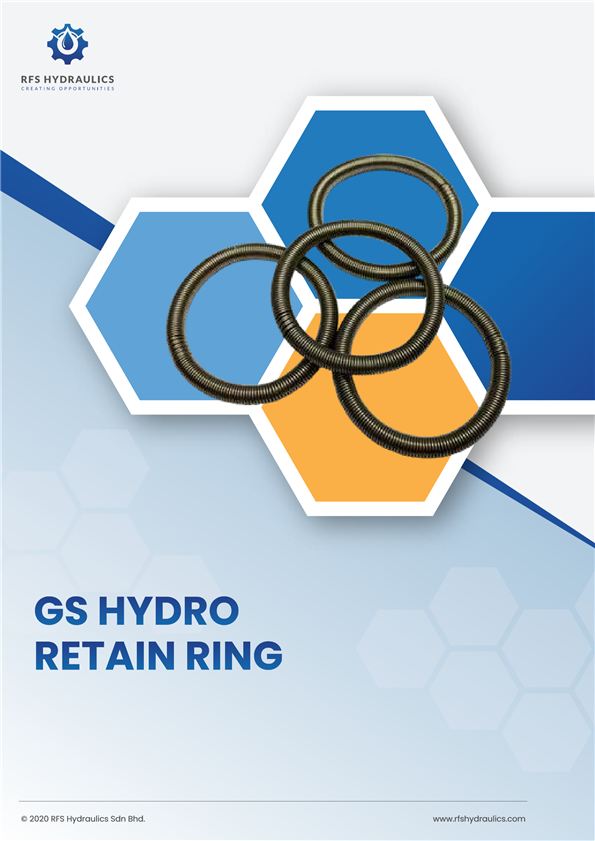
Catalogues
Direct PDF download — no form, no email address.
Related: bonded seals — the other half of the joint · SAE flanges · ISO 6164 ball valves for the same flange pattern.
Send the pipe outside diameter, the wall, and whether it is metric or ANSI.
That is enough to name the ring, the seal and the flange. A product specialist confirms it within two working hours.