
Home › Products › Low pressure valves › Ball valves › 1‑piece
Solid cast body · not serviceable1‑piece ball valve, SS316, 1/4" to 4"
A single casting: body and end connections from one piece of material, so there is no body joint to leak from. 1000 PSI in SS316, threaded BSPP or NPT, for −29 °C to 150 °C. Always reduced bore, and it cannot be opened for service — both consequences of that one casting.
Get a quotation within 2 working hours
Send the part number, standard, size or quantity. Stock in Malaysia or Singapore, ISO 9001:2015 certified.
What a one‑piece ball valve is
One casting. No body joint. No way in.
A one‑piece low pressure ball valve has its body and end connections made from a single piece of material. That single detail drives everything else about it. Because there is no seam between two halves of the body, the solid cast body significantly decreases the risk of leakage — there is simply no body joint to weep from. It is the tightest of the three constructions.
The trade‑off is access. The valve trim and seals are inserted through one of the end connections during manufacture, and that is the only route in. It follows that the port size cannot equal the line size — so valves of this design do not have a port size equal to the line size and are always reduced bore. It also means the valve cannot be taken apart: when the seat eventually wears, you replace the valve rather than re‑seat it.
- Fewest leak paths of the three. One casting, so the only sealing points are the two threads you make up and the stem. That is the reason to specify it.
- ⚠ Reduced bore is not optional here. At 1/2" the bore is 9 mm against a 15 mm pipe — roughly 36% of the flow area. If that matters, you need the two‑piece. The numbers at every size.
- Not serviceable, by design. Specify it where nobody will ever open the valve. If seat replacement is foreseeable, the two‑piece; if it has to happen without stopping the line, the three‑piece.
- IMPA coded. 75 24 11 to 75 24 18 across 1/4" to 2" in BSPP, so it can be ordered against a marine code rather than a supplier part number.
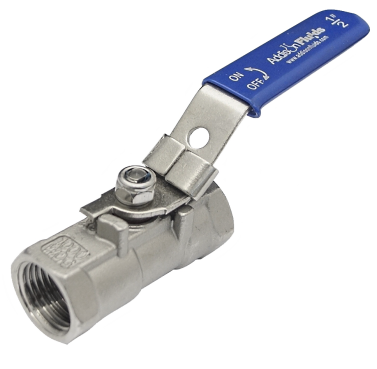
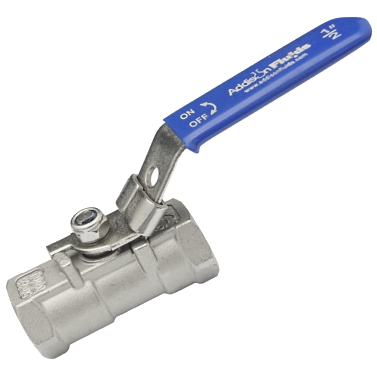
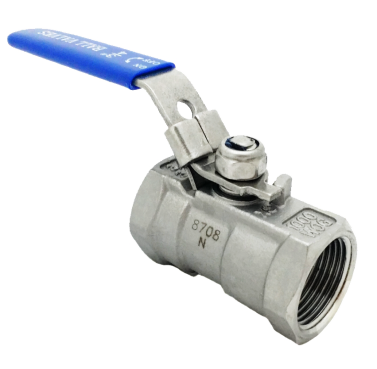
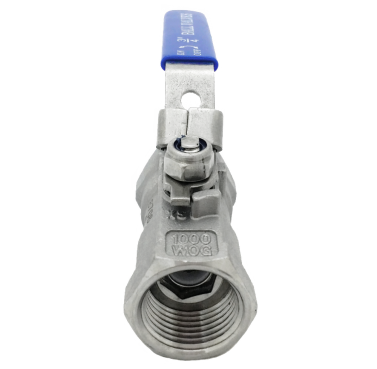
Four angles on the same valve. All photographs of the stocked item, not renders.
Specification
Everything that goes on a purchase order.
| Size range | 1/4" to 4" (DN8 to DN100) |
| Body construction | One piece — body and end connections from a single piece of material. Not serviceable |
| Bore | Reduced bore, always — why |
| Body material | Stainless steel SS316, with CF8M where the part is cast |
| Working pressure | 1000 PSI cold — 63 bar on the manufacturer’s curve, derating with temperature |
| Working temperature | −29 °C to 150 °C — 150 °C is a hard ceiling |
| Connection type | Threaded BSPP or NPT |
| Seat and seals | PTFE seat, seal gasket, stem seal and stem packing |
| Ball and stem | SS316, with an SS304 anti‑static device |
| Operation | Quarter turn manual lever |
| IMPA codes | 75 24 11 to 75 24 18 (1/4" to 2", BSPP) |
| Stock | Held in Malaysia or Singapore |
Bill of materials and sectional drawing
All 13 parts, what each is made of, and where each one sits.
| No | Part name | Material |
|---|---|---|
| 1 | Body | SS316 and CF8M |
| 2 | Cap | SS316 |
| 3 | Seat | PTFE |
| 4 | Ball | SS316 |
| 5 | Seal Gasket | PTFE |
| 6 | Stem Seal | PTFE |
| 7 | Stem | SS316 |
| 8 | Anti-static Device | SS304 |
| 9 | Stem Packing | PTFE |
| 10 | Packing Gland | SS304 |
| 11 | Spring Washer | SS301 |
| 12 | Handle | SS201 |
| 13 | Stem Nut | SS304 |
The manufacturer’s sectional drawing. The callout numbers correspond to the part numbers in the table above.
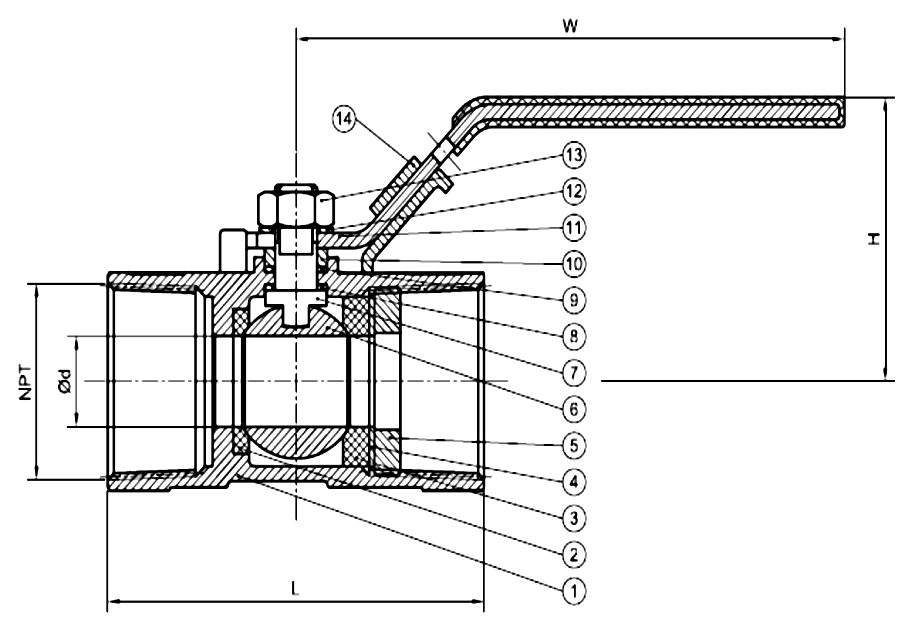
- Read the drawing with the table. The section is the quickest way to see why the bore is reduced: the ball, seats and stem all had to pass in through one end connection, so the ball cannot be over‑sized.
- ⚠ The drawing carries 14 callouts; the parts list has 13. Items 1 to 13 match, but the drawing marks a 14th item on the handle that the published table does not name. We have not guessed at it — ask us and we will confirm with the factory before you order spares.
- ⚠ The drawing calls the handle span W; the size table calls it E. Same dimension, different letter — the manufacturer is not consistent between the drawing and the table. Use the E column in the size table for the figure, and check it against your swing clearance.
- Everything wetted is SS316 or PTFE. Body, cap, ball and stem in SS316; seat, seal gasket, stem seal and stem packing in PTFE. If you need to know what touches your fluid, that is the whole list.
- CF8M is the cast grade of 316, not a lesser material — it is the correct specification for a cast valve body and is chemically equivalent to wrought 316.
- The anti‑static device matters on hydrocarbons. A ball turning on PTFE seats is electrically isolated from the body; the SS304 anti‑static device (item 8) bonds the ball and stem back to the body so charge cannot build up. It is standard here, not an option.
- Handle in SS201, gland and nuts in SS304, spring washer in SS301. Lower grades than the body, on parts outside the pressure boundary — normal practice, and worth knowing if the valve lives somewhere salty.
Sizes, dimensions and part numbers
BSPP and NPT share every dimension — only the part number changes.
Dimensions in millimetres, matching the letters on the sectional drawing. d is the actual bore through the ball, L the face‑to‑face length, H the height from the pipe centreline, and E the handle length — the drawing calls that one W. Check E against the space you have, because the lever needs a clear 90° sweep.
| Size | Bore d | Length L | Height H | Handle E | Weight (kg) | Part no, BSPP | Part no, NPT | IMPA, BSPP | IMPA, NPT |
|---|---|---|---|---|---|---|---|---|---|
| 1/4" | 5 | 40 | 24 | 72 | 0.07 | VL-S-B1-G-1000-04 | VL-S-B1-N-1000-04 | 75 24 11 | – |
| 3/8" | 7 | 45 | 27 | 80 | 0.10 | VL-S-B1-G-1000-06 | VL-S-B1-N-1000-06 | 75 24 12 | – |
| 1/2" | 9 | 57 | 34.5 | 97 | 0.20 | VL-S-B1-G-1000-08 | VL-S-B1-N-1000-08 | 75 24 13 | – |
| 3/4" | 12 | 60 | 40 | 92 | 0.26 | VL-S-B1-G-1000-12 | VL-S-B1-N-1000-12 | 75 24 14 | – |
| 1" | 15 | 70.5 | 44 | 125 | 0.40 | VL-S-B1-G-1000-16 | VL-S-B1-N-1000-16 | 75 24 15 | – |
| 1 1/4" | 20 | 78 | 50 | 125 | 0.70 | VL-S-B1-G-1000-20 | VL-S-B1-N-1000-20 | 75 24 16 | – |
| 1 1/2" | 25 | 83.5 | 54 | 155 | 0.80 | VL-S-B1-G-1000-24 | VL-S-B1-N-1000-24 | 75 24 17 | – |
| 2" | 32 | 99.5 | 60 | 155 | 1.28 | VL-S-B1-G-1000-32 | VL-S-B1-N-1000-32 | 75 24 18 | – |
| 2 1/2" | 38 | 122 | 87 | 183 | 2.34 | VL-S-B1-G-1000-40 | VL-S-B1-N-1000-40 | – | – |
| 3" | 50 | 148.5 | 97 | 183 | 3.50 | VL-S-B1-G-1000-48 | VL-S-B1-N-1000-48 | – | – |
| 4" | 65 | 193 | 117 | 220 | 9.05 | VL-S-B1-G-1000-64 | VL-S-B1-N-1000-64 | – | – |
- BSPP and NPT are dimensionally identical here. Every bore, length, height, handle and weight matches across the two thread forms — so the only thing that changes is the part number. We verified that row by row rather than assuming it.
- ⚠ BSPP and NPT are not interchangeable. They will start to engage and feel tight, then leak. If you are not certain which is on the existing pipework, send a photo before ordering.
- The bore is about one size down. A 1" valve has a 15 mm bore — the same as a 1/2" full‑bore valve. Size on flow, not on the thread. Flow area at every size.
- IMPA codes stop at 2". 75 24 11 through 75 24 18 cover 1/4" to 2" in BSPP; above that, and for NPT, order by part number.
- Weight climbs steeply at the top. 4" is 9.05 kg against 1.28 kg at 2" — worth knowing before it is specified for an overhead or unsupported position.
Pressure–temperature rating
1000 PSI is the cold figure. Here is the curve, and the same curve as numbers.
This valve is used in service from −29 °C to 150 °C, and the environment temperature affects the working pressure across that range. The limit is set by the PTFE seat (item 3 on the parts list), not by the stainless body — SS316 is untroubled by 150 °C, but PTFE softens as it warms and the seat is the part holding the pressure.
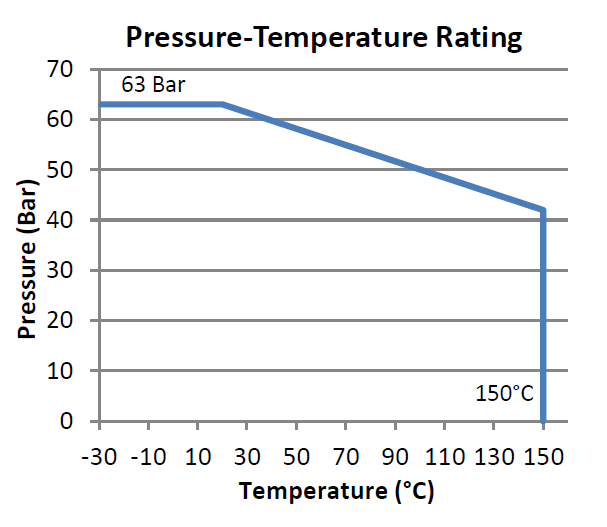
Read off that curve and interpolated along its straight section. Treat these as approximate figures for selection and ask us to confirm any duty close to the limit.
| Temperature | Working pressure | Approx. PSI | Share of the cold rating |
|---|---|---|---|
| −30 to +20 °C | 63 bar | 914 PSI | 100% |
| 40 °C | 59.8 bar | 867 PSI | 95% |
| 60 °C | 56.5 bar | 819 PSI | 90% |
| 80 °C | 53.3 bar | 773 PSI | 85% |
| 100 °C | 50.1 bar | 727 PSI | 80% |
| 120 °C | 46.8 bar | 679 PSI | 74% |
| 140 °C | 43.6 bar | 632 PSI | 69% |
| 150 °C | 42 bar | 609 PSI | 67% |
- ⚠ A third of the rating is gone by 150 °C. 63 bar cold, 42 bar hot — 67%. If you sized on the catalogue figure and the line runs warm, the margin you thought you had is not there.
- Nothing is lost below about 20 °C. The curve is flat from −30 °C, so ambient and chilled service get the full rating. Derating only begins once the line is warm.
- ⚠ 150 °C is a wall, not a taper. The curve drops vertically to zero there. Do not design a small margin beyond it.
- Rated 1000 PSI, with the derating curve drawn to 63 bar. Both are the manufacturer’s figures, quoted as printed. For duty near the limit, give us the pressure and temperature together and we confirm against the specific part number.
- The same curve applies across the stainless range. It is the PTFE seat that governs, and the two‑piece and three‑piece use the same seat material. The range‑wide view.
Not sure this is the right one?
Eight variants. Two questions separate them.
Choose the one‑piece when
- The valve will never be opened for service.
- Leak‑tightness matters more than flow area — no body joint at all.
- The duty is isolation: fully open or fully shut, where pressure drop across an open valve is irrelevant.
- You want the lowest‑cost stainless option in the range.
Choose something else when
- You need full bore → two‑piece or three‑piece.
- You need 2000 PSI → two‑piece, the only variant that reaches it.
- You need to service it without a line shutdown → three‑piece.
- You need to divert or mix rather than isolate → L‑port or T‑port.
- The duty is water or air at low pressure and cost rules → brass, but note it is 300 PSI.
- You need 1/8", or a compact body → SS316 mini or brass mini.
All eight, side by side: the comparison table. Other variants: 2‑piece · 3‑piece · L‑port · T‑port · Brass · Brass mini · SS316 mini.
Questions we get asked
The ones that come up on the phone.
What is a 1 piece ball valve?
A ball valve whose body and end connections are made from a single piece of material. The solid, cast body significantly decreases the risk of leakage because there is no body joint. The trim and seals are inserted through one of the end connections, which is why the port size cannot equal the line size and the valve is always reduced bore. The sectional drawing shows exactly why.
Is a 1 piece ball valve full bore or reduced bore?
Always reduced bore. It is a consequence of the construction, not an option — the trim has to pass through an end connection, so the ball cannot be over‑sized. At 1/2" the bore is 9 mm against 15 mm for a full‑bore valve, which is about 36% of the flow area. If you need full bore, use the two‑piece or three‑piece.
Can a 1 piece ball valve be repaired or re-seated?
No. There is no way into the body, so it cannot be disassembled — when the PTFE seat wears, the valve is replaced. That is the deliberate trade for having no body joint. If seat replacement is foreseeable, specify the two‑piece; if it must happen without stopping the line, the three‑piece.
When should I choose a 1 piece over a 2 piece ball valve?
When leak‑tightness matters more than flow and nobody will ever open the valve. The one‑piece has the fewest leak paths and is the cheapest of the three. Choose the two‑piece instead if you need full bore, if you may want to replace internal parts, or if you need 2000 PSI — which only the two‑piece offers.
What is the pressure-temperature rating?
63 bar at ambient, derating to about 42 bar at 150 °C — two thirds of the cold figure. The valve is dead at 150 °C. The limiting part is the PTFE seat, not the stainless body. For duty near the limit, give us the pressure and temperature together and we confirm against the specific part number. The full table and the graph.
Is there a drawing of the valve?
Yes — a sectional drawing is on this page, with numbered callouts that match the bill of materials and the dimensions L, H, W and the bore Ød marked. Two things to know: the drawing shows a 14th callout that the published parts table does not name, and it labels the handle span W where the size table calls it E.
What are the internal parts made of?
SS316 body, cap, ball and stem (CF8M where cast); PTFE seat, seal gasket, stem seal and stem packing; an SS304 anti‑static device and packing gland; SS301 spring washer; SS201 handle. The full numbered list, and the drawing it maps to, are on this page.
Do you supply it in BSPP and NPT?
Both, and they are dimensionally identical — every bore, length, height, handle length and weight matches across the two thread forms, so only the part number changes. They are not interchangeable with each other, though: a mismatched pair engages and feels tight, then leaks.
What sizes are held in stock?
1/4" to 4" (DN8 to DN100) in both BSPP and NPT, held in Malaysia or Singapore. Send the size and thread form and we will confirm availability and a landed price. The full dimension table is above.
Catalogue
Direct PDF download — no form, no email address.
Related: all ball valves · class 150 threaded fittings for the pipework · Y‑strainers to keep grit off the seat · all low pressure valves.
Send the size, the thread form and the service temperature
We will confirm the bore you are actually getting, give you the derated pressure rather than the catalogue figure, and quote a landed price. Stock in Malaysia and Singapore.