
Home › Products › Low pressure valves › Flange end ball valves › PN16/PN40 SS316 wafer type
1/2" to 4" · PN16 / PN40 · CF8M · ISO 5211PN16/PN40 SS316 wafer type ball valve, 1/2" to 4"
A full stainless ball valve in a wafer body — it bolts between two flanges instead of taking a flanged valve’s length. CF8M body, SS316 ball, PTFE seat, and a published ISO 5211 pad for an actuator.
Get a quotation within 2 working hours
Send the part number, standard, size or quantity. Stock in Malaysia or Singapore, ISO 9001:2015 certified.
A ball valve in a wafer body
Ball valve internals, butterfly valve footprint.
This is a quarter‑turn ball valve — a drilled ball turning between two PTFE seats, exactly like the threaded ball valves we stock. What is different is the body. Instead of two flanges of its own, it is a thin wafer with cast lugs, clamped between the two pipe flanges by their own bolts.
That gets you the sealing behaviour of a ball valve in roughly the space of a butterfly valve. At 4" this body is 152 mm face to face against about 394 mm for a flanged ball valve — and unlike a butterfly valve, nothing sits in the flow when it is open and the seat is PTFE rather than rubber, so oil is not a problem.
- ⚠ PN16 and PN40 differ at two sizes. For most of the range the two standards are dimensionally identical, but not at 2½" and 4"; the published table follows PN16. Check those two sizes before you order.
- It is actuator‑ready, and that is unusual here. The body carries a proper ISO 5211 mounting pad — F03 and F04 are cast into the top plate and the pad is drawn on the manufacturer’s section. Almost nothing else in our ball valve range publishes one.
- ⚠ A wafer body cannot sit at the end of a line. It is held only by the bolts passing either side of it. Take one flange off and nothing holds the valve — the same limitation as a wafer butterfly valve or a dual plate check valve.
- The O‑ring is FKM, not NBR. Different from most of our range. FKM (Viton) suits oils, fuels and many chemicals and is weaker on hot water and steam than EPDM. The seat, gasket, thrust washer and packing are all PTFE.
- Face‑to‑face carries a tolerance. The drawing gives it as L ±2 mm, not a fixed figure. On a tight replacement, that 4 mm band is worth knowing about before you cut anything.
Photographs of the stocked item, not renders.
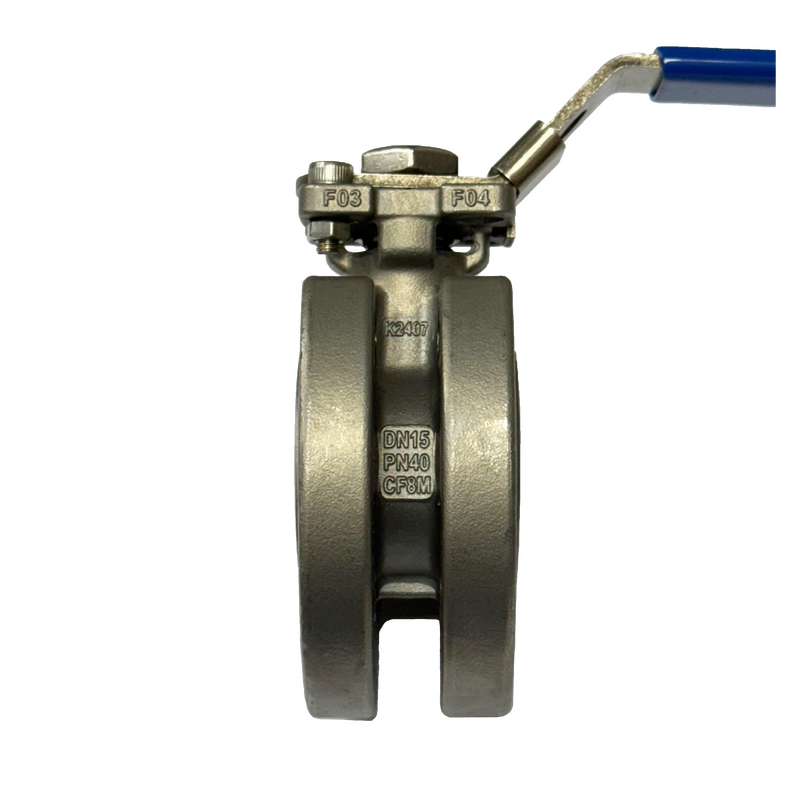
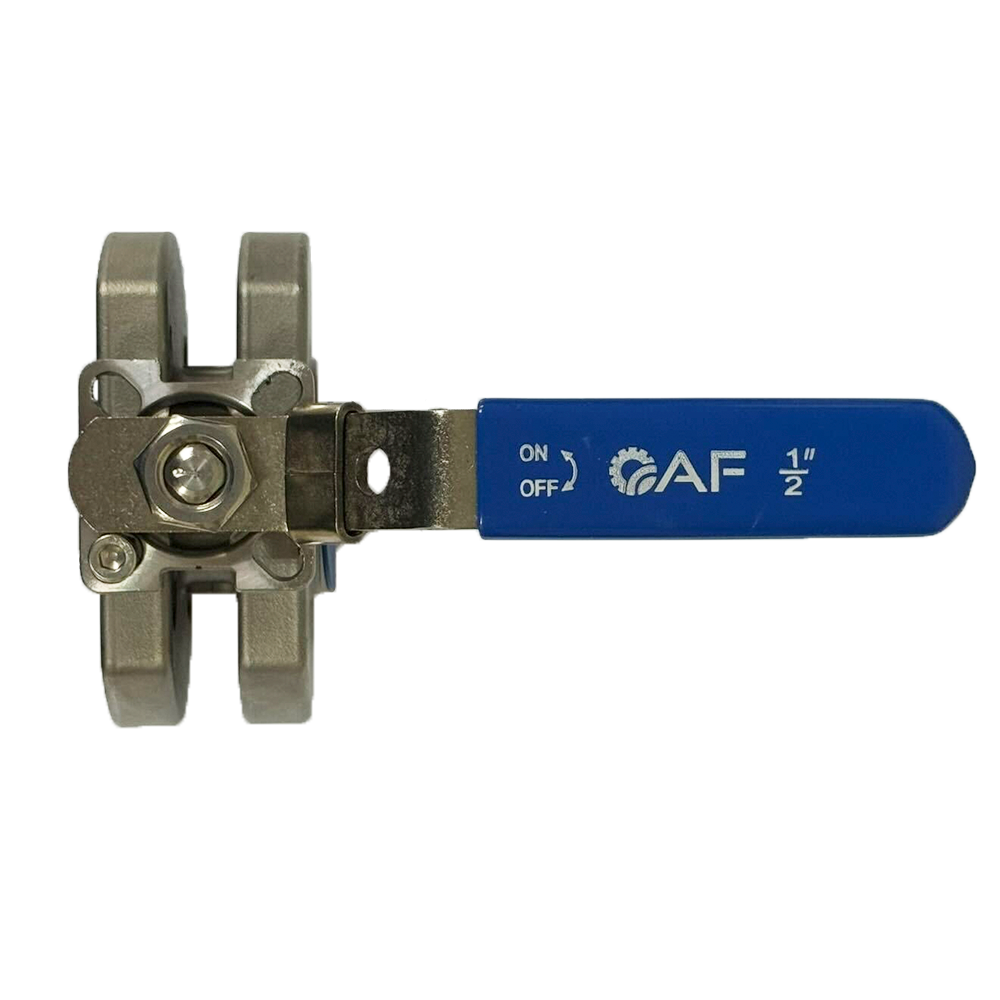
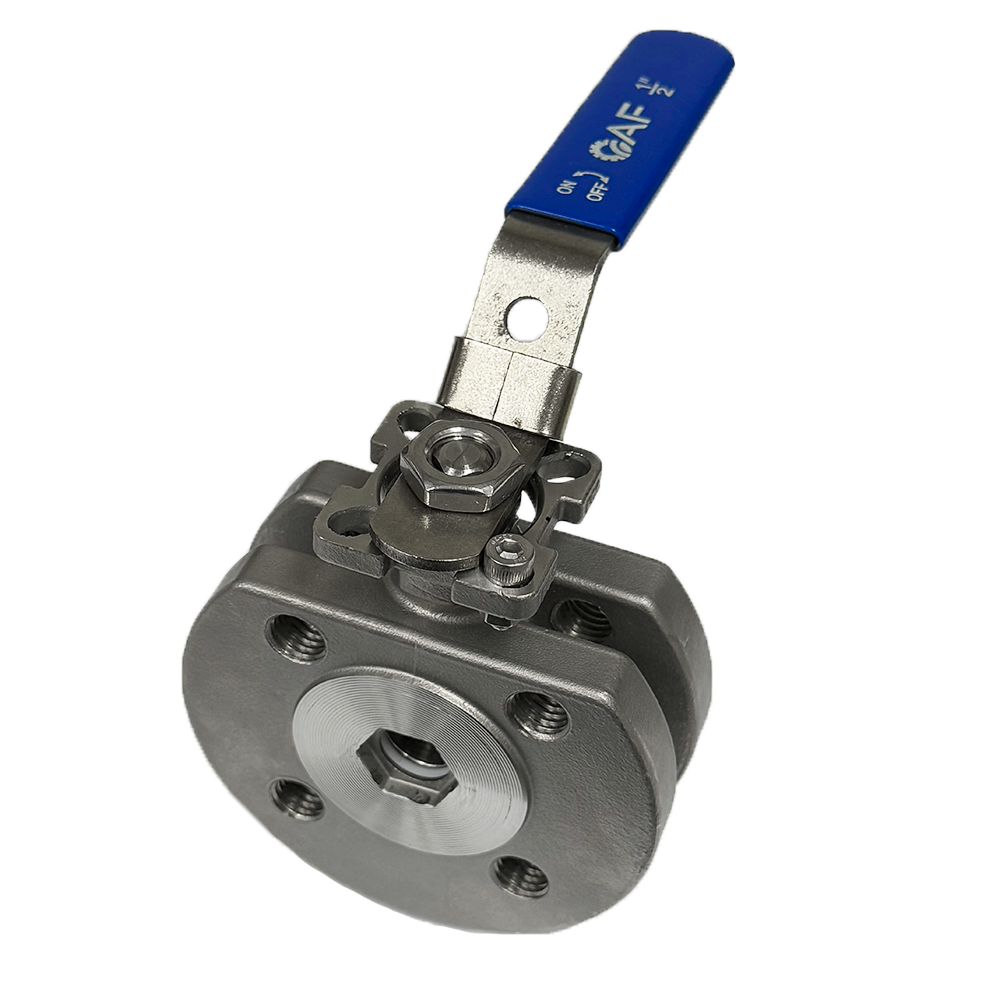
PN16 or PN40 — check two sizes
Identical at most sizes. Genuinely different at two of them.
The page is offered as PN16 / PN40, and for most of this range that is fine: EN 1092‑1 PN16 and PN40 share the same flange outside diameter and bolt circle from DN15 to DN80. But they diverge at the top of the range, and the published dimensions follow PN16 throughout.
| Size | Published D1 / D2 / bolts | PN16 | PN40 | Does the table fit PN40? |
|---|---|---|---|---|
| 1/2" to 2" | as published | same | same | Yes — the two standards are identical here |
| 2½" (DN65) | 185 / 145, 4 bolts | 185 / 145, 4 | 185 / 145, 8 | ⚠ Bolt count only. The circle matches; the hole count does not |
| 3" (DN80) | 200 / 160, 8 bolts | 200 / 160, 8 | 200 / 160, 8 | Yes |
| 4" (DN100) | 220 / 180 | 220 / 180 | 235 / 190 | ⚠ No. A PN40 flange at 4" is 15 mm larger on a 10 mm bigger bolt circle |
- ⚠ On PN40 pipework at 4", tell us it is PN40 and we confirm the correct body with the factory before anything ships — the published figures are PN16, and a PN40 DN100 flange is drilled differently.
- ⚠ At 2½" check the hole count, not the circle. Both standards use a 145 mm bolt circle, so a PN40 flange will sit correctly — but it has eight holes where the published figure is four. Four bolts through an eight‑hole flange is not a joint anyone should sign off.
- Everywhere else, the two standards genuinely are interchangeable on flange dimensions, which is why one valve can legitimately be offered for both. We are flagging the two sizes where that stops being true, not the principle.
- The pressure rating is the other half of the question. PN16 is 16 bar and PN40 is 40 bar — two and a half times as much. Send us the working pressure as well as the flange standard, because they are not the same question and this page does not resolve which body you are being quoted.
- The casting tells you what you have. The stocked valve in the first photograph reads “DN15 · PN40 · CF8M” — the rating is in the metal, so a valve already on your shelf can be identified without paperwork.
It is built to be actuated
The only valve in our ball valve range with a published ISO 5211 pad.
ISO 5211 is the standard that makes an actuator bolt to a valve without an adaptor: it fixes the bolt pattern, the pad diameter and the stem drive, and sizes are designated F03, F04, F05 and upward. If a valve and an actuator both state the same F number, they mate.
This body publishes one. F03 and F04 are cast into the top plate — you can read them in the first photograph — and the manufacturer’s section carries a dedicated ISO 5211 pad detail with the square drive drawn on it. That is a published interface, not an inference.
Why that matters here
- Our threaded ball valves publish no ISO 5211 pad at all — no pad size, no bolt pattern, no stem square. If you need to automate a ball valve from stock, this is the one that says how.
- Two pad sizes on one body. F03 and F04 cast together means the smaller sizes accept either, which widens the range of actuators that will fit.
- The lever comes off. Take the handle and nut off the stem and the pad is what is underneath — the same arrangement as the top flange on our butterfly valves.
- Quarter turn suits automation. 90° of travel is what pneumatic and electric quarter‑turn actuators are built for, unlike a multi‑turn gate or globe valve.
What we still need to check
- Which F size applies to your size. F03 and F04 are cast on the body we photographed at DN15; the manufacturer does not publish a size‑by‑size pad table, so we confirm the pad for the size you want.
- The stem square across the sizes. The section shows a square drive but does not dimension it per size.
- Torque. No breakaway or running torque figure is published, and an actuator has to be sized on torque. Tell us and we will get it — guessing this is how undersized actuators get bought.
- Send us the actuator — make, model and F size — and we will confirm it mates before you order either half.
Wafer ball, flanged ball, or butterfly
Three ways to put a quarter-turn valve into flanged pipework.
| Wafer ball valve | Flanged ball valve | Butterfly valve | |
|---|---|---|---|
| Length at 4" | 152 mm ±2 | About 394 mm | 24 to 28 mm |
| In the flow when open | Nothing — clear through the ball | Nothing | The disc, always |
| Seat | PTFE | PTFE | EPDM rubber — and it is the pressure boundary |
| Oil and fuel | Yes — PTFE seat, FKM O‑ring | Yes | ⚠ No — EPDM swells in mineral oil |
| Body | CF8M stainless | SS316 or cast steel | Cast iron with a CF8 disc |
| Flange standard | PN16 / PN40 — with a caveat at 2½" and 4" | ANSI 150, ANSI 300, JIS 10K, PN10/16 | ANSI 150 drilling |
| Actuator pad | ISO 5211 F03 / F04, published | Not published | Top flange published |
| End of a line | ⚠ No — wafer body | Yes | Lug type yes, wafer no |
| Choose it when | The run is short and the duty needs a ball valve — oil, tight shut‑off, or automation | You have the length, or need ANSI/JIS flanges, or dead‑end service | Large bore water where cost and space rule |
- This valve exists for one situation: flanged pipework, not enough room for a flanged ball valve, and a duty a butterfly valve cannot take — oil, a tight shut‑off requirement, or a full‑bore path.
- If the fluid is water and the bore is large, the butterfly valve is cheaper and shorter. We would say so.
- If you have 400 mm of straight pipe and need ANSI or JIS flanges, use a flanged ball valve — this one is PN only.
- All three need something upstream. A Y‑strainer keeps grit off a PTFE seat, and grit on a PTFE seat is what scores it.
Specification
Everything that goes on a purchase order.
| Size range | 1/2" to 4" (DN15 to DN100) — nine sizes |
| Body style | Wafer — clamped between two pipe flanges. It cannot terminate a run |
| Flange standard | PN16 / PN40 — the published dimensions follow PN16; check 2½" and 4" |
| Body and cap | CF8M — cast 316 stainless |
| Ball | SS316 |
| Stem | F316 forged stainless |
| Seat | PTFE |
| Gland | SS316 |
| O‑ring | FKM — suits oils and fuels, weaker than EPDM on hot water and steam |
| Gasket, thrust washer, packing | PTFE throughout |
| Operation | Quarter turn lever, marked ON / OFF |
| Actuator mounting | ISO 5211, F03 and F04 cast into the top plate — what we confirm before you order |
| Face‑to‑face | 42 to 152 mm, published as L ±2 mm |
| Parts in the list | 10 |
| Not published | No working temperature, no test pressures, no weights, no torque figures — we obtain these from the factory on request |
| Catalogue | The manufacturer’s PDF (6.7 MB) |
| Fit upstream | A Y‑strainer — grit is what scores a PTFE seat |
| Stock | Held in Malaysia or Singapore |
Bill of materials
All 10 parts. Everything in the pressure boundary is stainless or PTFE.
| No | Part name | Material |
|---|---|---|
| 1 | Body | CF8M |
| 2 | Cap | CF8M |
| 3 | Joint Gasket | PTFE |
| 4 | Ball | SS316 |
| 5 | Seat | PTEF |
| 6 | Stem | F316 |
| 7 | Thrust Washer | PTFE |
| 8 | O-Ring | FKM |
| 9 | Packing | PTFE |
| 10 | Gland | SS316 |
The manufacturer’s sectional drawing. The callout numbers correspond to the item numbers above, and the inset is the ISO 5211 pad.
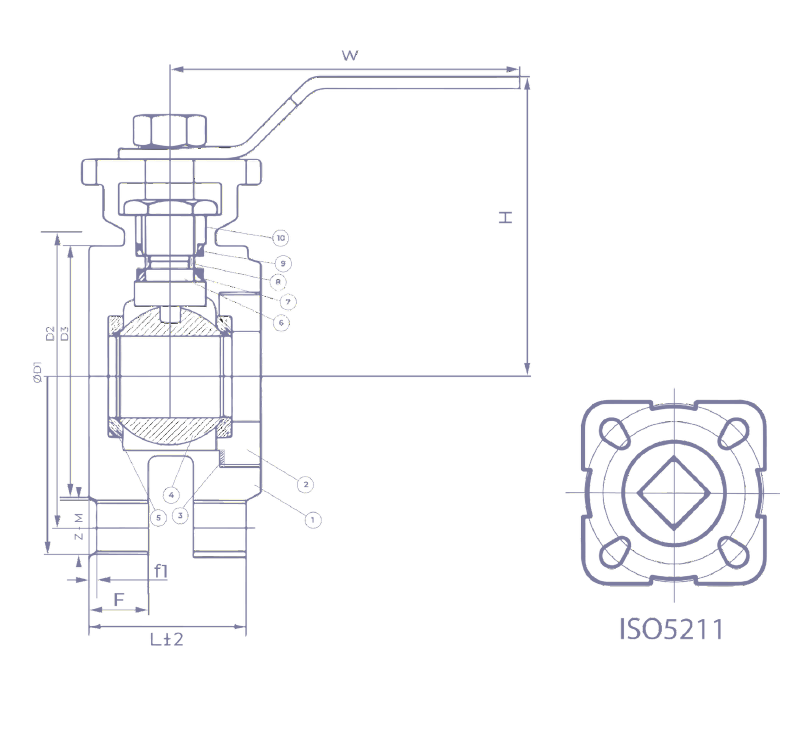
- Everything wetted is CF8M, SS316 or PTFE. Body and cap in CF8M, ball and gland in SS316, stem in F316, and the seat, joint gasket, thrust washer and packing all in PTFE. There is no lower‑grade fastener hiding in this list.
- ⚠ The O‑ring is FKM, and it is the one non‑PTFE seal. FKM — Viton — is good with oils, fuels and many chemicals and weaker on hot water and steam than EPDM. It is also the part to name if you are asking us about an unusual fluid.
- Item 5 is printed “PTEF” in the catalogue — the material is PTFE, the same as items 3, 7 and 9.
- A PTFE seat sets the temperature, and none is published here. Across our range PTFE‑seated ball valves are rated to 150 °C, but this variant states no figure and we will not attribute another valve’s number to it. Ask us.
Sizes and dimensions
9 sizes. Dimensions in millimetres, to PN16.
Read D1 and D2 against your flange — outside diameter and bolt circle — and Z‑M for the number and size of bolts. L is the gap the valve needs in the run, and it is published ±2 mm. W is how far the handle sweeps, which is the dimension people forget in a crowded plant room.
| Size | Part no | DN | Flange OD D1 | Bolt circle D2 | Seal face D3 | Face‑to‑face L ±2 | Flange thk F | Raised face f1 | Bolts Z‑M | Handle W | Height H |
|---|---|---|---|---|---|---|---|---|---|---|---|
| 1/2" | VL-B-S-T-F-08 | 15 | 95 | 65 | 45 | 42 | 16 | 2 | 4-12 | 130 | 79 |
| 3/4" | VL-B-S-T-F-12 | 20 | 105 | 75 | 58 | 45 | 18 | 2 | 4-12 | 130 | 82 |
| 1" | VL-B-S-T-F-16 | 25 | 115 | 85 | 68 | 51 | 18 | 2 | 4-12 | 165 | 94 |
| 1 1/4" | VL-B-S-T-F-20 | 32 | 140 | 100 | 78 | 59 | 18 | 2 | 4-16 | 165 | 100 |
| 1 1/2" | VL-B-S-T-F-24 | 40 | 150 | 110 | 88 | 64 | 18 | 2 | 4-16 | 185 | 118 |
| 2" | VL-B-S-T-F-32 | 50 | 165 | 125 | 102 | 79 | 20 | 2 | 4-16 | 185 | 125 |
| 2 1/2" | VL-B-S-T-F-40 | 65 | 185 | 145 | 122 | 112 | 18 | 3 | 4-16 | 290 | 146 |
| 3" | VL-B-S-T-F-48 | 80 | 200 | 160 | 138 | 121 | 20 | 3 | 8-16 | 325 | 167 |
| 4" | VL-B-S-T-F-64 | 100 | 220 | 180 | 158 | 152 | 20 | 3 | 8-16 | 325 | 180 |
- ⚠ These are PN16 figures. They are also correct for PN40 from 1/2" to 3", because the two standards share flange dimensions there — but not at 2½" for bolt count, and not at 4" at all. The comparison.
- ⚠ Face‑to‑face is a tolerance, not a target. L ±2 mm means a 4 mm band. On a replacement into an existing gap, measure the valve coming out.
- Leave room for the handle. W reaches 325 mm at 3" and 4", and it needs a clear 90° sweep. If it is tight, that is an argument for an actuator rather than a shorter lever.
- The jump in handle length is at 2½". 185 mm at 2" becomes 290 mm at 2½" — the torque needed to turn the ball rises faster than the size does.
- Hold it while you bolt up. A wafer body is centred by the flange bolts and has nothing of its own to hang on.
Questions we get asked
The ones that come up on the phone.
What is a wafer type ball valve?
A quarter‑turn ball valve whose body is a thin wafer with cast lugs rather than a pair of flanges. The flange bolts pass either side of it and clamp it between your two pipe flanges. You get ball valve internals — a drilled ball between PTFE seats, nothing in the flow when open — in roughly the length of a butterfly valve. At 4" this body is 152 mm against about 394 mm for a flanged ball valve.
Is it PN16 or PN40?
Both are offered, and for 1/2" to 3" that is genuinely fine — EN 1092‑1 PN16 and PN40 share the same flange outside diameter and bolt circle at those sizes. But the published dimensions follow PN16, and the two standards diverge twice: at 2½" PN40 uses eight bolts where the table gives four, and at 4" PN40 is 235 mm on a 190 mm bolt circle against the table’s 220 / 180. Tell us which standard your pipework is and we will confirm the body before anything ships. The full comparison.
Can I fit an actuator to it?
Yes, and this is the one ball valve in our range that says how. The body carries an ISO 5211 mounting pad with F03 and F04 cast into the top plate, and the manufacturer’s section includes a dedicated pad detail with the square drive. Our threaded ball valves publish no pad at all. What is not published is the torque, and an actuator has to be sized on torque — so send us the actuator make and model and we will confirm both the pad and the torque with the factory. The detail.
Can it sit at the end of a line?
No. A wafer body is held only by the bolts passing either side of it. Remove one flange and nothing holds the valve. For dead‑end service you need a flanged body — see our flange end ball valves — or a lugged valve. Same limitation as a wafer butterfly valve or a dual plate check valve.
Why choose this over a butterfly valve? They are both short.
Three reasons. Nothing sits in the flow when a ball valve is open, where a butterfly disc stays in the stream even fully open. The seat is PTFE, not rubber, so oil and fuel are fine — an EPDM‑seated butterfly valve is ruled out on oil. And the body is CF8M stainless rather than cast iron. The butterfly valve is shorter still and cheaper at large bore, so on plain water it is usually the better buy. Side by side.
What temperature can it take?
Not published for this variant, and we are not going to borrow a figure from another valve. What we can say is that the seat, gasket, thrust washer and packing are all PTFE and the one other soft part is an FKM O‑ring — so the ceiling will be set by those rather than by the CF8M body. Across the rest of our range PTFE‑seated ball valves are rated to 150 °C. Tell us your temperature and we will get the real number.
Can I use it on oil or fuel?
Yes. The seat is PTFE and the O‑ring is FKM (Viton), which is the combination you want for oils, fuels and many chemicals. This is the main thing that separates it from a butterfly valve of similar length, whose EPDM seat swells in mineral oil — and on a butterfly valve that seat is the pressure boundary.
Can the handle be locked?
The lever carries a slotted tab that looks made for a padlock, visible in the second photograph — but no locking option is published in the catalogue, so we are describing what we can see rather than confirming a specification. If your site procedure needs a valve that can be padlocked shut, say so at enquiry and we will confirm it with the factory.
What does the marking on the body mean?
The stocked valve is cast “DN15 · PN40 · CF8M” with a heat number above it, and F03 / F04 on the top plate. That is nominal size, pressure rating, material, the melt the casting came from, and the ISO 5211 pad sizes — enough to identify a valve already on your wall with no paperwork at all. The heat number is also what makes a material certificate possible later.
What sizes do you hold in stock?
1/2" to 4" (DN15 to DN100), held in Malaysia or Singapore and supplied across Malaysia and Singapore. Send the size, whether your flanges are PN16 or PN40, the working pressure, the fluid and the temperature — and whether it needs to be actuated. We will confirm availability and quote a landed price with transport, duties and taxes already inside the figure.
Catalogue
Direct PDF download — no form, no email address.
Tell us PN16 or PN40 — it is not a detail
At 2½" and 4" the two standards genuinely differ and the published table follows PN16. Send the size, the flange standard, the working pressure and the fluid, and say if it needs an actuator. Stock in Malaysia and Singapore.