
Home › Products › Low pressure valves › Gate valves › JIS 10K cast iron
JIS 10K flange ASME B16.10JIS 10K cast iron gate valve, 2" to 6"
A rising‑stem gate valve for isolation, with JIS 10K flange ends, 2" to 6" (DN50 to DN150), in Cast iron ASTM A126 B. Rated 10K, built to ASME B16.10 and tested to API 598. Graphite packed — isolation duty only, never throttling.
Get a quotation within 2 working hours
Send the part number, standard, size or quantity. Stock in Malaysia or Singapore, ISO 9001:2015 certified.
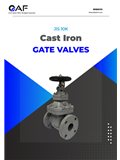
The JIS 10K cast iron gate valve
Isolation duty, JIS 10K flange ends, built to ASME B16.10.
A rising‑stem gate valve for isolation, with JIS 10K flange ends, in 2" to 6" (DN50 to DN150). The body is Cast iron ASTM A126 B, rated 10K, designed and manufactured to ASME B16.10 with ends to JIS B2212 and inspection and testing to API 598.
Fully open, the gate lifts clear of the bore and the valve presents almost no restriction and almost no pressure drop. That is what a gate valve is for. It is not a throttling valve: held part‑open, flow across the partly‑raised gate vibrates it and erodes both gate and seat, and the damage is permanent. To regulate flow, use a globe valve.
- ⚠ Isolation only. Fully open or fully shut — never throttle a gate valve. A throttled gate eventually will not shut off at all.
- ⚠ JIS 10K will not bolt to ANSI 150. Both sit near 1.6–2 MPa, which is what makes this an expensive mix‑up. Match the bolt circle on the pipework, not the pressure. The ANSI equivalent is here.
- ⚠ Cast iron is brittle. No impact, bending load or thermal shock. Support the pipework; do not let the valve carry it.
- Rated 429 °C, as the catalogue states. For hot service ask us to confirm the figure for your duty, or specify cast steel.
- Two size bands, 2" to 4" and 5" and 6", each with its own parts list and dimension table. The larger band adds a raised‑face dimension the smaller one does not publish.
- Tested to 2.06 MPa shell and 1.57 MPa seal, with gas tightness at 0.6 MPa. Proof tests, not working pressures. The figures.
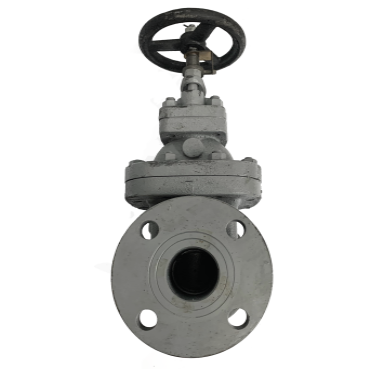
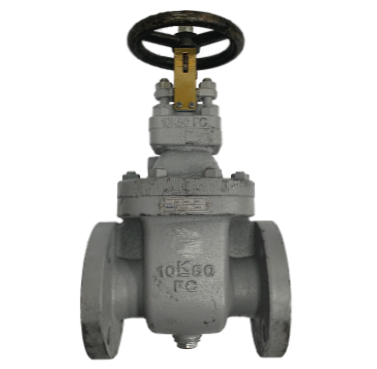
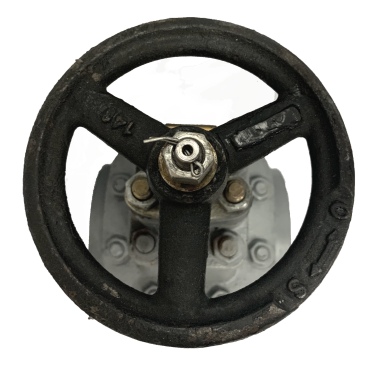
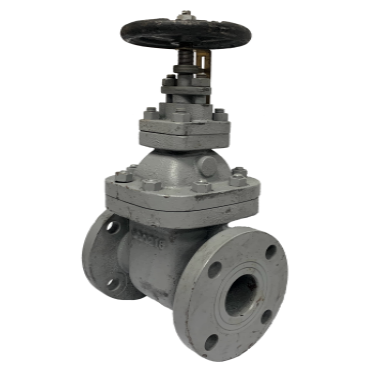
Four angles on the same valve. All photographs of the stocked item, not renders.
Specification
Everything that goes on a purchase order.
| Size range | 2" to 6" (DN50 to DN150) |
| End type | JIS 10K flange — to JIS B2212 |
| Body material | Cast iron ASTM A126 B |
| Working pressure | 10K |
| Maximum working temperature | 429 °C as published |
| Design and manufacture | ASME B16.10 |
| Inspection and test | API 598 |
| Shell or body test | 2.06 MPa |
| Seal test | 1.57 MPa |
| Gas tightness test | 0.6 MPa |
| Stem | Rising stem, handwheel operated, multi‑turn |
| Packing | Graphite |
| Duty | Isolation only — never for throttling. For throttling use globe valves |
| Stock | Held in Malaysia or Singapore |
Bill of materials — 2" to 4"
All 21 parts, with the manufacturer’s own item numbers.
| No | Part name | Material |
|---|---|---|
| 1 | Body | ASTM A126 B + SS |
| 2 | Wedge | ASTM A126 B + SS |
| 3 | Stem Nut | ASTM A276 410 |
| 4 | Stem | ASTM A276 410 |
| 5 | Bolts | ASTM A29 1035 |
| 6 | Nuts | ASTM A29 1025 |
| 7 | Gasket | SS304+Graphite |
| 8 | Bonnet | ASTM A126 B |
| 9 | Gasket | Flexible Graphite |
| 10 | Thrust Washer | SS |
| 11 | Yoke | ASTM A126 B |
| 12 | Packing | Flexible Graphite |
| 13 | Nuts | ASTM A29 1025 |
| 14 | Bolts | ASTM A29 1035 |
| 15 | Pin | ASTM A29 1025 |
| 16 | Packing Gland | ASTM A276 410 |
| 17 | Gland Flange | ASTM A126 B |
| 18 | Nuts | ASTM A29 1025 |
| 19 | Eye Bolts | ASTM A29 1035 |
| 20 | Handwheel | ASTM A47 32510 |
| 21 | Nut | ASTM A29 1025 |
- The item numbers are the manufacturer’s, taken from the sectional drawing rather than renumbered 1 to 21. We publish them as printed so a spares order matches the drawing.
- Graphite packing is what allows the temperature rating. A gate valve seats metal to metal and packs the stem with graphite — no PTFE in the pressure boundary, which is why this range goes far past a ball valve.
Sizes and dimensions — 2" to 4"
4 sizes. Dimensions in millimetres.
Letters follow the manufacturer’s drawing. L is the face‑to‑face length and the figure that decides whether the valve drops into your run; H is the height with the stem risen. Where a letter is ambiguous we have left it exactly as published rather than guess at it.
| Size | Part no | Bore d | Face‑to‑face L | O | Handwheel W | Bolts n‑z | Flange thk t |
|---|---|---|---|---|---|---|---|
| 2" | VL-CI-GA-F-10K-32 | 50 | 200 | 155 | 120 | 4- 19 | 20 |
| 2 1/2" | VL-CI-GA-F-10K-40 | 65 | 220 | 175 | 140 | 4- 19 | 22 |
| 3" | VL-CI-GA-F-10K-48 | 80 | 230 | 185 | 150 | 8- 19 | 22 |
| 4" | VL-CI-GA-F-10K-64 | 100 | 250 | 210 | 175 | 8- 19 | 24 |
- ⚠ Allow headroom above the height figure. This is a rising stem valve — the stem and handwheel travel up as it opens, and you need clearance above that plus room to turn the wheel.
- Measure the gap in the run against L, and on a replacement measure the valve coming out rather than trusting a drawing.
Test pressures — 2" to 4"
Factory proof tests. Not working pressures.
| Normal Pressure | 10K |
| Hydraulic Body Test | 2.06 MPa |
| Seal Test | 1.57 MPa |
| Hermetical Seal Test | 0.6 MPa |
| Max Working Pressure | 429&°;C |
- ⚠ Do not design to these. They are proof tests well above the working rating — the body or shell test proves the casting or forging, the seal test proves the gate against its seat.
- Inspected and tested to API 598, the standard common to all ten gate valve variants, which is what makes these figures comparable across the range. All ten.
Bill of materials — 5" and 6"
All 17 parts, with the manufacturer’s own item numbers.
| No | Part name | Material |
|---|---|---|
| 1 | Body | ASTM A126 B + SS304 |
| 2 | Wedge | ASTM A126 B + SS304 |
| 3 | Stem | ASTM A276 304 |
| 4 | Bolts | ASTM A29 1035 |
| 5 | Nuts | ASTM A29 1025 |
| 6 | Gasket | SS304+Graphite |
| 7 | Bonnet | ASTM A126 B |
| 8 | Packing | Flexible Graphite |
| 9 | Pin | ASTM A29 1045 |
| 10 | Packing Gland | ASTM A276 304 |
| 11 | Gland Flange | ASTM A126 B |
| 12 | Eye Bolts | ASTM A29 1035 |
| 13 | Nuts | ASTM A29 1025 |
| 14 | Stem Nut | ASTM A276 410 |
| 15 | Cover | ASTM A29 1025 |
| 16 | Handwheel | ASTM A47 32510 |
| 17 | Nut | ASTM A29 1025 |
- The item numbers are the manufacturer’s, taken from the sectional drawing rather than renumbered 1 to 17. We publish them as printed so a spares order matches the drawing.
- Graphite packing is what allows the temperature rating. A gate valve seats metal to metal and packs the stem with graphite — no PTFE in the pressure boundary, which is why this range goes far past a ball valve.
Sizes and dimensions — 5" and 6"
2 sizes. Dimensions in millimetres.
Letters follow the manufacturer’s drawing. L is the face‑to‑face length and the figure that decides whether the valve drops into your run; H is the height with the stem risen. Where a letter is ambiguous we have left it exactly as published rather than guess at it.
| Size | Part no | Bore d | Face‑to‑face L | O | Handwheel W | Bolts n‑z | Flange thk t | RF height f |
|---|---|---|---|---|---|---|---|---|
| 5" | VL-CI-GA-F-10K-80 | 125 | 250 | 250 | 216 | 8- 22 | 23.9 | 2 |
| 6" | VL-CI-GA-F-10K-96 | 150 | 270 | 280 | 241.5 | 8- 22 | 25.4 | 2 |
- ⚠ Allow headroom above the height figure. This is a rising stem valve — the stem and handwheel travel up as it opens, and you need clearance above that plus room to turn the wheel.
- Measure the gap in the run against L, and on a replacement measure the valve coming out rather than trusting a drawing.
Test pressures — 5" and 6"
Factory proof tests. Not working pressures.
| Normal Pressure | 10K |
| Hydraulic Body Test | 2.06 MPa |
| Seal Test | 1.57 MPa |
| Hermetical Seal Test | 0.6 MPa |
| Max Working Pressure | 429&°;C |
- ⚠ Do not design to these. They are proof tests well above the working rating — the body or shell test proves the casting or forging, the seal test proves the gate against its seat.
- Inspected and tested to API 598, the standard common to all ten gate valve variants, which is what makes these figures comparable across the range. All ten.
Not sure this is the right one?
End type first, then material, then pressure.
Choose this one when
- Your pipework is JIS 10K flange — checked, not assumed.
- The duty suits Cast iron ASTM A126 B.
- 10K covers the working pressure.
- Your specification names ASME B16.10.
- You need to isolate, not regulate.
Choose something else when
- You need to throttle → globe valves. A gate valve will be damaged doing it.
- You need fast, frequent isolation → ball valves, a quarter turn instead of many.
- Your pipework is a different end type or flange standard → pick by end type.
- You need more pressure at small bore → the threaded or socket weld forged valves at 800 PSI.
- You need corrosion resistance → an SS316 variant.
- You need larger than 6" → butterfly valves.
All ten, side by side: the comparison table. Other variants: ANSI 150 cast iron · ANSI 150 cast steel · ANSI 150 forged steel · ANSI 150 SS316 · JIS 10K SS316 · Threaded forged steel · Threaded SS316 200 PSI · Threaded SS316 800 PSI · Weld end forged steel.
Questions we get asked
The ones that come up on the phone.
What is the JIS 10K cast iron gate valve?
A rising‑stem gate valve for isolation duty with JIS 10K flange ends, 2" to 6" (DN50 to DN150), in Cast iron ASTM A126 B, rated 10K. Designed and manufactured to ASME B16.10, ends to JIS B2212, inspected and tested to API 598. Tested at 2.06 MPa shell and 1.57 MPa seal.
Can I use it to control flow?
No. It is an isolation valve — fully open or fully shut. Held part‑open, flow across the partly‑raised gate makes it vibrate and erodes both the gate and its seat, and that damage is permanent: a throttled gate valve eventually will not shut off at all. To regulate flow use a globe valve.
What temperature will it take?
429 °C as published. Gate valves reach this because they seat metal to metal and pack the stem with graphite — there is no PTFE in the pressure boundary. A PTFE‑seated ball valve stops at 150 °C. All ten compared.
Will it fit my pipework?
Only if your pipework is JIS 10K flange. ANSI 150 and JIS 10K are rated similarly and will not bolt to one another — the bolt circles differ. Count the bolt holes and measure the bolt circle on the mating flange, or send us a photo. You also need the face‑to‑face L to match the gap in the run.
What is it made of?
Cast iron ASTM A126 B. The full numbered parts list is on this page, with the manufacturer’s own item numbers preserved so a spares order matches the drawing. ⚠ Cast iron is brittle — no impact, bending load or thermal shock, and it must not carry pipe load.
Why is it rated 10K?
The JIS 10K flange rating sets it, not the body. A flanged Class 150 or 10K joint is the limiting element — which is why the threaded and socket weld valves in the same range reach 800 PSI from a similar body.
Do I need extra height above the valve?
Yes. This is a rising stem valve — the stem and handwheel travel up as it opens. Allow clearance above the published height plus room to turn the wheel. It is the dimension most often forgotten when replacing a valve in a tight space.
Gate valve or ball valve?
Temperature and speed decide it. Gate valves in this range work to 425 °C because they seal metal‑to‑metal with graphite packing; the PTFE‑seated ball valves stop at 150 °C. But a ball valve is a quarter turn and a gate valve is many turns. For hot service, gate. For fast or frequent isolation, ball.
What sizes do you hold in stock?
2" to 6" (DN50 to DN150), held in Malaysia or Singapore. Send the size and the end type and we will confirm availability and a landed price — transport, currency, duties and taxes already inside the figure.
Catalogue
Direct PDF download — no form, no email address.
Send the end type, the size and the temperature
We will confirm the JIS 10K flange actually matches your pipework, check the temperature against this variant, tell you if a globe valve is the right tool instead, and quote a landed price. Stock in Malaysia and Singapore.