
Home › Products › Low pressure valves › Swing check valves › Threaded brass
NPT threaded - 200 PSI on 1/2 inch and 2 1/2 inch, 300 PSI on the other seven as publishedThreaded brass swing check valve, 1/2" to 4"
A swing check valve in 1/2" to 4" (DN15 to DN100) with NPT threaded ends and a body in Brass throughout. Rated 200 PSI on 1/2" and 2½", 300 PSI on the other seven as published. One moving part and no handle — the flow operates it.
Get a quotation within 2 working hours
Send the part number, standard, size or quantity. Stock in Malaysia or Singapore, ISO 9001:2015 certified.
The Threaded brass swing check valve
NPT threaded ends, Brass throughout.
A swing check valve in 1/2" to 4" (DN15 to DN100), with NPT threaded ends and a body in Brass throughout. The gasket is PTFE. Rated 200 PSI on 1/2" and 2½", 300 PSI on the other seven as published for service at not published.
It is a disc on a hinge. Forward flow pushes it open and holds it clear of the bore; when flow stops or reverses, the disc swings shut under its own weight and the backpressure behind it. Nothing operates it — no handle, no stem, no actuator — which makes it the cheapest way to stop a stopped pump being spun backwards, and the least visible when it stops working. How it works, in full.
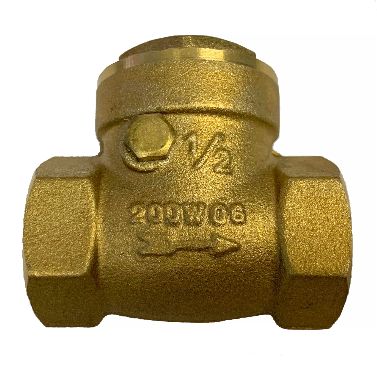
- The rating is carried in the part number. Seven of the nine sizes read ‑300‑ and two read ‑200‑ — the 1/2", which has “200 WOG” cast into the body (visible in the first photograph above), and the 2½". State the size on your enquiry and the rating is confirmed on the quotation.
- The rating is the PSI figure in the part number and in the casting. The catalogue does not print a test table or a working temperature for this variant; we obtain shell and seal figures from the factory on request.
- The range is 1/2" to 4", DN15 to DN100, with full dimensions and part numbers for every size.
- Brass all the way through, including the pin. Body, disc, cap, pin, plain washer and bolt are all brass, with PTFE gaskets. That means no galvanic pair inside the valve — and also no corrosion resistance beyond what brass gives you. On anything aggressive, use the SS316 version.
- ⚠ Brass and hot water do not mix indefinitely. Dezincification thins brass over time in some water chemistries, and there is no published temperature limit for this valve to design against. On heating circuits or anything above ambient, we would use stainless.
- Weights are published for every size, from 0.13 kg at 1/2" to 4.20 kg at 4" — a fraction of the flanged equivalents. A 4" brass check valve weighs less than a 1½" flanged one.
- NPT only. No BSPT option on this variant. If your pipework is BSPT, the threaded SS316 valve offers both thread forms.
- ⚠ Fit a Y‑strainer upstream. A flake of scale between disc and seat holds the disc fractionally open, and the valve then passes reverse flow while looking perfectly normal from outside. There is no stem position or indicator to check. A strainer is the single most effective thing you can do for a check valve.
- Orientation is not optional. Flow follows the arrow cast into the body; on a horizontal run the bonnet points up; on a vertical run flow must be upward. Never on downward flow — use a spring check for that. The three rules.
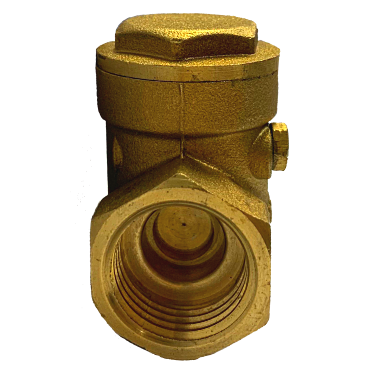
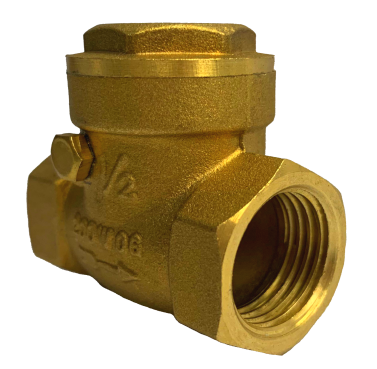
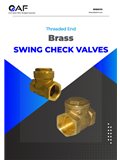
Four angles on the same valve. Photographs of the stocked item, not renders.
Specification
Everything that goes on a purchase order.
| Size range | 1/2" to 4" (DN15 to DN100) |
| End connection | NPT threaded |
| Working pressure | 200 PSI on 1/2" and 2½", 300 PSI on the other seven as published |
| Working temperature | not published |
| Body and disc | Brass throughout |
| Gasket | PTFE |
| Shell test | not published |
| Seal test | not published |
| Moving parts | One — the disc, on its hinge pin |
| Parts in the list | 8 |
| Operation | Automatic. No handle, stem or actuator |
| Orientation | Flow follows the cast arrow · bonnet up on a horizontal run · flow upward on a vertical run — see fitting |
| Not an isolating valve | Fit a gate valve or ball valve as well if you need to shut the line |
| Catalogue | The manufacturer’s PDF for this variant |
| Stock | Held in Malaysia or Singapore |
Bill of materials
All 8 parts, and only one of them moves.
| No | Part name | Material |
|---|---|---|
| 1 | Body | Brass |
| 2 | Disc | Brass |
| 3 | Cap | Brass |
| 4 | Body Gasket | PTFE |
| 5 | Pin | Brass |
| 6 | Plain Washer | Brass |
| 7 | Bolt | Brass |
| 8 | Gasket | PTFE |
The manufacturer’s sectional drawing. The callout numbers correspond to the item numbers in the parts list.
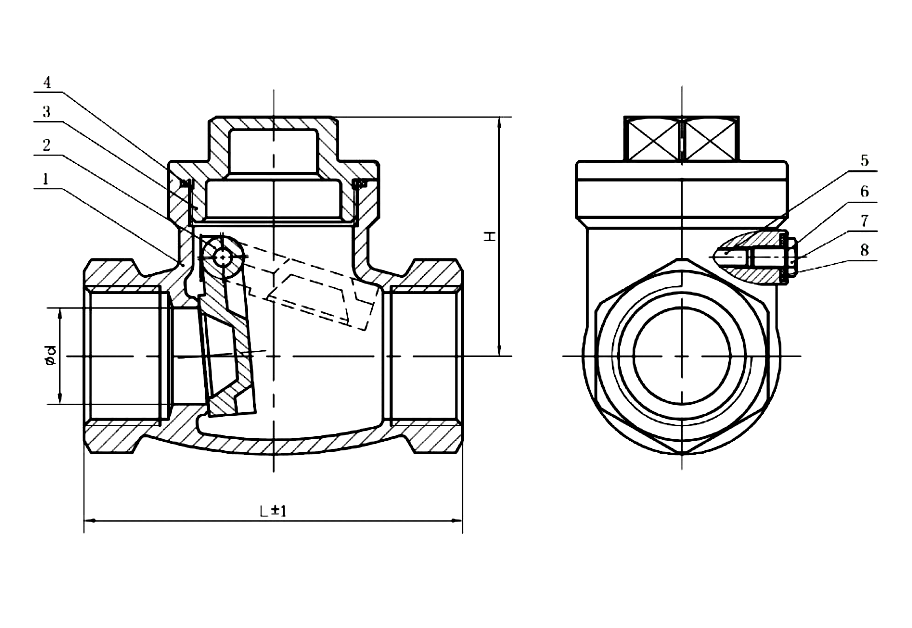
- The disc and the seat face are what wear. Everything else is a casting or a fastener. On a valve that closes every time the pump stops, those two surfaces take the whole duty cycle.
- The hinge pin is the other one to ask about. A disc that chatters — which happens when the valve is oversized for the flow — wears the pin, and a worn pin lets the disc sit crooked on the seat.
- The item numbers are the manufacturer’s, matching the callouts on the drawing above, so a spares order matches the section.
- Everything here is published, not on request. If you need to know what touches your fluid, the whole list is above.
Sizes and dimensions
9 sizes. Dimensions in millimetres.
The dimension that decides whether it fits is face‑to‑face L — the gap it needs in the pipe run. On a swing check you also need headroom above the valve, because the disc, hinge and pin come out upward through the bonnet or cap. Letters follow the manufacturer’s drawing; where a letter is ambiguous or mislabelled we say so rather than guess.
| Size | Thread | Part no | Length L | Height H | Bore d | Weight (kg) |
|---|---|---|---|---|---|---|
| 1/2" | NPT | VL-B-SC-N-200-08 | 45 | 31 | 12.8 | 0.13 |
| 3/4" | NPT | VL-B-SC-N-300-12 | 55 | 36 | 17.0 | 0.18 |
| 1" | NPT | VL-B-SC-N-300-16 | 61.5 | 43 | 23.0 | 0.28 |
| 1 1/4" | NPT | VL-B-SC-N-300-20 | 68 | 54 | 29.5 | 0.45 |
| 1 1/2" | NPT | VL-B-SC-N-300-24 | 83 | 57 | 31.0 | 0.55 |
| 2" | NPT | VL-B-SC-N-300-32 | 95.5 | 68 | 41.0 | 0.86 |
| 2 1/2" | NPT | VL-B-SC-N-200-40 | 120 | 78 | 57.0 | 1.80 |
| 3" | NPT | VL-B-SC-N-300-48 | 144 | 86 | 66.0 | 2.60 |
| 4" | NPT | VL-B-SC-N-300-64 | 164 | 105 | 91.0 | 4.20 |
- ⚠ Leave headroom, not just length. The disc, hinge and pin lift out upward through the bonnet or cap. A check valve you cannot open is a check valve nobody inspects — and this is the valve that fails without telling you.
- Measure the gap in the run against face‑to‑face L. On a replacement, measure the valve coming out rather than trusting a drawing.
- Support the weight. A valve must not hang on the pipework, and must never be used to pull a misaligned flange together.
- Height H is the room the disc needs. Where it is published it is the overall figure with the valve closed — the disc swings up inside the body, not outside it, so H does not change in service.
Test pressure and temperature — not published
The only variant in this range with no test table at all.
The other four variants each publish a test table — a shell test, a seal test, an air test and, on two of them, a temperature range. This variant publishes none of it. There is no test table on the manufacturer’s sheet, not a blank one, and no working temperature anywhere on the page. The only rating it carries is the PSI figure in the part number, and the one cast into the body.
What is published
- 200 PSI on the 1/2" and 2½" part numbers, 300 PSI on the other seven.
- “200 WOG” cast into the 1/2" body — water, oil and gas — visible in the first photograph. That is the one rating figure on this valve that is in metal rather than on paper.
- Full dimensions and weights for all nine sizes, 0.13 to 4.20 kg — the table.
- An eight‑part bill of materials and a sectional drawing with matching callouts.
What we will get for you
- The shell and seal test figures. The other threaded variant in this range is tested at 2.1 and 1.6 MPa for 200 PSI, but we are not going to attribute those to a different valve in a different material.
- The working temperature. There is no published limit at all, and that matters more on brass than on steel — see the note about hot water on this page.
- The 2½" rating. Its part number reads ‑200‑ where the neighbouring sizes read ‑300‑; state the size on your enquiry and the rating is confirmed on the quotation.
- Ask before anything demanding. On ambient water service this valve is entirely fit for purpose; on hot, pressurised or aggressive duty, tell us and we will get the figures first — or point you at the stainless version.
Not sure this is the right one?
Type first, then end connection, then material.
Choose this one when
- You want the lowest pressure drop of any check valve type, and slam is not a concern.
- Your pipework takes NPT threaded ends — checked, not assumed.
- Working pressure is within 200 PSI on 1/2" and 2½", 300 PSI on the other seven as published.
- The duty suits Brass throughout.
- Your size falls in 1/2" to 4".
Choose something else when
- You need downward flow, or any orientation → spring check valves. A swing disc needs gravity.
- Slam is a concern, or the run is short → dual plate or single plate check valves.
- Your end connection is different → the other four variants.
- The fluid or environment is corrosive → an SS316 variant.
- Pressure is well beyond 300 PSI → high pressure check valves.
- You need to isolate rather than prevent backflow → gate valves or ball valves.
All five, side by side: the comparison table. Other variants: ANSI 150 cast steel · ANSI 150 SS316 · JIS 10K SS316 · Threaded SS316.
Questions we get asked
The ones that come up on the phone.
What is the Threaded brass swing check valve?
A swing check valve in 1/2" to 4" (DN15 to DN100) with NPT threaded ends and a body in Brass throughout, gasketed with PTFE. Rated 200 PSI on 1/2" and 2½", 300 PSI on the other seven as published for service at not published. It is a disc on a hinge, opened and closed by the flow itself — one moving part, and no handle.
What does it actually do?
Stops reverse flow. The commonest job is at a pump discharge: stop the pump on a filled line and the column above it tries to run back down through the impeller, spinning it backwards. It also keeps two pumps on a common header from pushing each other back, and stops a drain line siphoning the wrong way. It does not isolate — for that you need a gate valve or a ball valve as well.
Which way up does it go?
Three rules. Flow follows the arrow cast into the body. On a horizontal run the bonnet points up, so the hinge pin sits horizontally above the disc and gravity closes it. On a vertical run flow must be upward. Never on downward flow — a swing disc needs gravity working with it, and for downward flow you need a spring check valve. The full explanation.
How will I know if it has failed?
Very likely you will not, and that is the honest answer. Debris caught between disc and seat holds the disc fractionally open, and the valve then passes reverse flow while looking completely normal — no stem position, no handle, no indicator. This is exactly why we say fit a Y‑strainer upstream: it costs a fraction of the pump behind it and it is the single most effective thing you can do for a check valve.
Why does it bang when the pump stops?
Water hammer. The disc swings back through most of 90°, and by the time it reaches the seat the fluid is already moving backwards; stopping that column almost instantly sends a pressure spike up the line. The risk rises with line length and pump head and is worst on a power cut. If slam is a concern, a dual plate or spring check closes earlier and more gently. The full explanation.
Can I fit one that is bigger than the line?
You can, and you should not. A swing check needs a minimum forward flow to hold the disc fully open; below that the disc floats near the seat and chatters, wearing the hinge pin and the seat face. Oversized wears out faster than correctly sized. If your flow varies, tell us the low figure as well as the high one.
What is it made of?
Body and disc in Brass throughout, gasket in PTFE. Everything is brass — body, disc, cap, pin, washer and bolt — so there is nothing dissimilar in the assembly to seize or corrode galvanically. There is also no corrosion resistance beyond what brass gives you. The full numbered list is on this page.
What temperature can it run at?
No working temperature is published for this variant. Three of the five in this range publish none. The gasket is PTFE, and the PTFE‑gasketed threaded stainless valve here is rated 180 °C — but that is an inference about a different valve and we will not print it as a figure for this one. Tell us the temperature and we will get the number from the factory.
Will it fit my pipework?
It has NPT threaded ends. NPT only on this variant. If your pipework is BSPT, the threaded SS316 valve offers both thread forms. Send the size and end type, or a photo, and we will confirm. All five compared.
Should I use a swing check at all, or a different type?
A swing check is right for the general case: lowest pressure drop, because the open disc lifts clear of the bore, and the widest size range. Use a spring check if you need any orientation including downward flow. Use a dual plate if the run is short or if slam must be minimised. All six kinds we stock, compared.
What sizes do you hold in stock?
1/2" to 4" (DN15 to DN100), held in Malaysia or Singapore. Send the size, the end connection, the fluid and the temperature — and the line length and pump head if backflow protection is critical, because that decides whether a swing check is the right type at all. We will confirm availability and a landed price, with transport, currency, duties and taxes already inside the figure.
Catalogue
Direct PDF download — no form, no email address.
Tell us the line, not just the size
Send the size, the end connection, the fluid and the temperature — and the line length and pump head if backflow protection is critical. We will confirm the NPT threaded ends match your pipework, confirm a swing check is the right type, and quote a landed price. Stock in Malaysia and Singapore.