
Home › Products › Valves › High pressure ball valves
MHA Zentgraf · ready stockHigh pressure ball valves, 1/8" to 2"
German‑made MHA two‑way ball valves in the BKH, MKH and 3KH ranges, 1/8" to 2", in steel or SS316. Rated 250 to 500 bar depending on size — and the rating falls as the bore grows, which is the whole point of the tables below. BSPP, NPT, DIN 2353 and SAE ends.
What a high pressure ball valve is for
One quarter turn, fully open or fully shut — nothing in between.
A ball valve is an isolation device, not a throttle. A bored ball turns inside two seats: with the bore in line with the flow the valve is fully open and offers almost no restriction; a 90° turn of the lever puts the solid face of the ball across the bore and the line is fully shut. There is no useful position in between — running one part‑open wire‑draws the seats and ruins the valve.
What makes these high pressure valves is the construction behind that simple idea: a heavy one‑piece or bolted body, a hardened ball, and an anti‑blowout stem that is loaded from inside so line pressure cannot push it out if the packing is disturbed. That is what lets a 1/4" valve sit safely in a 500 bar line.
Not the same thing as a low pressure ball valve. Our low pressure valve range covers ball, gate, globe, butterfly and check valves for water, air and general service. Those are flanged or screwed to a pipe standard and rated in the tens of bar. These are hydraulic valves rated in the hundreds.
Specification
Everything that has to be on the enquiry, in one table.
| Property | Specification |
|---|---|
| Size | 1/8" to 2" · DN4 to DN50 most movement is 1/2" to 1" |
| Working pressure | 250 to 500 bar by size and material — see the tables |
| Ranges | BKH / BKHP420 · MKHP420 · 3KH |
| Body material | Carbon steel · stainless SS316 |
| Temperature | Steel −20 °C to +100 °C · SS316 −30 °C to +100 °C |
| End connections | Female BSPP (DIN ISO 228) · female NPT (ANSI B1.20.1) · DIN 2353 / ISO 8434‑1 compression · SAE J514 · welding end |
| Pattern | Two‑way, full bore, quarter turn |
| Stem | Anti‑blowout, loaded from inside the body |
| Material combination | Four‑digit code — 112A and 212A in steel, 442A in stainless, 44HA for gas |
| Origin | MHA Zentgraf, made in Germany |
Four things pin a high pressure ball valve down: the bore (DN), the end connection, the working pressure the line actually sees, and the material code for the fluid. Get the code wrong and you have the right valve with the wrong seals in it — which is the one failure mode that is not covered by warranty.
Buying high pressure ball valves in Malaysia and Singapore
Where the stock sits, and what the market you are in usually means for the material code.
Stock, delivery and ordering
- Where the stock is — the office is in Kuala Lumpur, and valves are held in two warehouses: Johor Bahru and Singapore. The running sizes, 1/2" to 1" in steel and SS316, are the ones on the shelf. Addresses and direct lines are on the contact page.
- Dispatch — stock items leave the same or next working day.
- Delivery within Malaysia — 3 to 5 working days after dispatch. On an urgent stocked item, message us on WhatsApp and say it is urgent.
- Delivery cost — already inside the product price, along with transport, currency conversion, duties and taxes. Nothing is added afterwards.
What moves where. Singapore is mostly marine, offshore and high‑pressure cleaning — usually SS316 bodies on the 442A code, and remember stainless derates further than steel at the same bore. Malaysia is hydraulics, palm oil mills, mining and agricultural plant — mostly steel bodies on 112A. Gas lines need 44HA, not a liquid‑service code.
How a ball valve enquiry runs
Four things and we can price it without going back and forth:
- Bore — 1/8" to 2". The rating falls as the bore rises, so this comes first.
- End connection — threaded or compression, and the thread form.
- Working pressure — the line pressure, not the range name. Check it against the table before you specify.
- The medium — this is what picks the four‑digit material code, and a valve on the wrong code falls outside its warranty.
A product specialist prices it within two working hours. Replacing an existing valve? Send a photo of the body marking — it carries the range, the bore, the thread, PN and the code.
| Singapore | Johor Bahru & Malaysia | |
|---|---|---|
| Stock | Held locally — ask for Singapore stock on the enquiry | Main warehouse; dispatch same or next working day |
| Typical duty | Marine, offshore, high‑pressure cleaning | Hydraulics, palm oil mills, mining, agricultural plant |
| Usual body | SS316, code 442A | Steel, code 112A |
| Watch for | The stainless derate — less pressure at the same bore | Gas lines need 44HA, not a liquid‑service code |
| Delivery | Confirmed on enquiry | 3 to 5 working days, cost already inside the price |
Working pressure, size by size
Because “high pressure” is not one number.
The rating falls as the bore grows — and this is where specifying goes wrong. A 1/4" valve holds 500 bar; the same family at 1" holds 315 bar; at 1½" NPT it is 250 bar. Asking for “a 500 bar ball valve” in 1" is asking for something that does not exist in this range. Tell us the bore and the working pressure and the table picks the valve.
Start from your system pressure
What is actually available at each bore, in steel.
| If the line runs at… | Up to 1/2" | 3/4" | 1" | 1¼" and above |
|---|---|---|---|---|
| Up to 250 bar | Any BKH | Any BKH | Any BKH | BKH or MKHP420 |
| Up to 315 bar | BKH | BKH | BKH — at its limit | BKH (BSPP) or MKHP420 |
| Up to 420 bar | BKH | BKH | BKHP420 — the plain BKH will not do it | MKHP420 |
| Up to 500 bar | BKH or 3KH | Not available | Not available | Not available |
| Above 500 bar | Outside these two catalogues. Ask us and we will check the wider MHA range against the exact duty rather than quote a headline figure. | |||
Read the bottom two rows together. 500 bar exists only at the small bores. If a specification asks for 500 bar at 1", nothing in these ranges meets it — the honest answers are to drop to 420 bar with a BKHP420, split the duty across smaller bores, or go outside the published range. Anyone quoting you a 500 bar 1" ball valve off this catalogue has misread it.
Steel · female BSPP, DIN ISO 228
| Type | Bore LW mm | Thread | Length L mm | Weight | PN bar |
|---|---|---|---|---|---|
| BKH‑DN4‑G1/8 | 5 | G1/8 | 69 | 0.41 | 500 |
| BKH‑DN6‑G1/4 | 6 | G1/4 | 69 | 0.40 | 500 |
| BKH‑DN10‑G3/8 | 10 | G3/8 | 72 | 0.54 | 500 |
| BKH‑DN13‑G1/2 | 13 | G1/2 | 83 | 0.65 | 500 |
| BKH‑DN16‑G5/8 | 15 | G5/8 | 83 | 0.70 | 420 |
| BKH‑DN20‑G3/4 | 20 | G3/4 | 95 | 1.50 | 420 |
| BKH‑DN25‑G1 | 25 | G1 | 113 | 2.20 | 315 |
| BKHP420‑DN25‑G1 | 25 | G1 | 113 | 3.10 | 420 |
| BKH‑DN25/32‑G1 1/4 | 25 | G1 1/4 | 120 | 2.30 | 315 |
| BKH‑DN25/40‑G1 1/2 | 25 | G1 1/2 | 130 | 2.60 | 315 |
| MKHP420‑DN32‑G1 1/4 | 32 | G1 1/4 | 111 | 3.47 | 420 |
| MKHP420‑DN40‑G1 1/2 | 38 | G1 1/2 | 130 | 5.67 | 420 |
| MKHP420‑DN50‑G2 | 48 | G2 | 140 | 8.14 | 420 |
Stainless SS316 · female BSPP, DIN ISO 228
| Type | Bore LW mm | Thread | Length L mm | Weight | PN bar |
|---|---|---|---|---|---|
| BKH‑DN4‑G1/8 | 5 | G1/8 | 69 | 0.41 | 500 |
| BKH‑DN6‑G1/4 | 6 | G1/4 | 69 | 0.40 | 500 |
| BKH‑DN10‑G3/8 | 10 | G3/8 | 72 | 0.54 | 500 |
| BKH‑DN13‑G1/2 | 13 | G1/2 | 83 | 0.65 | 500 |
| BKH‑DN16‑G5/8 | 15 | G5/8 | 83 | 0.70 | 400 |
| BKH‑DN20‑G3/4 | 20 | G3/4 | 95 | 1.50 | 315 |
| BKHP420‑DN20‑G3/4 | 20 | G3/4 | 107 | 2.57 | 420 |
| BKH‑DN25‑G1 | 25 | G1 | 113 | 2.20 | 315 |
| BKHP420‑DN25‑G1 | 25 | G1 | 131 | 3.94 | 420 |
| BKH‑DN25/32‑G1 1/4 | 25 | G1 1/4 | 120 | 2.30 | 315 |
| BKH‑DN25/40‑G1 1/2 | 25 | G1 1/2 | 130 | 2.60 | 250 |
Stainless derates further than steel at the same size. Compare the two tables: at G5/8 steel holds 420 bar and stainless 400; at G3/4 steel holds 420 and standard stainless only 315; at G1 1/2 steel holds 315 and stainless 250. If you are switching a line to SS316 to fight corrosion, re‑check the pressure — it is not a like‑for‑like swap.
Where the standard valve is not enough, there is a P420 version. A plain BKH‑DN25‑G1 is rated 315 bar; the BKHP420‑DN25‑G1 is the same bore and thread rated 420 bar — heavier, and it shows in the weight, 3.10 kg against 2.20. In stainless there is a P420 at DN20 as well, where the standard valve drops to 315.
Steel · female NPT, ANSI B1.20.1
| Type | Bore LW mm | Thread | Length L mm | Weight | PN bar |
|---|---|---|---|---|---|
| BKH‑DN4‑1/8"NPT | 5 | 1/8" | 69 | 0.30 | 500 |
| BKH‑DN6‑1/4"NPT | 6 | 1/4" | 69 | 0.40 | 500 |
| BKH‑DN10‑3/8"NPT | 10 | 3/8" | 72 | 0.55 | 500 |
| BKH‑DN13‑1/2"NPT | 13 | 1/2" | 83 | 0.75 | 500 |
| BKH‑DN20‑3/4"NPT | 20 | 3/4" | 95 | 1.63 | 420 |
| BKH‑DN25‑1"NPT | 25 | 1" | 113 | 2.30 | 315 |
| BKHP420‑DN25‑1"NPT | 25 | 1" | 113 | 3.16 | 420 |
| BKH‑DN25/32‑1 1/4"NPT | 25 | 1 1/4" | 120 | 2.51 | 315 |
| BKH‑DN25/40‑1 1/2"NPT | 25 | 1 1/2" | 130 | 2.70 | 250 |
| MKHP420‑DN32‑1 1/4"NPT | 32 | 1 1/4" | 120 | 3.52 | 420 |
| MKHP420‑DN40‑1 1/2"NPT | 38 | 1 1/2" | 130 | 5.69 | 420 |
| MKHP420‑DN50‑2"NPT | 48 | 2" | 140 | 8.14 | 420 |
Steel · DIN 2353 / ISO 8434‑1 compression, light series
| Type | Bore LW mm | Thread | Length L mm | Weight | PN bar |
|---|---|---|---|---|---|
| BKH‑DN4‑6L | 5 | M12×1.5 | 67 | 0.36 | 500 |
| BKH‑DN6‑8L | 6 | M14×1.5 | 67 | 0.37 | 500 |
| BKH‑DN8‑10L | 8 | M16×1.5 | 74 | 0.38 | 500 |
| BKH‑DN10‑12L | 10 | M18×1.5 | 74 | 0.50 | 500 |
| BKH‑DN13‑15L | 13 | M22×1.5 | 82 | 0.61 | 500 |
| BKH‑DN13‑18L | 13 | M26×1.5 | 82 | 0.60 | 500 |
| BKH‑DN16‑18L | 15 | M26×1.5 | 82 | 0.75 | 420 |
| BKH‑DN20‑22L | 20 | M30×2 | 101 | 1.49 | 420 |
| BKH‑DN25‑28L | 25 | M36×2 | 108 | 2.00 | 315 |
| BKH‑DN25/32‑35L | 25 | M45×2 | 112 | 2.12 | 315 |
| BKH‑DN25/40‑42L | 25 | M52×2 | 112 | 2.27 | 315 |
| MKHP420‑DN32‑35L | 32 | M45×2 | 136 | 3.58 | 420 |
| MKHP420‑DN40‑42L | 38 | M52×2 | 147 | 5.54 | 420 |
Mind the connection, not just the valve. MHA print the warning on every page of the catalogue and it is worth repeating: note the pressure ratings of the tube connections. A 500 bar valve on a tube fitting rated below that is a 500 bar valve in a lower‑pressure joint — the lowest‑rated part in the assembly sets the line.
Figures are from the MHA BKH/BKHP420 and MKHP420 catalogues (edition 10.04.2015) held on this site — see catalogues. Stainless is also available in NPT and DIN 2353; SAE J514 ends are listed for the MKHP420 range. Larger bores and higher pressures exist outside these two catalogues — ask and we will confirm against the specific model rather than quote a headline number.
BKH, MKHP420 or 3KH?
Three body styles, and the bore decides which one you get.
BKH · BKHP420
The workhorse, DN4 to DN25 — 1/8" up to 1½" thread. Hex‑flatted body, female threads or a compression end, lever on top. Rated 500 bar at the small end, falling to 250–315 at the top of the range.
BKHP420 is the reinforced version at DN20 and DN25, holding 420 bar where the standard valve would drop to 315.
MKHP420
The large‑bore range, DN32 to DN50 — G1¼, G1½ and G2. Round body, flat 420 bar across all three sizes, and heavy with it: 8.14 kg at DN50 against 0.4 kg for a DN6.
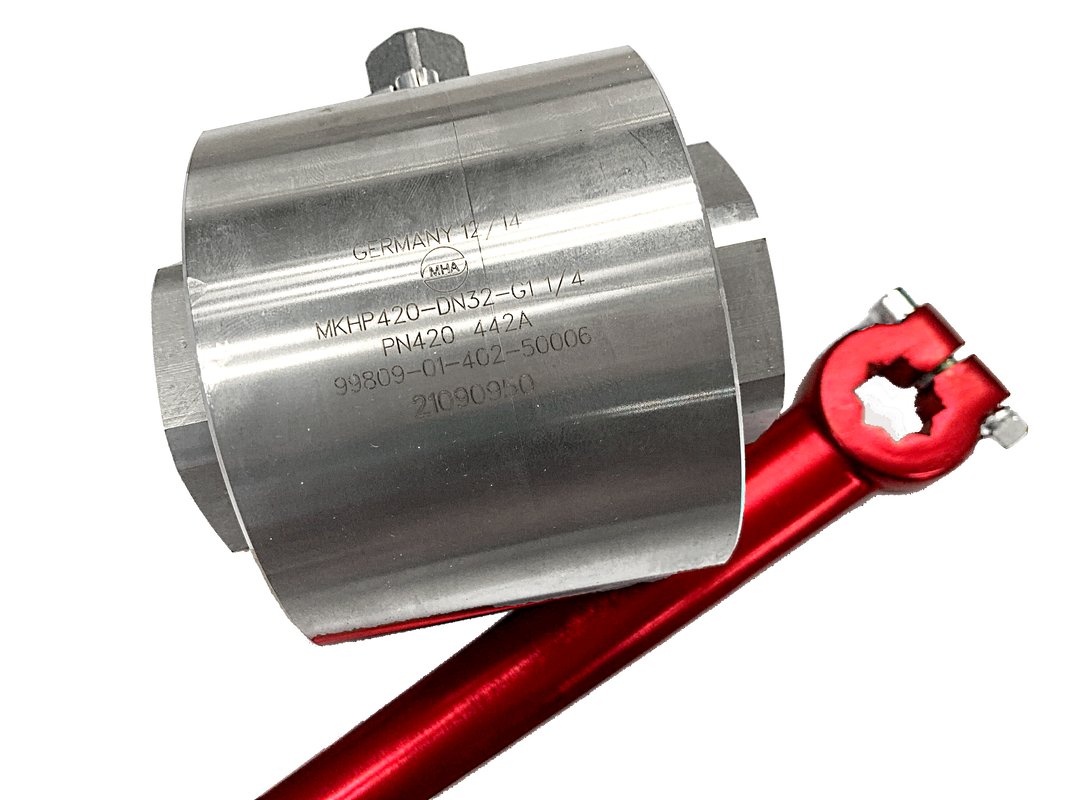
This is the range in the photo at the top of the page — MKHP420‑DN32‑G1 1/4, PN420.
3KH
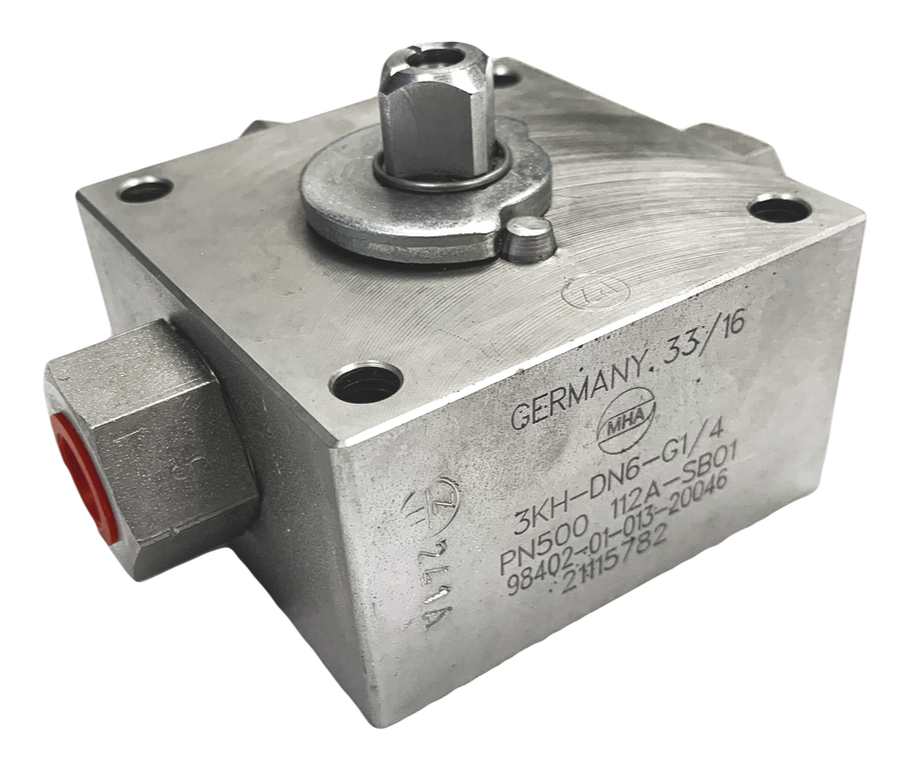
The square‑bodied valve. Same internals, but the flat sides carry mounting holes, so it bolts to a plate or manifold rather than hanging on the pipework. Useful where vibration would otherwise be carried by the threads.
The example on this page is 3KH‑DN6‑G1/4 at PN500.
What they share
Two‑way, full bore, quarter turn, anti‑blowout stem, steel or SS316 body, and the same four‑digit material code system for seats and seals. Made by MHA Zentgraf in Germany.
The four ranges, side by side
One screen, to narrow it down before you read a table.
| BKH | BKHP420 | MKHP420 | 3KH | |
|---|---|---|---|---|
| Bore range | DN4–DN25 | DN20 & DN25 | DN32–DN50 | Small bores |
| Thread range | 1/8"–1½" | 3/4" & 1" | 1¼"–2" | 1/4" upward |
| Pressure | 250–500 bar falls with bore | 420 bar where BKH drops to 315 | 420 bar flat across all sizes | 500 bar at DN6 |
| Body shape | Hex‑flatted | Hex‑flatted, heavier | Round | Square, with mounting holes |
| Mounts to | The pipework | The pipework | The pipework | A plate or manifold |
| Weight, typical | 0.30–2.60 kg | 3.10–3.94 kg | 3.47–8.14 kg | Light |
| Choose it when | Standard duty inside the pressure ladder | You need 420 bar at 3/4" or 1" | You need 1¼" or bigger | Vibration — bolt it down instead of hanging it on the threads |
If you only remember one row, make it the pressure row. BKH is the only range whose rating changes with size — the other three hold one figure.
End connections
Five ways in, and the choice is usually made by the pipework, not the valve.
| Connection | Standard | Where it fits |
|---|---|---|
| Female BSPP | DIN ISO 228 | The default across the region. Parallel thread, sealed on a bonded washer or an O‑ring at the port — not on the thread. |
| Female NPT | ANSI B1.20.1 | Tapered thread, sealed on the thread itself. Common on American and offshore‑spec equipment. |
| Compression | DIN 2353 / ISO 8434‑1 | Straight onto hydraulic tube via a cutting ring — no threading of the tube. Light series listed; sizes 6L to 42L. |
| SAE | SAE J514 | Listed on the MKHP420 range for equipment built to SAE porting. |
| Welding end | — | Where a permanent joint is wanted. Keep the heat off the seals — see fitting. |
We also stock the hydraulic steel tube and the fittings that land on these ends, so the valve and the run come from one order.
If a ball valve is the wrong device for the job — and often it is — the neighbours are: needle valves where you genuinely need to regulate rather than isolate; high pressure check valves where flow must go one way only; and flange‑end ball valves or a SAE flange‑end ball valve where the port is a flange rather than a thread — which at larger bores is usually the tidier answer.
The four‑digit material code
The part of the order most likely to be got wrong — and the one that voids the warranty.
The body material is only half the specification. Every MHA valve carries a four‑digit code that fixes the material of each wetted part independently, and it is printed on the valve next to the pressure rating.
| Digit | What it sets |
|---|---|
| 1 | Body and adapters |
| 2 | Ball and stem |
| 3 | Ball seat |
| 4 | Sealing on the stem and adapters |
| Code | Reads as | Typical use |
|---|---|---|
| 112A | Steel body, steel ball and stem | General hydraulics on mineral oil. The commonest code we ship. |
| 212A | Steel, alternative ball and stem | Where the duty asks for a different ball or stem material in a steel body. |
| 192A | Steel, alternative seat | Specified against a particular fluid or temperature. |
| 442A | Stainless throughout | Corrosive service, washdown, marine. This is the code on the MKHP420 in the photo above. |
| 44HA / 44aA | Stainless, gas‑duty seat and seals | Gas applications. Do not substitute a liquid‑service code into a gas line. |
Decoding a real one
The two codes on the photos at the top of this page, digit by digit.
| Code | Digit 1 body & adapters | Digit 2 ball & stem | Digit 3 ball seat | Digit 4 sealing |
|---|---|---|---|---|
| 112A | 1 steel | 1 | 2 | A |
| 442A | 4 stainless | 4 stainless | 2 | A |
| 44HA | 4 stainless | 4 stainless | H gas duty | A |
Notice what changes between 112A and 442A: the first two digits. Same seat, same sealing — the difference is a stainless body, ball and stem. And between 442A and 44HA only the third digit moves, because gas duty is a seat problem, not a body problem. That is the whole logic of the system: you change only the digit that the duty actually affects.
Which code for which fluid
What we can state, and what has to be confirmed against the specific model.
| Medium | Usual answer | Watch |
|---|---|---|
| Mineral hydraulic oil | 112A steel | The default. Nothing special needed. |
| Seawater, washdown, salt air | 442A stainless | Remember the derate — stainless holds less than steel at the same bore. |
| Gas | 44HA or 44aA | Never substitute a liquid‑service code. Gas duty is a different seat. |
| Water glycol, HFC and other fire‑resistant fluids | Confirmed per model | The seat and seal have to be matched to the specific fluid — tell us the fluid by name and we will confirm the code before quoting. |
| Chemical or petrochemical service | Confirmed per model | Same — the medium, concentration and temperature all bear on the code. |
The first three rows are the codes MHA and RFS ship as standard for those duties. The last two we deliberately do not publish a code for — a fire‑resistant fluid or a chemical service is specified against the actual medium, and guessing it from a table is how the wrong seal gets fitted.
Is SS316 worth the premium?
Sometimes plainly yes, sometimes plainly no.
Yes where the outside of the valve is the problem: deck and splash‑zone installations, washdown bays, salt air, chemical plant, or anywhere a rusted body means the valve gets replaced long before it wears out. A stainless valve in that environment outlives a painted steel one several times over, and the labour to change a seized valve usually costs more than the valve.
No where the duty is mineral oil in a dry machine room. There, stainless buys you nothing mechanically — and it costs you pressure: at 3/4" the steel valve holds 420 bar and the standard stainless one 315. Paying more for less rating is a poor trade unless corrosion is the actual failure mode.
The awkward middle case is high pressure and corrosive at once. There the answer is usually a BKHP420 in stainless, which recovers 420 bar at DN20 and DN25 where the standard stainless valve drops to 315.
This is the one to get right. A valve chosen on an incomplete order specification — the right body, the wrong seat or seal for the medium — sits outside the warranty. So the medium, the working pressure and the temperature all need to be on the enquiry, not just the size. If you tell us the fluid we will pick the code; if you tell us the code we will confirm it suits the fluid.
How to read a valve you already have
Everything you need is stamped on the body.
You do not need the paperwork to identify one of these. Look along the flat of the body and you will find, in order: the type and size, the pressure rating, the material code, then a works order and a batch number.
| On the body | Example | What it tells you |
|---|---|---|
| Type and size | MKHP420‑DN32‑G1 1/4 | Range, bore in DN, and the thread. Everything needed to find the row in the tables above. |
| Pressure | PN420 | The working pressure in bar — for that size. Do not read a rating off a different valve in the same family. |
| Material code | 442A | The four wetted‑part materials. Stainless throughout in this case. |
| Origin and date | GERMANY 33/16 | Made in Germany, week 33 of 2016. |
| Works order | 99509‑01‑402‑90006 | Traceability back to the build. Quote it if you need an identical replacement. |
Two readings from the photos at the top of this page — 3KH‑DN6‑G1/4 · PN500 · 112A is a 1/4" square‑body steel valve for 500 bar on oil; MKHP420‑DN32‑G1 1/4 · PN420 · 442A is a 1¼" round‑body stainless valve for 420 bar. Same maker, entirely different valve.
If the stamping is painted over or worn, send a photo of the body and the ports to info@rfshydraulics.com and we will identify it from the shape, the bore and the thread.
Fitting it
Three checks — before, during and after.
Before
1. Confirm the valve is the right one. Check the design against what the system actually needs — bore, pressure, medium and temperature — before it goes anywhere near the pipe.
2. Depressurise, then fit. Installation is for qualified people, with the valve and the pipe system unpressurised. Bring the pipework to the valve without tension.
3. Inspect and flush. Check for damage and contamination and rinse every line first. Residue left in the pipe damages internal parts, and that shows up as malfunction or outright failure later.
During, and after
4. No tension, no vibration. Nothing external should be transferred into the valve body. Use a proper tool on the flats when screwing pipe in — not the lever, and not the body.
5. Keep heat off the seals. On welding‑end valves, overheating the seals must be prevented. On a flanged end, centre the valve by screwing up the counter‑flange before tightening the flange screws crosswise.
6. Function test, then leave it alone. Switch it open and shut as a function test. Do not slacken or tighten body, adaptor or connection pieces afterwards — they are torqued as assembled.
7. Empty it before work. With media that are hazardous, flammable or explosive, make sure the valve and the system are completely drained first.
One habit worth keeping: a ball valve is open or shut. Left part‑open it wire‑draws the seat, and once the seat is cut the valve will weep in the closed position for the rest of its life. If the job needs regulation, it needs a different valve.
Accessories
All to order, and all fitted in place of the plain lever.
| Accessory | What it does | Specify |
|---|---|---|
| Locking device | Stops the valve being actuated by accident. Takes a padlock, so the valve cannot move without the key — the usual answer where isolation has to be provable. | Steel or stainless |
| Detent | Holds the lever positively at open and shut, so it cannot creep off position under vibration. | — |
| Pneumatic or electric actuator | Opens and closes the valve remotely. The handle comes off to fit it. | Medium, temperature and working pressure — the actuator is configured to them |
| Limit switch | Reports valve position back to the panel — open or shut. | — |
The photo of the valve with the lever removed, at the top of this page, is what all four of these bolt onto — the same stem drive.
Why buy high pressure ball valves from RFS Hydraulics
Six things that decide whether a valve order goes smoothly.
Ready stock, not ordered in
The running sizes — 1/2" to 1" in steel and SS316 — are held in Johor Bahru and Singapore, and stock items dispatch the same or next working day.
German‑made
MHA Zentgraf, marked and dated on the body. Not an unbranded valve with a pressure figure on the box.
The right material code
We size the four‑digit code to your fluid rather than shipping whatever is on the shelf — which is what keeps the valve inside its warranty.
Both bodies, both materials
BKH, MKHP420 and 3KH, steel or SS316, threaded or compression. You are not pushed to the one range a supplier happens to carry.
Pressure published
The rating for every size is on this page, not hidden behind an enquiry. Check us before you call.
Frequently asked questions
Twelve, from how it works through pressure and material codes to delivery.
Can a high pressure ball valve be used for throttling?
No — and this is the commonest way these valves get ruined. A ball valve is an isolation device: open or shut. Held part‑open, the flow is forced through a narrow crescent between the ball and the seat, and the velocity there wire‑draws the seat — it erodes a channel across the sealing face. Once that channel exists the valve weeps in the closed position for the rest of its life, and no amount of handle force will stop it. If the job needs regulation, use a needle valve, which is built with a tapered stem for exactly that. Use the ball valve to isolate the needle valve.
How does a high pressure ball valve work?
A bored ball turns between two seats. With the bore in line with the flow the valve is fully open and barely restricts it; a 90° turn of the lever puts the solid side of the ball across the bore and the line is fully shut. It is an isolation device — there is no useful throttling position, and running one part‑open cuts the seat.
What pressure will it actually hold?
Between 250 and 500 bar, depending on the size — the rating falls as the bore grows. In steel: 500 bar up to G1/2, 420 at G5/8 and G3/4, 315 at G1, and 250 at 1½" NPT. There is no single number for the range, which is why the size‑by‑size tables are on this page.
Is stainless rated the same as steel?
No — stainless derates further at the same size. At G5/8 steel holds 420 bar and SS316 holds 400; at G3/4 steel holds 420 and standard stainless 315; at G1½ steel holds 315 and stainless 250. If you are moving a line to SS316 for corrosion reasons, re‑check the pressure — it is not a like‑for‑like swap.
What is the four-digit material code for?
It fixes the material of each wetted part separately: digit 1 body and adapters, digit 2 ball and stem, digit 3 ball seat, digit 4 sealing on the stem and adapters. Common codes are 112A, 212A and 192A in steel and 442A in stainless, with 44HA or 44aA for gas. A valve chosen on an incomplete specification — right body, wrong seat or seal for the medium — falls outside the warranty, so put the medium, pressure and temperature on the enquiry.
What does BKHP420 mean, against plain BKH?
It is the reinforced version at the same bore and thread. A BKH‑DN25‑G1 is rated 315 bar; a BKHP420‑DN25‑G1 is rated 420 bar, and it is heavier for it — 3.10 kg against 2.20. In stainless there is a P420 at DN20 as well.
What is the difference between BKH, MKHP420 and 3KH?
Bore, mostly. BKH covers DN4 to DN25 — 1/8" to 1½" thread. MKHP420 covers the large bores, DN32 to DN50 (G1¼ to G2), at a flat 420 bar. 3KH is the square‑bodied version whose flat sides carry mounting holes, so it bolts to a plate or manifold instead of hanging on the pipework.
What end connections can I have?
Female BSPP to DIN ISO 228, female NPT to ANSI B1.20.1, DIN 2353 / ISO 8434‑1 compression straight onto hydraulic tube, SAE J514 on the MKHP420 range, and a welding end. Note the pressure rating of the connection too — the lowest‑rated part in the assembly sets the line.
What temperature range do they cover?
Steel bodies −20 °C to +100 °C and SS316 bodies −30 °C to +100 °C on the standard material combinations. Outside that band the material code changes, so tell us the temperature with the medium.
How do I identify a valve already in service?
Read the body. It carries the type and size (for example MKHP420‑DN32‑G1 1/4), the pressure (PN420), the material code (442A), the origin and date (GERMANY 33/16) and a works order number. That is everything needed to match it. If the stamping is painted over, send us a photo of the body and ports.
Can it be locked shut, or actuated?
Yes — all in place of the plain lever. A locking device takes a padlock so the valve cannot be moved without the key; a detent holds it positively at open and shut; a pneumatic or electric actuator operates it remotely; a limit switch reports the position. For an actuator we need the medium, temperature and working pressure so it can be configured.
Where are these valves used?
Hydraulic systems, chemical and petrochemical plant, offshore, water and high‑pressure cleaning, mining, agricultural machinery and gas pipelines. Gas duty needs a gas material code — 44HA or 44aA — not a liquid‑service one.
Catalogues
Direct PDF download — no form, no email address.
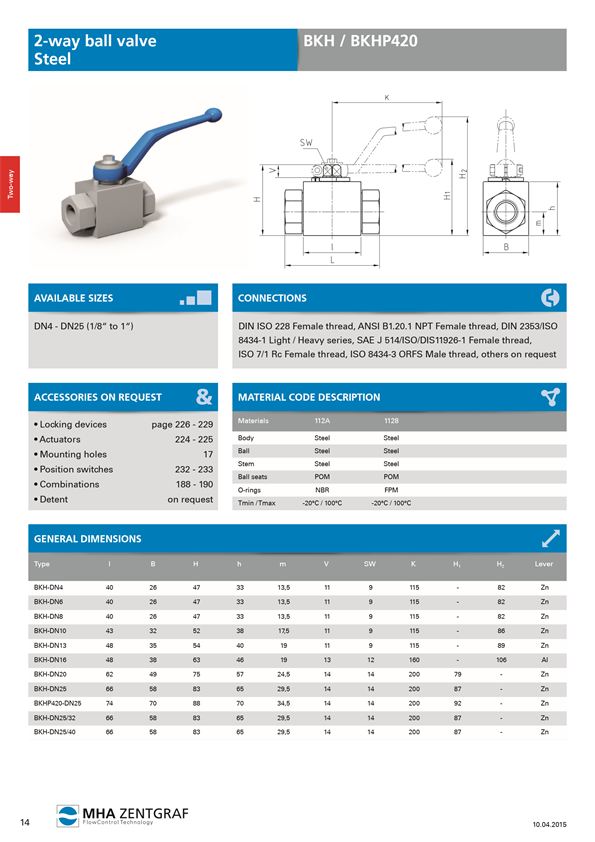
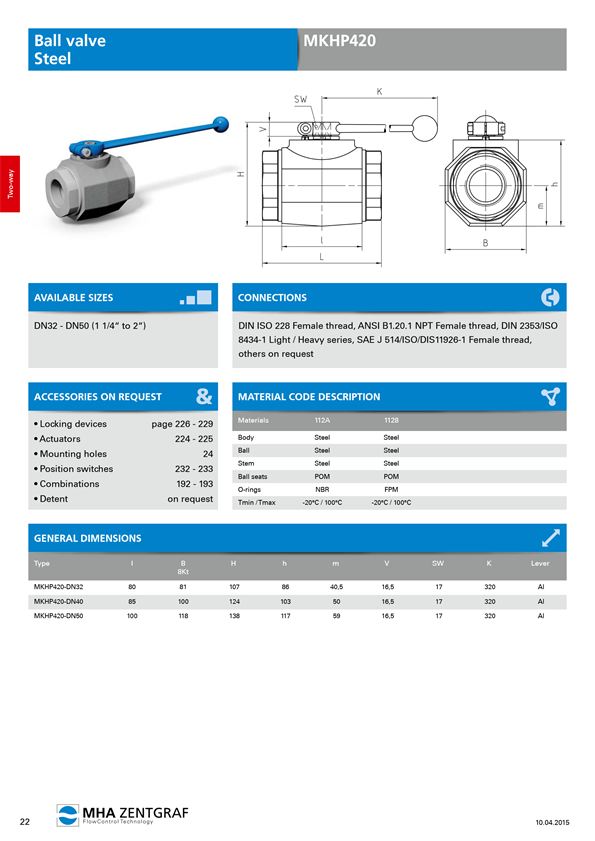
Both are the 10.04.2015 edition and carry the full dimension and order‑code tables in steel and stainless, for BSPP, NPT and DIN 2353 ends. Dimensions and part numbers are in the catalogues; stock and price are not, so send us the list and we will confirm both.
Related: all high pressure valves · low pressure valves · hydraulic steel tubes · pipe fittings · SAE flanges · O‑rings
Send the bore, the ends, the pressure and the medium.
Four things and we can quote the exact valve and material code — priced by a product specialist within two working hours.